Nothing here is a hit piece. LTESocks has customers who are well served by it, and this page says which ones. It also says where we think the model costs a buyer money.
What we can and cannot tell you about LTESocks
The company behind the name sits at ltesocks.io.
A price is missing here on purpose. We have not captured a sourced rate for LTESocks recently enough to publish one, and a stale number in this market is a wrong number.
Their pricing page will answer three of the four questions that matter. Send an email for the fourth, which is usually whether blocked requests are billed, and keep the reply.
What LTESocks says about itself today
On 9 September 2026 their homepage carried the title "Buy Mobile proxies from LTESocks: Premium Proxy Site Online". The description they publish for search engines reads: "Reliable proxy website to buy fast and anonymous mobile proxies. Try LTE/4G/5G private proxies with real mobile IPs and a test period from LTESocks."
Also on the page, stated plainly:
The product lines named on that page are residential, datacenter, ISP or static residential, mobile, SOCKS5 and IPv6. They advertise 195 countries or locations. Payment methods mentioned: PayPal, crypto, cards and Wise or Payoneer. Support is advertised as around the clock. A refund or money-back term is mentioned. We found no separate pricing page linked from the homepage, which usually means the price arrives by quotation.
Those are claims, and claims are free. They earn their place here only because the date makes them checkable later.
How much site there is
Our own crawl reached 2.287 of their pages, last run 19 June 2026. The mix was 268 blog pages and 647 use-case pages.
That mix tells you how the company sells. Heavy location pages mean a geography-led pitch, heavy blog means a search-led one, and a single pricing page usually means one simple offer or one sales call.
The activity record
Our crawl of their site found 2,051 pages carrying a date, 257 of them articles. The oldest is from April 2024 and the newest from August 2026. 2,027 of them carry a date inside the last twelve months.
An actively maintained site is table stakes rather than a recommendation. It does rule out the failure that costs buyers the most here, which is prepaying a company that has quietly stopped.
What the advertised numbers cannot tell you
Who else is using your address
A shared address arrives with a history you did not create and cannot see. For read-only work it rarely matters. For anything that keeps a session, it is the most common cause of unexplained failure.
The line item hidden in the success rate
Some vendors bill every request, some bill only successful ones, and the difference is the whole comparison once a target starts blocking. A cheap rate with a fifty percent success rate is twice its advertised price.
What actually caps your throughput
Rate limits are often enforced per account rather than per plan, which means buying more traffic does not raise them. Confirm how yours scales before you assume a bigger plan runs faster.
What separates them, in a table
The rows below are the ones that change what you pay and whether the job runs:
| Question to ask | LTESocks | HProxy |
|---|---|---|
| Entry price | Not verified by us, read their page | From $0.44/GB, pay as you go |
| Does unused balance expire? | Worth confirming in writing before you commit | Never |
| Minimum commitment | Their terms page answers this | None |
| Identity checks | Check the current terms, this one moves | Card orders are screened, and verification is sometimes requested |
| Targeting | Their terms page answers this | Country, city and ISP |
| Free way to evaluate | Check the current terms, this one moves | Free proxy list and proxy checker |
That comparison covers what is publishable. What is not publishable, and what actually decides this, is how many of your requests come back correct.
How to settle it yourself in ten minutes
Run this before you commit any volume. It replaces every opinion on this page, including ours.
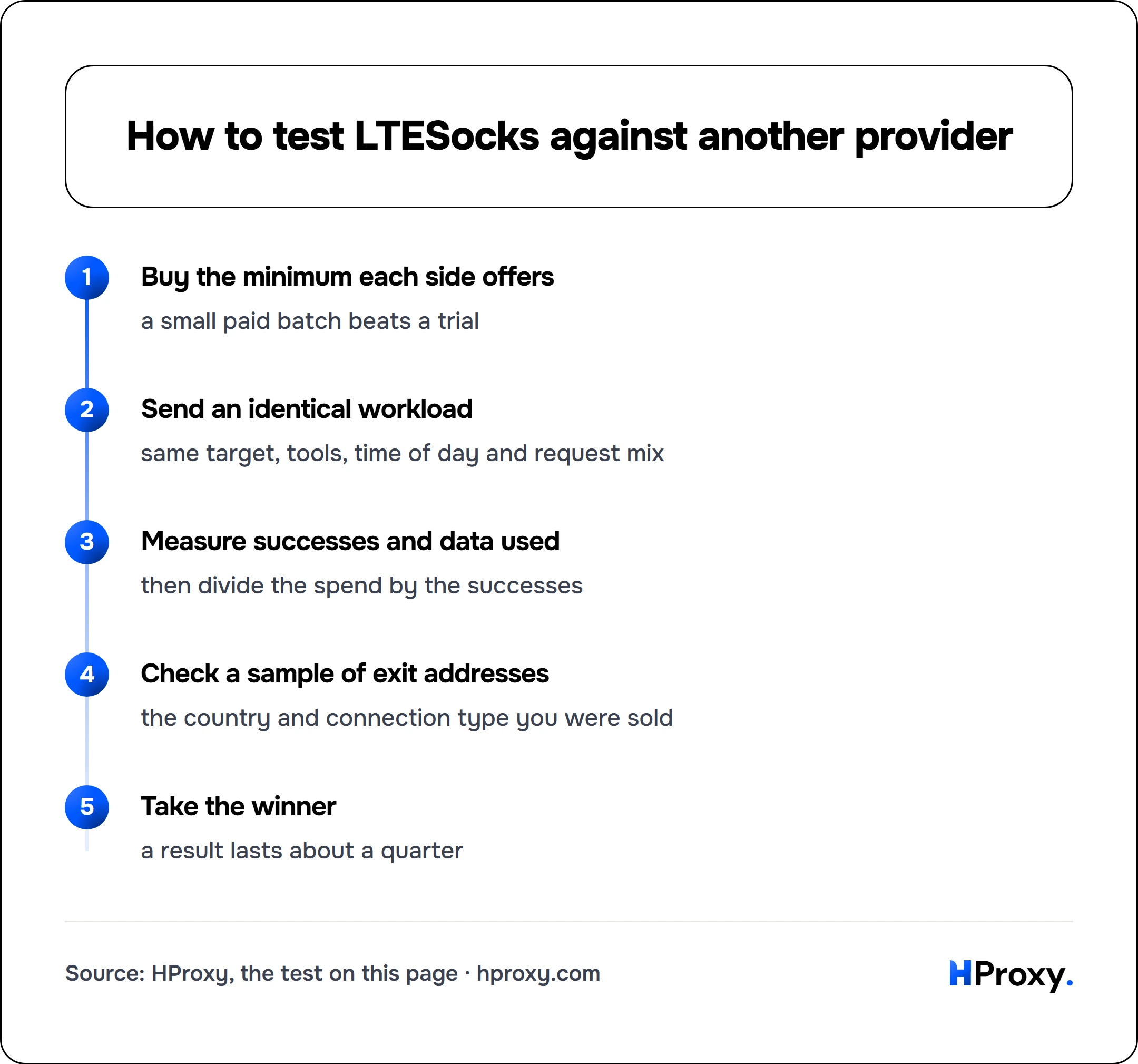
- Buy the minimum each side offers. Prefer a small paid batch over a trial, because trial traffic does not always ride the same pool.
- Send an identical workload through each: same target, same tooling, same time of day, same request mix.
- Measure what came back correctly and what it consumed, then divide the spend by the successes.
- Push a sample of exit addresses through an independent checker and confirm the country and connection type are what was advertised.
- Take the winner and set a reminder to run this again, since a result has a shelf life of about a quarter.
Buy the minimum each side offers
a small paid batch beats a trial
Send an identical workload
same target, tools, time of day and request mix
Measure successes and data used
then divide the spend by the successes
Check a sample of exit addresses
the country and connection type you were sold
Take the winner
a result lasts about a quarter
Who else is in this bracket
The same treatment, applied to the providers most often weighed against this one:
- Surge Proxies alternatives
- Taiyanghttp (太阳代理) alternatives
- Tavel alternatives
- Tckworld alternatives
- Teletype alternatives
The competing offer, for completeness
We are the pay as you go option in this market. Residential from $0.44 per GB, ISP and datacenter per address, mobile alongside them, all from one balance with nothing to forfeit. That model wins on irregular volume and loses on very large steady volume, which is worth knowing before you test.