ASocks (asocks.com) sells rotating mobile, residential and "corporate" proxy traffic at one rate, $3 a GB, with no expiry, and "unlimited" proxies by the month, $15 for mobile and $5 for residential or corporate. Its terms of 6 October 2026 name TechnoWave L.L.C., a Wyoming company, and the laws of Seychelles. About 8,100 people a month search Google for the name. Below are its prices then and now, its rules, who it says it is, where it says its proxies come from, what five other pages say and the alternatives.
Who runs ASocks, the four companies its terms have named since 2022 and its record are on our ASocks company page.
What ASocks charges
ASocks's prices, 13 October 2026
| Product | Price | Terms |
|---|---|---|
| Pay as you go | $3 a GB, every type | Traffic does not expire |
| Unlimited mobile proxy | $15 a proxy a month | 5% off from 10, 15% from 100 |
| Unlimited residential or corporate proxy | $5 a proxy a month | 5% off from 10, 15% from 100 |
asocks.com, its tariff data and its terms of 6 October 2026, read from our server on 13 October 2026
The site advertises 7M+ addresses in 150+ locations and a 99.7% connection success rate. The terms describe a trial of 3 days with at least 500 MB, for new users once. For billing, "each individual data packet smaller than 150 bytes is rounded up to 150 bytes", which adds up on chatty connections. Payment runs through card processors or cryptocurrency, and the terms let ASocks change prices "at any time without prior notice".
Refunds are narrow. Unspent gigabytes come back only within 24 hours of the last payment. Unlimited proxies come back only within 24 hours of purchase, and only if less than 500 MB went through them. Otherwise charges are final, and a refund can take up to 14 days. The terms also describe monthly plans whose unused gigabytes lapse, except on Premium and VIP plans, which the site does not show.
How the prices moved
ASocks's prices in Internet Archive copies
| When | Pay as you go, a GB | Unlimited proxies |
|---|---|---|
| October 2022 | "1Gb = $3" | Not shown |
| December 2024, June 2025 | Mobile $6, residential $5.50, corporate $0.60 | Not shown |
| December 2025 | Not in the copy | 100 for $95, down to $0.75 each |
| April 2026 | Not in the copy | $15 mobile, $5 residential or corporate |
| October 2026 | $3 for every type | $15 mobile, $5 residential or corporate |
asocks.com in Internet Archive copies of 2022 to 2026 and the live page, read from our server on 13 October 2026
In 2024 and 2025 larger top-ups cut the rate, down to $4.50 for mobile and $4.13 for residential above $1,000. The packs of December 2025 ran from 100 proxies for $95 to 5,000 for $3,750, each with an unlimited traffic limit.
Who sells it
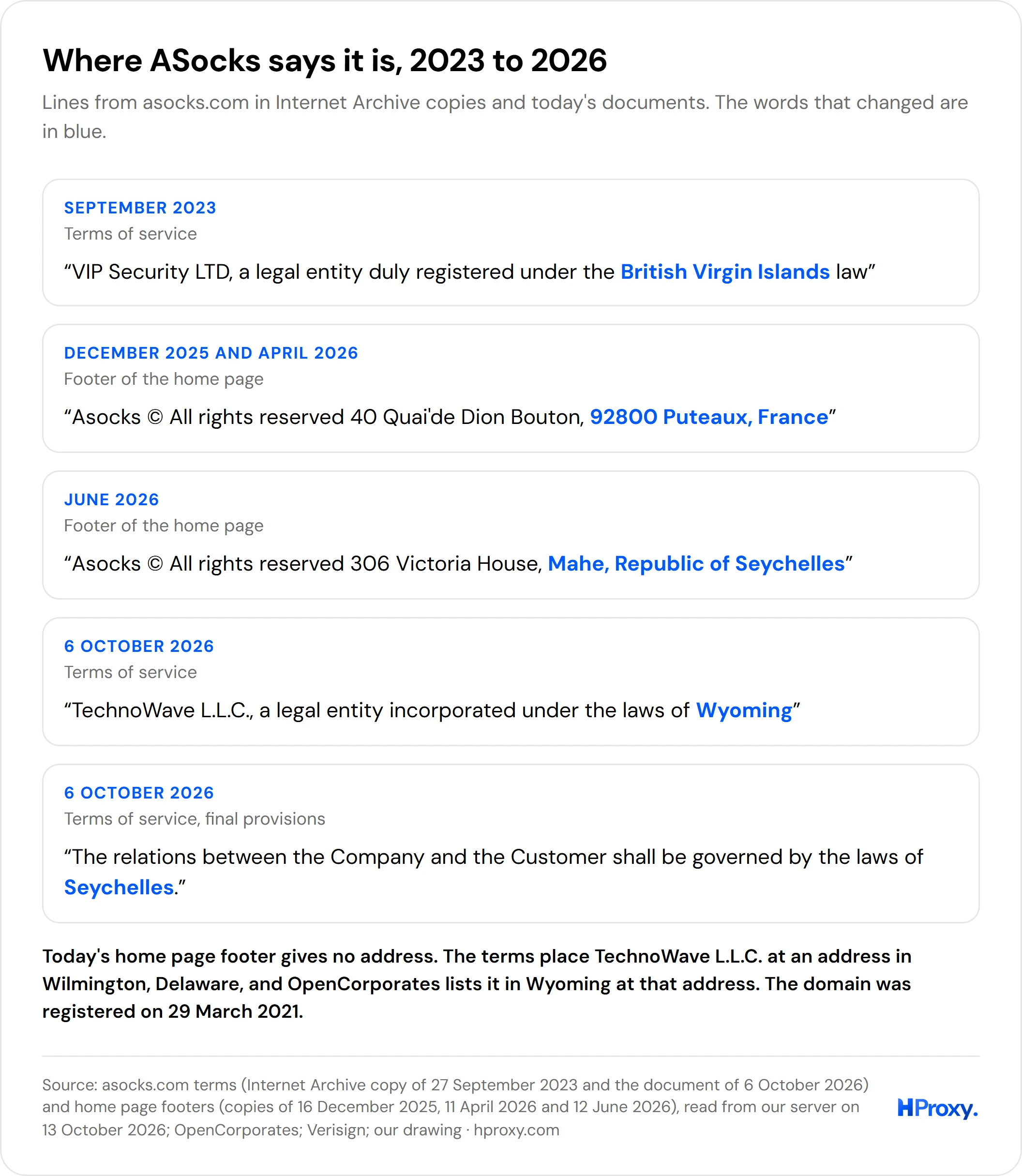
The terms of 6 October 2026 place TechnoWave L.L.C. at an address in Wilmington, Delaware, and send disputes to the courts "at the place of registration of the Company". OpenCorporates lists TechnoWave L.L.C. in Wyoming at that Wilmington address. Today's home page gives no address at all. The domain was registered on 29 March 2021.
Where it says its proxies come from
The home page says: "We have our own proxy infrastructure with clean addresses that will save you from bans". The terms describe a system that lets you browse "through other users' devices". ASocks also published a statement titled "Official Position on the Origin and Legality of ASocks Proxy Infrastructure", first archived on 12 June 2026. It calls ASocks "a commercial proxy platform and proxy marketplace that connects independent proxy infrastructure suppliers with customers".
The same statement says publications had mentioned ASocks "in the context of an investigation by competent authorities". It says ASocks reviewed its suppliers and found that one of them, a platform for monetising mobile apps, may have acted against its rules and the law. ASocks ended that relationship, and it "does not dispute the investigation", the statement adds. The Sell proxy button on its home page leads to ProxySell, which offers to buy uploaded proxies at $0.40 a GB for mobile, residential and corporate traffic alike, and "We sell them to clients".
What other pages say about ASocks
- Caproxy's list of alternatives (2 September 2026) opens with "Asocks sells one thing: rotating traffic billed by the gigabyte". ASocks has sold unlimited proxies by the month since at least December 2025.
- Caproxy's review (26 December 2025) notes "no KYC requirement" and 1,500+ cities, and counts a 4.9/5 average across 417 Trustpilot reviews. It says nothing of who sells the service.
- Proxyway (February 2024, updated February 2026) describes a "flat rate of $3/GB for both residential and mobile proxies" and a trial: "You can claim 1 GB (or 3 GB as a company) by reaching out on Telegram". It has not benchmarked ASocks, and today's terms describe a 3-day trial of at least 500 MB.
- Multilogin (October 2024, updated August 2025) gives "$3 per GB for both residential and mobile proxies". ASocks's own page in June 2025 showed $6 for mobile and $5.50 for residential.
- GoLogin counts "almost 200 countries on the list"; ASocks's home page says 150+ locations.
The alternatives
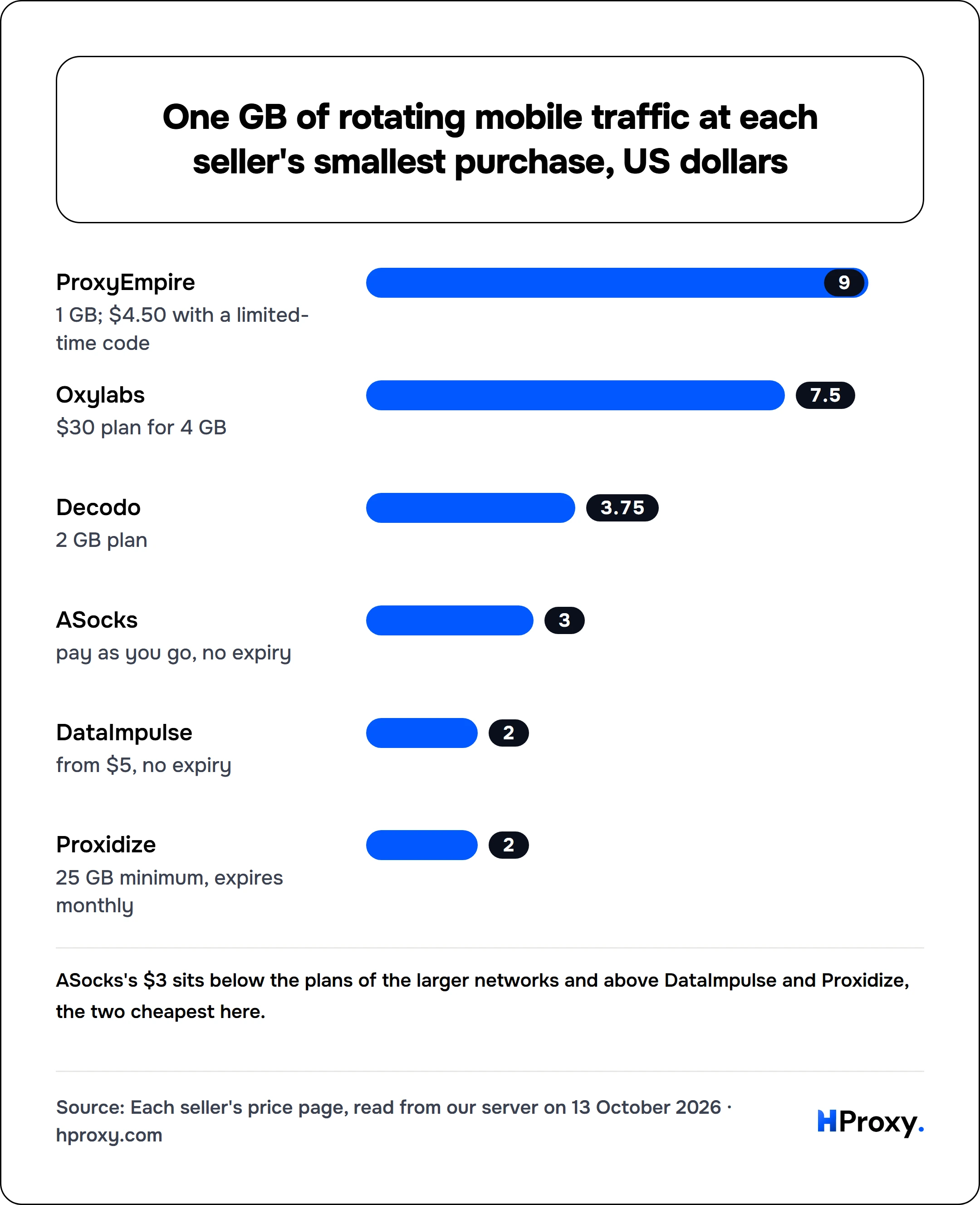
For residential traffic, the first gigabyte cost $1 at DataImpulse, $3.50 at Webshare and Rayobyte, $4 at Decodo and $8 at Bright Data on 12 October 2026. DataImpulse also sells mobile traffic at $2 a GB that does not expire. Our pages on Proxidize, DataImpulse and AstroProxy cover their rules.
Where HProxy fits
We sell residential traffic from $0.44 per GB, Premium with city and ISP targeting and sticky sessions of up to 24 hours from $1.00 per GB, and mobile traffic at $1.50 per GB. Residential traffic does not expire, and our datacenter addresses cost $1.58 per IP a month.
Which one to pick
- ASocks for one rate across mobile, residential and corporate traffic with no expiry, if its terms, its refund window and its record suit you.
- DataImpulse for the lowest rates here, $1 a GB residential and $2 mobile, also without expiry.
- Decodo or Oxylabs for monthly plans from larger networks.
- Proxidize for mobile traffic with city targeting from 25 GB a month.
What we could not find out
Nothing was bought or tested, so its speed and success rates remain unknown. We could not confirm what "corporate" proxies are, which investigation the statement refers to, or how ProxySell is related to ASocks beyond the link. Today's terms do not mention an identity check. ASocks's tariffs, terms and statement will be read again by 13 January 2027.
Sources
- asocks.com: the home page and its tariff data, the legal statement, the comparison and partner pages, and the terms and refund policy of 6 October and 15 July 2026, read from our server on 13 October 2026.
- The Internet Archive's copies of asocks.com from 2022 to 2026, including the terms of September 2023.
- proxysell.com, the page behind ASocks's Sell proxy button, the same day.
- OpenCorporates and Verisign's records for asocks.com and proxysell.com, 13 October 2026.
- Pages about ASocks by Caproxy (two), Proxyway, Multilogin and GoLogin, read 13 October 2026.
- The price pages of DataImpulse, Decodo, Oxylabs, ProxyEmpire and Proxidize (13 October) and of Webshare, Rayobyte and Bright Data (12 October 2026).
- Search counts for ASocks from Google Keyword Planner, worldwide, 13 October 2026.
- HProxy's residential, mobile and datacenter prices, drawn from our live price data.