Proxidize (proxidize.com) began in November 2020 by selling software, and the hardware to run it, for turning 4G USB modems into your own mobile proxies. On 3 June 2026 it made that product, Proxy Builder, a legacy platform. It now sells mobile proxies at $2 a GB and residential proxies at $1 a GB as a managed cloud service, to customers who pass an ID check. About 1,900 people a month search Google for the name. Below are its prices and rules, what five other pages say about it, and the replacements for builders and for buyers.
From modem kits to cloud proxies
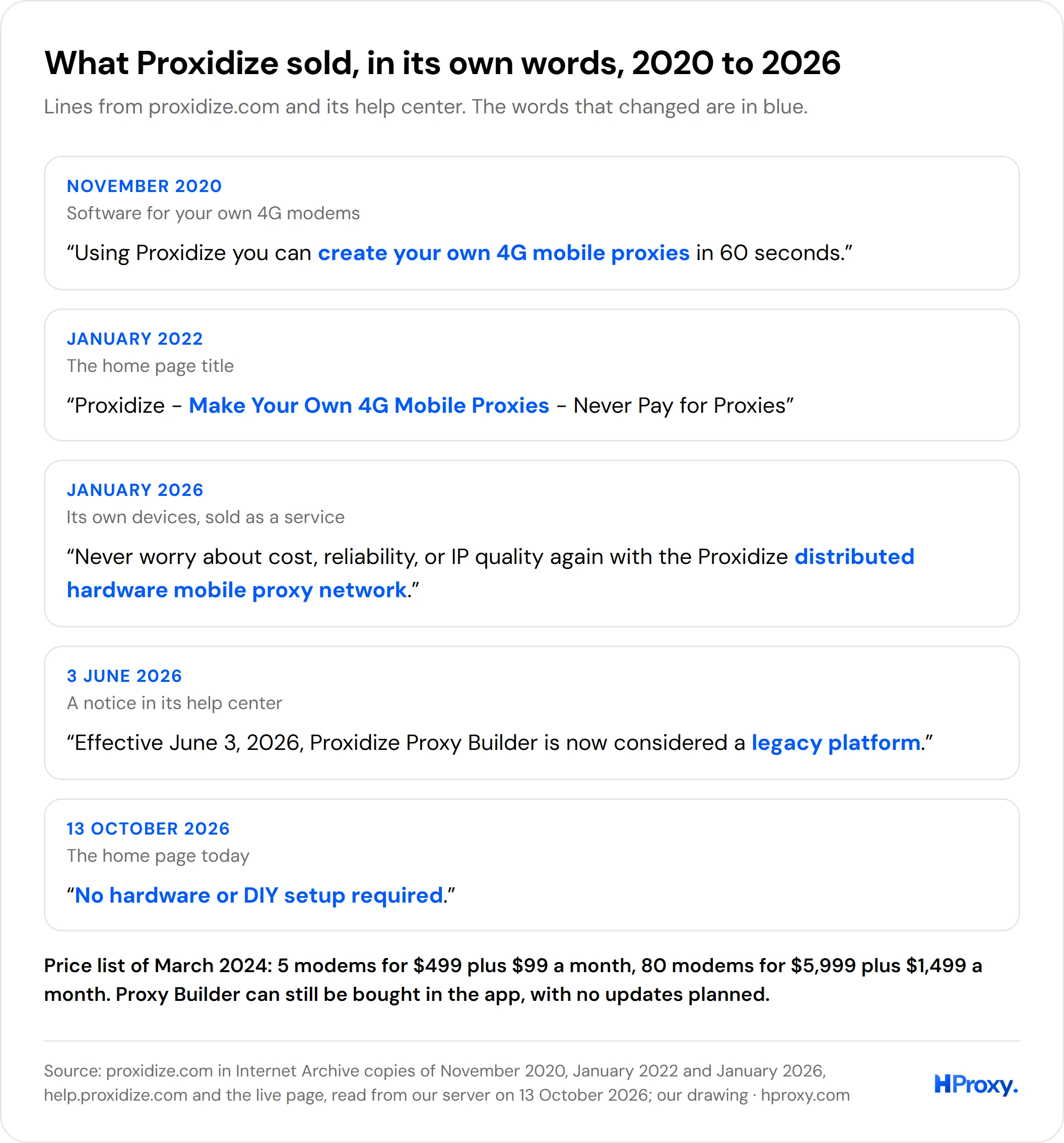
The oldest copy in the Internet Archive, from 1 November 2020, counts down to the launch of software for 4G dongles, with plans from $14.99 a month billed yearly. It also sells the Proxidize Box, its own device to run them on. By February 2021 a free plan ran 10 dongles and the Professional plan cost $79 a month. In March 2024 Proxidize sold whole kits with a small server, USB hubs and its own MX2 modems: 5 modems for $499 plus $99 a month, 20 for $1,699 plus $389, and 80 for $5,999 plus $1,499. By January 2025 the software was priced per endpoint, free for up to five and $8.80 each on the Personal plan.
Selling proxies came next. The about page dates managed mobile proxies for companies to 2023 and their opening to everyone to December 2024; residential proxies followed in 2026. On 3 June 2026 the help center declared Proxy Builder a legacy platform. It still runs and the app still sells it, with no updates planned for its dashboard, its Linux and Android agents or its modem support. By 12 June the home page carried the title "Managed Cloud Mobile & Residential Proxies". The old /proxy-builder/ and /hardware/ addresses now redirect. The file Proxidize writes for AI assistants asks them to stop presenting Proxy Builder or hardware kits as its "current primary product model".
What Proxidize charges now
Proxidize's prices, 13 October 2026
| Product | Price | Data |
|---|---|---|
| Mobile by the GB | $2 a GB, from $50 for 25 GB a month | Expires after a month |
| Mobile by the proxy, US only | In the app; $59 a proxy a month in January 2026 | Unlimited; may slow past 50 GB a month |
| Residential by the GB | $1 a GB from $25 for 25 GB; $0.90 a GB at 10 TB | Rolls over and never expires |
proxidize.com price pages and help.proxidize.com, read from our server on 13 October 2026; the January 2026 price from the Internet Archive
Mobile plans keep the same rate from 25 GB up to 10 TB, which costs $20,000. They include city and network (ASN) targeting, sticky sessions of up to three days, and HTTP, HTTPS and SOCKS5. Above 10 TB, sales quotes from $0.50 a GB. Its pages count 195+ countries for the residential network; a summary of its own comparison pages lists the mobile network in five, the US, Canada, the UK, Germany and India.
The per-proxy plan uses US carriers only and lets traffic out on ports 80 and 443 only. Its devices are pooled between customers, so on a busy location two accounts can briefly share one. The help center adds that carriers change a mobile address on their own, in practice every 1 to 4 hours. Payment is by card only, Visa, Mastercard or Amex. There is no free trial, prices exclude VAT, and the terms allow a price rise at each renewal with 30 days' notice.
The ID check and the blocked sites
Every customer pays first, then verifies a government photo ID with a selfie in the app before the proxies switch on. A passport works from any country; national ID cards, driving licences and residence permits only from 37 listed countries. This first tier caps the number of connection threads. A second check, of the business, lifts the cap and opens three gated groups of sites: financial, recruitment and consumer reviews.
Nineteen categories stay blocked for everyone, whatever the tier. Among them are adult, crypto, gambling, government and military sites, streaming services such as Netflix, Spotify and Hulu, game stores such as Steam and Epic, surveys and torrents. The acceptable use policy of 18 August 2026 adds crypto trading and mining, ticket bots, fake accounts and fake engagement, SEO manipulation, paid surveys, collecting data behind a login without permission, and reselling.
Two of its own pages describe looser rules. The FAQ on the mobile price page says the proxies serve "all legal use cases" and names "adult industry sites and .gov domains" as the only exceptions. The home page of January 2026 listed ticketing, "securing tickets for high-demand events", and managing several social media accounts among its popular uses.
Refunds, stated four ways
Proxidize's money-back rule, by where you read it
| Where | The rule |
|---|---|
| Mobile price page | 30 days, under 10 GB used |
| Residential price page | 30 days, at most 10 GB on the proxy, two refunds an account |
| Terms of 18 August 2026 | 30 days from the start of the term, at most 10 GB on any proxy or in total, two refunds an account |
| Help center | 30 days from payment, under 10 GB across all proxies of one product |
proxidize.com price pages and terms, and help.proxidize.com, read from our server on 13 October 2026
An approved refund cancels the subscription and removes its proxies or gigabytes. Outside this guarantee the terms call charges "non-cancellable and non-refundable". They make one more exception: money back for the time without access when the ID check is never completed, unless Proxidize suspects false information.
Who sells it
The terms name the seller as Proxidize Ltd, company 13941330, registered in England on 25 February 2022 at an address on Great Portland Street in London. The law and courts of England and Wales apply. That matches the founding year of 2022 on the about page. The website is older: the domain dates from 25 September 2019, and the footer of 2020 named Astronomical Information Technology LLC as its owner, a name OpenCorporates does not find. OpenCorporates also lists a Proxidize Inc. in Delaware, which the terms do not mention.
What other pages say about Proxidize
- Coronium (1 January 2026) presents Proxidize as a seller of "expensive pre-built kits" and puts a 20-modem kit at "~$3,000-4,000". Proxidize's own list of March 2024 priced it at $1,699 plus $389 a month.
- Caproxy (updated 15 May 2026) quotes mobile proxies at "$59.00/port/month", finds "no aggressive KYC gate at signup", lists cryptocurrency among the payment methods and sees no money-back guarantee. Proxidize now verifies everyone, takes cards only and offers 30 days. Caproxy puts the head office in Philadelphia, a city the footer of proxidize.com also named in 2024; the terms name a company in London.
- iProxy, which sells software for Android phones, describes a kit of USB modems with a plan for each modem, priced at $499, $899 and $1,699. Those prices match the 2024 list, and the page says nothing of June 2026. It calls the software "primarily designed to work exclusively with their proprietary hardware"; the home page of January 2025 offered a policy for bringing your own.
- ProxySmart, which sells software for modem farms, says Proxidize raised its prices to "up to $20 per modem per month". It also says it moved former customers onto their old modems for a one-time payment. The 2024 list fits the first claim, at $19.80 a modem for five. ProxySmart's own price page sells licences of 6 to 36 months.
- ProxyEmpire (Proxidize details of 26 September 2026) has the current prices, $1 a GB residential and $2 a GB mobile. It says nothing of the ID check or the blocked sites, and its words "with bandwidth rollover" follow both products, while Proxidize's FAQ says mobile data "expires after one month".
If you ran Proxy Builder
Proxy Builder keeps working for existing farms, without updates. Three other products run proxies on devices you own, at these list prices for ten devices a month.
Software for ten of your own devices, a month
| Software | Runs on | Ten devices |
|---|---|---|
| Proxy Builder (legacy) | USB modems, Android phones | $86.50 (January 2026) |
| ProxySmart | USB modems on a Linux server | $21.33 on a 6-month licence, $12.27 on 12 months |
| XProxy | USB modems; phones on Premium | $19.67, billed $59 every 3 months |
| iProxy | Android phones | $90, at $9 a phone per 30 days |
proxysmart.org, xproxy.io and iproxy.online price pages, read from our server on 13 October 2026; Proxy Builder from the Internet Archive's copy of January 2026; our arithmetic
ProxySmart charges an $80 setup fee plus $0.80 a modem a month, less on longer licences, and offers a free demo. Its claim about reusing old Proxidize modems is one we did not test. XProxy is free for up to five modems, gives seven days for a refund and also sells its own servers and modems. iProxy turns Android phones into proxies, and its Pro plan at $12.50 a phone comes with a free trial. Our pages on iProxy and XProxy cover both.
If you bought mobile traffic from Proxidize
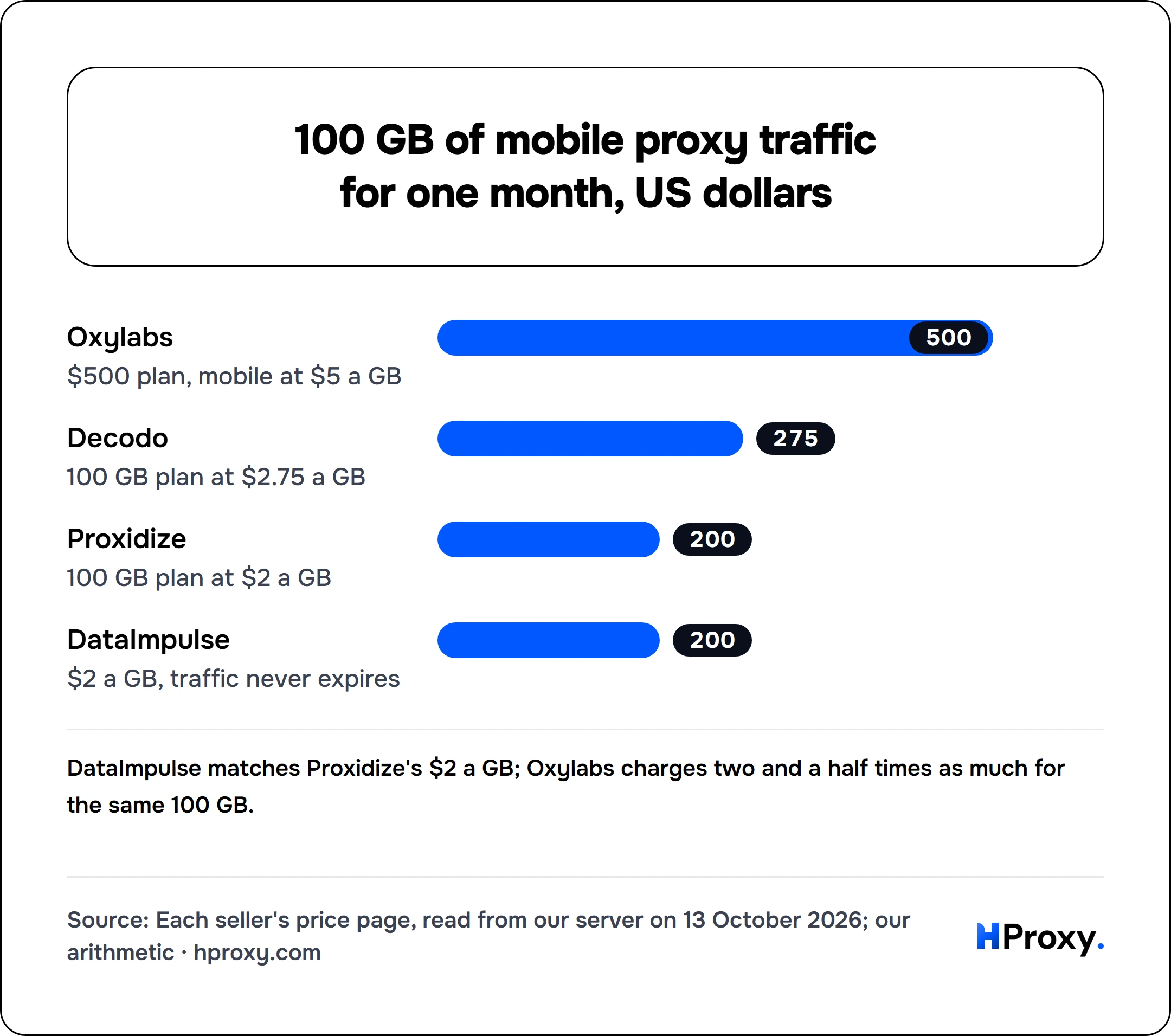
DataImpulse sells mobile traffic at $2 a GB from $5, and at $1.60 a GB for 1 TB. Country targeting is included, sticky sessions last up to two hours and the traffic never expires. Decodo charges $3.75 a GB for 2 GB down to $2.25 at 500 GB, shown as half its old prices. Oxylabs puts mobile traffic inside one subscription for all its products, from $7.50 a GB on the $30 plan to $3.50 on plans from $2,500. ProxyEmpire lists 110 GB for $650, halved for now by a code on its page.
Where HProxy fits
We sell rotating mobile proxies by the gigabyte at $1.50 per GB, from one gigabyte and targeted by country. Residential traffic starts at $0.44 per GB, and Premium adds city and ISP targeting with sticky sessions of up to 24 hours from $1.00 per GB. We make no software for your own modems and sell no hardware.
Which one to pick
- Proxy Builder if your farm runs today and you can live without updates.
- ProxySmart or XProxy to keep your own modems on maintained software; iProxy for Android phones.
- Proxidize for mobile traffic with city targeting in the US, Canada, the UK, Germany or India, if its ID check and blocked sites suit your work.
- DataImpulse for mobile traffic in other countries or traffic that does not expire; Decodo or Oxylabs for larger monthly plans.
What we could not find out
We bought nothing and tested no proxy, so speed and success rates are unknown. Today's per-proxy price shows only inside the app. We could not check whether Proxidize's MX2 modems work with other software, how many farms still run Proxy Builder, or who stood behind Astronomical Information Technology LLC. Proxidize's price pages and help center are due another reading by 13 January 2027.
Sources
- proxidize.com: the home page, price pages, about page, terms and acceptable use policy of 18 August 2026, KYC page of 8 October 2026 and llms.txt, read from our server on 13 October 2026.
- help.proxidize.com: the Proxy Builder notice, the per-proxy guides and the refund policy, read the same day.
- The Internet Archive's copies of proxidize.com and its price page, November 2020 to August 2026.
- Companies House for Proxidize Ltd (13941330), OpenCorporates and Verisign's registry record, 13 October 2026.
- Pages about Proxidize by Coronium (1 January 2026), Caproxy (15 May 2026), iProxy, ProxySmart and ProxyEmpire, read 13 October 2026.
- The price pages of ProxySmart, XProxy, iProxy, DataImpulse, Decodo, Oxylabs and ProxyEmpire, read from our server on 13 October 2026.
- Monthly searches for Proxidize from Google Keyword Planner, worldwide, 13 October 2026.
- HProxy's mobile and residential prices, rendered from our live price data.