Anti-Captcha (anti-captcha.com) is a captcha solving API that has run since 2007. On 9 October 2026 its price table listed $0.50 to $0.70 per 1,000 image captchas and $0.95 to $2 per 1,000 reCAPTCHA v2 tokens. The same table prints a solve time of 5 seconds for every type. Its own live feed reported slower solves: over 7 readings on 9 October, reCAPTCHA v2 took 17 seconds at the median. If the price per solve decides it for you, the alternatives table prices six other services on the same day.
The record, with dates
| date | what happened |
|---|---|
| 20 October 2007 | The domain anti-captcha.com is registered, through DNC Holdings. |
| 25 November 2007 | The Internet Archive makes its first capture. It holds captures from every year since. |
| 18 October 2016 | antcpt.com, the site of its browser plugin, is registered. |
| 4 October 2021 | Anticaptcha Development LP is registered at Companies House, number LP022085. |
| 21 December 2024 | Geekflare's review, updated that day, notes the Chrome extension is missing from the Chrome Web Store. |
| 9 October 2026 | Our check: the site answers, and we read its live queue feed every 10 minutes. |
Sources: the Verisign registry, the Internet Archive, Companies House, Geekflare's review (last updated 21 December 2024) and our own checks.
Who runs it, and how support works
The contacts page names the owner as Anticaptcha Development LP, at an address in London. Companies House lists that partnership as active since 4 October 2021, with its registered office in Kington, Herefordshire. The two addresses differ, and the register itself says it does not check what companies file.
Support runs through tickets alone. The contacts page says it plainly: "We provide no email, phone or messenger app support." A separate mailbox is kept for people who cannot sign in.
The homepage says that "100% of captchas are solved by human workers from around the world". It adds that an average worker earns "about $100 per month", and it names Bangladesh, Pakistan and Venezuela.
What Anti-Captcha costs
The price table charges per 1,000 solves, by captcha type. Two footnotes change the price. Discounts apply by themselves as your daily volume grows, and the reCAPTCHA v3 price depends on the score you ask for.
Anti-Captcha's own price table
| Captcha type | Price per 1,000 |
|---|---|
| Image captcha (text) | $0.50 to $0.70 |
| reCAPTCHA v2 | $0.95 to $2 |
| reCAPTCHA v3 | $1 to $2 |
| reCAPTCHA Enterprise v2 and v3 | $5 |
| GeeTest | $1.80 |
| Arkose Labs (FunCaptcha) | $3 |
| Cloudflare Turnstile | $2 |
| Custom tasks, object coordinates, Prosopo, Friendly Captcha, Amazon WAF, Altcha | $2 each |
anti-captcha.com price table, read 9 October 2026
A second tab sells monthly credits instead. The plans run from $9.90 for 15,000 credits to $495 for 1,000,000. On the smallest plan that works out at $0.66 per 1,000 image captchas and $1.98 per 1,000 reCAPTCHA tokens. On the largest it falls to $0.49 and $1.48. The smallest plan buys a fixed monthly bill, not a lower price: its reCAPTCHA rate sits at the top of the pay-as-you-go range.
You do not have to trust the table blindly. Each finished task comes back with a "cost" field in dollars, so your first solve shows what you were charged.
Anti-Captcha also pays the makers of tools that send it work. A tool that adds its own ID to each task "earns 10% commission" on that spend, its API reference says.
How fast is Anti-Captcha?
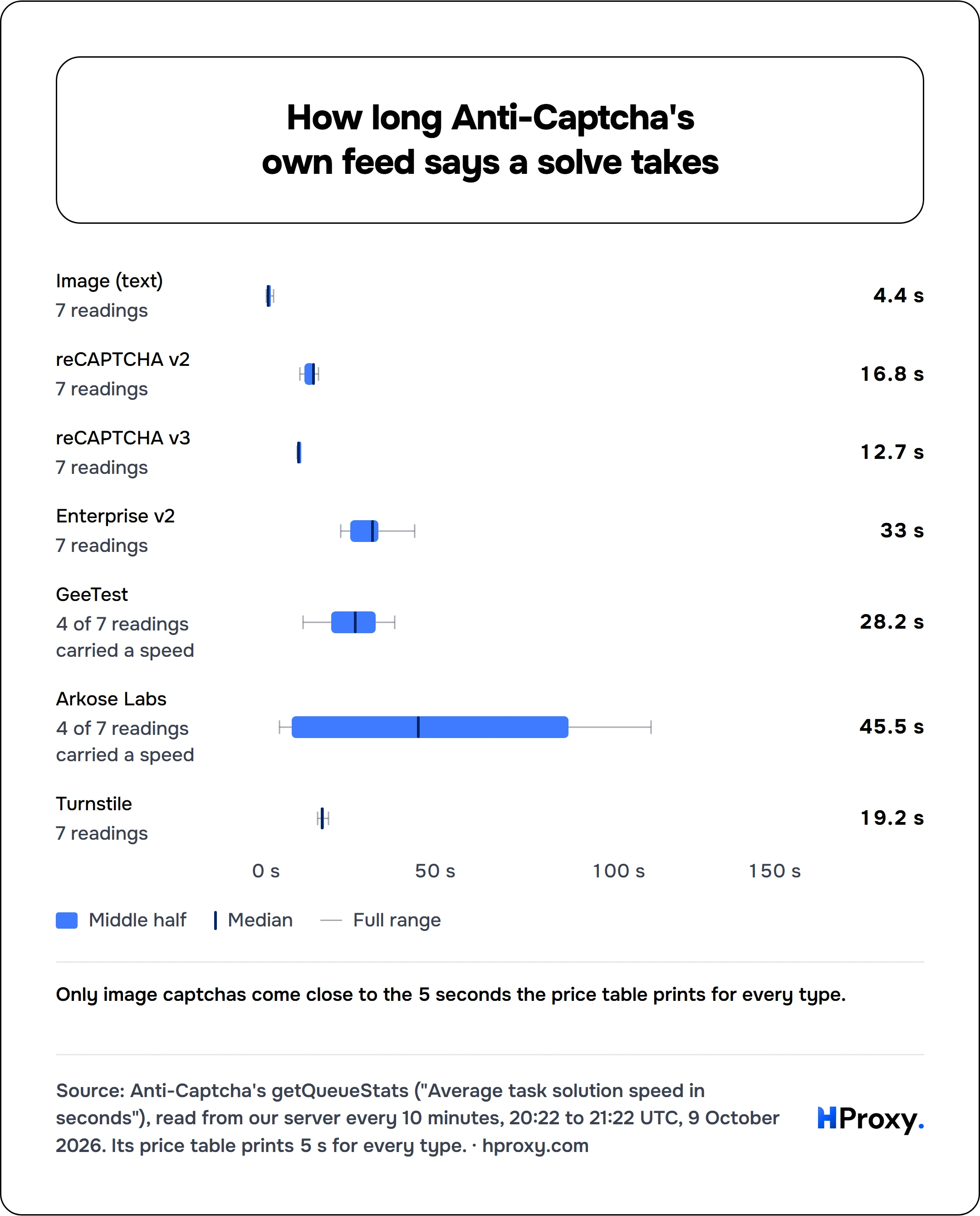
The table prints "5 s" for every captcha type. That figure is a default in the page's own script. In a browser, the script swaps in the speed from a live feed every three seconds. When the feed reports no speed, it shows a random 5 to 7 seconds instead.
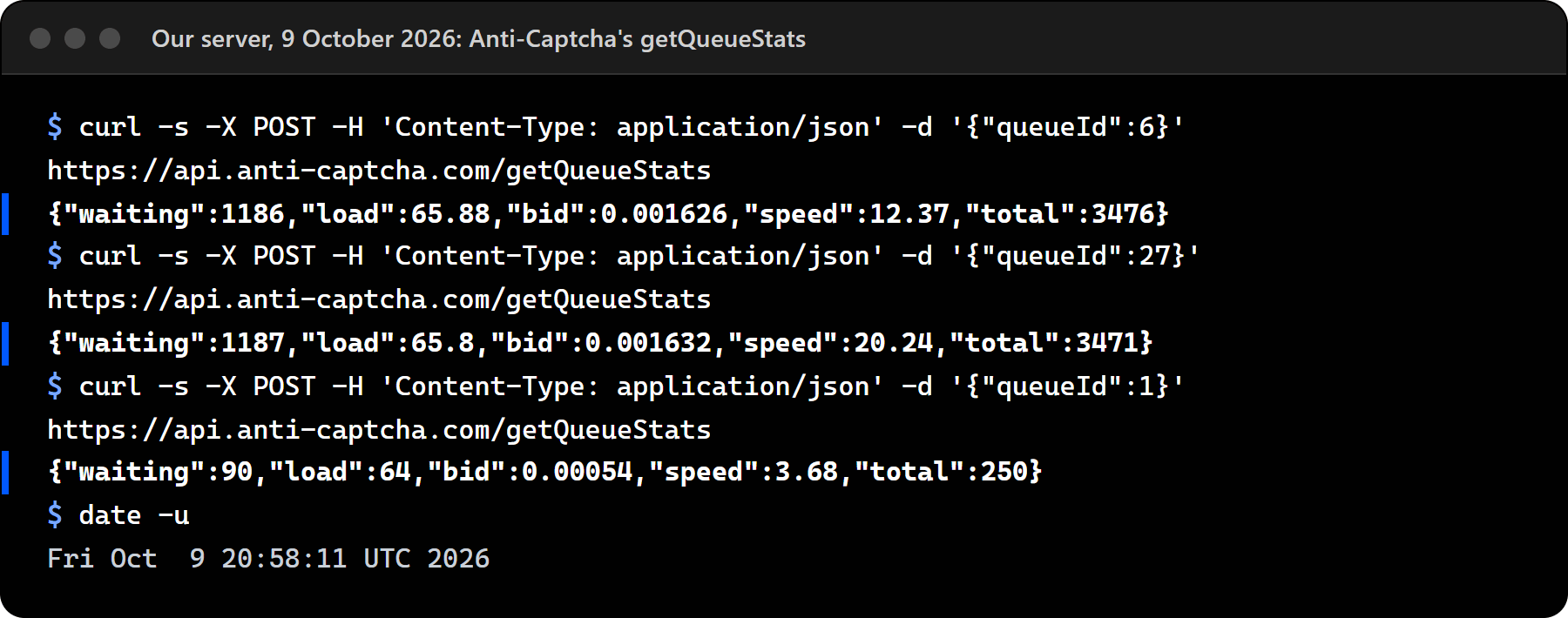
Anti-Captcha also publishes that feed as a public API method, getQueueStats. Its docs define the speed field as the "Average task solution speed in seconds". The bid field is the "Average task solution cost in USD". We read it from our server every 10 minutes, from 20:22 to 21:22 UTC on 9 October 2026. That made 7 readings for each captcha type.
Middle halfMedianFull range
Only image captchas came close to the table's 5 seconds, with a median of 4. reCAPTCHA v2 took 17 seconds, reCAPTCHA v3 13 and Cloudflare Turnstile 19. reCAPTCHA Enterprise took 33 seconds. GeeTest and Arkose Labs moved the most, from 14 to 39 seconds and from 8 to 109. The feed gave no speed at all in 3 of the 7 GeeTest readings and 3 of the 7 Arkose Labs readings.
Price table against the feed's average cost
| Captcha type | Price table, per 1,000 | Feed's average cost, per 1,000 | Feed's median speed |
|---|---|---|---|
| Image captcha (text) | $0.50 to $0.70 | $0.51 to $1.90 (median $0.59) | 4 s |
| reCAPTCHA v2 | $0.95 to $2 | $1.40 to $1.61 (median $1.57) | 17 s |
| reCAPTCHA v3 | $1 to $2 | $0.96 to $1.00 (median $1.00) | 13 s |
| reCAPTCHA Enterprise v2 | $5 | $4.74 to $5.00 (median $4.84) | 33 s |
| GeeTest | $1.80 | $1.80 | 28 s |
| Arkose Labs (FunCaptcha) | $3 | $8.00 to $10.00 (median $9.00) | 46 s |
| Cloudflare Turnstile | $2 | $1.38 to $1.75 (median $1.65) | 19 s |
anti-captcha.com price table and getQueueStats, 9 and 10 October 2026
For every type but one, the median of the feed's average cost sat inside the table's price or below it. Arkose Labs did not: the table prints $3 per 1,000, while the feed's average cost ran from $8.00 to $10.00 per 1,000. We bought no solve, so we cannot say which figure a customer pays. The cost field of your first task will tell you.
Speed matters because tokens expire. Cloudflare's docs say a Turnstile token is valid for 300 seconds and can be checked only once. A solve of 19 seconds leaves most of that window. Your polling and your own request still have to fit inside it.
Speed is also not success. Two third-party reports measured both, and they agree on the pattern. WP Fastest Cache, citing CaptchaTheCat's data in August 2026, found Anti-Captcha right 99% of the time on Turnstile, at 29 seconds, but only 45% to 47% of the time on reCAPTCHA v2. Magecomp, summarising a MegaIndex test in October 2026, put Anti-Captcha level with the best on image captchas, at 22 seconds per correct answer. It needed 28 seconds per correct Turnstile token against 8 for 2Captcha, and 63 seconds per easy reCAPTCHA v2 against 41. Both reports put 2Captcha first, and neither states how many requests each test sent. Read them as leads to test, not as results.
How the API works, and when it needs your proxy
An integration takes two calls. You create a task with the captcha's details, then you ask for the result every few seconds. The answer is a token, a text or a set of coordinates, which your code then sends to the site.
Every web task comes in two forms. The proxyless form solves from Anti-Captcha's own workers and addresses, and its reference tells you to start there. The proxy form solves through a proxy you supply. The reference calls it "required when the target binds the token to the solver's IP/session". It names Cloudflare and other anti-bot screens as the usual cases.
For reCAPTCHA outside Google's own services, the proxyless form is enough. Anti-Captcha's docs say that "Google's API does not disclose the solver's IP address to website owners." Google's own docs bear that out. When a site checks a token, the answer holds the success flag, the time of the challenge and the hostname, and no IP address.
The proxy form has two conditions. The proxy must be given as an IP address, with "no hostnames", and the internet must be able to reach it. And the code samples in its docs carry a warning in capitals: "DO NOT USE PURCHASED/RENTED PROXIES ON PROXY SERVICES!!! THEY WILL NOT WORK!" They point to a Squid proxy on your own server instead.
That warning covers our proxies too. Our residential lines start with a hostname, so they do not fit that field as they are. We have not tested our dedicated IPs there either.
The browser extension in 2026
The plugin is free to install, but it solves with your balance. Anti-Captcha's own guide says: "You'll need a positive balance to get it working."
On Chrome it takes more work than it used to. The plugin site says: "Google has removed our extension from the Chrome Web Store, and now there are only two installation options." Both options need developer mode. The CRX file updates itself, but on Windows it also needs a registry entry. The ZIP file needs no registry change, and it never updates. Both stood at version 0.83 on 9 October 2026. Firefox installs the plugin normally, and Safari has an App Store app.
Is there a free option?
No free plan appeared on the pages we read. The plugin is free; the solving is not. Two of the alternatives below offer a small test. CapMonster Cloud gives a $0.10 test balance on request. DeathByCaptcha gives 100 free credits to people who sign up and then contact it.
Six alternatives, priced the same day
Every figure below comes from each service's own page, read from our server on 9 October 2026. Four sell solves, one by one. Two sell capacity instead: CaptchaAI by the number of parallel solves, NopeCHA by a daily cap.
Anti-Captcha and six alternatives, priced the same day
| Service | reCAPTCHA v2 | Cloudflare Turnstile | Image captcha | Test or refund it publishes |
|---|---|---|---|---|
| Anti-Captcha | $0.95 to $2 | $2 | $0.50 to $0.70 | None found on its pages |
| CapMonster Cloud | $0.60 | $1.30 | $0.30 (its "Text CAPTCHA") | $0.10 test balance on request; refund within 3 days |
| CapSolver | $0.80 | $1.20 | $0.40 | Not stated on its price page |
| 2Captcha | $1 to $2.99 | $1.45 | $0.50 to $1 | Not stated on its price page |
| DeathByCaptcha | $2.89 | $2.89 | $0.99 to $2 | 100 free credits on request |
| CaptchaAI | $15 a month for 5 parallel solves, no cap | Same plan | Same plan | Not stated on its price page |
| NopeCHA | $4.99 a month for 2,000 solves a day | Same plan | Same plan | Not stated on its price page |
The pricing pages of anti-captcha.com, capmonster.cloud, capsolver.com, 2captcha.com, deathbycaptcha.com, captchaai.com and nopecha.com, read 9 October 2026
CapMonster Cloud
CapMonster Cloud has the lowest reCAPTCHA v2 price in the table, at $0.60 per 1,000 tokens. It solves with AI rather than people, and it prints a success rate next to each price. Its page says that "in most cases, you won't need to connect your own proxies".
CapSolver
CapSolver lists $0.80 for reCAPTCHA v2 and the lowest Turnstile price here, at $1.20. It advertises solves in under 3 to 5 seconds for most types. Its packages, it says, "save up to 50% compared to pay per use".
2Captcha
2Captcha quotes $1 to $2.99 for reCAPTCHA v2, a range that tops out higher than Anti-Captcha's. Its Turnstile price of $1.45 is lower than Anti-Captcha's $2.
DeathByCaptcha
DeathByCaptcha charges a flat $2.89 per 1,000 for reCAPTCHA, Turnstile, GeeTest and most other token types. That makes it the most expensive per 1,000 in this table. Its audio captchas, at $0.59, are the one exception.
CaptchaAI
CaptchaAI sells parallel solves, not single ones. $15 a month buys 5 at a time, with no cap on how many it finishes. That beats any price per solve once your volume runs steadily all month. Our captcha solving services comparison works out where the two meters cross, and the CaptchaAI review covers the plans.
NopeCHA
NopeCHA caps solves by the day instead. Its plans run from $4.99 a month for 2,000 a day to $99.99 for 200,000 a day.
Anti-Captcha or 2Captcha?
At the top of their ranges, Anti-Captcha was the cheaper of the two on 9 October 2026. It charged at most $2 for reCAPTCHA v2 against $2.99, and $0.70 for image captchas against $1. 2Captcha was cheaper for Turnstile, at $1.45 against $2. Both quote ranges, so your real rate depends on your volume and, for reCAPTCHA v3, on the score you need. Both benchmark reports above rank 2Captcha first overall, while one puts Anti-Captcha first on Turnstile and image captchas. Neither speed column can be taken from the page alone: as its server sends it, 2Captcha's table prints "0 sec." in every speed cell.
Which one to pick
- Mostly reCAPTCHA v2, and the price decides: CapMonster Cloud at $0.60 per 1,000, or CapSolver at $0.80.
- Image captchas, or Turnstile where accuracy counts more than seconds: Anti-Captcha. One report puts it first on both, the other level with the best on image captchas. Check its live speed before you commit.
- A steady volume of tens of thousands a month: a parallel-solve plan, such as CaptchaAI's.
- Rare types such as Prosopo, Friendly Captcha or Altcha, or a scripted custom flow: Anti-Captcha, which lists them all at $2 a thousand.
- DeathByCaptcha for reCAPTCHA or Turnstile: skip it at $2.89 per 1,000, when three services in the table charge less for both at any volume.
Where proxies fit
A solver clears a challenge after it appears. Fewer challenges appear when the address behind your requests is not shared with abusive traffic. Google says some VPNs and tunnel services "make it impossible for Google to tell the difference between abusive and non-abusive traffic". Shared addresses, such as those on any free proxy list, are the case it describes.
Every challenge you never see is one you never pay for. HProxy sells residential proxies from $0.44 per GB, aimed by country. To aim by city or ISP as well, Residential Premium starts at $1.00 per GB. Sticky sessions keep one exit address for a whole flow, so a login does not change address halfway through. You can test any address first with our free proxy checker.
If you would rather not handle challenges at all, a scraping API returns the page with them already handled. See how scraping API prices spread and how credit multipliers change them.
Other tools on our list: 2Captcha, ScrapingAnt, ScrapingDog, Scrapoxy, Value SERP and Coresignal.
The limits of this record
We did not buy a solve from any service on this page. The speeds and costs above are Anti-Captcha's own feed, read by us, not a stopwatch on finished tasks, and they cover only the window named above. Its refund and terms pages build their text in the browser only, so we could not read them. The benchmark figures are other people's reports. Prices in this market change often, so this page is due for a check by 9 January 2027.
Sources
Read on 9 October 2026, from our server, unless a line says otherwise:
- Anti-Captcha: the homepage price table, and the script behind its subscription tab.
- Anti-Captcha: its llms.txt API reference, and the documentation pages for getQueueStats and for reCAPTCHA v2 with a proxy.
- Anti-Captcha: the contacts page, and its guide to the plugin in Puppeteer or Selenium.
- AntCpt.com: the plugin's install page for Chrome, Opera and Edge.
- Anti-Captcha: getQueueStats, read every 10 minutes from 20:22 to 21:22 UTC on 9 October 2026.
- Companies House: the register entry for ANTICAPTCHA DEVELOPMENT LP (LP022085).
- Verisign: registry records for anti-captcha.com and antcpt.com. Internet Archive: the capture index for anti-captcha.com.
- Cloudflare: "Validate the token" for Turnstile, last updated 16 September 2026.
- Google: "Verifying the user's response" for reCAPTCHA, and the Search Help page on unusual traffic.
- CapMonster Cloud, CapSolver, 2Captcha, DeathByCaptcha, CaptchaAI and NopeCHA: their pricing pages.
- Reports, not our findings: WP Fastest Cache (18 August 2026, from CaptchaTheCat's data), Magecomp (2 October 2026) and Geekflare (last updated 21 December 2024).