CaptchaAI sells concurrency. Every competitor in this market sells solves. That one difference decides whether it is the cheapest option available to you or an expensive way to buy something you do not need. The crossover sits at about 25,000 solves a month.
We have no product in captcha solving. We read every published figure on 8 September 2026 and did the arithmetic the vendor does not publish. This review is that arithmetic, plus the two things that argue against buying.
Since 12 October 2026, CaptchaAI has been on our partners page. We wrote this review a month before that, and the partnership changed nothing in it.
What you are actually buying
A thread is one simultaneous solve. The vendor's own FAQ says so. It also adds the part that matters more. A request sent while every thread is busy is rejected with ERROR_NO_SLOT_AVAILABLE rather than queued, and your client handles the retry.
So a plan buys a number of slots, and how many captchas those slots deliver depends entirely on how long a solve takes.
The nine plans, and what a thread costs on each
| Plan | Per month | Threads | Per thread |
|---|---|---|---|
| BASIC | $15 | 5 | $3.00 |
| STANDARD | $30 | 15 | $2.00 |
| ADVANCE | $90 | 50 | $1.80 |
| PREMIUM | $170 | 100 | $1.70 |
| CORPORATE | $240 | 150 | $1.60 |
| ENTERPRISE | $300 | 200 | $1.50 |
| VIP-1 | $1,500 | 1,000 | $1.50 |
| VIP-2 | $4,500 | 3,000 | $1.50 |
| VIP-3 | $7,500 | 5,000 | $1.50 |
The ladder is worth reading closely. Price per thread halves between the entry plan and the ENTERPRISE tier, then stops moving. The three VIP plans, up to 5,000 threads and $7,500 a month, sit at exactly the same $1.50 per thread as the $300 plan.
Buying a thousand times the capacity gets you no better rate than buying two hundred threads. That is unusually honest for this market, and it also means there is no reason to over-buy.
What a thread is worth
Throughput is threads divided by seconds per solve. The vendor's own advertised speed ceilings therefore convert straight into a monthly ceiling.
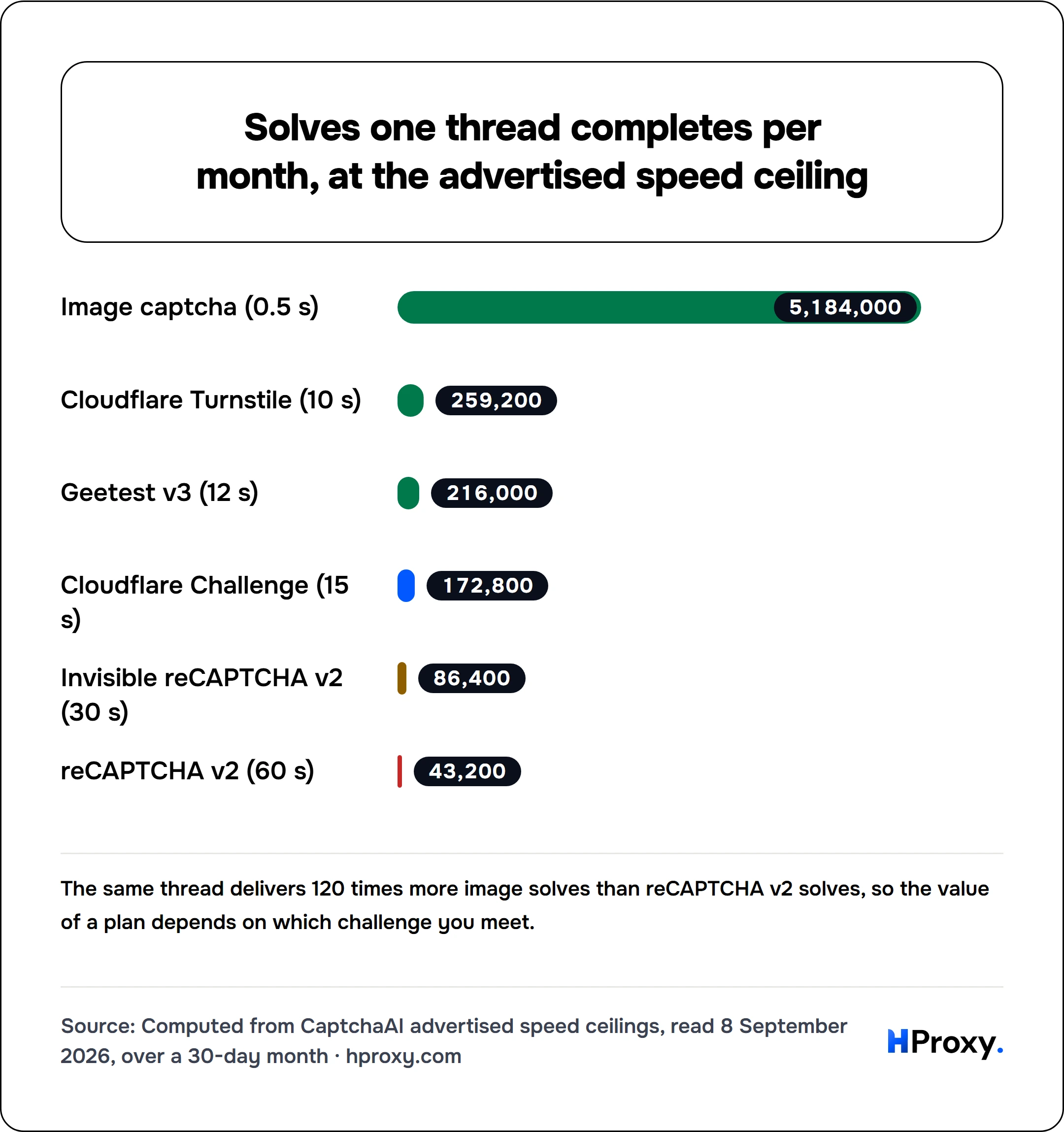
A single plan therefore has no single price. The $15 entry plan ceilings at 216,000 reCAPTCHA v2 solves a month, an effective $0.069 per 1,000. On Turnstile the same $15 reaches 1,296,000 solves, or $0.0116 per 1,000.
Both figures are ceilings, not prices. They assume the threads run flat out for a month at the vendor's own worst-case advertised speed, and no real job does that. What they establish is the direction of the model. Past the break-even, this is cheaper than metered solving by roughly an order of magnitude.
The break-even
Divide the plan price by a metered rate per solve. That gives the volume at which the subscription stops being the expensive choice.
When the $15 plan becomes the cheaper option
| Compared with | Their published rate | Break-even solves / month |
|---|---|---|
| The dearest metered rate we found | $2.89 / 1,000 | 5,190 |
| The cheapest metered rate we found | $0.60 / 1,000 | 25,000 |
Under 5,000 solves a month, pay per solve. Every metered vendor beats every subscription there, and it is not close.
Over 25,000, the subscription beats all of them.
Between the two, it depends who you are leaving. A scraper doing 10,000 reCAPTCHA v2 solves a month saves money moving off the dearest metered vendor and loses money moving off the cheapest.
The number that decides it is utilisation, not volume
A thread only earns while it is solving. A job that fires 20,000 challenges in one hour on Monday and nothing else all week needs enough threads for the peak, and pays for them through six idle days. The same 20,000 solves spread evenly needs a fraction of the threads. Metered pricing does not care about the shape of your traffic and capacity pricing cares about nothing else, which is the real question to ask before switching, and it is not on anybody's pricing page.
What we would be careful about
The extension rates poorly. The Chrome Web Store listing sits at 2.6 out of 5 from 28 ratings, with about 1,000 users. The extension got a new version, 4.0.1, on 7 April 2026, so some of those ratings may be older than the version on the store today. SourceForge gives the service itself 4.8 from 5 ratings. Small samples on both sides, and they disagree. The extension is a convenience wrapper rather than the product. Even so, 2.6 is the only rating here that the vendor did not write, and it is the one going the wrong way.
Independent evidence is thin. Searching the brand returns mostly partner content on proxy company blogs. Two of those reviews carry the same title and share 25 word-for-word sentences of twelve words or more. They are one supplied text published under two names, and neither page says so. Trustpilot is the first organic result and would not load for us on 8 September 2026. It answered with a challenge interstitial, in a real browser as well as a plain fetch. That is a fitting obstacle while researching a captcha solver, and it still leaves those reviews unread.
None of that is evidence against the service. It is evidence that almost nobody outside its partner programme has tested it in public. That is a reason to run the trial yourself, not a reason to skip it.
Advertised speeds are ceilings, and reCAPTCHA v2 is slow. Under 60 seconds is a wide promise, and the whole throughput calculation rests on it. Cloudflare documents that a Turnstile token is valid for 300 seconds and single-use. A 60 second solve therefore spends a fifth of the usable window before your own request fires.
What we would use it for
High, steady volume on one challenge type. This is the case the model is built for. Above 25,000 solves a month it wins on published prices against everything metered.
Testing a switch cheaply. The documentation describes an emulator that mimics other captcha services. Software already wired to a competitor can be repointed with a key change. Its site carries switch-from pages for six competing services, and the listed 3-day free trial makes the test close to free.
Budget certainty. A fixed monthly figure is easier to forecast than a metered bill. A metered bill moves with how hard your targets got this week.
We would not buy it for a low-volume job, nor for a spiky one that needs peak threads it cannot keep busy. Nor on the strength of the reviews currently ranking for its name.
The part a solver cannot fix
A captcha is a verdict on your traffic, and a solver is an appeal against that verdict. It never changes the rate at which verdicts arrive.
Google is explicit about where the rate comes from. Its own help page states that shared network services "cause all traffic to be blocked because they make it impossible for Google to tell the difference between abusive and non-abusive traffic." The challenge is raised against the address, before the request is read.
We have measured numbers on that half. When an independent benchmark tested our residential pool, the Google search scenario returned 60 percent success with a third of requests blocked. Across the 50 residential networks in the same publisher's August report, that scenario averaged 44.49 percent success and a 54.22 percent block rate. On a job like that, most of every thousand attempts becomes a challenge somebody pays to clear.
Halve the challenge rate and you halve the solver bill, on any pricing model. Residential traffic here is $0.50/GB for the first gigabyte, with no plan and no minimum order, and the balance does not expire. Testing your own targets costs about a dollar. Buy the solver for the challenges you cannot avoid, and fix the address that is generating the rest.
If you want the full market rather than one vendor, we put every published price side by side in captcha solving services compared.
Sources
- CaptchaAI, pricing plans, FAQ and advertised solving speeds, read 8 September 2026.
- CaptchaAI, developer documentation, read 8 September 2026.
- CaptchaAI listing on SourceForge, read 8 September 2026.
- CaptchaAI Captcha Solver, Chrome Web Store listing, read 8 September 2026.
- CapMonster Cloud and DeathByCaptcha pricing pages, read 8 September 2026.
- Cloudflare, "Validate the token", Turnstile documentation, last updated 5 May 2026.
- Google Search Help, "Resolve Google Search's 'Unusual traffic from your computer network' message", read 8 September 2026.