Under about 25,000 solves a month, buy captcha solving by the solve. Above it, buy capacity. That single number decides the choice. No roundup ranking for this term publishes it, because working it out means converting two incompatible pricing models into the same unit.
We read the published pricing at six services on 8 September 2026 and did that conversion. We sell proxies, not captcha solving, so there is nothing on this list we would rather you bought.
Why this list has no favourite
Four of the six roundups ranking for this term are published by a company inside their own list. One is a scraping platform that places itself at number one among captcha solvers. One is a captcha vendor that places itself at number one. Two more are scraping APIs comparing themselves to solvers. We have no product in this category, which is not a virtue, just a different bias worth naming: we sell the layer underneath, and the last section of this page argues that the layer underneath is where your solver bill actually comes from.
The market sells on two different meters
Four of the six services bill per solve. You send a challenge, you get a token, you are charged for that token, and you can run as many at once as you like.
Two bill for capacity. You buy parallelism by the month and the number of solves is either uncapped or capped by the day.
Those two models are not comparable at a glance, which is why the headline numbers in most comparisons are meaningless. A rate of $0.60 per 1,000 and a price of $15 a month describe different things.
Six captcha solving services, as each one publishes itself
| Service | What you buy | reCAPTCHA v2 | Cloudflare Turnstile | Cheapest listed type |
|---|---|---|---|---|
| CapMonster Cloud | Solves | $0.60 / 1k | $1.30 / 1k | $0.04 / 1k images |
| Anti-Captcha | Solves | $0.95 to $2 / 1k | not listed on the front table | $0.50 / 1k images |
| 2Captcha | Solves | EUR 0.99 to 2.8 / 1k | EUR 1.4 / 1k | EUR 0.5 / 1k images |
| DeathByCaptcha | Solves | $2.89 / 1k | $2.89 / 1k | $0.59 / 1k audio |
| CaptchaAI | Capacity, no solve cap | $15/mo for 5 threads | $15/mo for 5 threads | same plan covers every type |
| NopeCHA | Capacity, capped by day | $4.99/mo for 2,000 a day | $4.99/mo for 2,000 a day | same plan covers every type |
Two things in that table are easy to miss. CapMonster prints a claimed success rate beside every price, which nobody else does. And DeathByCaptcha charges the same $2.89 for almost every token type, which makes it the most expensive per solve and the easiest to budget.
The per-solve prices, side by side
For the four metered services, reCAPTCHA v2 is the fair comparison point. Every one of them prices it, and almost every scraper meets it.
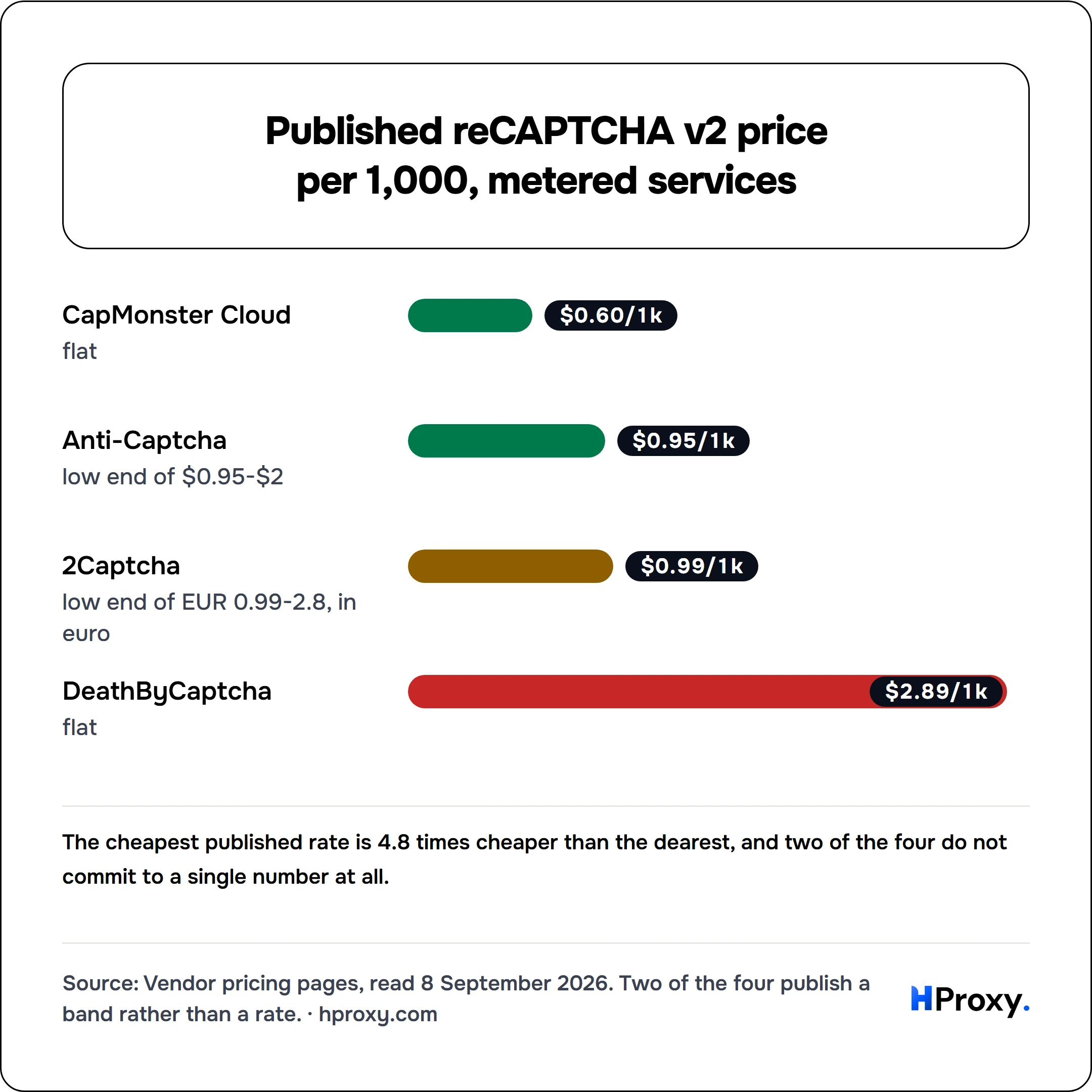
The bands matter more than the ranking. Anti-Captcha and 2Captcha both publish a low and a high figure without saying which jobs land where. The bar above uses their low end, so a real invoice may be double it.
One band is in a different league. 2Captcha prices Arkose Labs FunCaptcha from EUR 1.4 to EUR 50 per 1,000. That is a 35-fold spread inside a single challenge type, wider than the entire spread between vendors. If Arkose is what you meet, it is the number that decides your choice.
Where capacity beats solves
A subscription is cheaper than metering above a volume you can calculate. Divide the monthly plan price by the metered price per solve.
Break-even against a $15 monthly capacity plan
| Metered vendor | Published rate | Break-even solves / month |
|---|---|---|
| DeathByCaptcha | $2.89 / 1k | 5,190 |
| 2Captcha (low band) | EUR 0.99 / 1k | 15,152 |
| Anti-Captcha (low band) | $0.95 / 1k | 15,789 |
| CapMonster Cloud | $0.60 / 1k | 25,000 |
Below 5,000 solves a month, every metered vendor is cheaper than any subscription. Above 25,000, the subscription wins against all of them.
The ceiling is where the gap becomes absurd. CaptchaAI advertises reCAPTCHA v2 in under 60 seconds, and its own documentation defines a thread as one simultaneous solve. One thread at 60 seconds completes at most 43,200 solves in a 30-day month, so five threads reach 216,000. At $15 that is an effective $0.069 per 1,000, about a ninth of the cheapest metered rate in the table.
On Cloudflare Turnstile, advertised at under 10 seconds, the same five threads reach 1,296,000 solves a month. That works out at $0.0116 per 1,000, against $1.30 metered.
Treat both figures as ceilings rather than prices. They assume the threads run flat out, all month, at the vendor's own worst-case advertised speed, and no real workload does that. What they establish is the direction: past the break-even, capacity pricing is cheaper by an order of magnitude.
NopeCHA sells the same idea with the cap on the other axis. Its own plans work out at $0.083 per 1,000 on Starter, $0.033 on Basic, $0.021 on Professional and $0.017 on Enterprise. Each one caps daily solves, so a burst cannot borrow tomorrow's allowance.
Speed is a budget item, not a comfort
Every solver returns a token, and the token has a clock on it. Cloudflare's own documentation is explicit: "Tokens expire. Each token is valid for 300 seconds (5 minutes) after generation. Tokens are single-use."
A solver advertising up to 60 seconds for reCAPTCHA v2 has therefore used a fifth of the window before your scraper has done anything with the answer. Add a retry, a proxy handshake and a page load and the margin gets thin. An expired token is billed exactly like a used one.
Speed also sets the ceiling on a capacity plan, because throughput is threads divided by seconds per solve. Halving the solve time doubles what the same subscription delivers. The advertised speed table therefore matters more on a capacity plan than on a metered one.
The number to check before you sign anything
Find your challenge type on each vendor's price list before comparing vendors at all. The spread inside one challenge type is frequently wider than the spread between companies: Arkose runs EUR 1.4 to EUR 50 per 1,000 at a single vendor, reCAPTCHA Enterprise is $5 per 1,000 at Anti-Captcha against $1.00 at CapMonster, and image captchas run from $0.04 to about $1. A vendor that is cheapest on reCAPTCHA v2 can be the dearest on the type you actually meet.
What the challenge is telling you
A captcha is a verdict on your traffic, and the solver is an appeal.
Google states the mechanism plainly on its own help page. Shared networks and some VPN services "cause all traffic to be blocked because they make it impossible for Google to tell the difference between abusive and non-abusive traffic". The challenge is raised against the address, before your request is examined at all. Google is also folding its classic reCAPTCHA documentation into a fraud product. The deprecation notice on its own developer guide now points readers at Cloud Fraud Defense.
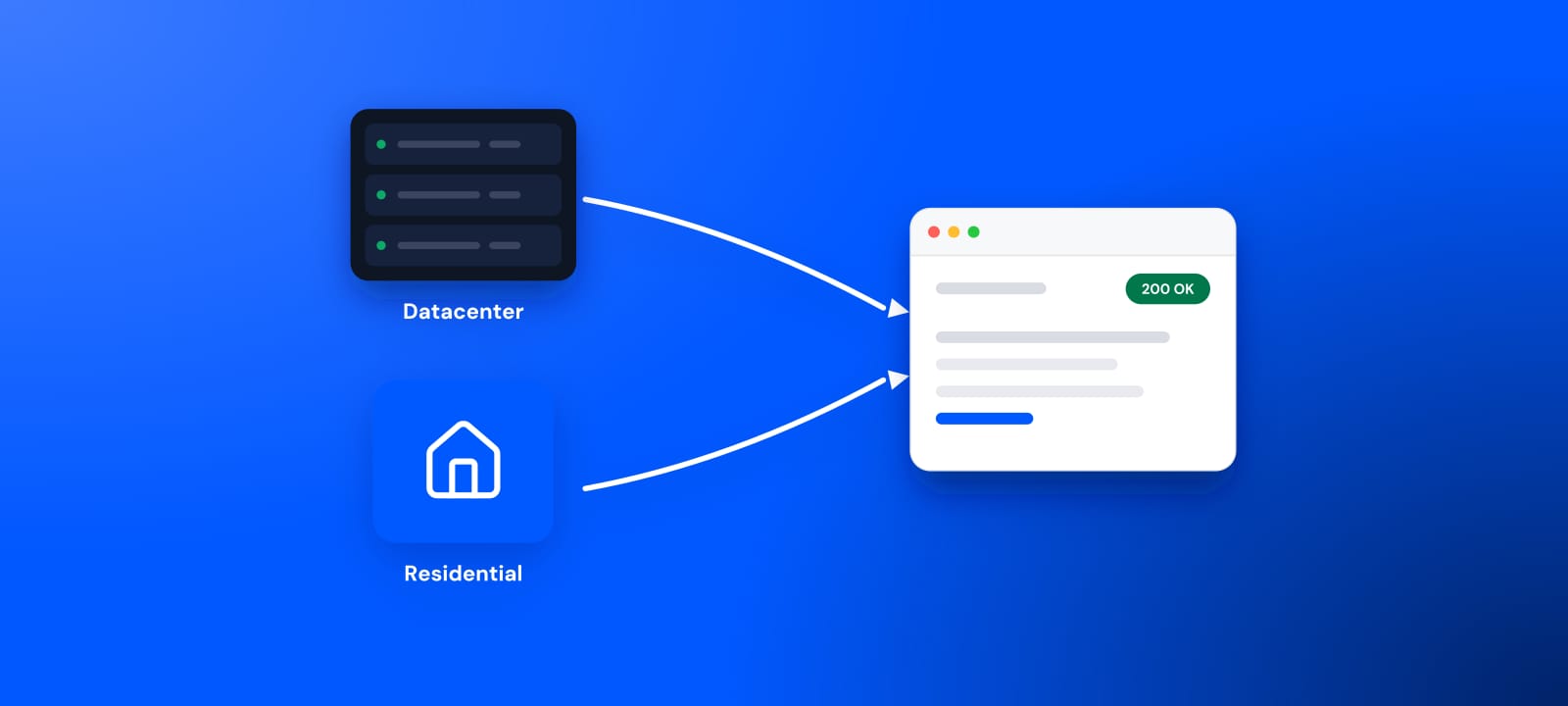
So the solver bill is a function of the challenge rate, and the challenge rate is a function of the exit address. Halve the rate and you halve the bill, whichever model you are on.
We have numbers on that half of the problem rather than the solver half. When an independent benchmark tested our residential pool, the Google search scenario returned 60 percent success with a third of requests blocked. Across the 50 residential providers in the same publisher's August report, that scenario averaged 44.49 percent success and a 54.22 percent block rate. On a job like that, more than half of every thousand attempts becomes a challenge somebody has to pay to clear.
That is the case for spending on the address before spending on the appeal. Residential traffic here is $0.50/GB for the first gigabyte with no plan, and the balance does not expire. Testing your own targets before committing costs about one dollar.
Which one to pick
Under 25,000 solves a month: the cheapest metered rate for your specific challenge type. On reCAPTCHA v2 that is CapMonster Cloud at $0.60 per 1,000 on its published pricing.
Over 25,000 solves a month, running steadily: a capacity plan. CaptchaAI is the only service here that caps concurrency and nothing else, so a burst is free as long as the threads are free. Its API also accepts 2Captcha-format calls through its emulator, which makes switching a key change rather than a rewrite.
Bursty jobs on a daily rhythm: NopeCHA fits a workload with a predictable daily ceiling, and fits a spiky one badly, because the cap resets rather than pools.
A challenge type nobody prices clearly: budget for the top of the band, not the bottom. On Arkose that is the difference between EUR 1.4 and EUR 50 for the same thousand solves.
And before any of it, look at what is raising the challenges. A solver that clears 100,000 challenges a month is a bill. The address that stopped raising 50,000 of them is a saving.
Sources
- CaptchaAI, pricing plans, FAQ and advertised solving speeds, read 8 September 2026.
- 2Captcha, captcha price list, read 8 September 2026.
- Anti-Captcha, supported captcha types and prices, read 8 September 2026.
- CapMonster Cloud, pricing table, read 8 September 2026.
- DeathByCaptcha, captcha pricing by type, read 8 September 2026.
- NopeCHA, pricing, read 8 September 2026.
- Cloudflare, "Validate the token", Turnstile documentation, last updated 5 May 2026.
- Google, reCAPTCHA Developer's Guide deprecation notice, read 8 September 2026.
- Google Search Help, "Resolve Google Search's 'Unusual traffic from your computer network' message", read 8 September 2026.