2Captcha (2captcha.com) is a captcha-solving service: a program sends it the captcha it meets, and it returns the answer, from AI models first and from human workers when the AI is unsure. On 12 October 2026 it listed $1 to $2.99 per 1,000 reCAPTCHA v2 solves, and its own statistics showed customers paying $2.99 all week. SolveCaptcha, CapMonster Cloud and CapSolver listed $0.55 to $0.80 the same day. The comparison sets out each service's prices and model.
What 2Captcha sells, and what it costs
A captcha solver sits between a script and a website. The script sends the captcha, or for token captchas such as reCAPTCHA the page address and site key; the service returns the text or token, and the script submits it. 2Captcha says that "Most captchas tasks are solved automatically by AI models for speed. If AI confidence is low, the task is passed to verified human workers".
2Captcha prices for the commonest captchas, 12 October 2026
| Captcha | Price per 1,000 | Note |
|---|---|---|
| reCAPTCHA v2 | $1 to $2.99 | also Callback and Invisible |
| reCAPTCHA v3 | $1.45 or $2.99 | by the score asked for |
| Image captcha | $0.50 to $1 | text in a picture |
| Cloudflare Turnstile | $1.45 | |
| Arkose Labs | $1.45 to $50 | FunCaptcha |
| Audio captcha | $0.50 |
2captcha.com/pricing and its payment policy, read from our server on 12 October 2026
The page shows a solving speed of "0 sec." for every captcha until a script fills it in, and a "free capacity" per minute that read exactly the same on 9 and 12 October: 11,273 for reCAPTCHA v2, 2,883 for Turnstile. The currency is set for each visitor: our server in the United States was given dollars and a cookie naming its country, and the euro setting shows €0.99 to €2.80 for reCAPTCHA v2. Beside captchas, 2Captcha sells residential and SOCKS5 proxies from $3.99 for one gigabyte down to $1.25 a gigabyte at 10 terabytes, a scraping API and data annotation.
Several scraping guides still show 2Captcha solving hCaptcha. On 12 October 2026 its menu of captcha types had 34 entries, from reCAPTCHA and Turnstile to slider and math captchas, and none for hCaptcha; the price list had no hCaptcha row, and the address of its hCaptcha demo led to the home page.
Both sides of 2Captcha's market
2Captcha runs a public network status page, and the statistics behind it cover both its customers and its workers, hour by hour. We read the week from 5 October at 11:00 to 12 October at 10:00: 168 hourly readings.
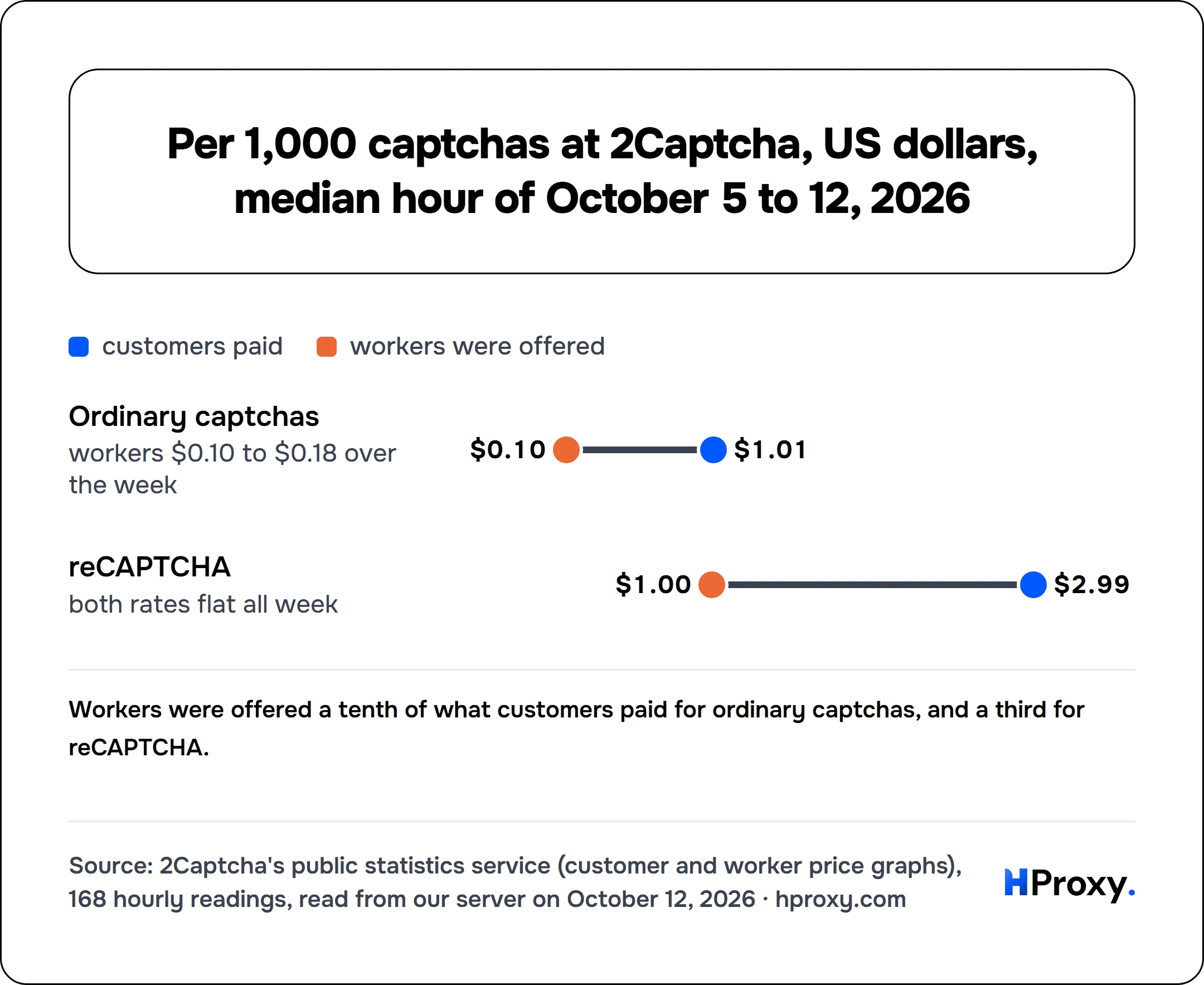
- customers paid
- workers were offered
Customers paid $1.00 to $1.01 per 1,000 ordinary captchas and $2.99 per 1,000 reCAPTCHAs in every hour of the week, the top of both ranges on the price list. Workers were offered $0.10 to $0.18 and $1. The worker FAQ promises "between $0.14 - $0.6 per 1000" for ordinary captchas; the live rate sat below $0.14 in 126 of the 168 hours, and at $0.10 in 98. The human share is the part that pays workers at all, since the AI takes most tasks first.
The same statistics show the size of the workforce. Between 167 and 327 workers were online for image captchas, and between 989 and 5,113 for reCAPTCHA, with the daily median rising from 1,434 on 6 October to 4,471 on 11 October. Ordinary captchas came back in 2.7 seconds at the median hour, and no hour averaged more than 4.74. The worker page tells people they can make "$0.50 for 1-2 hours, depending on service load", paid out from $0.50 without fees.
The same statistics in 2018 and 2023
The Internet Archive kept copies of these graphs: a week in May 2018, a day in August 2021 and a week in March 2023. Read side by side, they show what changed and what did not.
2Captcha's own statistics, median hour of a week
| Week | Ordinary captchas | reCAPTCHA |
|---|---|---|
| 20 to 27 May 2018 | $0.89 paid, $0.22 offered; 13.2 s; 734 workers | $2.99 paid, $1 offered; 45 s; 1,515 workers |
| 26 March to 2 April 2023 | $1.01 paid; 13.7 s; 482 workers | $2.99 paid; 64 s; 1,532 workers |
| 5 to 12 October 2026 | $1.01 paid, $0.10 offered; 2.7 s; 234 workers | $2.99 paid, $1 offered; 3,281 workers |
Internet Archive copies of 2captcha.com/public_statistics (26 May 2018, 24 August 2021, 2 April 2023) and the live statistics service on 12 October 2026, read from our server
The price of an ordinary captcha rose by about an eighth, from $0.89 to $1.01, while the rate offered to the workers who type them fell from $0.22 to $0.10; the August 2021 copy shows $0.30. Ordinary captchas now come back five times faster with a third of the workers online, which fits 2Captcha's account that AI answers most of them first. reCAPTCHA has stood still on both sides: $2.99 to customers and $1 to workers in all three years, with more than twice as many workers online now as in 2018.
Who runs 2Captcha
The domain dates from 22 April 2014, and the first archived capture describes "a human-powered image and CAPTCHA recognition service" that invited visitors to "Earn with us". Its contracting company changed in the two weeks to 12 October 2026.
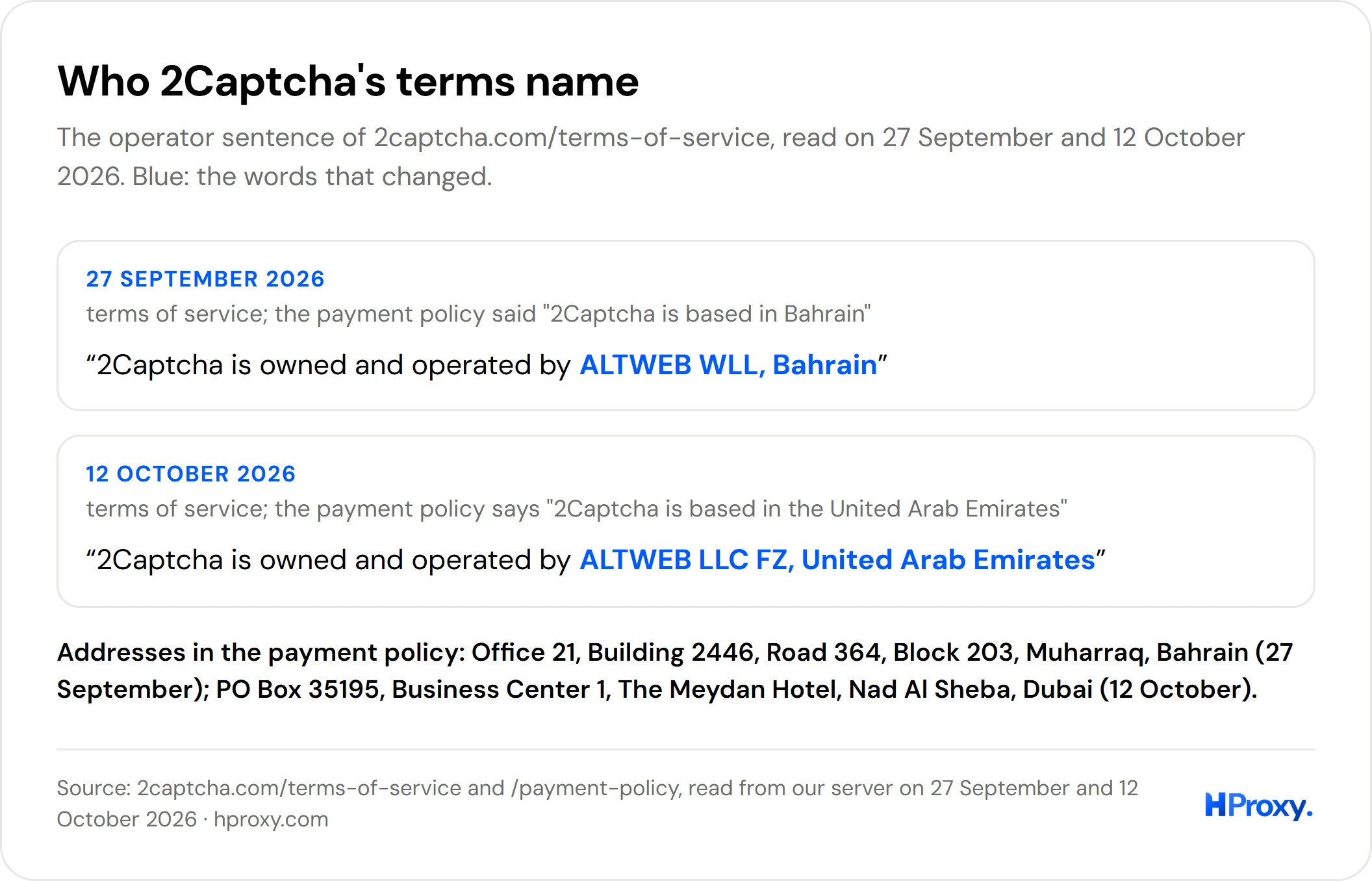
On 12 October 2026 the terms, the payment policy and the privacy notice all named ALTWEB LLC FZ, with a business-centre address at the Meydan Hotel in Dubai. The payment policy refunds an unused balance within 30 days of payment and the payment itself within 60 days "if you are not satisfied", only to the paying account, processed within 30 days.
Why people look for an alternative
Google's suggestions on 12 October 2026 put 2Captcha beside CapSolver, Anti-Captcha, CapMonster, DeathByCaptcha and SolveCaptcha, and asked whether it is legit, safe, legal and "worth it". The name draws 165,000 searches a month, CapSolver 74,000 and SolveCaptcha 14,800. Questions from workers sit beside those from buyers: "is 2captcha real or fake", "does 2captcha really pay".
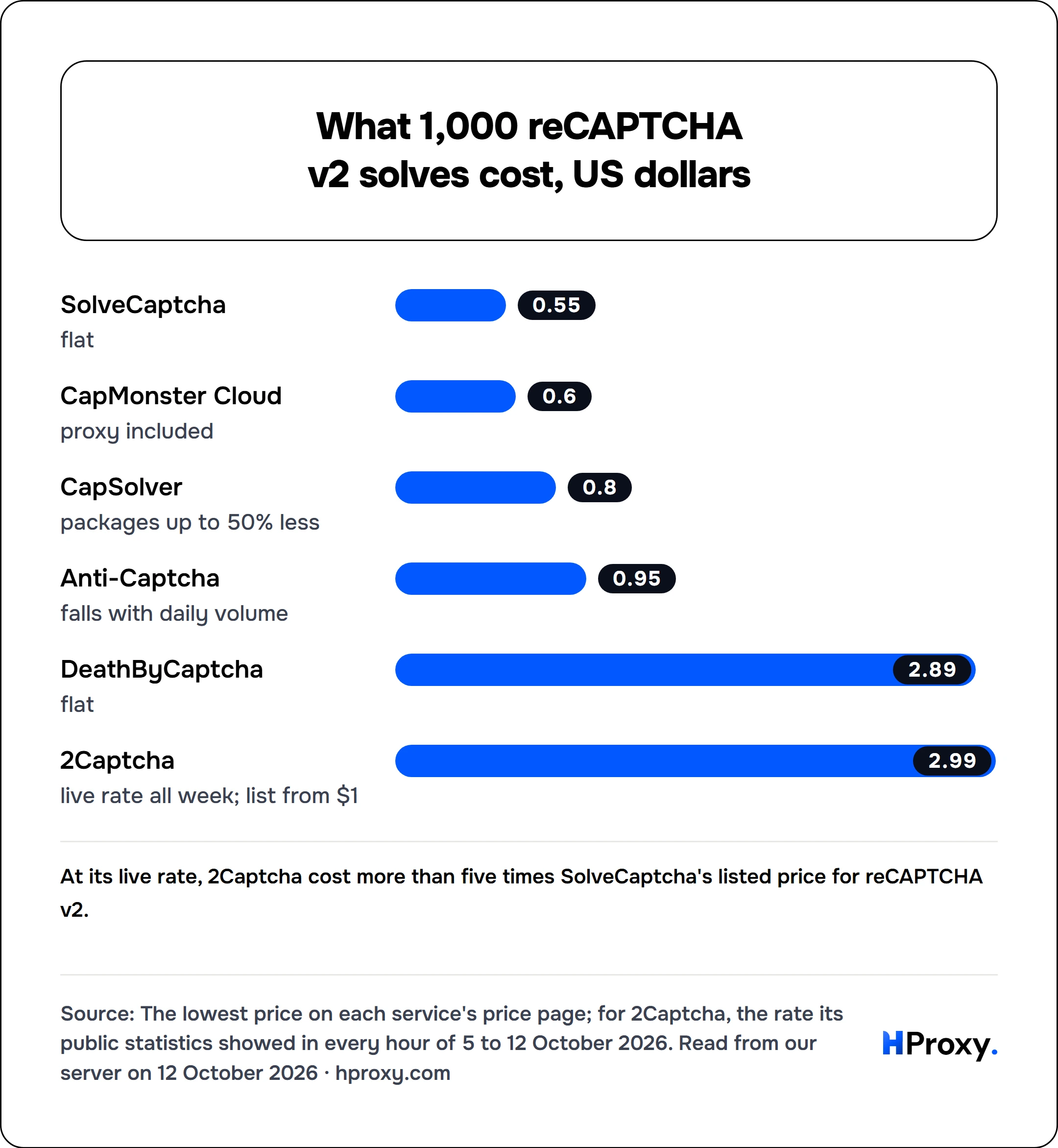
For buyers, price is the plain reason. A reCAPTCHA costs $2.99 per 1,000 at the live rate, about five times what SolveCaptcha and CapMonster list, and a script that meets thousands a day feels that quickly.
The alternatives side by side
Every price below comes from each service's own pages on 12 October 2026, read from our server, and matches what the same pages showed on 9 October. We sent none of them a captcha, so nothing here compares accuracy or speed under load.
2Captcha and seven alternatives, 12 October 2026
| Service | Per 1,000 solves |
|---|---|
| 2Captcha | reCAPTCHA v2 $1 to $2.99; Turnstile $1.45 |
| SolveCaptcha | reCAPTCHA v2 $0.55; Turnstile $0.80 |
| CapMonster Cloud | reCAPTCHA v2 $0.60; Turnstile $1.30 |
| CapSolver | reCAPTCHA v2 $0.80; Turnstile $1.20 |
| Anti-Captcha | reCAPTCHA v2 $0.95 to $2; Turnstile $2 |
| DeathByCaptcha | reCAPTCHA v2 and Turnstile $2.89 |
| CaptchaAI | no price per solve: from $15 a month for 5 threads, unlimited solves |
| NopeCHA | no price per solve: from $4.99 a month for 2,000 solves a day |
Each service's price page, read from our server on 12 October 2026
What the difference costs a scraper
Take a scraper that meets a reCAPTCHA v2 on one page in ten, across 100,000 pages a month: 10,000 solves. At 2Captcha's live rate that comes to $29.90 a month; at the list prices of SolveCaptcha, CapMonster Cloud and CapSolver, $5.50, $6 and $8. The gap scales with volume, which is why buyers compare. Time costs too, since the script waits for each token, and 2Captcha's feed gave no reCAPTCHA time for the week we read; in March 2023 its reCAPTCHA answers took 64 seconds at the median hour.
SolveCaptcha
SolveCaptcha is the cheapest on the list: $0.55 per 1,000 reCAPTCHA v2 solves, $0.35 per 1,000 images and $0.80 for Turnstile. It also advertises a "captcha typing job", so humans stand behind its AI too. Its pages name no company, and its domain dates from March 2018.
CapMonster Cloud
CapMonster Cloud charges $0.60 per 1,000 reCAPTCHA v2 tokens, $0.90 for v3 and $1.30 for Turnstile, and says the proxy is included in the price and that you pay only for captchas it solves. It gives a $0.10 test balance on request and refunds within 3 days of a purchase. Its support desk runs on ZennoLab's help site.
CapSolver
CapSolver is the most searched rival, with 74,000 searches a month. It lists $0.80 per 1,000 reCAPTCHA v2 solves, $1.00 for v3, $1.20 for Turnstile and $0.40 per 1,000 images, and says its packages save up to 50% against those rates.
Anti-Captcha
Anti-Captcha has run since 2007 and lists $0.95 to $2 per 1,000 reCAPTCHA v2 solves, falling with daily volume, $0.50 to $0.70 per 1,000 images and $2 for Turnstile. Support is by ticket only. Its own documentation warns against rented proxies in its proxy tasks and takes a proxy by IP address only.
DeathByCaptcha
DeathByCaptcha charges $2.89 per 1,000 for reCAPTCHA, Turnstile and most token captchas, and $0.99 to $2 for ordinary ones. It describes AI-assisted OCR backed by an "expert verification network", gives 100 free credits on request, and sells a $4.99 monthly membership.
CaptchaAI and NopeCHA
Both sell time rather than solves. CaptchaAI rents captcha threads, $15 a month for 5 threads with unlimited solves, up to $7,500 for 5,000. NopeCHA sells a daily allowance through its browser extensions and SDKs, from $4.99 a month for 2,000 solves a day to $99.99 for 200,000. For steady, high volume both can undercut any per-solve price; for bursts they cannot.
Where HProxy fits
When a site checks that a captcha was solved from the same address as the visit, the solver has to load it through your proxy. 2Captcha's tasks come in two forms: one solved through its own proxy pool, and one through a proxy you supply, HTTP, SOCKS4 or SOCKS5, given by IP or hostname with a login. CapMonster includes its own proxy; Anti-Captcha accepts an IP address only and warns against rented proxies.
When the solve has to come from the same address as the session, our residential proxies fit 2Captcha's fields as they are: a hostname, a port, a username and a password. Residential Lite costs $0.50/GB for a single gigabyte, with country targeting; Residential Premium adds state, city and ISP targeting from $1.49, and an address can be held for up to 24 hours. Residential balance does not expire. Our guide to proxies for web scraping covers the rest of the setup.
Which one to pick
- Stay with 2Captcha for unusual captchas: its list covers some twenty types, and human workers take what its AI cannot.
- For the lowest per-solve price: SolveCaptcha or CapMonster Cloud, from $0.55 and $0.60 per 1,000 reCAPTCHAs.
- For a large monthly volume: CapSolver's packages, or CaptchaAI's threads with unlimited solves.
- For one browser running all day: NopeCHA's daily allowance.
- The weakest fit on price: DeathByCaptcha, at $2.89 per 1,000 for every token captcha.
What we could not find out
We solved no captchas, so accuracy, speed under load and how often a solved token is rejected are not compared. 2Captcha's statistics give rates and counts, not the share of tasks its AI solves without a human. We did not research RuCaptcha or Kolotibablo, which Google also pairs with 2Captcha, and SolveCaptcha's pages give no company or address. We plan to read every page again before 12 January 2027.
Sources
- 2Captcha: price page, home page, worker page and FAQ, about page, terms of service, payment policy, privacy notice, residential proxy page and API documentation; its public statistics service for 5 to 12 October 2026. Read 12 October 2026.
- 2Captcha's terms and payment policy as read on 27 September 2026, and its price list as read on 8 September and 9 October 2026, from our earlier research; the same list in its euro setting on 12 October 2026.
- Internet Archive: 2captcha.com from 2014. Domain records of 2captcha.com and solvecaptcha.com.
- SolveCaptcha, CapMonster Cloud, CapSolver, Anti-Captcha, DeathByCaptcha, CaptchaAI and NopeCHA: home and price pages, read 12 October 2026, against our readings of 9 October.
- Search volumes from Keyword Planner (worldwide) and the autocomplete Google sent our server, both of 12 October 2026.
- Our own figures: HProxy's price tokens and product pages on the day of writing.