The answer to "what should I use instead of Coresignal" depends entirely on why you are leaving. Price, a commitment, a country, a support experience and a blocked target all point at different replacements.
What is on file for Coresignal
Their site is coresignal.com. Category, as we track it: scraping API.
There is no price in this comparison because we do not have one we can date and attribute. What follows instead is the set of questions that decide the cost once you do read their page.
The four figures worth copying down are the rate without a commitment, the smallest purchase allowed, what happens to unspent balance, and whether a failed request still costs money.
The site, as it reads today
On 9 September 2026 the site introduced itself as "Real-Time Public Web Data, Coresignal". Their own summary of the product runs: "Coresignal offers fresh web data on companies, professionals, and job postings, providing businesses with millions of continuously updated data records."
Taken from the same page, on the same day:
The page offers some form of free trial. Their pricing page is titled "Coresignal Datasets and Data APIs Pricing".
Every line above is a quotation from their marketing rather than a measurement by us. It is included because it is checkable, not because it is evidence of performance.
Age, and why it matters here
The domain was registered on 16 December 2014, through GoDaddy.com, LLC, which makes it about 11 years old. We pulled that from the registry on 9 September 2026. The current registration term ends 16 December 2027.
None of it predicts success rate. It is here because domain age and archive depth are free to check, and a provider whose public record starts last quarter deserves a smaller first order.
Their published surface
A crawl of 387 pages returned 274 blog pages, 1 pricing page and 31 use-case pages.
Site size is a signal about marketing budget rather than network quality, and the two are frequently unrelated. It is useful for a different reason: a provider with many pricing pages is usually segmenting hard, and a provider with none is selling by quotation.
What the search data says about Coresignal
Worldwide, the brand carries about 160 searches a month: 110 a month for their pricing and 50 a month for an alternative to them. Figures read from Google Keyword Planner on 9 September 2026.
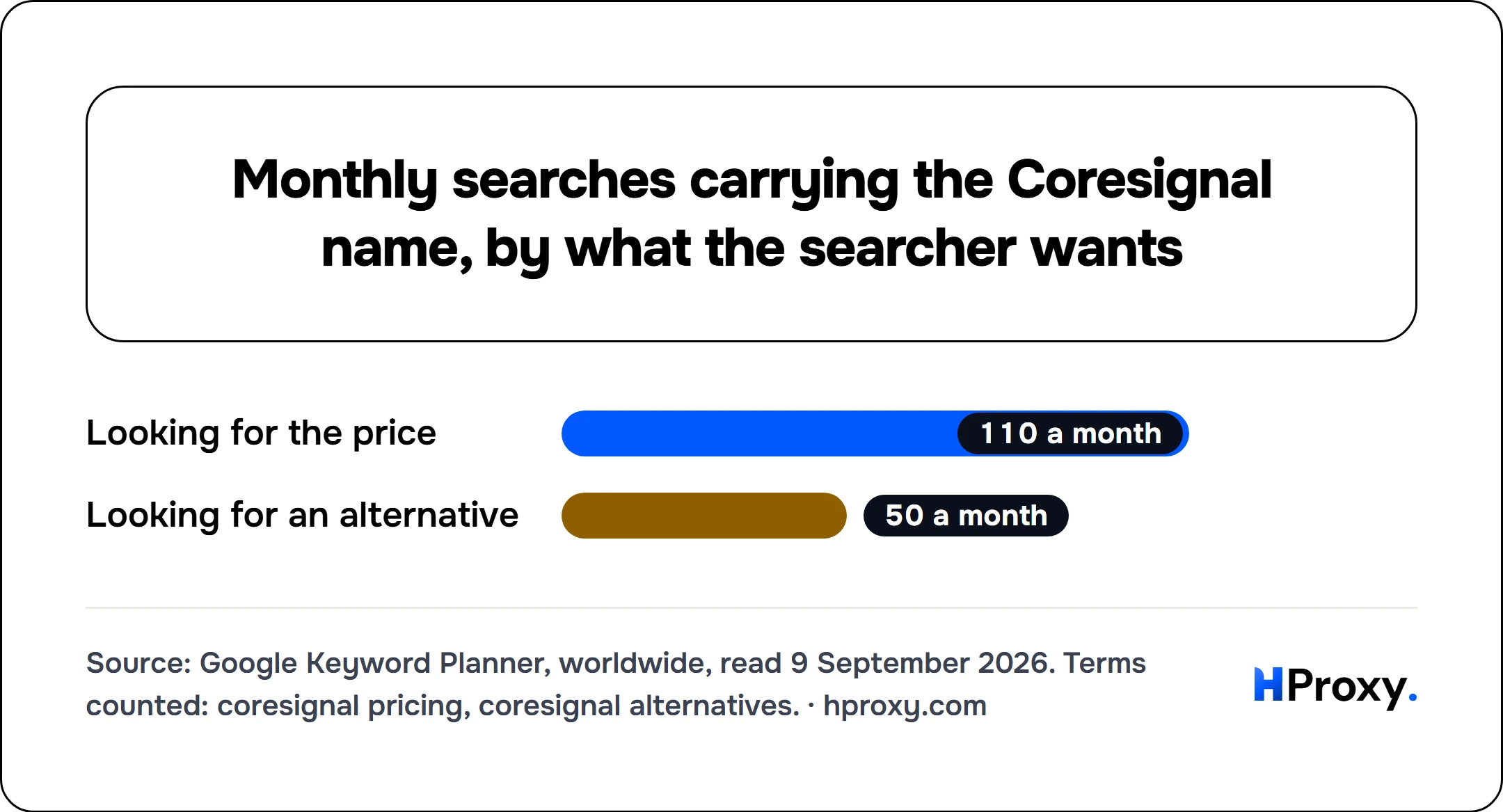
The largest share is people trying to work out what it costs, which is the honest starting point for a page like this one.
At up to $31.18 a click, these are expensive words. Worth remembering when a review ranks first and happens to recommend whoever pays the most.
The questions behind the numbers
Ask whether failed requests are billed
On a hard target, failures are the majority of your traffic. Whether those failures are billed decides the real cost, and the clause covering it is rarely on the pricing page.
The gap between the headline and the bill
Rates in this market are quoted from the bottom of the table. The relevant question is which row you land on at your volume, and whether reaching a cheaper row costs more in commitment than it saves per unit.
The limit that stops the job
Bandwidth is rarely the constraint on a real workload. Concurrent connections, requests per second and per-session caps are, and they are frequently buried in the documentation rather than the pricing page.
The comparison, honestly framed
Here are the comparisons that survive contact with a real workload:
| Question to ask | Coresignal | HProxy |
|---|---|---|
| Entry price | Not verified by us, read their page | From $0.44/GB, pay as you go |
| Does unused balance expire? | Their terms page answers this | Never |
| Minimum commitment | Worth confirming in writing before you commit | None |
| Identity checks | Read their current terms | Card orders are screened, and verification is sometimes requested |
| Targeting | Worth confirming in writing before you commit | Country, city and ISP |
| Free way to evaluate | Read their current terms | Free proxy list and proxy checker |
Where a cell points you at their terms, that is because the answer moves and a stale quotation would be worse than none. The missing row, in every table of this kind, is the one only your own measurement can fill.
The measurement that outranks every review
This costs less than a coffee and produces the only evidence that applies to your workload.
- Take the smallest paid unit each provider will sell you. A free trial works for a first pass, though trials sometimes ride better pools than paid plans do.
- Fire the same batch through both on one afternoon. Different days are different conditions, and that ruins the comparison.
- Write down two numbers per provider: the share of requests that succeeded, and the traffic it cost.
- Take a handful of the addresses you were given and verify their country and type against a checker you do not control.
- Go with whichever performed, then measure again next quarter. Networks change underneath you.
Comparable providers
We hold the same record for these, and the same honest limits apply to each:
What we sell, stated plainly
If you want our side of it: $0.44 per GB for residential, pay as you go, nothing expires, and the free tools stay free. We would rather you measured than believed us, which is why the test comes before this paragraph rather than after it.