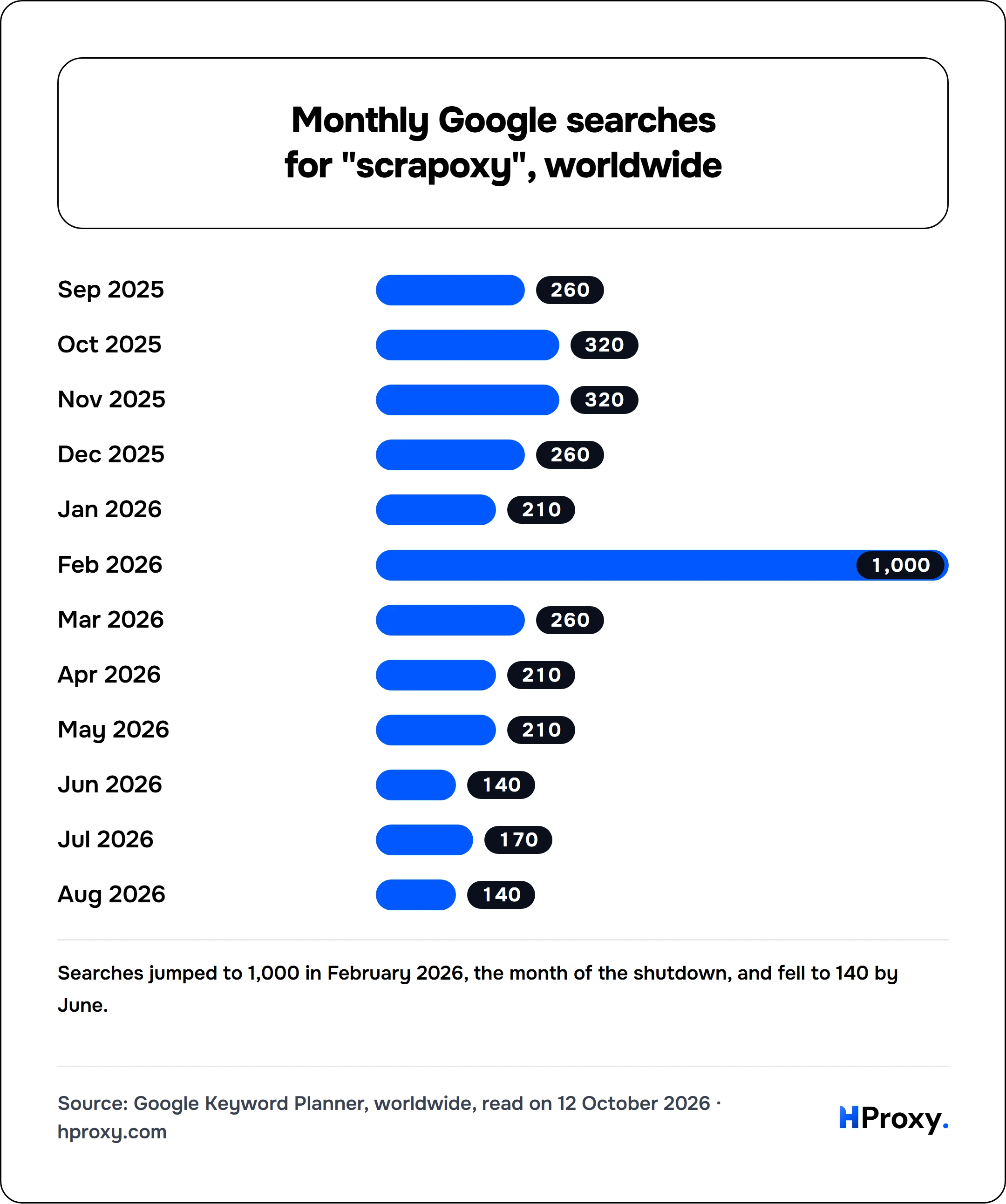
Scrapoxy (scrapoxy.io) was a proxy manager: one endpoint in front of many proxies, which it rotated, checked and, on your own cloud account, started and stopped. Its developer discontinued it on 6 February 2026, after more than eleven years. The public Docker images were replaced and the documentation went offline. The shared backend that checked and located proxies was shut down as well, so existing installations lost part of their function too. Its jobs now fall to several tools, free and paid.
What happened
The notice on scrapoxy.io, dated 6 February 2026, dates the first commit to 31 August 2015. Over its lifetime Scrapoxy "served 1,742 users, tracked 19 million IPs, handled 115 billion requests, and processed nearly 12 petabytes of data". The software stayed free; support and dedicated infrastructure were paid, and "very few users were willing to pay".
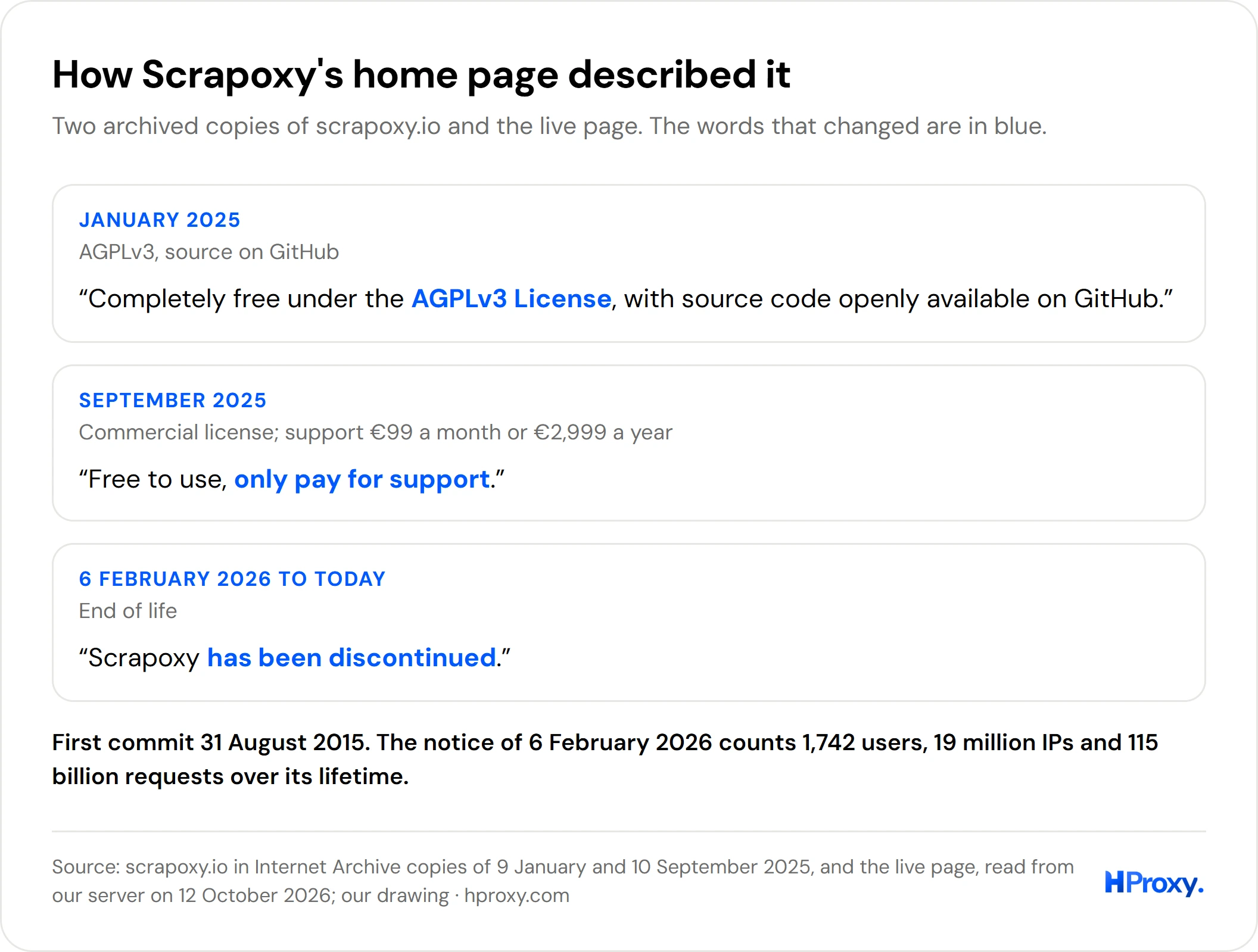
The license changed before the end. In January 2025 the home page called Scrapoxy "Completely free under the AGPLv3 License". By September 2025 it read "Free to use, only pay for support", "Released under commercial license", with support at €99 a month or €2,999 a year. The license file in its repository now names CoreDump Engineering as the owner, reserves all rights and forbids using the software "to build, operate, or support a proxy service for resale".
Its FAQ adds the practical points. "Sales of support subscriptions have been closed." Enterprise subscribers keep a dedicated version until their contract ends; for everyone else, "There was no obligation to provide a transition period, and none was offered." The source code will not be released, forks are not allowed, and the FAQ names no successor.
What still works and what does not
Scrapoxy's parts on 12 October 2026
| Part | State |
|---|---|
| Docker images | All 144 tags replaced on 6 February 2026 by images of 3.6 to 7.7 MB |
| npm package | One version left, 4.28.5 of 7 February 2026 |
| Source repository | A README that reads only "Scrapoxy has been discontinued." |
| Documentation | Offline, except for enterprise subscribers |
| Shared backend | GeoIP, proxy status and country checks shut down |
| License | Commercial, all rights reserved, no forks |
Docker Hub, the npm registry and GitHub's public data, and scrapoxy.io, read from our server on 12 October 2026
Docker Hub still counts 87,486 pulls, and it recorded pulls of the replaced tags on 12 October 2026, so some deployments still fetch Scrapoxy by tag. We did not download the new images, so we cannot say what they do. The repository still shows 2,408 stars.
What Scrapoxy did
The archived home page of January 2025 promised to "Manage all your proxies in one place" behind one proxy port, 8888, with a dashboard on port 8890. It had connectors for 20 proxy sellers and cloud platforms, 30 or more by September 2025. On AWS, Azure, Google Cloud, DigitalOcean or OVH it built a private pool of datacenter proxies on your own account. It scaled the pool up for a job and down afterwards, a saving it put at 80%. It held sticky sessions for headless browsers, and the shared backend validated each proxy and looked up its country.
What replaces it, by job
Five replacements, 12 October 2026
| Tool | Covers | Terms |
|---|---|---|
| mubeng | One port that rotates a proxy list | Free, Apache 2.0 |
| Glider | Balancing and health checks over proxies | Free, GPL 3.0 |
| Crawlee | Rotation and sessions in Node.js scrapers | Free, Apache 2.0 |
| scrapy-rotating-proxies | Rotation and ban checks in Scrapy | Free, MIT |
| ScrapeOps Proxy Aggregator | 20+ proxy sellers behind one endpoint | From $9 a month |
GitHub's public data for the four projects and scrapeops.io, read from our server on 12 October 2026
One local port in front of your proxy list
mubeng, "An incredibly fast proxy checker & IP rotator", runs a local proxy that switches to the next address every N requests, in order or at random. It can also rotate and retry when a request fails. Its last update was on 10 September 2026, and it has 2,737 stars. Glider, a forward proxy under GPL 3.0, spreads traffic over upstream proxies by round robin, high availability, lowest latency or destination hashing. It checks each upstream on a schedule and was updated on 9 October 2026. Neither starts cloud servers for you, so Scrapoxy's private datacenter pool has no packaged replacement among these tools.
Rotation inside your scraper
Crawlee, a Node.js scraping library with 26,126 stars, takes a list of proxy addresses and rotates through them "in a round-robin fashion". Each session keeps its own address, and when Crawlee recognises that the crawler is being blocked, it starts a new session. For Scrapy, scrapy-rotating-proxies (MIT) rotates a list, checks that each proxy is alive, detects bans and slows down; its last update was on 8 April 2026. Our guides cover Crawlee and Scrapy setups.
Many sellers behind one endpoint, as a service
ScrapeOps Proxy Aggregator is the closest paid match to Scrapoxy's connectors: one endpoint in front of "20+ proxy providers", which reroutes traffic when one seller is blocked. Plans run from $9 a month for 25,000 credits to $699 for 10 million, and include rotation, sticky sessions and JavaScript rendering. It gives 1,000 free credits and bills only successful requests.
Where HProxy fits
We sell proxies, and a rotating gateway does on our side what Scrapoxy did on yours. Our residential Lite pool gives a new address on every request from $0.44 per GB. Premium can hold one address in a sticky session for up to 24 hours, from $1.00 per GB. Either one works behind mubeng, Glider, Crawlee or Scrapy if you keep a manager in front.
Which one to pick
- mubeng or Glider if you have a proxy list and want one local port that rotates it, at no cost.
- Crawlee or scrapy-rotating-proxies if rotation can live in your scraper's own code.
- ScrapeOps Proxy Aggregator if you want many sellers behind one endpoint without hosting anything, from $9 a month.
- A rotating gateway from a single seller if one pool is enough; rotation and sticky sessions come with it.
What we could not find out
We ran none of these tools and pulled no Docker image, so we cannot say what the replaced Scrapoxy images do or how many installations still run. Two archive copies place the license change between January and September 2025; the exact date is not on the site. The stars and update dates come from GitHub's public data on 12 October 2026, and we will read them again by 12 January 2027.
Sources
- Scrapoxy: the end-of-life notice and FAQ on scrapoxy.io, read from our server on 12 October 2026; its home page in Internet Archive copies of 9 January and 10 September 2025.
- Docker Hub, the npm registry and GitHub's public data for Scrapoxy, 12 October 2026.
- GitHub's public data and documentation for mubeng, Glider, Crawlee and scrapy-rotating-proxies; Crawlee's proxy guide; ScrapeOps' Proxy Aggregator page, 12 October 2026.
- Monthly search counts for Scrapoxy from Google Keyword Planner, worldwide, read on 12 October 2026.
- HProxy's prices, rendered from our live price data.