
BeeProxy is now part of 9Proxy. From 21 December 2025 it stopped accepting new accounts and new orders, and on 15 September 2026 every beeproxy.com address answered a permanent redirect to 9proxy.com. If you had a balance there, it moved with your account rather than disappearing. If you are here to replace it rather than to find it, the sourced rates are in the alternatives table.
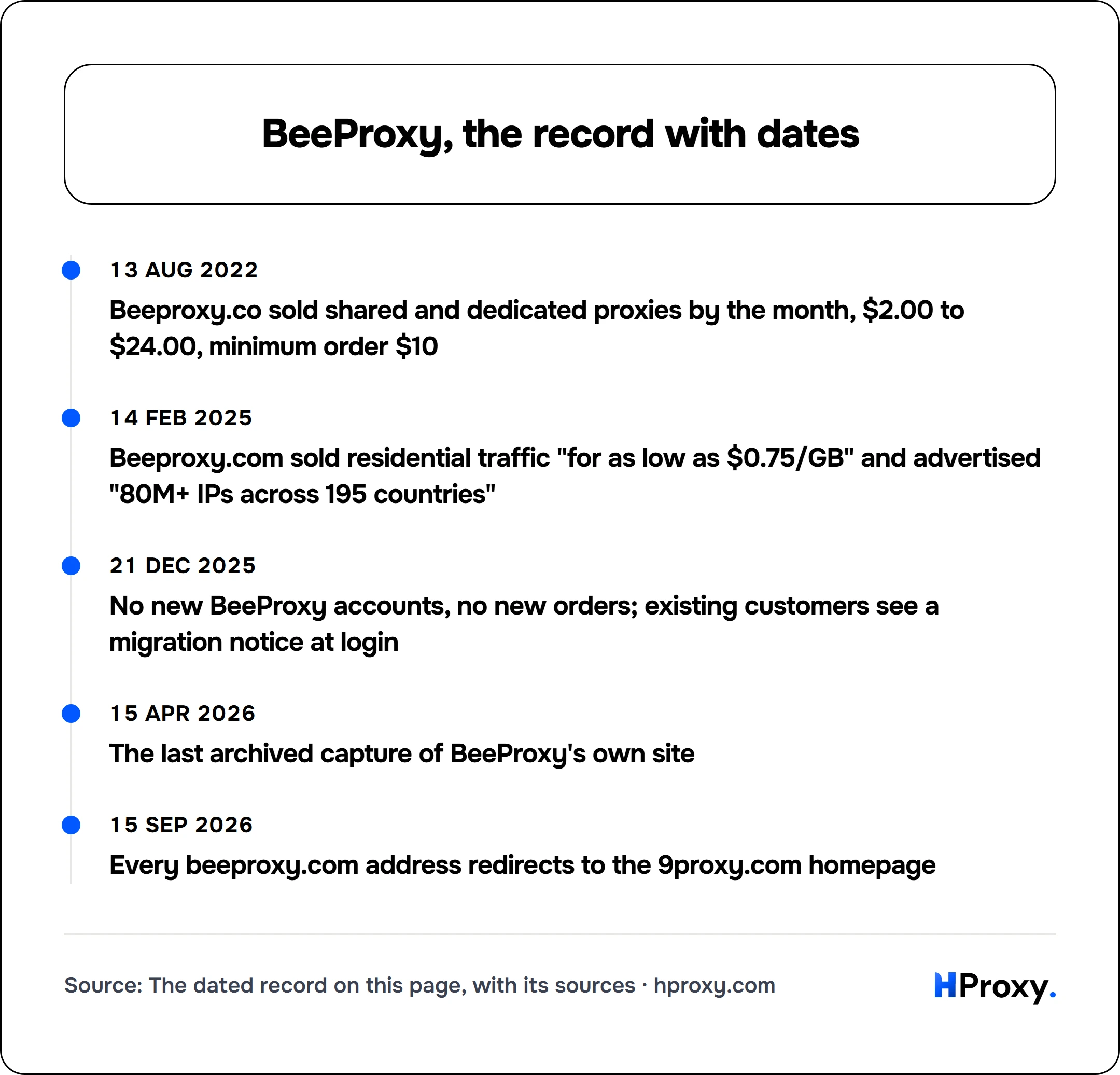
The record, with dates
| date | what the name was doing |
|---|---|
| 13 August 2022 | beeproxy.co sold shared and dedicated proxies by the month, $2.00 to $24.00, minimum order $10 |
| 14 February 2025 | beeproxy.com sold residential traffic "for as low as $0.75/GB" and advertised "80M+ IPs across 195 countries" |
| 21 December 2025 | no new BeeProxy accounts, no new orders; existing customers see a migration notice at login |
| 15 April 2026 | the last archived capture of BeeProxy's own site |
| 15 September 2026 | every beeproxy.com address redirects to the 9proxy.com homepage |
13 Aug 2022
Beeproxy.co sold shared and dedicated proxies by the month, $2.00 to $24.00, minimum order $10
14 Feb 2025
Beeproxy.com sold residential traffic "for as low as $0.75/GB" and advertised "80M+ IPs across 195 countries"
21 Dec 2025
No new BeeProxy accounts, no new orders; existing customers see a migration notice at login
15 Apr 2026
The last archived capture of BeeProxy's own site
15 Sep 2026
Every beeproxy.com address redirects to the 9proxy.com homepage
Sources: the Internet Archive captures named above, read 15 September 2026, and 9Proxy's migration guide, archived 12 December 2025.
What the merge moved
9Proxy's migration guide is the only account of the merge we can read. Its own words: "We're excited to announce that BeeProxy is officially merging into 9Proxy." It lists what transfers: the account identity, remaining balances and active resources such as valid IPs, remaining traffic and active packages, and unused share codes with their original expiry. It adds: "Nothing from BeeProxy is deleted during the merge."
The move starts inside the old account. A customer logs in to BeeProxy, sees the notice, and clicks through. Where the same email already exists on 9Proxy, the two are joined instead of a new account being created.
One gap is worth stating. 9Proxy's own announcement post about the merger answered a Cloudflare error on 15 and 16 September 2026, and no archived copy exists, so the announcement date that other pages print could not be checked here.
What BeeProxy sold, and what a customer said
Its last archived homepage advertised residential proxies "for as low as $0.75/GB", "80M+ Residential IPs", coverage of 195 countries and "99.99% Uptime". Support ran over email and a Telegram channel.
Against that, the only first-hand account on the public record is a single Trustpilot review from 23 May 2025, rated one star. It reports the opposite of the pool claim: "The pool size is not as significant as they claim, barely one singular ip in each isp category." The same reviewer describes daily dashboard and login failures, a plan that was revoked, and DNS leaking on most connections.
One review is one customer, and we did not measure the network ourselves. It is here because it is the only customer voice that exists for this brand.
Where the name lives today
The name did not vanish with the site. 9Proxy's pricing page, read on 16 September 2026, carries the banner "2X SAVINGS: Pay only $0.75/GB with BEEPROXY, Our Trusted Partner!" and a second line crediting "BEEPROXY's 99.99% UPTIME". The same page prints $0.018 per IP for its address-based plans.
So the rate a BeeProxy buyer knew is still on sale, under the same name, on the site the redirect lands on.
The alternatives at that rate
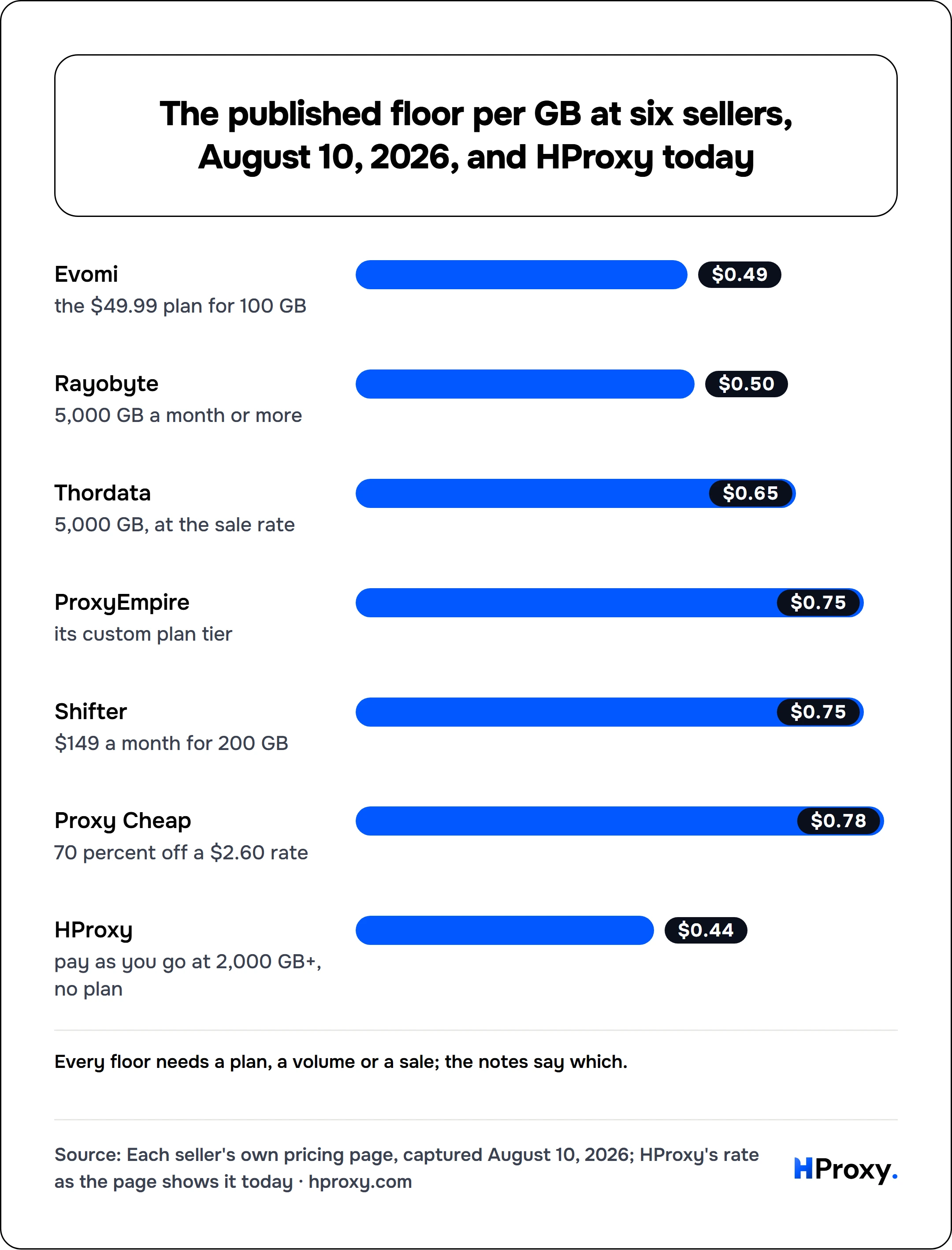
Every figure below comes from the vendor's own pricing page, captured on 10 August 2026, together with what the floor actually requires. A rate you cannot reach is not a price.
| provider | published floor | what the floor needs |
|---|---|---|
| Evomi | $0.49 a gigabyte | the $49.99 plan for 100 GB; overage is the same rate |
| Rayobyte | $0.50 a gigabyte | the Enterprise band, 5,000 GB a month or more; their entry plan is $3.50 |
| Thordata | $0.65 a gigabyte | 5,000 GB, at the sale rate |
| ProxyEmpire | $0.75 a gigabyte | their custom plan tier |
| Shifter | $0.75 a gigabyte | $149 a month for 200 GB |
| Proxy Cheap | $0.78 a gigabyte | 70 percent off a $2.60 rate, tiers not published |
| HProxy | $0.44/GB | pay as you go, no plan and no commitment |
What the name bought then, and what it buys now
| BeeProxy's own site, 14 February 2025 | 9proxy.com, 16 September 2026 | |
|---|---|---|
| residential rate | "for as low as $0.75/GB" | "$0.75/GB with BEEPROXY", and $0.68/GB elsewhere on the page |
| pool claim | "80M+ Residential IPs" | not stated under the BeeProxy name |
| countries | 195 | not stated under the BeeProxy name |
| uptime claim | "99.99% Uptime" | "BEEPROXY's 99.99% UPTIME" |
| sold by the address | not offered | $0.018 per IP |
| support | email and a Telegram channel | 9Proxy's own channels |
The headline rate survived the merge intact. The pool and country claims did not come with it: the 9proxy.com pricing page we read on 16 September 2026 does not repeat them.
Before you commit
Log in at 9Proxy first and read what your migrated balance actually says. Until you know whether your traffic and your active packages came across, you are not choosing a replacement, only comparing one. Then buy the smallest amount any candidate sells and put your own job through it, because the advertised rate is not the price; what you spent divided by the requests that came back correct is.
The limits of this record
We cannot say whether BeeProxy and 9Proxy share owners, what the pool really held, or whether one particular account's balance survived its migration. The customer evidence is a single review. 9Proxy's announcement post could not be read on either of our checks.
Prices, banners and redirects all move. Every figure here carries the day it was read, beeproxy.com's registration runs to 2 May 2027, and this page is due for a check by 16 December 2026 or sooner if the redirect stops.
Sources
- 9Proxy, "BeeProxy to 9Proxy Migration Guide", docs.9proxy.com, archived 12 December 2025 and 19 April 2026. Read 15 September 2026.
- Internet Archive, captures of beeproxy.com from 14 February 2025 and 15 April 2026, and of beeproxy.co from 13 August 2022. Read 15 September 2026.
- Internet Archive, capture index for beeproxy.com. Read 15 September 2026.
- Verisign, registry records for beeproxy.com and 9proxy.com. Read 15 September 2026.
- 9Proxy pricing page. Read 16 September 2026.
- Trustpilot, review page for beeproxy.com, single review dated 23 May 2025. Read 16 September 2026.
- HProxy, our own check of every beeproxy.com address, 15 September 2026, and vendor pricing pages captured 10 August 2026.