A comparison written by a competitor is worth reading only if it says where the competitor loses. That rule shapes this page about TND, and the last section names the reader who should stay put.
What we can and cannot tell you about TND
The company behind the name sits at tnd.vn. We carry them as a proxy provider.
A price is missing here on purpose. We have not captured a sourced rate for TND recently enough to publish one, and a stale number in this market is a wrong number.
Copy down the entry rate, the commitment attached to the cheapest rate, the minimum top-up and the expiry rule. Those four turn a marketing figure into something you can compare.
What TND says about itself today
On 9 September 2026 their homepage carried the title "TND - Cloud VPS, Bản Quyền Microsoft, Hosting, Proxy, Email". In the description they hand to search engines: "TND dịch vụ Cloud VPS, Hosting, Proxy, VPN. Cung cấp bản quyền phần mềm Microsoft, Adobe, Kaspersky và Email Google Workspace, đầy đủ hóa đơn VAT."
Reading the same page for the things buyers actually ask about:
The product lines named on that page are IPv6. Support is advertised as around the clock. We found no separate pricing page linked from the homepage, which usually means the price arrives by quotation.
Nothing there has been tested. It is a record of what the page said on the day, which is the honest limit of what a page like this can offer without a measurement.
What the advertised numbers cannot tell you
Who else is using your address
A shared address arrives with a history you did not create and cannot see. For read-only work it rarely matters. For anything that keeps a session, it is the most common cause of unexplained failure.
The line item hidden in the success rate
Some vendors bill every request, some bill only successful ones, and the difference is the whole comparison once a target starts blocking. A cheap rate with a fifty percent success rate is twice its advertised price.
What actually caps your throughput
Rate limits are often enforced per account rather than per plan, which means buying more traffic does not raise them. Confirm how yours scales before you assume a bigger plan runs faster.
What separates them, in a table
The rows below are the ones that change what you pay and whether the job runs:
| Question to ask | TND | HProxy |
|---|---|---|
| Entry price | Not verified by us, read their page | From $0.44/GB, pay as you go |
| Does unused balance expire? | Worth confirming in writing before you commit | Never |
| Minimum commitment | Their terms page answers this | None |
| Identity checks | Check the current terms, this one moves | Card orders are screened, and verification is sometimes requested |
| Targeting | Their terms page answers this | Country, city and ISP |
| Free way to evaluate | Check the current terms, this one moves | Free proxy list and proxy checker |
Nothing in that table settles the decision on its own. It narrows the field to two or three, and then measurement finishes the job.
A test worth more than this comparison
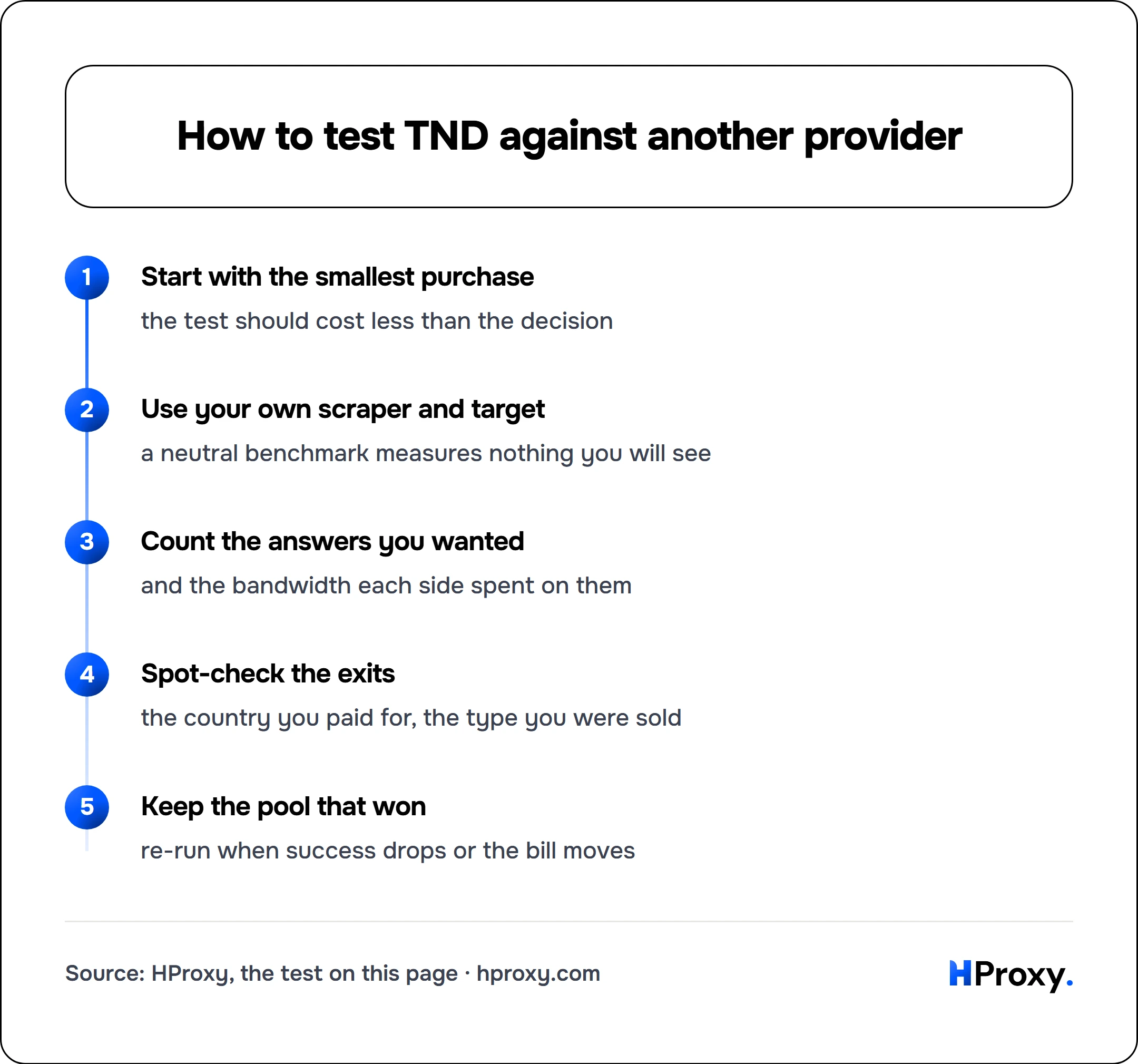
Do this once and you will never need a comparison page for this decision again.
- Start with the smallest purchase each vendor allows, so the test costs less than the decision it replaces.
- Use your own scraper and your own target. A benchmark against a neutral site measures nothing you will experience.
- Count how many requests returned what you wanted, and how much bandwidth each side spent doing it.
- Spot-check the exits. Confirm they are in the country you paid for and the connection type you were sold.
- Keep whichever pool won on your job. Re-run this whenever success rate drops or the bill moves.
Start with the smallest purchase
the test should cost less than the decision
Use your own scraper and target
a neutral benchmark measures nothing you will see
Count the answers you wanted
and the bandwidth each side spent on them
Spot-check the exits
the country you paid for, the type you were sold
Keep the pool that won
re-run when success drops or the bill moves
Who else is in this bracket
The same treatment, applied to the providers most often weighed against this one:
- LiveProxies alternatives
- Localproxies alternatives
- Localtonet alternatives
- Ltesocks alternatives
- Luminati Networks alternatives
- Lumiproxy alternatives
The competing offer, for completeness
We are the pay as you go option in this market. Residential from $0.44 per GB, ISP and datacenter per address, mobile alongside them, all from one balance with nothing to forfeit. That model wins on irregular volume and loses on very large steady volume, which is worth knowing before you test.