LocalProxies (localproxies.com) sells residential proxies by the month, in two families: sticky Ports from $50 and rotating Threads from $120. In the archived copies of its homepage we read, from August 2020 to 11 July 2026, each plan came with "Unlimited Bandwidth". Its new site, with a pricing article dated 5 August 2026, keeps every price and attaches a monthly allowance: about 17 GB to the $50 port, which works out at $3.00 a GB. Its terms name LocalProxies Inc., a Delaware corporation. Bought as 100 GB in one month, its traffic cost $267 on 14 October 2026; DataImpulse charged $100 for the same amount.
What LocalProxies sells
Both plan families run through one gateway, gate.localproxies.com. A sticky port keeps its IP for "10 minutes or more" and reaches every location it sells, "including US, CA, GB, EU". A rotating thread takes a new IP on every connection, from an "International mix (excludes US, CA, GB, EU, AU, NZ)". A buyer who needs American, British or European addresses has to take ports.
Every plan supports HTTPS and SOCKS5, login by whitelisted IP or by username and password, and targeting by country or by region, such as a US state. The FAQ describes the addresses as "Primarily IPv4, with IPv6 available on request". Plans are "monthly subscriptions only" and renew until cancelled.
Access goes through a review. Each new account is checked by its team, "typically within 24 hours", and some must pass identity checks (KYC for people, KYB for businesses) through an outside provider. The free 12-hour trial needs no card and is "Available to approved accounts". The values page adds "AI agents are our primary users." and calls the company "a small team".
Same prices, now metered
Set against the last archived copy of the old homepage, the live plan list differs in one column:
| Plan | 11 July 2026 | 14 October 2026 |
|---|---|---|
| 1 port | $50, unlimited | $50, about 17 GB |
| 3 ports | $132, unlimited | $132, 50 GB |
| 10 ports | $400, unlimited | $400, about 167 GB |
| 50 ports | $1,750, unlimited | $1,750, about 833 GB |
| 40 threads | $120, unlimited | $120, 40 GB |
| 650 threads | $1,365, unlimited | $1,365, 650 GB |
All fourteen plans, seven of each family, kept their monthly price to the dollar. The allowance follows a fixed rule: every port carries 16.7 GB, from the single port to the fifty-port plan, and every thread 1 GB. The price per gigabyte falls from $3.00 to $2.10 only because the plan discount grows from 0 to 30%. The number of IPs a customer may whitelist fell from "Unlimited" to 4 on the smallest plans and 25 on the largest.
For six years the homepage set LocalProxies against "regular proxy services" in a table. In its last archived version those services were "Billed per each used GB" and allowed "Only a couple IPs" for authorization. The pricing article that came with the new site, "How LocalProxies Pricing Works", opens its short version with "you pay for bandwidth".
In use, about 17 GB a month comes to roughly 550 MB a day. Traffic beyond the allowance is sold as top-ups: $30 for 10 GB, $135 for 50 GB, $255 for 100 GB and $2,100 for 1 TB, the same $3.00 to $2.10 range as the plans. The FAQ says of top-ups that "any unused GB roll over to the following months and never expire". It says nothing of the kind about the allowance inside a plan.
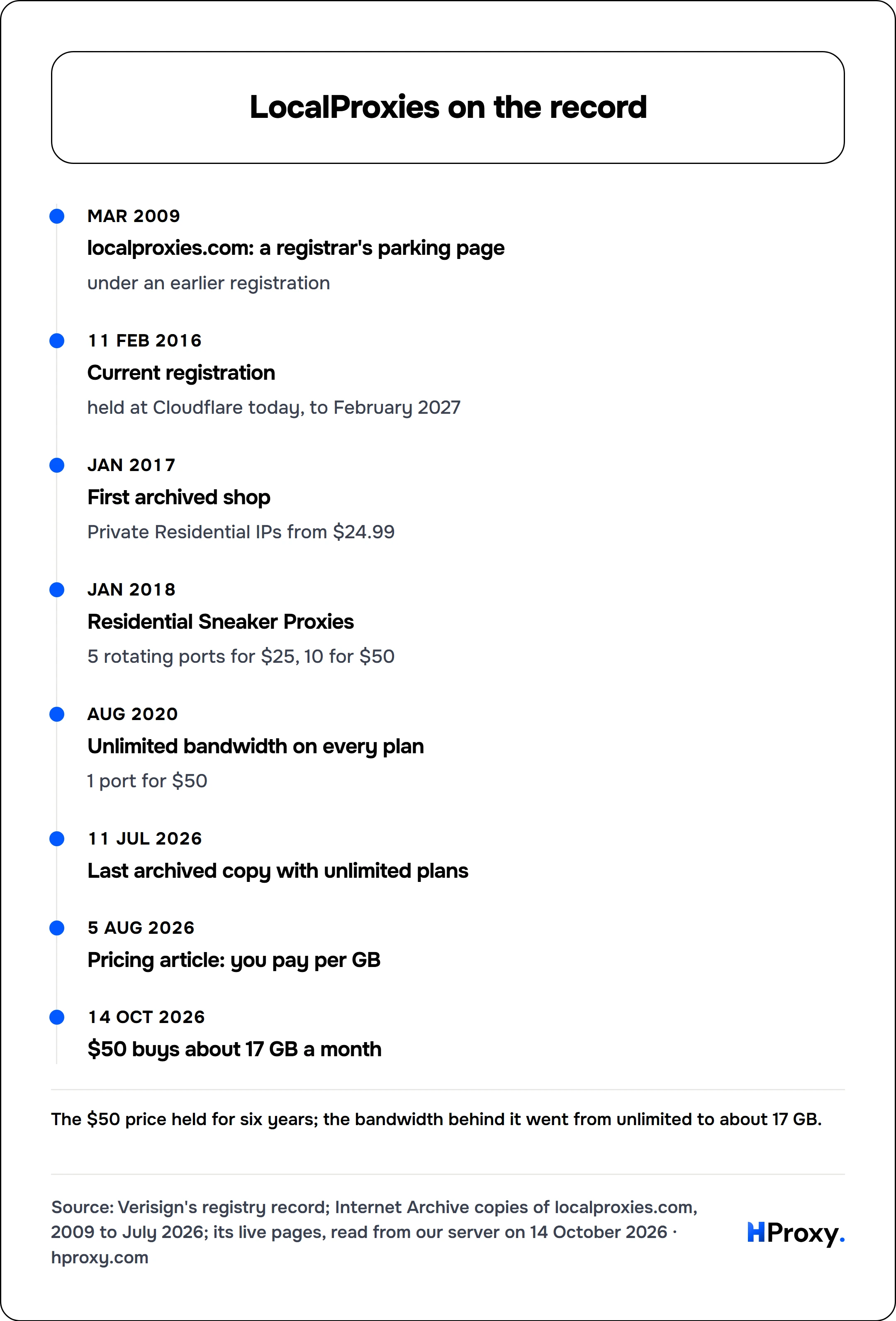
Mar 2009
localproxies.com: a registrar's parking page
under an earlier registration
11 Feb 2016
Current registration
held at Cloudflare today, to February 2027
Jan 2017
First archived shop
Private Residential IPs from $24.99
Jan 2018
Residential Sneaker Proxies
5 rotating ports for $25, 10 for $50
Aug 2020
Unlimited bandwidth on every plan
1 port for $50
11 Jul 2026
Last archived copy with unlimited plans
5 Aug 2026
Pricing article: you pay per GB
14 Oct 2026
$50 buys about 17 GB a month
The fine print
Refunds within seven days, on three conditions. The refund policy, effective 9 September 2025, requires all three. The request must come "within 7 calendar days of the original purchase date". The buyer must have used "less than 10% of your allocated bandwidth or session quota". And the reason must be "based on a technical issue or billing error that could not be resolved by our support team". On the single port, 10% is about 1.7 GB. The policy excludes "Dissatisfaction due to personal expectations unrelated to service availability or performance".
Chargebacks. "Filing a chargeback without first contacting our support team will be treated as a violation of our terms", the policy says, and names suspension and blacklisting among the possible results.
Two clauses that touch scraping. Section 2 of the terms lists what a customer may not do. Two items sit awkwardly with a service sold for scraping and AI agents: "Access the Services using automated means without our written permission" and "Use the Services for commercial purposes without a separate agreement". A business that runs automated jobs through LocalProxies should ask for that permission in writing before it pays.
Payments and logs. Payments go through FastSpring, which the refund policy calls "our authorized payment processor". The FAQ says the company keeps connection metadata, such as timestamps, bandwidth and the assigned IP, "for a maximum of 7 days".
No reselling. The values page rules out reselling and white-labeling of its service.
Who runs LocalProxies
The terms open with "LocalProxies is a service operated by LocalProxies Inc." and give a registered office at 1007 N Orange St., 4th Floor, Ste 5417, Wilmington, Delaware. Disputes go to the courts of Delaware under Delaware law. OpenCorporates lists LOCALPROXIES INC. as a Delaware domestic corporation, company number 10510771, with FIRSTBASE AGENT LLC as its registered agent at 1007 N Orange St. in Wilmington: the building of the terms' address, with another suite number. Its incorporation date and its officer are shown there only to logged-in users, and we did not log in.
The old site named no company. Its footer in July 2026 read "© Copyright 2025 www.localproxies.com".
The domain is older than the shop. The Internet Archive's copies of March 2009 and March 2016 show a Namecheap page announcing the name as registered. The current registration dates from 11 February 2016 and runs to 11 February 2027, now with Cloudflare as registrar. The first archived shop is from January 2017; the new site's page data gives 1 January 2018 as the founding date.
How it compares
The cheapest way to 100 GB in a month at LocalProxies is its 3-port plan, $132 for 50 GB, plus a 50 GB top-up at $135. That makes $267, or $2.67 a GB. Its rotating plans cost more for the same traffic and leave out the US, Canada, the UK, the EU, Australia and New Zealand.
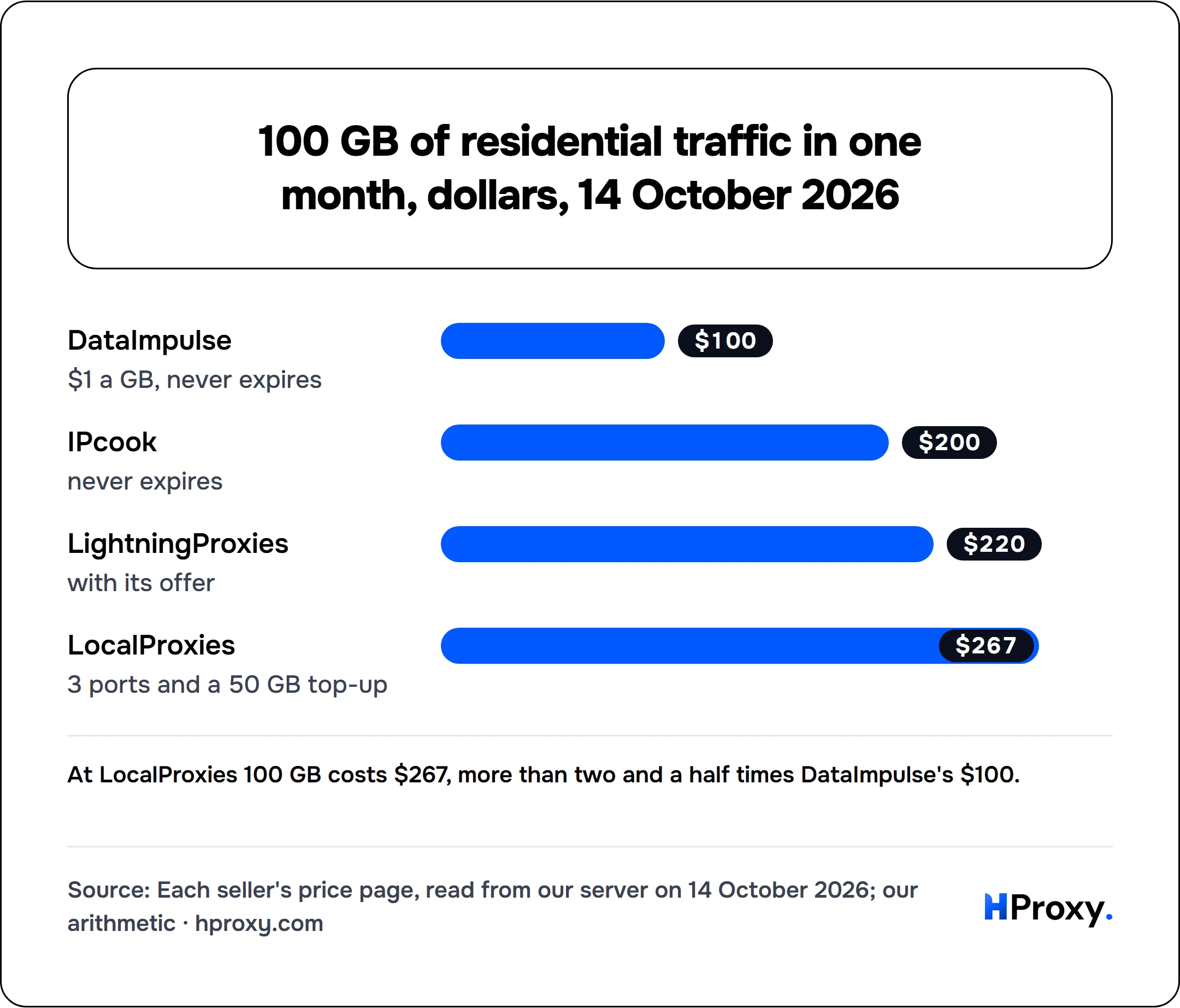
DataImpulse charged $1 a GB the same day, at every size, with traffic that never expires. IPcook charged $200 for 100 GB and LightningProxies $220. For a first test, LocalProxies' smallest purchase is $50 for a month, while IPcook sells a single gigabyte for $3.20 and Webshare 1 GB a month for $3.50.
What LocalProxies offers for the difference: a sticky IP it guarantees for 10 minutes, an account reviewed by a person, and support it advertises as human and around the clock. Whether that is worth $167 more per 100 GB depends on the job.
Where HProxy fits
We sell residential traffic as well, $0.50 per GB, with no monthly plan and a balance that never expires. Our company, Obsidian UG (haftungsbeschränkt), is named in our terms and can be looked up in the German commercial register. Before you rely on any seller's IPs, run a few of them through our free proxy checker.
Which one to pick
- LocalProxies if you need sticky IPs in the US, the UK or the EU that hold for 10 minutes or more. It suits traffic that stays near the plan's allowance, and buyers who want an account checked by a person.
- DataImpulse for traffic in any amount at a flat $1 a GB.
- IPcook once you buy 1,000 GB or more, where its price falls to $0.80 a GB.
- Any of them if you held an unlimited $50 port: measure last month's traffic first, because everything above about 17 GB now costs $2.10 to $3.00 a GB.
What we could not find out
How many connections one port allows. The pricing article says "Each port holds one concurrent connection". The FAQ gives the example of a port with "a limit of 50 threads", and the price table shows no thread count for ports. Whether ports bought before August 2026 kept their unlimited bandwidth. The day the plans changed, somewhere between 11 July and 5 August 2026; the Internet Archive holds no copy in between. The incorporation date of LocalProxies Inc. The size of its pool: the locations page grades countries in words such as Excellent, Good and Limited, and gives no counts. Nothing was bought and no LocalProxies proxy was tested, so speed and success rates are its own word. These pages are due for a fresh reading by 14 January 2027.
Sources
- localproxies.com: home, about, values, FAQ, free trial, legal index, terms of service, refund and KYC/KYB policies, contact, locations, the setup tutorial, the pricing article of 5 August 2026, its robots file and sitemap, read from our server on 14 October 2026.
- The Internet Archive's copies of localproxies.com from 2009 to 11 July 2026, among them the homepages of January 2017, January 2018, August 2020 and each month of 2026 up to July.
- The Verisign registry record of localproxies.com, read on 14 October 2026.
- OpenCorporates: the record of LOCALPROXIES INC., Delaware, number 10510771, read on 14 October 2026.
- The price pages of DataImpulse, IPcook, LightningProxies and Webshare, read from our server on 14 October 2026.
- HProxy's residential price: our live price table on 14 October 2026.