LocalToNet (localtonet.com) is a tunnelling service: it puts a website, game server or other service running on your own machine onto the internet without opening ports. It charges $2 a month per tunnel, with a free plan of one tunnel and 1 GB a month, and since 2025 it has also sold its tunnels as a way to turn Android phones into mobile proxies. The service began in late 2021 with plans at $5 and $8 a month, and its terms name no company. For tunnels, ngrok and Pinggy are the obvious comparisons; for phones used as proxies, iProxy and XProxy are. The two tables set them side by side.
What LocalToNet does
The home page lists HTTP, HTTPS, TCP and UDP tunnels, "Proxy Server" endpoints over HTTP and SOCKS, custom domains, request inspection, a web application firewall and team accounts. On 14 October 2026 its server map named Istanbul, Chicago, Madrid, Arezzo, Prague, Durham, São Paulo and Tokyo among its locations. Its 2021 page described the method plainly: "LocalToNet is a reverse proxy that enables you to expose your localhost to the internet."
The newer part is mobile. Under "Mobile Proxy Networks" the home page offers to "Turn Android phones into rotating mobile proxies. Perfect for geo-testing, ad verification, and data collection." Its Android app lets a phone "Share your mobile data IP as an HTTP/SOCKS proxy", and a "Wi‑Fi Split" option sends traffic over two paths to "Boost proxy throughput". The archived home page of January 2025 had no mention of phones, so the feature arrived between then and October 2026.
What it costs, and how the plans changed
| when | free plan | paid plan |
|---|---|---|
| November 2021 | 1 tunnel, unlimited bandwidth | Basic $5 a month (16 tunnels), Pro $8 (33) |
| January 2023 | "Free for non-commercial", 1 GB | monthly or yearly plans |
| January 2025 | 1 tunnel, 1 GB | pay-as-you-go |
| October 2026 | 1 tunnel, 1 GB a month, 30-minute timeout | $2 a month per tunnel, unlimited bandwidth |
The free plan has narrowed: unlimited bandwidth in 2021, 1 GB by 2023, and by October 2026 a 30-minute timeout on its single tunnel. The paid side moved from bundles to a price per tunnel, so two tunnels now cost $4 a month, where in 2021 $5 bought sixteen. The paid tier carries "Unlimited Tunnels", "Unlimited Bandwidth" and "No Tunnel Timeout".
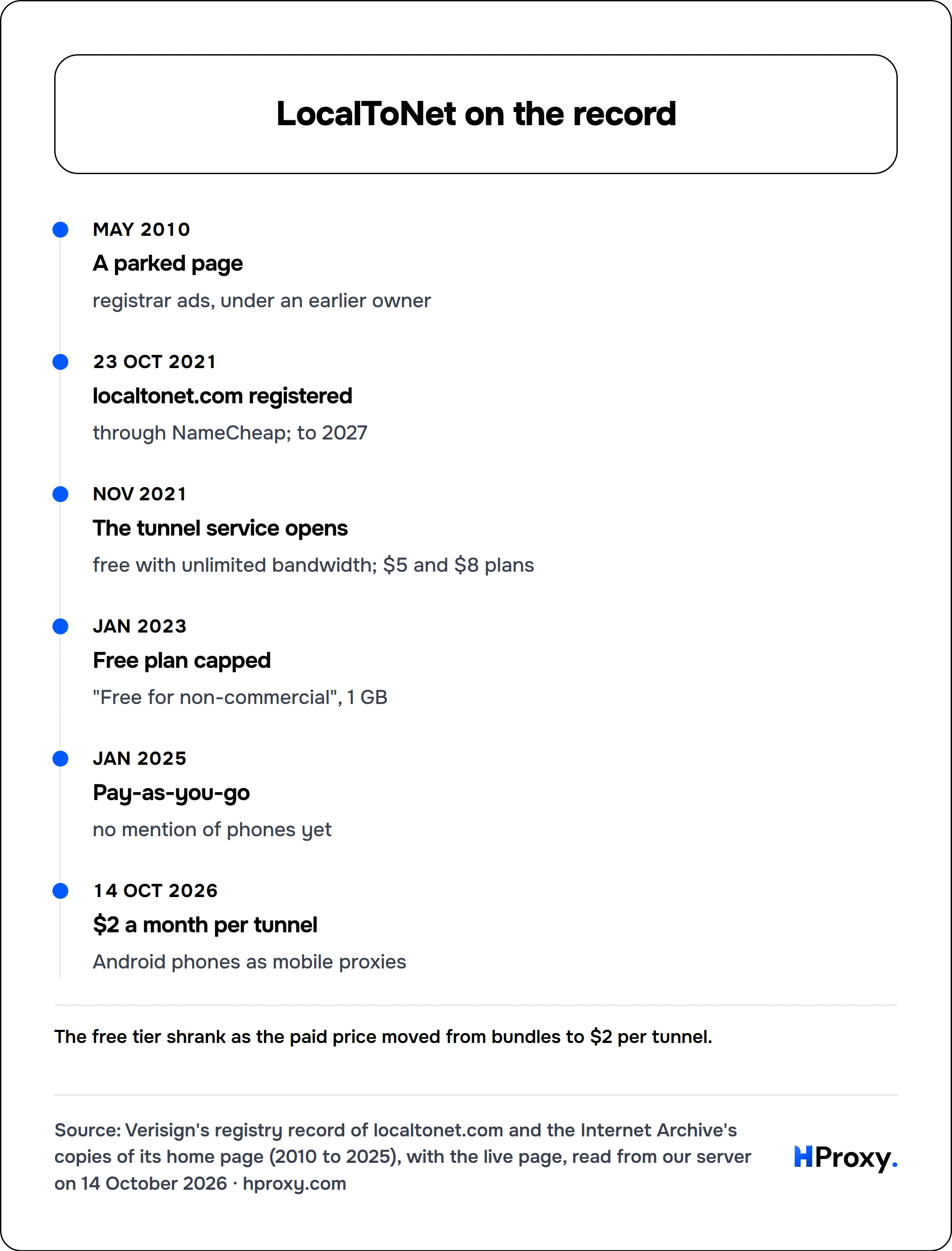
May 2010
A parked page
registrar ads, under an earlier owner
23 Oct 2021
localtonet.com registered
through NameCheap; to 2027
Nov 2021
The tunnel service opens
free with unlimited bandwidth; $5 and $8 plans
Jan 2023
Free plan capped
"Free for non-commercial", 1 GB
Jan 2025
Pay-as-you-go
no mention of phones yet
14 Oct 2026
$2 a month per tunnel
Android phones as mobile proxies
Phones as proxies: LocalToNet against phone-proxy software
Turning your own phone into a proxy needs software on the phone and a way in from the internet. LocalToNet sells the second as one tunnel per phone. Two dedicated products cover the same ground: iProxy, built for Android phones, and XProxy, built for USB modems, whose Premium plan adds "Make proxies from Android Phone".
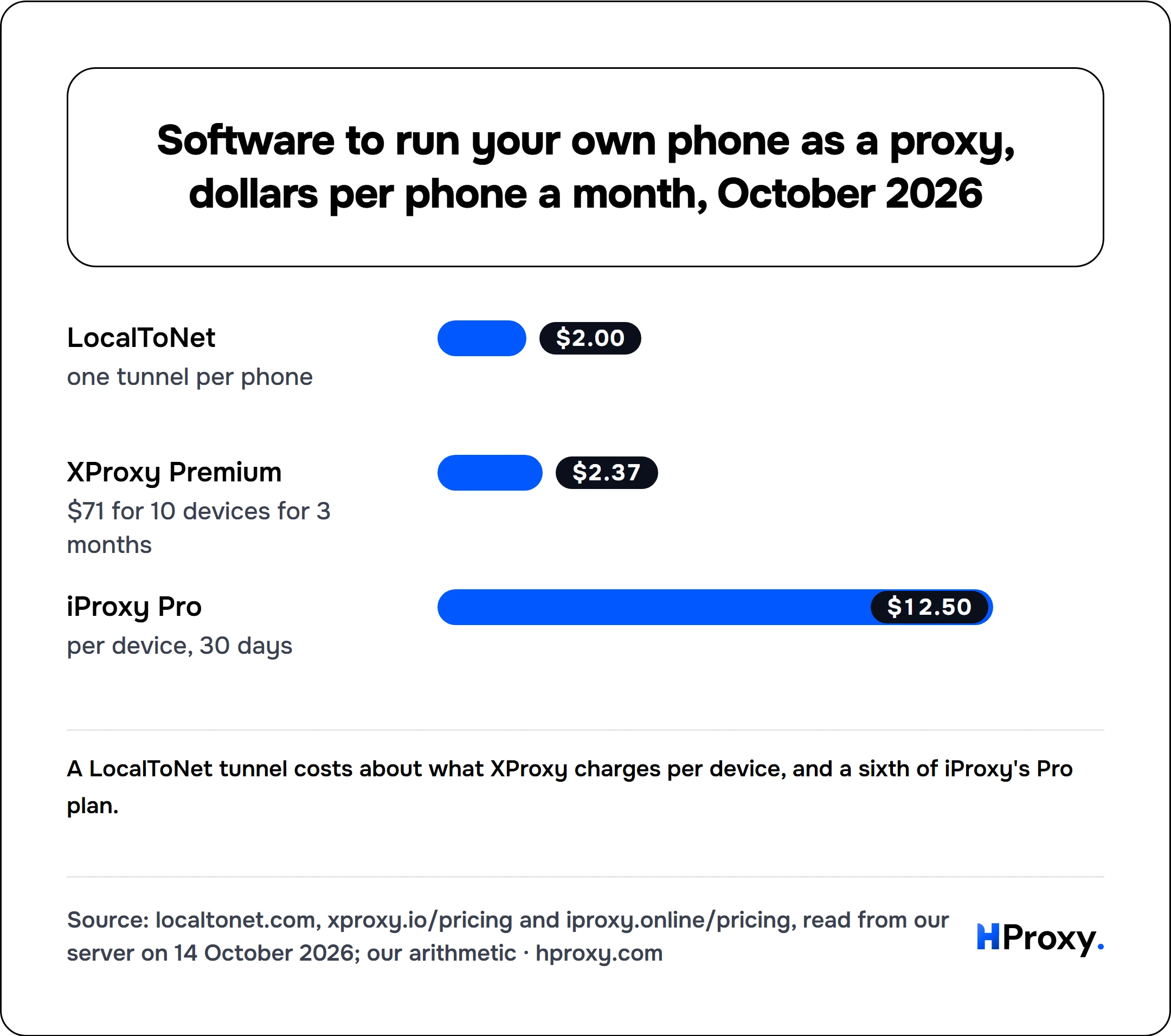
The prices cover software only. The phone, the SIM card and its data plan are yours to pay for, and a mobile operator's terms may not allow its connection to be resold. Our XProxy comparison works through the cost of building such a farm against buying mobile traffic.
Tunnels: LocalToNet against ngrok and Pinggy
| service | free plan | paid plan |
|---|---|---|
| LocalToNet | 1 tunnel, 1 GB a month, 30-minute timeout | $2 a month per tunnel, unlimited bandwidth |
| ngrok | 3 online endpoints, up to 1 GB, a warning page | Hobbyist $10 a month (5 GB); Pay-as-you-go from $20 |
| Pinggy | free tunnels with a URL that changes on reconnect | Pro: persistent URLs, 7-day free trial |
ngrok's free plan comes with "$5 of one-time included usage" and puts an "Interstitial page" in front of HTTP endpoints; Hobbyist removes it and includes "$10 of monthly included usage". Its Pay-as-you-go plan starts at "$20 of monthly included usage", with unlimited endpoints and extra transfer billed on top. Pinggy's free tunnels change their public URL when they reconnect, and its page offers "Pinggy Pro for persistent URLs" with a free trial; its prices are drawn by script, so we could not read them.
The fine print
Refunds within a day. "Refund requests must be submitted within the first 24 hours. Requests after this period will not be accepted."
Prices can move. The terms let LocalToNet "change fees with 30 days' notice", and add: "You are responsible for canceling your account."
No company named. The terms say the service "is owned and operated by LocalToNet". The contact page offers a form and a support address, and no page we read gives a company name, a country or a postal address.
Where HProxy fits
We sell proxies, and no tunnels. If the reason to look at LocalToNet is a mobile IP, our rotating mobile proxies cost $1.50/GB, targeted by country, with no phone or SIM card of your own. Residential traffic costs $0.50 per GB with no plan. For a tunnel to your own server, the services above are the right tools.
Which one to pick
- LocalToNet for a cheap tunnel with unlimited bandwidth at $2 a month, or to share your own phone's connection.
- ngrok for a tunnel with a free tier of 3 endpoints and billing by the data you move.
- Pinggy for a quick free tunnel when a changing URL does not matter.
- iProxy or XProxy to run phones or modems as proxies with dedicated software.
- Mobile proxy traffic from a seller when you need mobile IPs and no hardware.
What we could not find out
We do not know who runs LocalToNet: its terms name only the brand, and its pages give no country. We could not read Pinggy's prices, which load by script. We did not install any of these tools or run a tunnel. The free plan's 1 GB and the paid plan's unlimited bandwidth are LocalToNet's own terms, and we did not measure either. Our next check of LocalToNet is due by 14 January 2027.
Sources
- localtonet.com: home page, terms and contact page, its robots file and sitemap, read from our server on 14 October 2026.
- localtonet.com in the Internet Archive: home pages of May 2010, November 2021, January 2023 and January 2025.
- Verisign's registry record of localtonet.com, 14 October 2026.
- ngrok's price page, Pinggy's home page, and the price pages of XProxy and iProxy, read from our server on 14 October 2026.
- Our own prices, from HProxy's live price table.