Topic Explainers
What Is a Rotating Proxy? How One Endpoint Becomes Thousands of IPs
What is a rotating proxy? One gateway address that exits through a different IP on a schedule you control. How backconnect rotation works, what it defeats, and when it is the wrong tool.
What Is an ASN? The Number That Tells Websites Who Owns Your IP
An ASN identifies the network that owns a block of IP addresses. What an Autonomous System is, how ASNs are assigned, and why anti-bot systems check yours before anything else.
What Is an ISP Proxy? Static Residential IPs Explained
What is an ISP proxy? A static residential IP with a consumer ISP's reputation and a datacenter's speed. How it works, why logins survive on it, and what it costs.
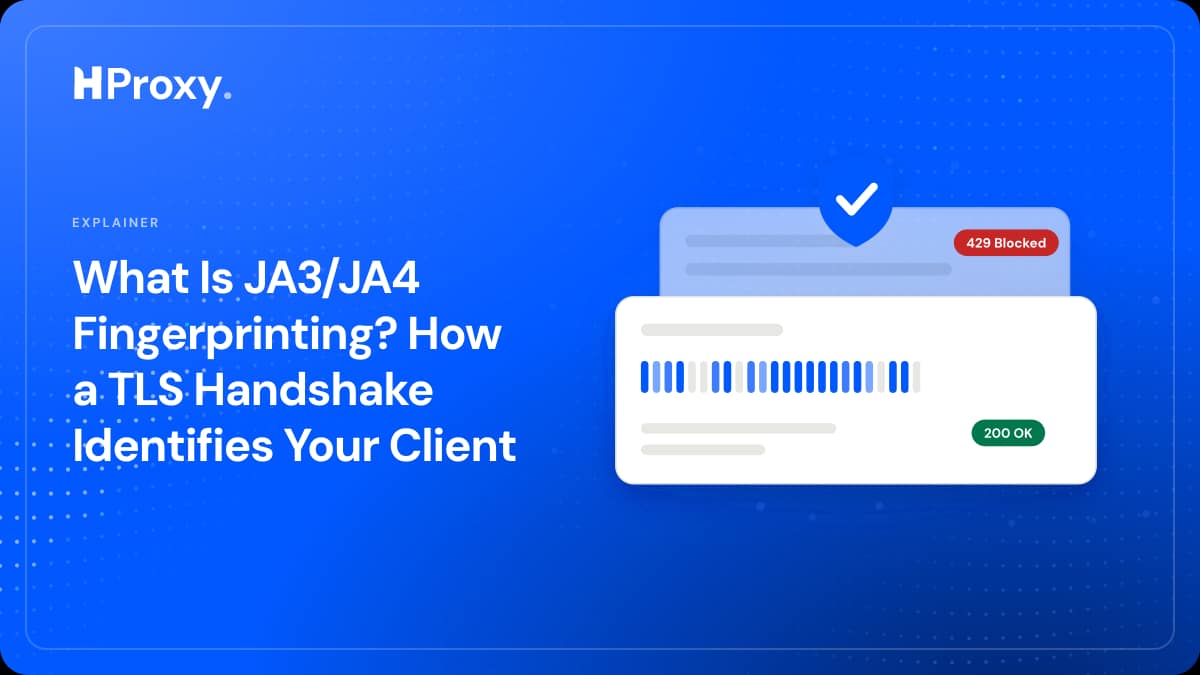
What Is JA3/JA4 Fingerprinting? How a TLS Handshake Identifies Your Client
JA3 and JA4 turn your TLS ClientHello into a fingerprint that names the software behind a connection. How the hash is built, why a proxy does not change it, and how to survive it.
Free Online Proxy Site: Instant Browsing, Nothing to Download
A free online proxy site unblocks pages in your browser with nothing to install. How web proxies work, what they do well, and where they quietly fail.
Unblock Proxy: How to Reach Any Blocked Site for Free (2026)
An unblock proxy fetches a blocked site through another server so the page loads. How each method works, why blocks return, and the safer options.
Free Proxy vs VPN vs Residential Proxy: A Plain-English Guide
Free proxy vs VPN explained without fluff: what each hides, real speed and trust differences, cost, and where a residential proxy beats both for your use case.
Datacenter vs Residential Proxies: Which to Use
Datacenter vs residential proxies: what separates cheap server IPs from real home IPs, how each gets flagged, what they really cost, and which one to use.

HTTP vs SOCKS5 Proxy: Which Should You Use?
HTTP vs SOCKS5 proxy, explained without the marketing: what each protocol does, which layer it works at, how they handle DNS and speed, and which to use.
What Is a Mobile Proxy? 4G and 5G IPs Explained
What is a mobile proxy? A real 4G/5G carrier IP shared by thousands of phone users, so sites can barely block it. How mobile IPs work, rotate, and what they cost.
What Is a Residential Proxy? A Plain Explanation
What is a residential proxy? A real home IP that makes your traffic look like an ordinary person online. How it works, why sites trust it, and what it costs.
Free Web Proxy vs Free Proxy List: Which One Do You Actually Need?
A free web proxy loads one site in your browser with no setup. A free proxy list gives you ip:port entries you control in any tool. Here's which one you need.
Rotating vs Static Residential Proxies: Which One Your Job Actually Needs
The real difference between rotating and static residential proxies, how rotation works mechanically, where each one fails, and a decision guide by use case.
What Is a SOCKS5 Proxy? A Plain-English Guide With the Details Kept In
What is a SOCKS5 proxy? How the protocol works, what it does that HTTP proxies can't, remote DNS, UDP support, and when a SOCKS5 proxy is the right choice.
Showing 25 to 38 of 38
Proxies that don't die mid-job
Residential, ISP, datacenter and mobile, verified by the same engine that runs tens of millions of checks. They read as a real device and hold up under load. Pay as you go, and your balance never expires. $0.44/GB is the 2,000 GB+ rate; a single gigabyte is $0.50/GB, with no minimum order.
129M+ proxy checks run · 100+ countries · HTTP / HTTPS / SOCKS · re-checked every few minutes · no signup