Choosing a proxy provider on price alone is the most common and most expensive mistake in this market, because a cheap request that fails costs more than a dearer one that works. That framing runs through the whole page.
What we know about ProxyStore, and what we do not
You will find them at proxystore.net.
We have no verified current rate for ProxyStore on file. Printing a guess would make this page worse than useless, so the price row below is empty and the reading list is not.
Check the reachable rate, the minimum, the expiry terms and the failure billing, and date your note. A price without those four attached is not a price.
Their own description, read this week
The title tag on 9 September 2026 was "ProxyStore - Buy Premium Dedicated Proxies". The blurb under their search result reads: "Residential/ISP/Datacenter Proxies, HTTPS/SOCKS5, Country/City targeting, 99.9% Uptime. 24/7 Support! Explore the internet with no limits with our Proxies!"
Taken from the same page, on the same day:
The product lines named on that page are residential, datacenter, ISP or static residential and SOCKS5. They advertise 20 countries or locations. Payment methods mentioned: crypto and cards. The page offers some form of free trial. Support is advertised as around the clock. A refund or money-back term is mentioned. We found no separate pricing page linked from the homepage, which usually means the price arrives by quotation.
Every line above is a quotation from their marketing rather than a measurement by us. It is included because it is checkable, not because it is evidence of performance.
How far back the record goes
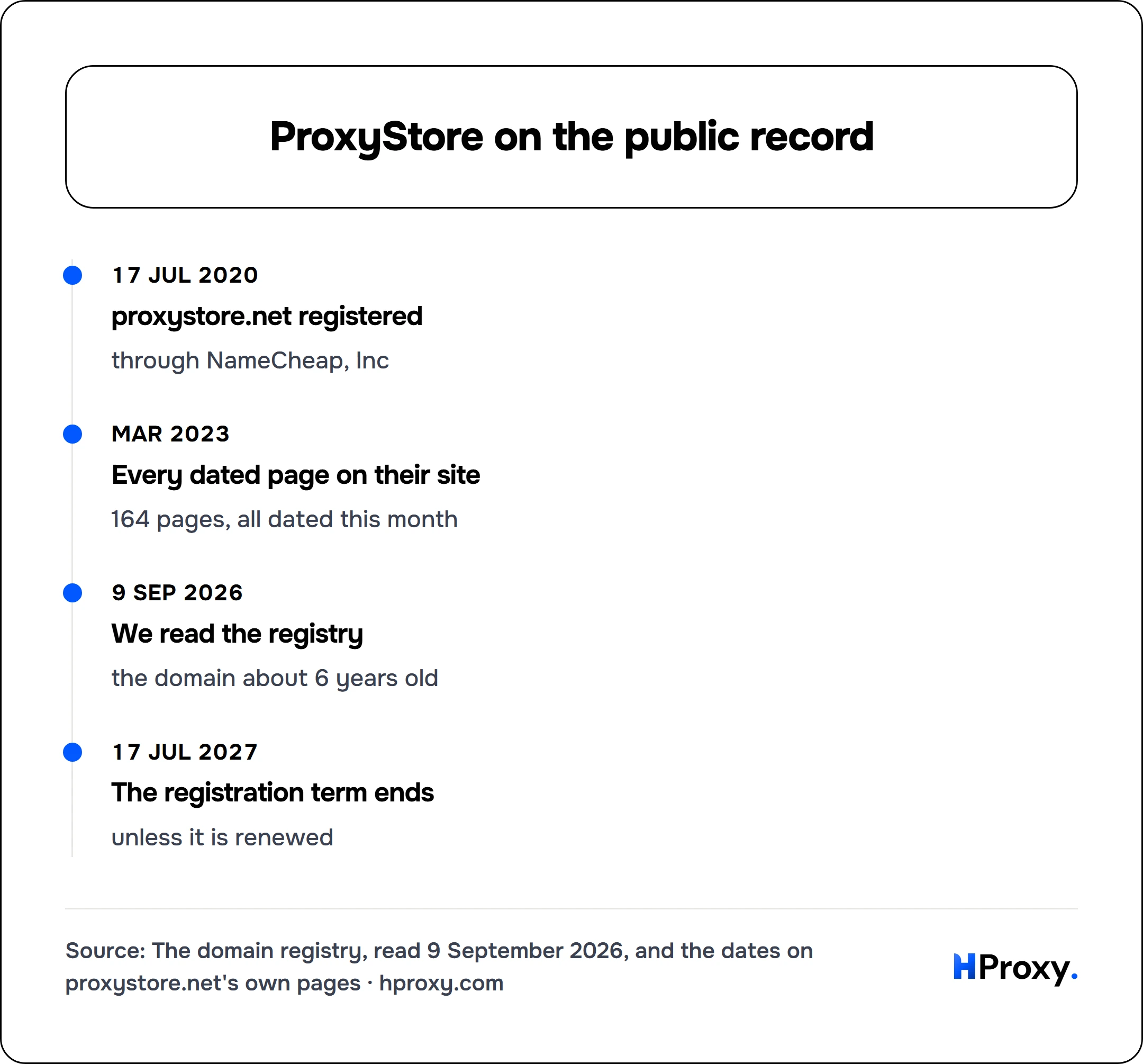
The domain was registered on 17 July 2020, through NameCheap, Inc, which makes it about 6 years old. We pulled that from the registry on 9 September 2026. The current registration term ends 17 July 2027.
17 Jul 2020
proxystore.net registered
through NameCheap, Inc
Mar 2023
Every dated page on their site
164 pages, all dated this month
9 Sep 2026
We read the registry
the domain about 6 years old
17 Jul 2027
The registration term ends
unless it is renewed
This proves nothing about the product. It is a cheap check against the one failure mode that costs buyers real money in this market, which is paying a provider that will not exist in six months.
How active ProxyStore still is
Our crawl of their site found 164 pages carrying a date. The oldest is from March 2023 and the newest from March 2023.
A site that has not been touched in a year is a signal, not a verdict. It can mean a stable product with nothing to announce, or a company that has stopped. The way to tell them apart is to ask them.
The questions behind the numbers
Why a cheap address is often a used one
An address you share carries the reputation of everyone else on it. That is acceptable for some work and fatal for anything involving a login. The price difference between shared and dedicated usually reflects exactly this.
What a blocked response costs you
On a hard target, failures are the majority of your traffic. Whether those failures are billed decides the real cost, and the clause covering it is rarely on the pricing page.
Concurrency limits decide throughput
A plan with generous traffic and a low thread limit is a slow plan. Find both numbers before you size anything, because the smaller of the two is your actual ceiling.
The comparison, honestly framed
Set the two side by side on the questions that decide the outcome, rather than on feature counts:
| Question to ask | ProxyStore | HProxy |
|---|---|---|
| Entry price | Not verified by us, read their page | From $0.44/GB, pay as you go |
| Does unused balance expire? | Not published clearly, ask before paying | Never |
| Minimum commitment | Worth confirming in writing before you commit | None |
| Identity checks | Read their current terms | Card orders are screened, and verification is sometimes requested |
| Targeting | Worth confirming in writing before you commit | Country, city and ISP |
| Free way to evaluate | Read their current terms | Free proxy list and proxy checker |
The useful part of that table is the left column. Take those six questions to any provider in this market and the answers will sort them faster than any review.
The measurement that outranks every review
This costs less than a coffee and produces the only evidence that applies to your workload.
- Put a few dollars on each account. Trials are fine for a first look, but paid traffic is what you will actually be buying.
- Run them against the site you actually care about, using the code you actually run, within the same hour.
- Record the success rate and the data consumed for the identical batch on each side.
- Check some of the addresses yourself for country, ASN and type before you trust the label on the plan.
- Choose on the measurement, not the marketing, and expect the answer to change within a year.
The rest of the shortlist
Buyers comparing this name usually have two or three of these open in other tabs:
- Lumiproxy alternatives
- LuxProxy alternatives
- LuxSocks alternatives
- luxurysocks.net alternatives
- Magneticproxy alternatives
Our own position
Residential starts at $0.44 per GB with country targeting, the balance never expires, there is no minimum commitment and no sales call, and city and ISP targeting come with Residential Premium from $1.00 per GB. We publish our free side openly, 129,131,311 verification checks and counting, because a network that is confident has no reason to fear measurement.