Free proxies are fine for jobs that are allowed to fail. Learning how a proxy works, testing your own software and looking at a public page from another country once all qualify. They are not fine for anything with a login, a payment, a stream, a game or a deadline. We measured where the line falls on 28 September 2026, with tests of working free proxies from our free proxy list.
This page covers what those tests showed, the jobs free proxies can do, the ones that burn you, and how to read a proxy list.
What our tests showed
Every test took working entries of our free pool from addresses that held fewer than 20 of them, and sent the same job through each of them from our server.
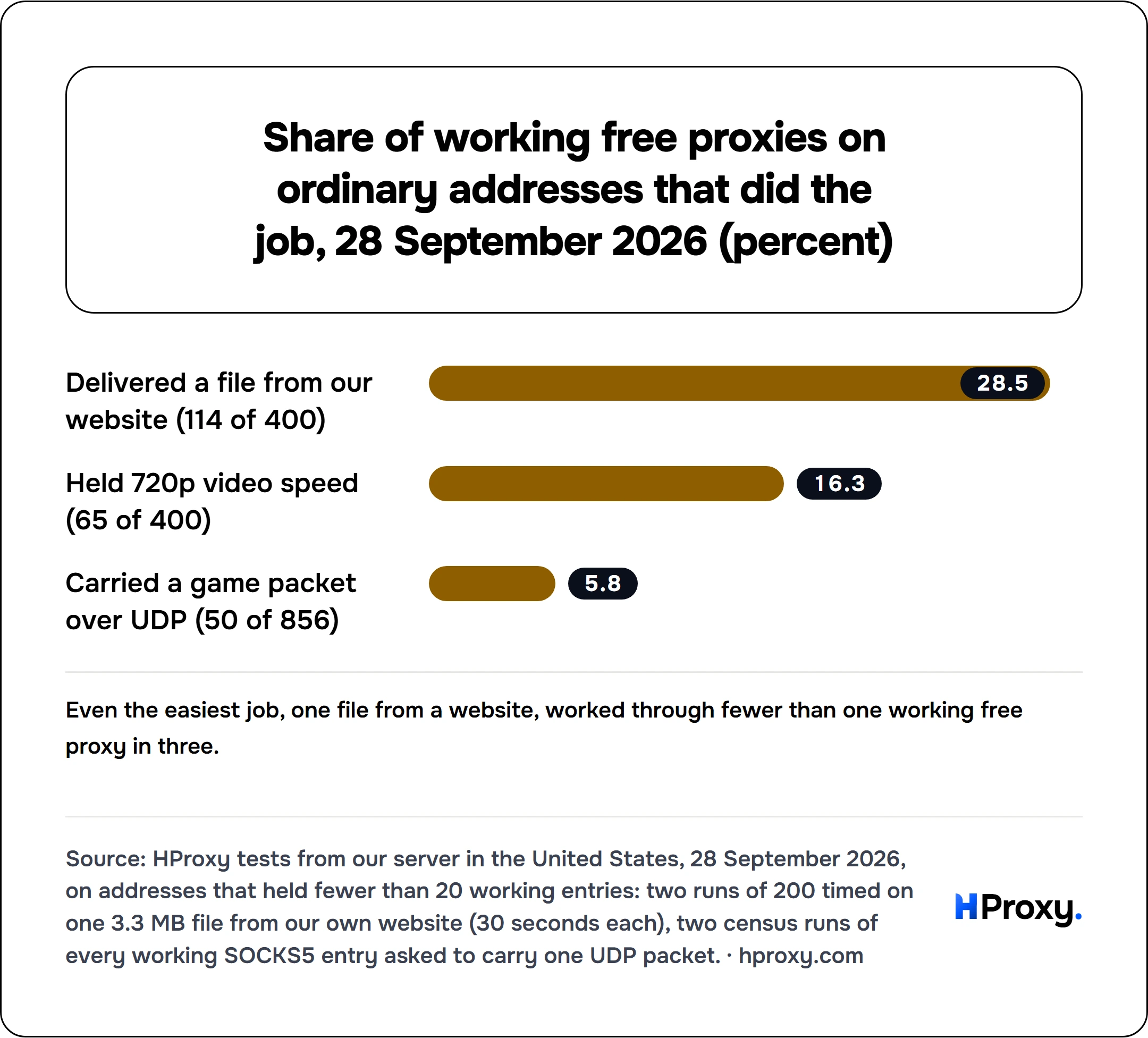
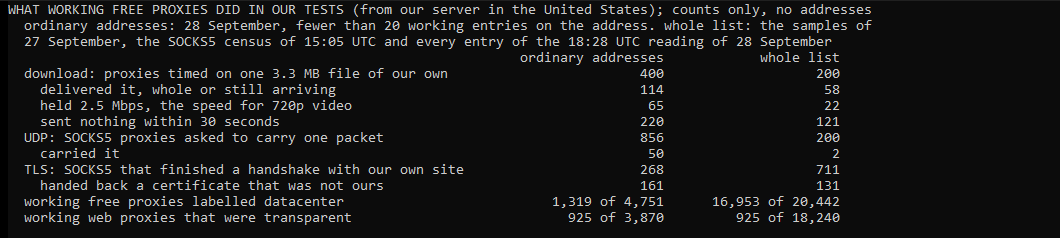
- Downloads. Two runs of 200 were timed on the same 3.3 MB file from our own website. 65 and 49 delivered it, at a median of 2.95 and 3.14 Mbps, and 35 and 30 held the 2.5 Mbps that 720p video needs. 104 and 116 sent nothing within 30 seconds.
- Games. Two runs asked every working SOCKS5 proxy on an ordinary address, 425 and 431 of them, to carry one UDP packet. 22 and 28 did. Over TCP, the median round trip was 334 and 230 milliseconds, against 14 and 4.7 straight from our server.
- Networks. On 28 September, 1,319 of the 4,751 working free proxies on ordinary addresses were labelled datacenter. Counting every entry, 82.9 percent were. The label is the public network type of each address.
- Privacy. On the same day, 925 of 3,870 working free web proxies on ordinary addresses were transparent, 23.9 percent, and 5.1 percent counting every entry. They pass your own address on.
- Certificates. Through every working SOCKS5 proxy on an ordinary address, we made one TLS handshake with our own site. 161 of the 268 that finished it handed back a certificate that was not ours.
- The whole list. Counting every entry, the samples of 27 September found 22 of 200 proxies at 720p and 2 of 200 carrying UDP. In a dated sample of 700 from the whole list that day, 116 loaded the real page of a game or app website within 20 seconds.
When free proxies are fine
The rule is simple: use a free proxy only where a failure costs you nothing but a retry.
- Learning how proxies work. Point curl or a browser at one and watch what changes. When it fails, you learn that too.
- Testing your own software. A free proxy is a cheap way to check that your code handles a proxy, and that it handles a dead one. Plan for failures: more than half of the proxies in our download test sent no data within 30 seconds.
- Looking at a public page from another country, once. It works sometimes. In a dated sample of 700 from our whole list on 27 September, 116 loaded the real page of a game or app website within 20 seconds. Never log in while you do it.
When free proxies will burn you
- Logins and payments. A proxy is a server run by a stranger, in the middle of your traffic, and it adds no encryption of its own. A hostile proxy can present a fake certificate and hope you click past the warning. In our test on 28 September 2026, 161 of the 268 free SOCKS5 proxies on ordinary addresses that finished a TLS handshake with our own site handed back a certificate that was not ours. A 2018 study of more than 107,000 listed open proxies found TLS man-in-the-middle attacks. In 2015, Christian Haschek tested 443 free proxies and found 33 of the 199 that were online modifying web pages to inject ads.
- Streaming. The proxies that delivered our test file ran at a median of 2.95 and 3.14 Mbps, just above what 720p video needs and well below 1080p. Only 35 and 30 of 200 held the 720p speed.
- Games. Live games usually send their play as UDP, and about 1 in 20 free SOCKS5 proxies carried it. Our page on free proxies for gaming has the full test.
- Anything that must stay up. Those that worked and then stopped lasted a median 10 days, counting only addresses with fewer than 20 of them, without Amazon's networks or one June evening when our checker failed (measured 2026-09-28). Within that time, many fail single requests: 104 and 116 of 200 sent no data within 30 seconds when asked for one file from our own website.
- Accounts on apps and games. Many services forbid automated access and extra accounts in their terms, whatever the proxy. Our pages for single services quote their rules.
The full safety picture is in our guide to whether free proxies are safe.
How to read a proxy list
A proxy list names an address, a port, a protocol, a country and often an anonymity grade. The grade says what a website can learn about you through the proxy:
| Grade | What the website sees | Safe for |
|---|---|---|
| Transparent | Your own address, often in a header | Nothing private |
| Anonymous | A proxy, but not your address | Public pages only |
| Elite | An ordinary visitor | Public pages only |
The headers behind these grades are well known. RFC 7239 defines the Forwarded header, which "allows proxy components to disclose information lost in the proxying process, for example, the originating IP address of a request". A transparent proxy discloses exactly that.
The country on a list is a guess until you test it. So is the word "alive". Both change by the hour.
Test any proxy before you use it
A free proxy that worked ten minutes ago may already be gone. Paste any candidate into our free proxy checker, with no signup. It makes a real connection through the proxy and reports the exit address, country, latency and anonymity grade. From the command line, the same check is one request to our free checker API.
# Tests one proxy from our server: alive or dead, protocols, anonymity, latency, country
curl "https://hproxy.com/api/proxy-check?proxy=203.0.113.7:1080"
The full method is in how to check if a proxy is working.
When free is not enough
For web tasks that have to keep running, such as checking your own site from another country, a residential proxy is the better tool. Its address belongs to a home connection, and it stays up while you work. Ours start at $0.44/GB, pay as you go, and purchased traffic has no scheduled expiry date. For everything that is allowed to fail, start with our free proxy list.
The plain answer
Free proxies are fine when a failure costs nothing: learning, testing your own code, a one-off look at a public page. In our tests on ordinary addresses, fewer than one working free proxy in three delivered a file from our own website, about one in six held 720p video, and about one in twenty carried game traffic. Never send a login or a payment through one. Test every proxy right before you use it.
How we measured
All tests ran from our server in the United States on 28 September 2026, on working entries of our free pool from addresses that held fewer than 20 of them. Each figure leaves out addresses that held 20 or more, and the figure over every entry stands next to it where it moves a lot. The download test timed two runs of 200 proxies that had passed our HTTPS check on the same 3.3 MB file from our own website, finished at 22:29 and 23:17 UTC. The game test asked every working SOCKS5 entry on such an address to carry one DNS question as a UDP packet and over TCP, at 16:04 and 21:54 UTC. The certificate test made one TLS handshake with our own site through every working SOCKS5 entry on such an address, from 18:28 to 18:35 UTC. The datacenter labels and the transparent share come from one read-only query at 18:28 UTC. The datacenter label is the public network type of each address. The figures over every entry come from random samples of the whole list on 27 September, from a census of every SOCKS5 entry at 15:05 UTC on 28 September and from the same query. The sample of 700 against game and app websites ran on 27 September between 17:30 and 23:25 UTC, with 20 seconds per proxy, and drew from every entry. We store no proxy addresses from these tests, and every time is in UTC.
Sources
- Akshaya Mani, Tavish Vaidya, David Dworken and Micah Sherr, An Extensive Evaluation of the Internet's Open Proxies, arXiv 1806.10258, 27 June 2018.
- Christian Haschek, Analyzing 443 free proxies: Only 21% are not shady, 21 June 2015, read on 28 September 2026.
- IETF, RFC 7239: Forwarded HTTP Extension, June 2014.
- Steam Support, Required Ports for Steam, read on 28 September 2026.
- HProxy documentation: the proxy checker API, read 28 September 2026.