ProxyUniverse (proxyuniverse.org) is a reseller. It sells keys and traffic of other proxy brands from one account: 9Proxy, 711Proxy, NovProxy, LokiProxy, Rola-IP and others. On 14 October 2026 its residential catalogue started at $0.30 for 5 LokiProxy IPs and $1.15 for 1 GB of 9Proxy traffic, unchanged since 27 September, and it had added a residential product under its own name. It takes crypto and cards. Its privacy policy names CodeNest B.V. of Rotterdam, while its user agreement governs another service, "the Luna Proxy service". The table of other ways to buy compares five options, read the same day.
The record, with dates
| date | what happened |
|---|---|
| 2022 | The year it gives for its start, on its about page. |
| 3 October 2023 | The domain proxyuniverse.org is registered, at Hostinger. |
| July 2024 | The oldest copy in the Internet Archive: the name only, the rest drawn by script. |
| 4 August 2025 | A privacy policy takes effect that names CodeNest B.V. of Rotterdam. |
| September 2025 | Its title in the archive: "Buy Proxies, PIA Proxy, 9Proxy & More". |
| August 2026 | Posts on 9Proxy "back online", the cheapest residential traffic and paying with crypto. |
| 27 September 2026 | Our check: live, with 13 residential products from other brands. |
| 14 October 2026 | Our second check: the same prices, plus its own Universe Residential GB and an SMS service. |
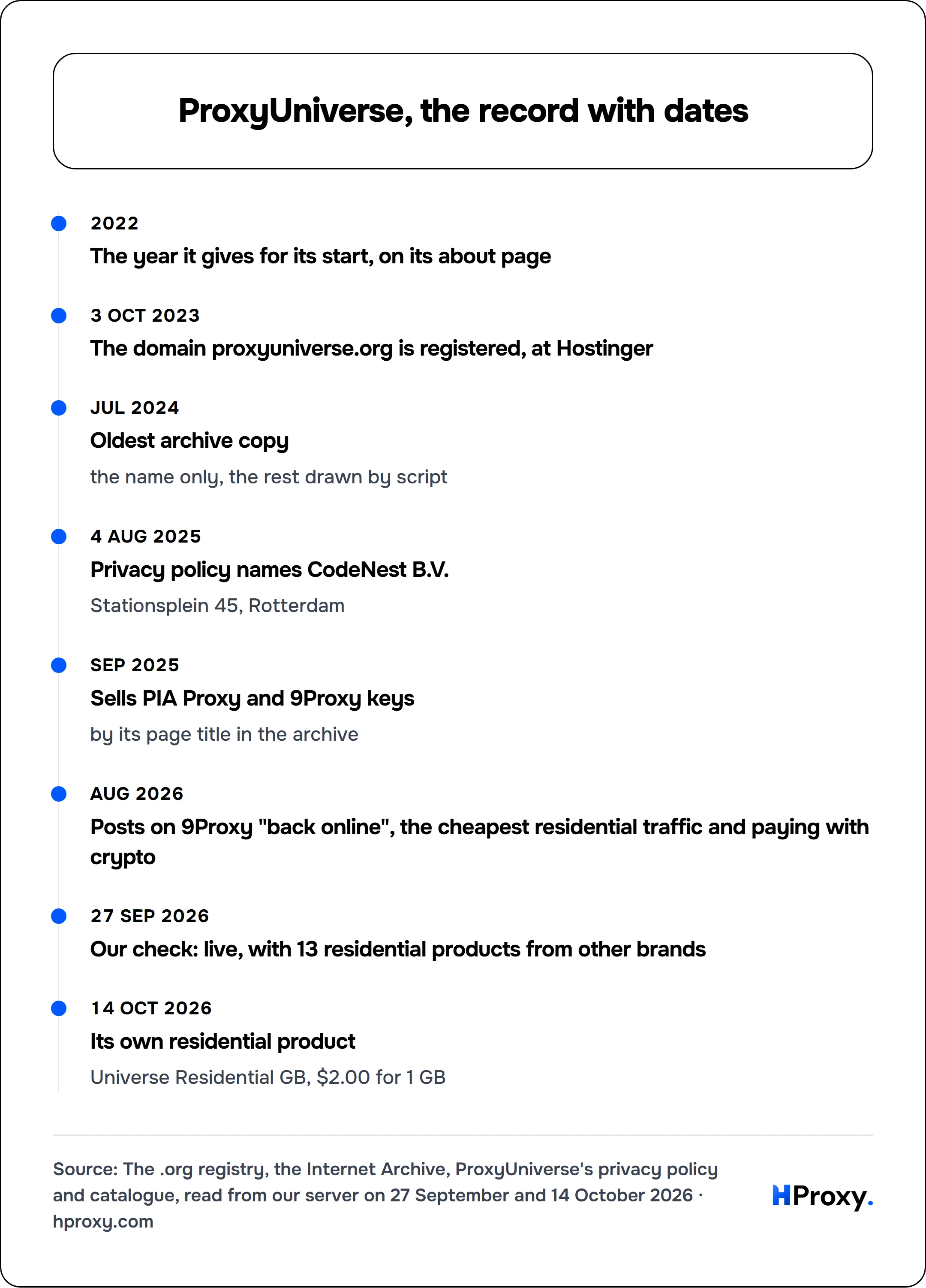
2022
The year it gives for its start, on its about page
3 Oct 2023
The domain proxyuniverse.org is registered, at Hostinger
Jul 2024
Oldest archive copy
the name only, the rest drawn by script
4 Aug 2025
Privacy policy names CodeNest B.V.
Stationsplein 45, Rotterdam
Sep 2025
Sells PIA Proxy and 9Proxy keys
by its page title in the archive
Aug 2026
Posts on 9Proxy "back online", the cheapest residential traffic and paying with crypto
27 Sep 2026
Our check: live, with 13 residential products from other brands
14 Oct 2026
Its own residential product
Universe Residential GB, $2.00 for 1 GB
What it sells, and what it costs
Prices at the smallest size shown in its catalogue:
| product | unit | price |
|---|---|---|
| 9Proxy residential IPs | per IP, 5 IPs | $0.40, "from $0.07" at volume |
| 9Proxy traffic | per GB, 1 GB | $1.15, "from $0.65/GB" at volume |
| LokiProxy | per IP, 5 IPs | $0.30 |
| NovProxy | per IP, 10 IPs | $0.42 |
| Rola-IP traffic | per GB, 1 GB | $1.10 |
| PIA Proxy traffic | per GB | $1.35 |
| private IPv4 | per IP | $1.00, no traffic limit |
| static residential | 24 hours | $2.50 |
| Universe Residential GB | per GB, 1 GB | $2.00, its own name |
Every price above was the same on 14 October 2026 as on 27 September. The catalogue also lists 711Proxy, Swift Proxy, IPRocket, Hide Proxy and Proxy001, from $0.36 to $2.25. Mobile starts at $1.04, and a VPN called "Vless VPN Premium" is shown as free.
Product pages sell "Keys Below the Official Price" and traffic "cheaper than official". Its blog explains the model: a reseller "buys bulk traffic from the same upstream networks", and keys arrive by CDKey. It says every GB plan it sells is non-expiring.
In October 2026 a product under its own name joined the brands. Universe Residential GB promises "10M+ real IPs across all 195+ countries", plans from 1 to 200 GB "from $0.50/GB", and sticky sessions of up to 30 minutes, without naming the network behind it. Its page showed $2.00 for 1 GB and "23 purchases". Beside it the site now offers "Universe SMS", a phone-number service for SMS verification.
The fine print
- The agreement. It governs "the Luna Proxy service", a different name. It provides everything "as is", without warranty.
- Refunds. "Refunds are available only in cases" set by a refund policy "published on the website". We found no such page linked.
- The company. The privacy policy, effective 4 August 2025, names CodeNest B.V., at Stationsplein 45 in Rotterdam, as the company that processes users' data. OpenCorporates' Dutch records showed no company named CodeNest on 14 October 2026, and the Dutch register's own search runs only in a browser. The site claims 60,000+ customers since 2022.
- Payment. Crypto and cards, "through Cryptomus and Crypto Pay". A crypto top-up can be as small as $0.10.
- The brands behind it. Its post of 14 August 2026 said only 9Proxy GB plans were back, with IP plans "still under maintenance".
Where ProxyUniverse is the stronger choice
- Many brands in one account, bought with one payment method.
- Small packs of IP-based brands, such as 5 LokiProxy IPs for $0.30.
- Crypto from $0.10, for buyers whose cards fail.
- Keys for brands whose own dashboards are down, by its account.
Where HProxy is different
| ProxyUniverse | HProxy | |
|---|---|---|
| what you buy | keys and traffic of other brands | our own plans, sold under our own terms |
| smallest buy | 1 GB of 9Proxy traffic for $1.15 | 1 GB of Lite at $0.50/GB |
| city and ISP targeting | depends on the brand behind the key | Premium, $1.49 for one GB |
| does traffic expire | it says its GB plans never do | never: the balance does not expire |
| terms | an agreement that names "Luna Proxy"; refund policy not found | public terms, a refund policy and an imprint |
| payment | crypto and cards | card, Alipay, crypto and local wallets |
The difference is who answers for the line. A key is sold by one company and served by another brand. We sell our own plans under published terms, and our support answers for them.
Other ways to buy, read the same day
Every line below comes from the page of each seller, read from our server on 27 September 2026.
| seller | the smallest buy | worth knowing |
|---|---|---|
| 9Proxy, bought direct | 5 GB for $15, or 100 IPs for $24 | Its unused IPs stay in the balance; IP plans run through its desktop app. |
| DataImpulse | 5 GB for $5 for a new user; $0.80 a GB at 1 TB | No expiry; targeting by city, ZIP or ASN is billed at twice the rate. |
| Evomi | $0.99 a GB as you go, from 15 GB | Its 100 GB plan works out at $0.49 a GB, for $49 a month. |
| Webshare | 1 GB for $3.50 a month, half its $7 list price | Down to $1.40 a GB at 3,000 GB; unused monthly traffic lapses. |
| HProxy | 1 GB of Lite at $0.50/GB | Premium, with city and ISP targeting, costs $1.49 for one GB. |
Compare a key with the brand bought direct before you pay. On 27 September 2026, 9Proxy sold 5 GB for $15 on its own site.
Which one to pick
- You use several IP-based brands and pay in crypto: ProxyUniverse puts them in one account.
- You use one brand in volume: check its own price first, then the resold key.
- City or ISP targeting from a single GB: our Premium pool, at $1.49 for one GB.
- You want one seller that answers for the plan under published terms: buy direct, from the brand itself or from us.
Before you settle on a seller, run a few of its addresses through our free proxy checker, which needs no account and tests HTTP and SOCKS addresses alike.
The limits of this record
We did not buy from ProxyUniverse, so nothing here measures the lines behind its keys. For five products the catalogue shows a price but not the unit. We could not match its "cheaper than official" claims plan by plan, except for the 9Proxy numbers above: several brands' own price pages draw their prices by script or answered our server with errors. The Internet Archive holds copies of the site from July 2024, but they show little more than its name and title. We could not confirm CodeNest B.V. in the Dutch register, and we did not learn which network serves Universe Residential GB. We will check this page again by 14 January 2027.
Sources
Read on 14 October 2026, from our server: ProxyUniverse's privacy policy, user agreement, residential catalogue and two product pages; its sitemap; OpenCorporates' Dutch records; the Internet Archive's copies of proxyuniverse.org (July 2024 to February 2026); the price pages of 9Proxy and Proxy001.
Read on 27 September 2026, from our server:
- ProxyUniverse: the homepage, the about page, the catalogue and five product pages, the user agreement, the partners page and three blog posts.
- Public Interest Registry, record for proxyuniverse.org, and the Undetectable partner page.
- 9Proxy, DataImpulse, Evomi and Webshare pricing pages, the DataImpulse targeting docs and the Webshare help center.
- HProxy: our product catalogue, legal pages and payment pages.