ProxyLogic (proxylogic.org) sells residential, datacenter IPv4, US mobile and IPv6 proxies from one wallet, and its pages name no company behind it. Every price below comes from the price list its own pricing page loads, read on 27 September 2026. For the comparison, jump to the alternatives table.
ProxyLogic at a glance
| what we found on 27 September 2026 | |
|---|---|
| status | live, plans on sale |
| operator | not named on its pages |
| residential | $1.50 a GB from 1 GB, each buy valid 180 days |
| datacenter IPv4 | from $9.99 a day with 500 threads |
| mobile | United States only, $2 a port plus $2 a day |
| IPv6 | from $5 a week with 100 threads |
| trial | 30 minutes of mobile, once every 7 days |
| refunds | purchases final unless the law requires one |
| payment | cards through Paddle, and crypto |
| pool | 100M+ residential IPs in 195+ countries, by its count |
What ProxyLogic sells
Residential. Rotating or sticky residential IPs with country and city targeting, bought by the gigabyte with separate credentials for every order.
Datacenter IPv4. Capacity sold by threads, meaning connections at once, with unlimited bandwidth for a day, a week, a month or 120 days.
US mobile. 4G and 5G routes in the United States, with state targeting and a carrier setting, from 1 to 25 ports for up to 31 days.
IPv6. Thread packages for 7, 30 or 90 days, also with unlimited bandwidth.
What ProxyLogic charges
| product | smallest option | largest option |
|---|---|---|
| residential | 1 GB for $1.50 | 1,000 GB for $1,500 |
| datacenter IPv4 | 1 day for $9.99, 500 threads | 120 days for $749.99, 2,000 threads |
| mobile | 1 port for 1 day, $2 | $2 a port plus $2 a day |
| IPv6 | 100 threads for 7 days, $5 | 5,000 threads for 90 days, $499 |
Extra datacenter threads cost $59.99 a month for 1,000, $249.99 for 5,000 and $449.99 for 10,000, and IPv6 also comes as a 100-day option at $100. Mobile is priced at $2 a port plus $2 a day for the order, and its buy form takes a fixed $2 off each order, so one port for 30 days comes to $60.
The fine print
180 days to use residential data. Each residential buy becomes a separate plan that lasts 180 days, while the wallet balance itself does not expire.
No refunds, no payouts. Its terms, last updated on 9 June 2026, say every sale is final and cannot be refunded unless the law requires it or the seller agrees. Wallet credits "may be used only inside ProxyLogic".
No company named. Its terms define the seller as the legal entity shown on your checkout, invoice or order, and they choose the law of that entity. The privacy policy says the same, so the company appears only when you pay.
Payment. Cards go through Paddle, and crypto through BTCPay Server or NOWPayments, with crypto payments final once confirmed on the chain.
Its own figures. It claims a 100M+ residential pool in 195+ countries and 2,000+ customers, and we found no outside source for any of them.
Its history
Its about page says the shop was founded in 2019, but proxylogic.org was registered in August 2023. The Internet Archive holds a customer dashboard on the domain from June 2024.
In December 2025 its homepage sold three products: residential from $1.75 a GB, IPv6 from $5 a week and mobile at $2 a day a port in 80+ countries. By September 2026 residential cost $1.50, mobile covered the United States only, and datacenter IPv4 was on sale as a fourth product.
Where ProxyLogic is stronger
Unlimited bandwidth by the thread. Datacenter IPv4 and IPv6 are sold by connections at once, not by traffic, which suits heavy jobs on easy targets.
A mobile trial. You can try its US mobile proxies for 30 minutes before any paid order.
US states. Mobile ports can be set to a US state, with a carrier setting as well.
Where HProxy differs
We sell proxies too, so read this part as the account of a competitor. Every HProxy fact here comes from our own product code and pages.
Residential with no deadline. Premium, our pool with state, city and ISP targeting, costs $1.49/GB for one gigabyte and $1.00/GB from 1,000 GB+. Purchased gigabytes have no scheduled expiry date, while a ProxyLogic buy lasts 180 days.
By country, from one gigabyte. Lite targets by country at $0.50/GB for one gigabyte, against $1.50 at ProxyLogic.
Mobile by the gigabyte. Rotating mobile traffic, targeted by country, costs $1.50/GB, with no ports or days to size.
Dedicated datacenter addresses. A dedicated IPv4 address costs $1.58/IP for a month and IPv6 $0.10/IP each, from ten addresses, both with unlimited bandwidth.
A named company. Our imprint names the company behind HProxy, registered in the German commercial register.
Where we are behind. We do not sell datacenter capacity by the thread, and our mobile targets by country, not by US state.
The alternatives, side by side
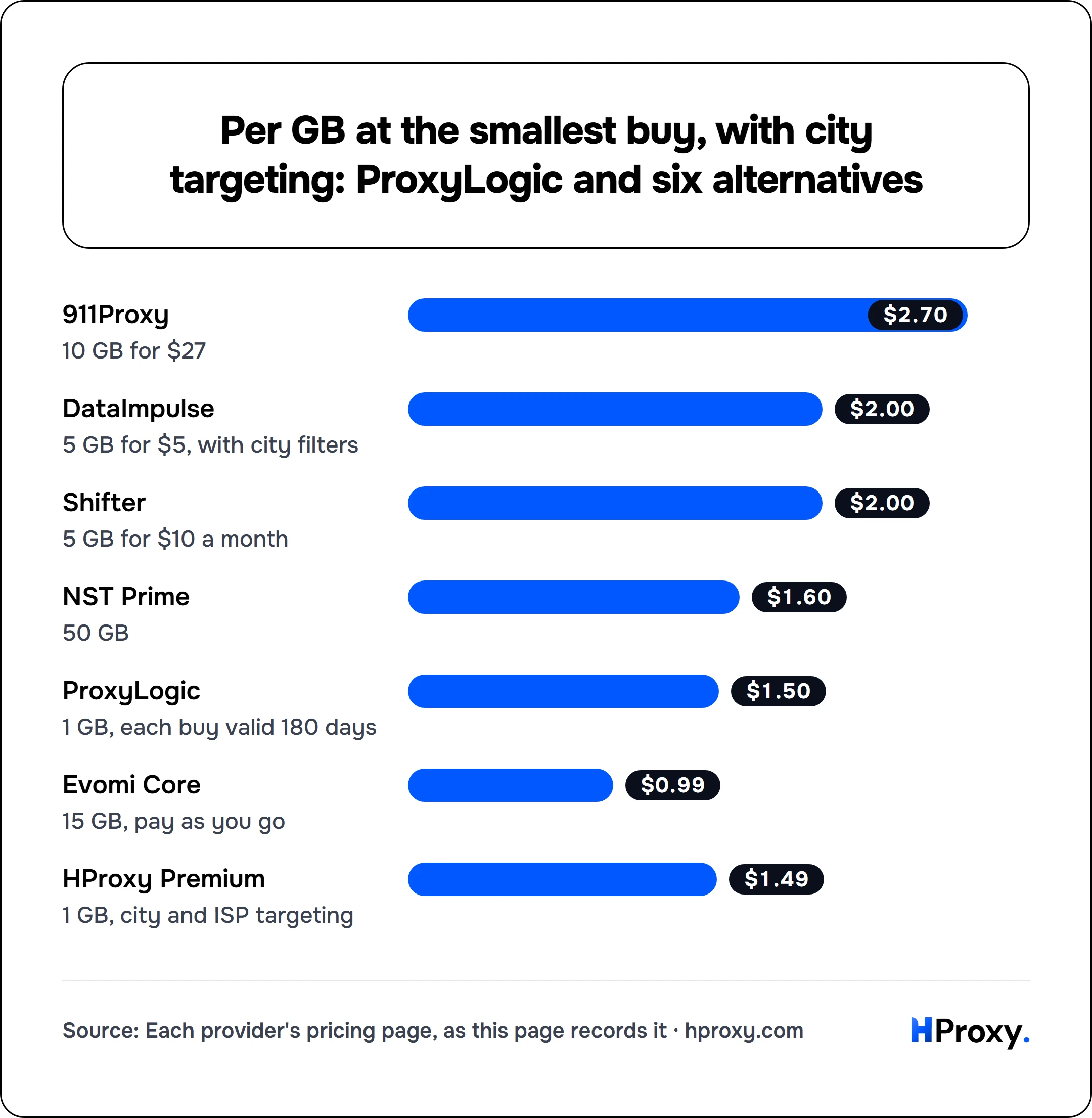
Residential proxies with city targeting, at the smallest buy. Its own row comes from its price list of 27 September 2026, and every other figure from the page of each vendor, read on 26 or 27 September 2026.
| provider | smallest buy | per GB at that size |
|---|---|---|
| ProxyLogic | 1 GB | $1.50 |
| Evomi Core | 15 GB, pay as you go | $0.99 |
| DataImpulse | 5 GB for $5 | $2.00 with city filters |
| Shifter | 5 GB for $10 a month | $2.00 |
| 911Proxy | 10 GB for $27 | $2.70 |
| NST Prime | 50 GB | $1.60 |
| HProxy Premium | 1 GB | $1.49/GB |
Our reviews of Evomi, DataImpulse, Shifter, 911Proxy and NST cover their terms in full.
Who ProxyLogic suits
It suits a buyer who runs heavy datacenter or IPv6 jobs and would rather pay for connections than for traffic. It also suits someone who needs US mobile ports by state and wants to try them first.
It suits you less if you want residential data that does not expire, a way to get unused money back, or a named company to hold to its terms.
Before you commit
Use the 30-minute trial if you need mobile, and buy the smallest residential amount first, since every purchase is final and lasts 180 days. Our proxy checker shows whether an address answers, how fast, and from where, whoever sold it.
The limits of this review
We did not buy a ProxyLogic plan or test its network. Its site draws its pages in the browser, so we read the text and prices from the files its app loads. The pool size, customer count and founding year are its own claims.
Every figure here carries the day it was read, and this page is due for a check by 27 December 2026.
Sources
- ProxyLogic, proxylogic.org: homepage, pricing page and the price list it loads, product pages, buy form, terms of service, privacy policy and about page. Read 27 September 2026.
- Internet Archive, copies of proxylogic.org and its dashboard from June 2024, December 2025 and April 2026. Read 27 September 2026.
- Public Interest Registry, registry record for proxylogic.org. Read 27 September 2026.
- Evomi, DataImpulse, Shifter, 911Proxy and NST, residential price pages. Read 26 and 27 September 2026.
- HProxy, our own product records, price table, terms and imprint.