ProxyGen is trading at proxygen.io, where it sells residential and mobile traffic in fixed packages that never expire, and static ISP addresses by the week or month. Residential traffic costs $9.99 for 5 GB and falls to $1.20 a GB at 1,000 GB; mobile runs from $14.99 for 5 GB down to $2.00 a GB. Its site names a Hong Kong company, and the domain was registered anew in December 2025. The like-for-like prices are in the alternatives table.
Is ProxyGen legit? The record in one table
| what we read on 27 September 2026 | |
|---|---|
| website | proxygen.io answers normally, behind Cloudflare |
| company | Hong Kong Hengda International Health Technology Co., Limited, trading as ProxyGenio |
| products | residential, mobile and static ISP proxies over HTTP, HTTPS and SOCKS5 |
| price | residential from $9.99 for 5 GB, mobile from $14.99 for 5 GB |
| payment | crypto with no fee, or card and local methods with a 7% fee |
| refunds | in full within 7 days, if less than 10% of the package is used |
| domain | registered 4 December 2025, behind a privacy service |
| reviews | "Excellent" from 962 reviews on its homepage, with no source named; no Trustpilot page we could read |
The shop publishes its prices, terms and company details in plain text. It also says where its traffic comes from: residential and mobile capacity is "sourced from vetted network partners", and "We are a retail brand on top of that capacity". It says it runs its own entry servers in Amsterdam, Las Vegas and Singapore.
What ProxyGen sells, and what it costs
Prices come from its pricing page and its price tables, read on 27 September 2026. Each package is a single purchase, and its gigabytes never expire.
| package | residential | per GB | mobile | per GB |
|---|---|---|---|---|
| 5 GB | $9.99 | $2.00 | $14.99 | $3.00 |
| 25 GB | $49.99 | $2.00 | $69.99 | $2.80 |
| 100 GB | $169.99 | $1.70 | $239.99 | $2.40 |
| 500 GB | $669.99 | $1.34 | $1,049.99 | $2.10 |
| 1,000 GB | $1,199.99 | $1.20 | $1,999.99 | $2.00 |
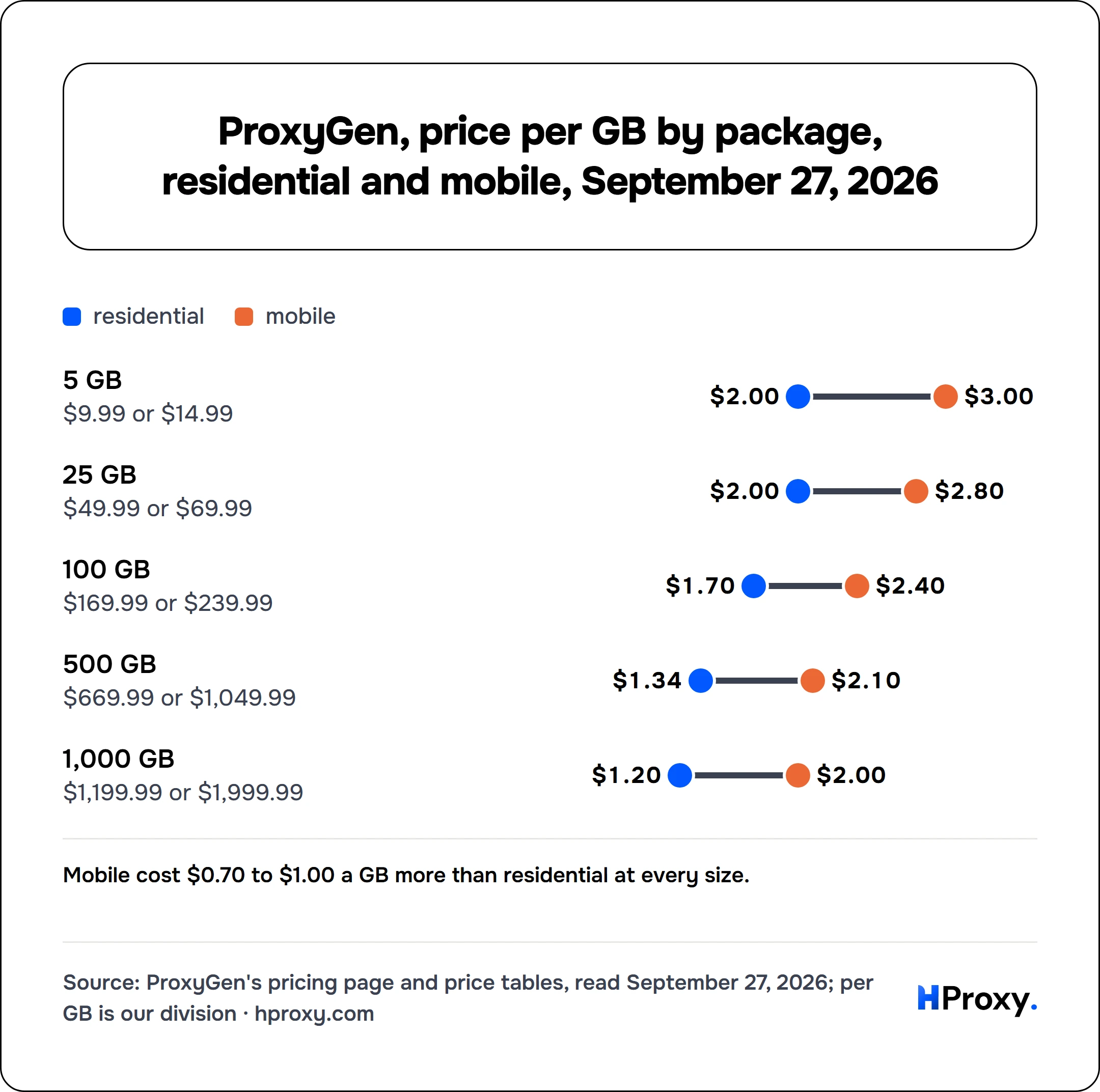
- residential
- mobile
The 10, 50 and 250 GB packages sit on the same ladder. Residential traffic covers 195 or more countries with city targeting, and a session can hold one address for up to 90 minutes. Mobile traffic comes from 4G and 5G carriers in 46 or more countries, with shorter sessions. The headline rate of $1.19 a GB is the 1,000 GB package, which its own table shows as $1.20. A code on every page takes 30% off the first order.
A static ISP address stays with one account for its whole term. In 93 of its 127 regions it costs $1.50 for 7 days or $5.00 for 30 days, and the other 34 regions cost $4.50 and $8.00. The site lists 57 countries for these. Its datacenter and IPv6 pages repeat the residential package table and name no price of their own.
The fine print that decides the cost
A refund after light use. The refund policy says: "You may request a full refund for any purchase within 7 calendar days" of the order, if less than 10% of the package is used. Between days 8 and 30 it may refund the unused part at its discretion, while under half is used.
Cards cost 7% more. Crypto through Cryptomus carries no fee and takes 25 or more coins. Card and local payment methods add a 7% fee at checkout.
A chargeback closes the account. A chargeback filed before asking support brings "Forfeiture of any remaining bandwidth credits and wallet balance", by its refund policy.
Credit over 30 days old. Wallet credit older than 30 days is not refundable if the service was never used. Bandwidth inside a package never expires.
Hong Kong law. The terms fall under the laws of Hong Kong, and disputes go to its courts.
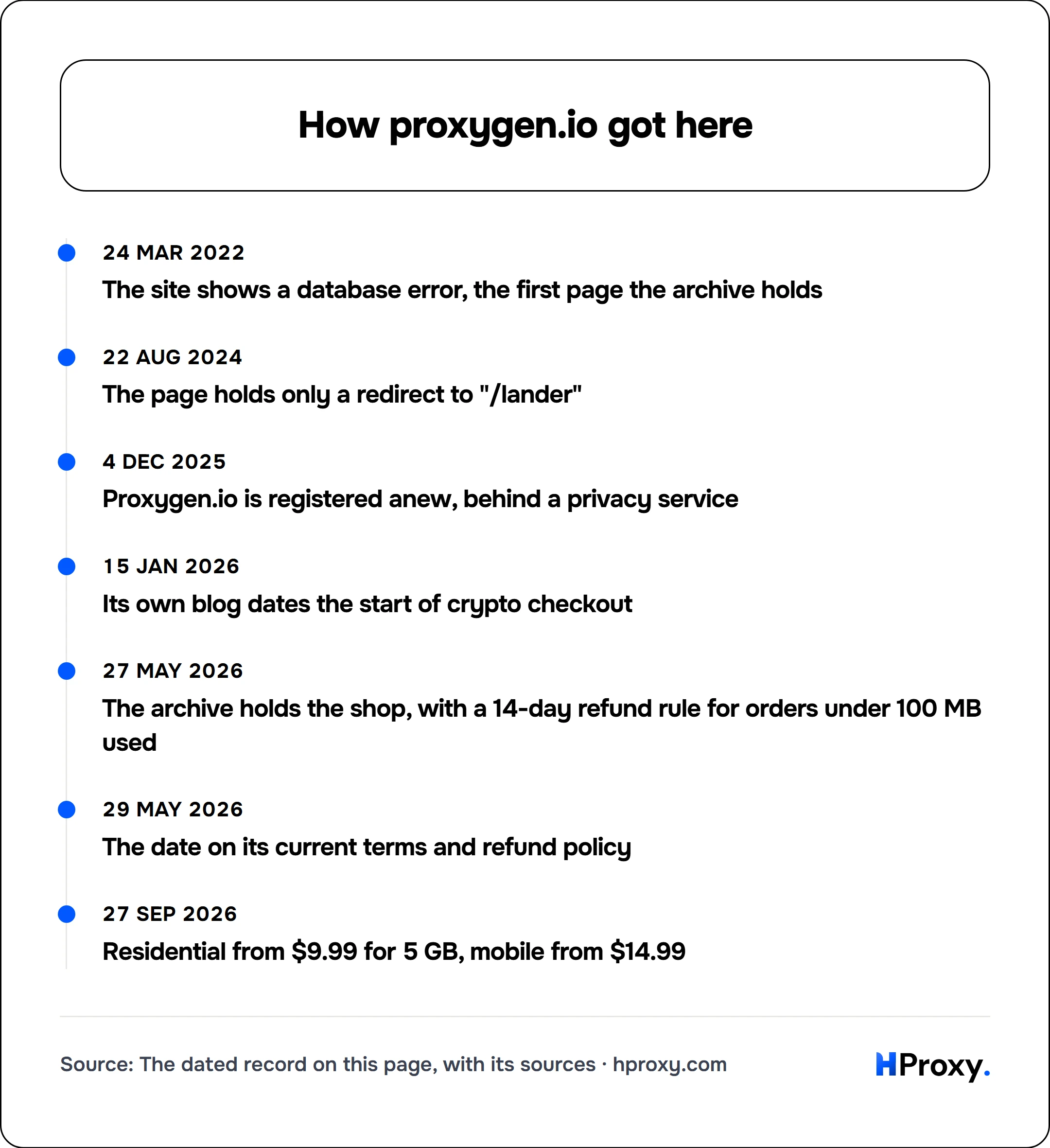
How proxygen.io got here
| date | what the record shows |
|---|---|
| 24 March 2022 | the site shows a database error, the first page the archive holds |
| 22 August 2024 | the page holds only a redirect to "/lander" |
| 4 December 2025 | proxygen.io is registered anew, behind a privacy service |
| 15 January 2026 | its own blog dates the start of crypto checkout |
| 27 May 2026 | the archive holds the shop, with a 14-day refund rule for orders under 100 MB used |
| 29 May 2026 | the date on its current terms and refund policy |
| 27 September 2026 | residential from $9.99 for 5 GB, mobile from $14.99 |
24 Mar 2022
The site shows a database error, the first page the archive holds
22 Aug 2024
The page holds only a redirect to "/lander"
4 Dec 2025
Proxygen.io is registered anew, behind a privacy service
15 Jan 2026
Its own blog dates the start of crypto checkout
27 May 2026
The archive holds the shop, with a 14-day refund rule for orders under 100 MB used
29 May 2026
The date on its current terms and refund policy
27 Sep 2026
Residential from $9.99 for 5 GB, mobile from $14.99
Sources: the domain registry, the Internet Archive and its own pages, read 27 September 2026. Nothing we read ties the current shop to what the address held before December 2025.
ProxyGen alternatives for residential traffic
The fair comparison is the smallest purchase and the lowest rate each vendor prints, from each pricing page. ProxyGen was read on 27 September 2026, the others a day earlier.
| provider | smallest purchase | lowest rate printed, and what it needs | unused traffic |
|---|---|---|---|
| ProxyGen | $9.99 for 5 GB, $2.00 a GB | $1.20 a GB, 1,000 GB for $1,199.99 | never expires |
| Webshare | $3.50 for a 1 GB plan | $1.40 a GB, 3,000 GB at $4,200 a month | resets monthly |
| Rayobyte | $3.50 a GB, from 1 GB | $0.50 a GB, 5,000 GB or more by contact | kept on pay as you go |
| Evomi | $0.99 a GB, from 15 GB | $0.49 a GB, the 100 GB plan at $49 a month | kept on pay as you go |
| DataImpulse | $5 for 5 GB, $1.00 a GB | $0.80 a GB, 1 TB for $800 | kept |
| HProxy Residential Lite, country targeting | $0.50/GB, from 1 GB | $0.44/GB at 2,000 GB+ | kept, the balance never expires |
| HProxy Residential Premium, state, city and ISP targeting | $1.49/GB, from 1 GB | $1.00/GB at 1,000 GB+ | kept, the balance never expires |
ProxyGen targets cities, so its like-for-like row on our side is Premium, at $1.49 per GB from the first gigabyte. Both of ours are on our residential price table.
For mobile traffic, Rainproxy charged $3.10 for 1 GB and $2.00 a GB at 500 GB on 27 September 2026, and Evomi $3.98 a GB pay as you go and $2.20 on its largest plans a day earlier. Our mobile proxies cost $1.50/GB, from 1 GB. For a fixed address, our ISP proxies cost $2.70 per IP for a month.
Where ProxyGen is the better buy
A refund after light use. Its full refund holds while less than 10% of a package is used. Ours covers residential traffic only while none of it has been routed.
Static addresses by the week. A static ISP address costs $1.50 for 7 days in most regions, which suits a short job.
A free trial without a card. Its trial page offers 200 MB of residential traffic after an email check.
Where HProxy is the better fit
Any amount from 1 GB. Our balance buys residential traffic from 1 GB upward, at the rates on our price table. ProxyGen sells eight fixed packages, and the smallest is 5 GB for $9.99.
Mobile from 1 GB. Our mobile proxies start at a single gigabyte. The smallest ProxyGen mobile package is 5 GB for $14.99.
Longer sticky sessions. On Residential Premium a session can be set from 3 minutes to 24 hours, by our API documentation. ProxyGen offers up to 90 minutes.
A company in Germany. Our imprint names Obsidian UG in Herford, Germany, and our balance never expires. ProxyGen names a company in Hong Kong, under Hong Kong law.
Before you commit
Take the ProxyGen trial and buy a single gigabyte of our Premium traffic, then run the same job through both. Check the exits in our proxy checker first. Our free proxy list and the checker need no account. Our refund policy says what comes back if we do not fit.
The limits of this record
We did not test ProxyGen, so nothing here grades speed or success. Its pages give pool sizes from 2 million to 100 million addresses, so we print none. Its pages also disagree in places: the trial page gives sessions of up to 120 minutes where the FAQ gives 90, and the mobile page showed the residential package table. Check the price at checkout. We could not read a review record, and we did not check the company in the Hong Kong register. This page is due for a check by 27 December 2026.
Other providers we cover
More pages in this series: 911Proxy.com, 9Proxy.com, A20.cn, Abcproxy.com and Aboutus.org.
Sources
Every source below was read on 27 September 2026, except the pricing pages of Webshare, Rayobyte, Evomi and DataImpulse, read a day earlier.
- ProxyGen: homepage, pricing page, product pages, FAQ, about and contact pages, terms of service, refund policy, acceptable use policy, sourcing page and trial page.
- Identity Digital, the registry record for proxygen.io.
- Internet Archive, captures of proxygen.io from 24 March 2022 to 27 May 2026.
- Webshare, Rayobyte, Evomi, DataImpulse and Rainproxy, pricing pages.
- HProxy, our own product catalog, price table, API documentation, refund policy and imprint.