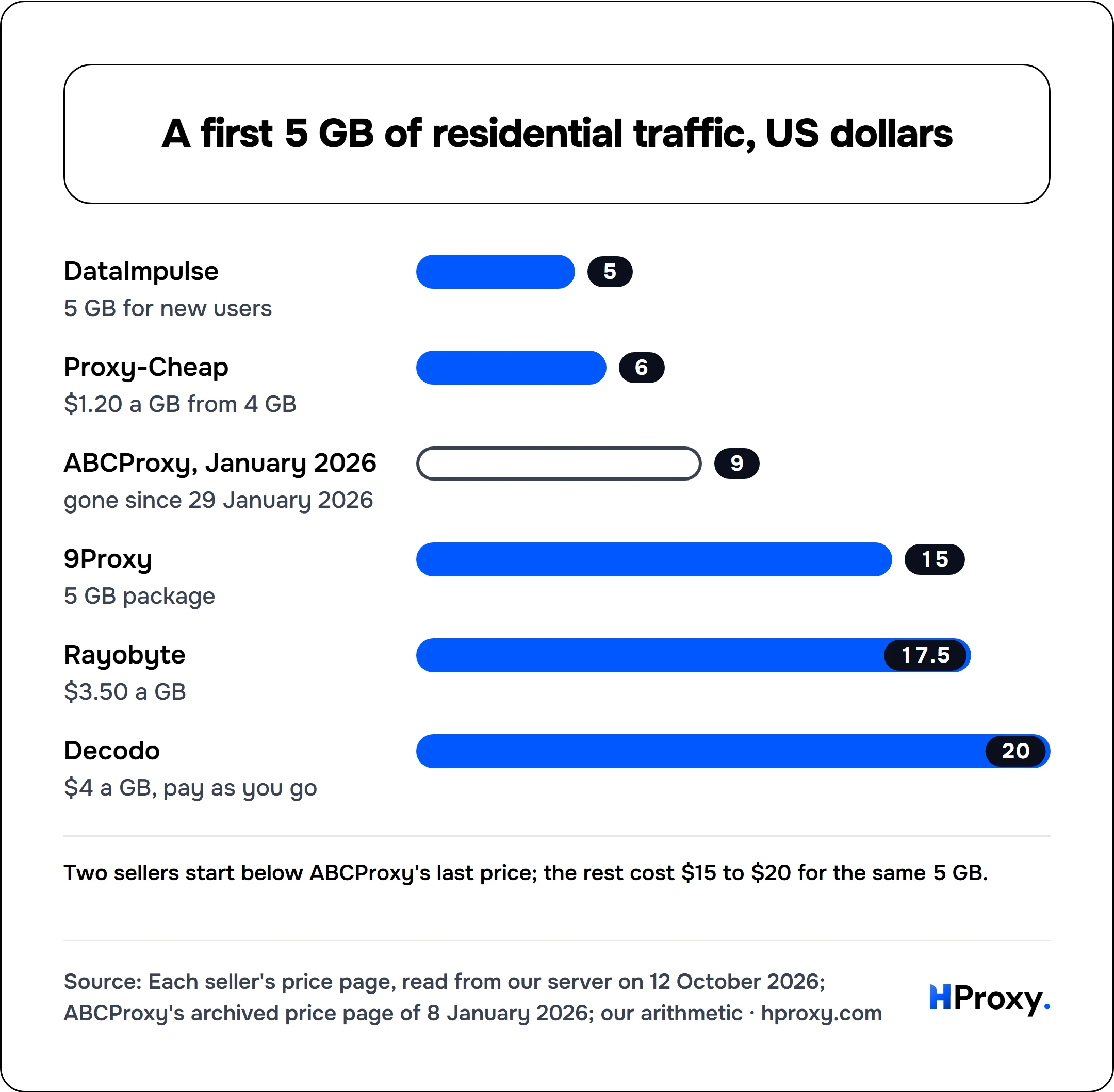
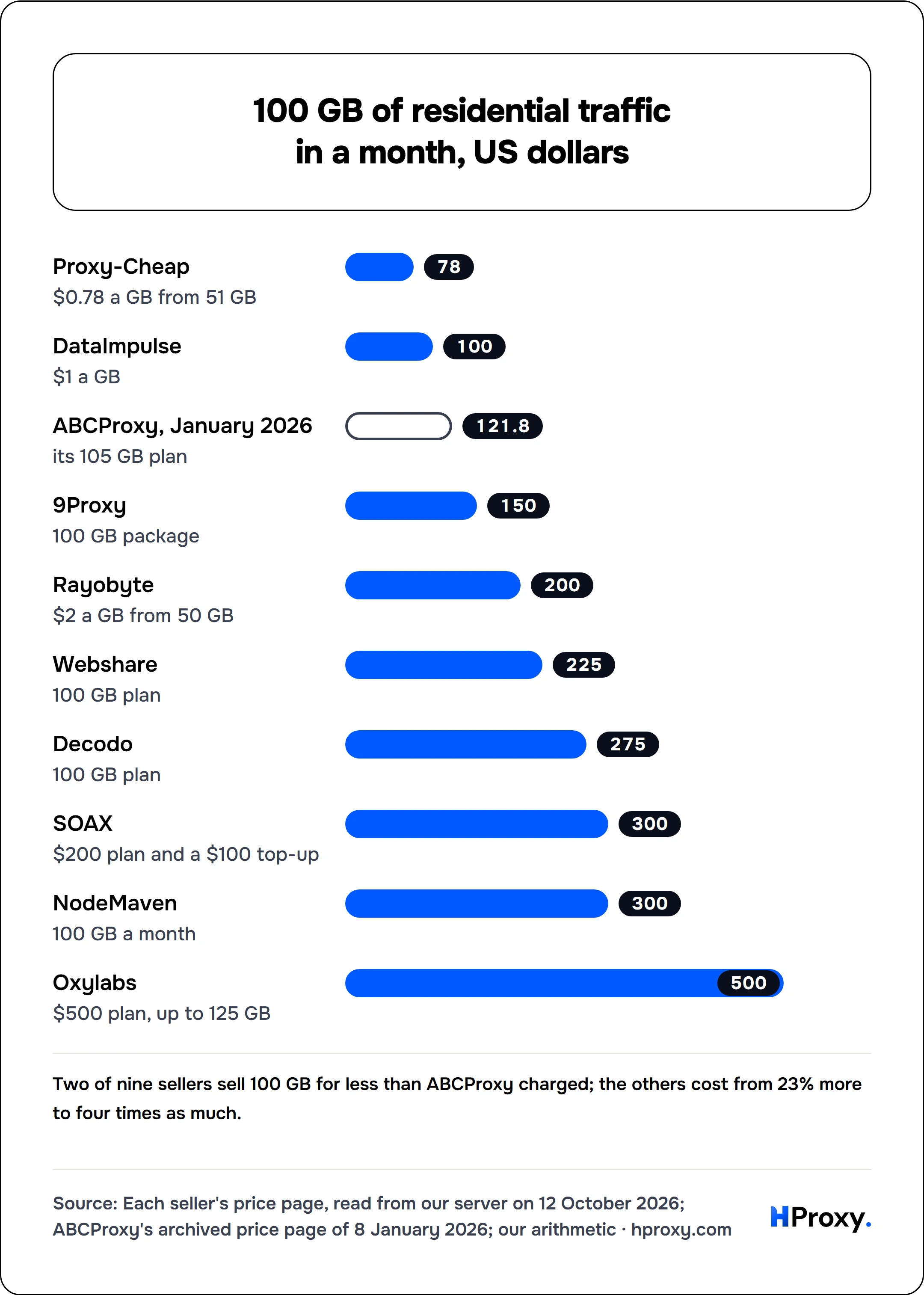
ABCProxy (abcproxy.com), also sold as ABC S5 Proxy, has served no page since 29 January 2026. The day before, Google's Threat Intelligence Group named it among the brands it says are "controlled by the actors behind IPIDEA", and on 12 October 2026 its domain still pointed at a sinkhole. Its last price list sold 5 GB for $9 and 105 GB for $121.80. At sellers that are not on Google's list, a first 5 GB now costs from $5 and 100 GB from $78. The comparison has the prices; the story is on our ABCProxy company page.
What ABCProxy charged at the end
ABCProxy's last price list, 8 January 2026
| Product | Price |
|---|---|
| Residential, first 5 GB | $9 ($1.80 a GB) |
| Residential, 45 GB | $63 ($1.40 a GB) |
| Residential, 105 GB | $121.80 ($1.16 a GB) |
| Residential, largest plans | $0.60 a GB |
| SOCKS5 residential address | $0.045 each |
| Unlimited residential | $79 a day |
abcproxy.com/pricing in the Internet Archive, 8 January 2026, read for our company page
Its terms said "all payments are final", and the site has answered nothing since January, so a balance left on an account had no way back. People still look for it: in October 2026 Keyword Planner counted 22,200 searches a month for "abcproxy", 480 for "abcproxy download" and 170 for "abcproxy login".
What to do with ABCProxy's software
ABCProxy shipped a client for its SOCKS5 addresses, listed as Socks5 Manager on its site and named ABC S5 Proxy on Windows, with versions for Mac and Android, and a browser extension for Chrome and Firefox. Its downloads went with the site, so a copy offered anywhere today comes from someone other than ABCProxy.
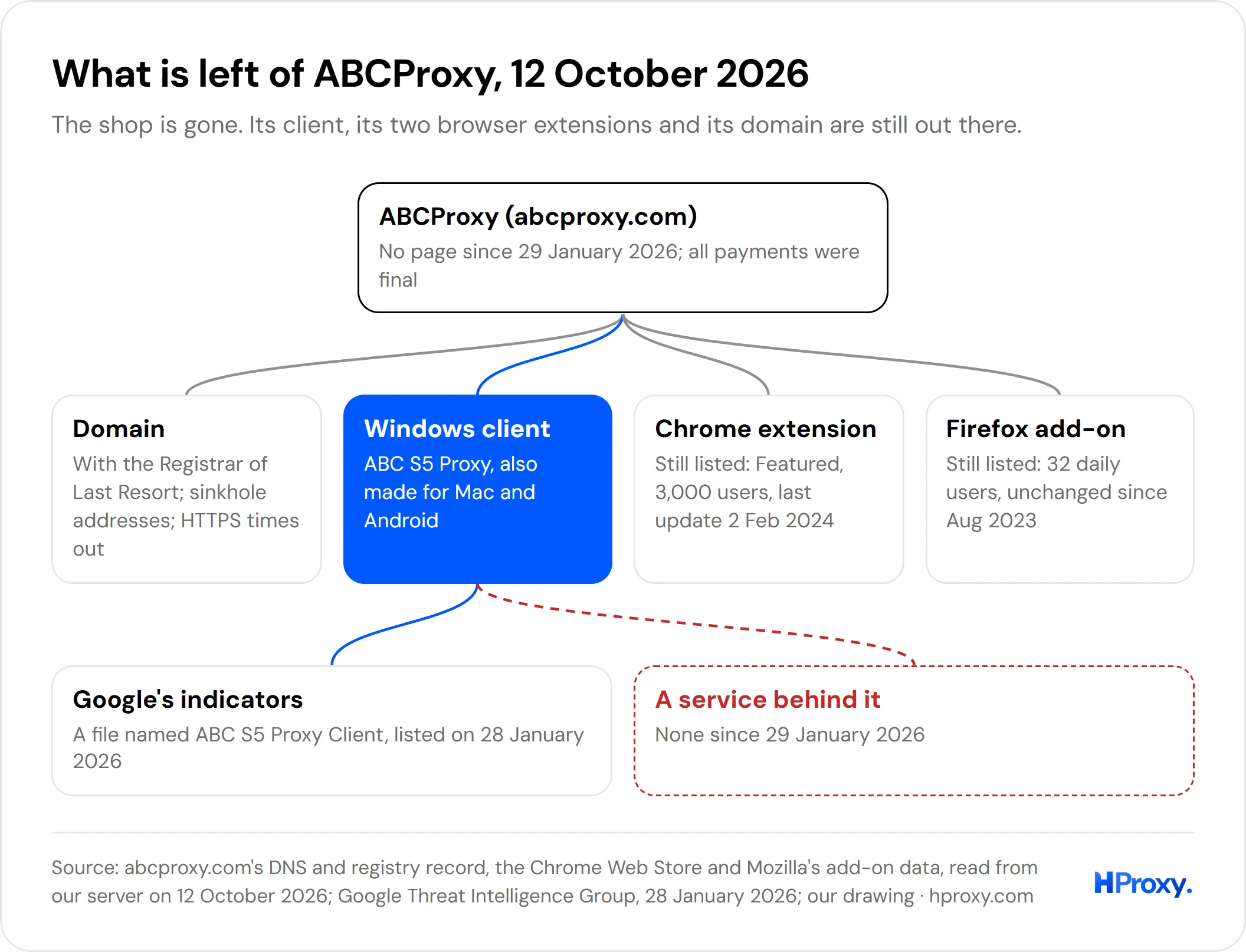
- The Windows client. Google's post of 28 January 2026 lists a file named "ABC S5 Proxy Client" among its indicators of compromise, published "to assist the wider community in hunting and identifying" the network's activity. The client has had no service behind it since January. If it is still installed, remove it.
- The browser extension. On 12 October 2026 the Chrome Web Store still listed the ABC Chrome Extension as Featured, with 3,000 users and a publisher, "ABCProxy Inc.", that has not identified itself as a trader. Its last update dates from 2 February 2024. Mozilla still listed the Firefox version, unchanged since 17 August 2023, with 32 daily users. The extension can hold proxies from any seller. Its maker is gone, and neither version has changed since early 2024. Our comparison of proxy switchers covers ones that are still updated.
Before you pick a replacement
Google's list of 28 January 2026 names ten proxy brands and three VPNs. The proxy brands are Ipidea, 360Proxy, 922Proxy, ABC Proxy, Cherry Proxy, IP2World, LunaProxy, PIA S5 Proxy, PyProxy and TabProxy; our page on Google's action covers each. None of the nine sellers priced below is on it.
Ask, too, where a seller's addresses come from. ABCProxy's homepage called its pool "200M+ ethically sourced" in July 2025. Google's post says of such claims across the trade that they "are often incorrect or overstated", and that many of the malicious apps it studied "did not disclose that they enrolled devices into the IPIDEA proxy network".
The other thing to check is what a seller asks of a new customer. Three of the nine check ID before a first purchase.
Rules for a new customer at nine sellers
| Seller | ID check before buying | Pay as you go |
|---|---|---|
| DataImpulse | No | Yes |
| Proxy-Cheap | No | Yes |
| 9Proxy | No | Yes |
| Decodo | No | Yes |
| NodeMaven | No | Yes |
| Rayobyte | Yes | Yes |
| SOAX | Yes | Credits expire after 60 days |
| Webshare | No | Monthly plans only |
| Oxylabs | Yes | Monthly plans only |
Each seller's pages, read from our server between 26 September and 12 October 2026
What the same traffic costs today
The prices below were read on 12 October 2026, for a new customer and before VAT. ABCProxy's last prices stand beside them for reference.
Single residential addresses: 9Proxy
ABCProxy sold SOCKS5 residential addresses at $0.045 each. The nearest model today is 9Proxy's, and 9Proxy is not on Google's list. A buyer pays for each address switched on in its desktop app for Windows, macOS or Linux, which forwards the address to a local port. The address then carries unlimited traffic while it stays online, "a few hours to ~24h" by 9Proxy's account, and unused addresses never expire.
9Proxy's address packages, 12 October 2026
| Addresses | Price | Each |
|---|---|---|
| 100 | $24 | $0.24 |
| 500 | $72 | $0.144 |
| 1,000 plus 500 | $126 | $0.084 |
| 2,500 | $210 | $0.084 |
| 5,000 | $360 | $0.072 |
| 15,000 | $720 | $0.048 |
| 25,000 | $863 | $0.035 |
| 50,000 | $1,438 | $0.029 |
The package data in 9proxy.com/pricing, read from our server on 12 October 2026; our arithmetic
Business packages run on to 500,000 addresses for $8,625. Below 25,000 addresses each one costs more than ABCProxy charged, over five times as much in the smallest pack. Two things changed at 9Proxy in 2026. On 1 June it raised the price of its address packages by 15 to 20%, the first rise in its history by its own account. By 12 July its site carried a notice: "New orders are temporarily paused while we continue working on full service recovery." Its price list answered normally on 12 October. Since 1 April 2026 its terms restrict streaming sites such as Netflix, YouTube and Spotify on address plans. Every purchase is final, as it was at ABCProxy, and a dead proxy is replaced only if it is reported within 60 seconds of use. Our 9Proxy page has the company named in its terms and the full price history.
The cheapest per gigabyte: DataImpulse and Proxy-Cheap
DataImpulse charges $1 a GB pay as you go, with 5 GB for $5 for new users and $0.80 a GB at 1 TB, and asks for no ID before a first purchase. Proxy-Cheap's residential traffic costs $1.50 a GB from 3 GB, $1.20 from 4 GB and $0.78 from 51 GB, also without an ID check.
Pay as you go: Decodo and NodeMaven
Decodo sells 1 GB for $4 pay as you go, and monthly plans from $3.75 a GB. NodeMaven charges $5 a GB for 2 GB pay as you go, or $3.50 for a trial with 750 MB. Neither checks ID before a first purchase.
Larger plans: Rayobyte, Webshare, SOAX and Oxylabs
These four cost $200 to $500 for 100 GB. Rayobyte, SOAX and Oxylabs check ID before a first purchase, and Webshare and Oxylabs sell monthly plans only.
Where HProxy fits
We sell residential traffic too. HProxy Lite sells at $0.50/GB with no plan, and an unused balance does not expire. Our residential proxies page has the details, and our free proxy checker tests any HTTP or SOCKS proxy you still hold.
Which one to pick
- DataImpulse for the cheapest start: 5 GB for $5, with no ID check.
- Proxy-Cheap for volume: 100 GB for $78.
- 9Proxy for single residential addresses, cheapest in packs of thousands; it raised its prices and paused new orders in summer 2026.
- Decodo or NodeMaven to pay as you go without an ID check.
- The costliest for this job: Oxylabs, $500 for 100 GB.
- Whichever you choose, check it against Google's list first, and remove the ABC S5 Proxy client if it is still installed.
What we could not find out
We bought nothing, tested no network and installed nothing, so we cannot say what the ABC S5 Proxy client does on a computer, and we did not look for copies of it on other sites. We checked the sellers against Google's list only, so we cannot say where any of them sources its addresses. ABCProxy's last prices rest on one archive copy, of 8 January 2026, and the other prices were read in the morning of 12 October 2026 for our Bright Data page. We will read them again by 12 January 2027.
Sources
- Internet Archive: abcproxy.com's price page of 8 January 2026, its terms and its homepage of July 2025, read for our ABCProxy company page.
- Google Threat Intelligence Group, its post on IPIDEA of 28 January 2026 and the indicators of compromise listed in it.
- abcproxy.com's DNS, HTTPS answer and registry record, checked from our server on 12 October 2026.
- The Chrome Web Store listing of the ABC Chrome Extension and Mozilla's add-on data for ABCProxy-Extension, read from our server on 12 October 2026.
- The price, KYC and terms pages of DataImpulse, Proxy-Cheap, 9Proxy, Rayobyte, Webshare, Decodo, SOAX, NodeMaven and Oxylabs, read 12 October 2026 (rules from 26 September).
- 9Proxy's terms, blog and site notices in the Internet Archive, read for our 9Proxy company page on 10 October 2026.
- The ABCProxy pages of SOAX, DataImpulse and Decodo, read 12 October 2026.
- Keyword Planner's worldwide counts for ABCProxy, taken 11 October 2026.
- HProxy's Lite price, taken from our live price data.