
PowerProxy (powerproxy.net) is a new proxy shop: its domain was registered in May 2026, and it sells about a dozen proxy products by the gigabyte from one wallet. Every price below comes from the price data on its own homepage, read on 27 September 2026. For the comparison, jump to the alternatives table.
PowerProxy at a glance
| what we found on 27 September 2026 | |
|---|---|
| status | live, plans on sale |
| operator | not named on its pages |
| residential | $2.25 a GB from 1 GB, with city targeting |
| Residential Lite | $1.25 a GB, by country |
| mobile | $2.10 a GB, by country |
| datacenter | $0.65 a GB, one fixed country |
| discounts | 5% off from 25 GB, up to 20% from 2,000 GB |
| traffic | never expires |
| refunds | generally none |
| domain | registered on 29 May 2026 |
What PowerProxy sells
Five residential pools. Residential, from a pool it puts at 120M+ IPs, takes a country, state and city. Residential Lite and Pool 5 target by country only. Pool 2 holds sticky sessions for up to 7 days, and Pool 4 gives fixed sessions of about 10 minutes, both with state and city targeting.
ISP proxies. ISP Rotating is a shared US pool, Shared ISP EU sits in the Netherlands, and ISP Static rents one dedicated IP for the length of a plan.
Datacenter, IPv6 and mobile. Datacenter and IPv6 traffic, each fixed to one country, plus mobile by country and a separate US mobile pool.
Unlimited plans. Residential and datacenter access with no traffic cap, sold by time and speed, with prices shown only at checkout.
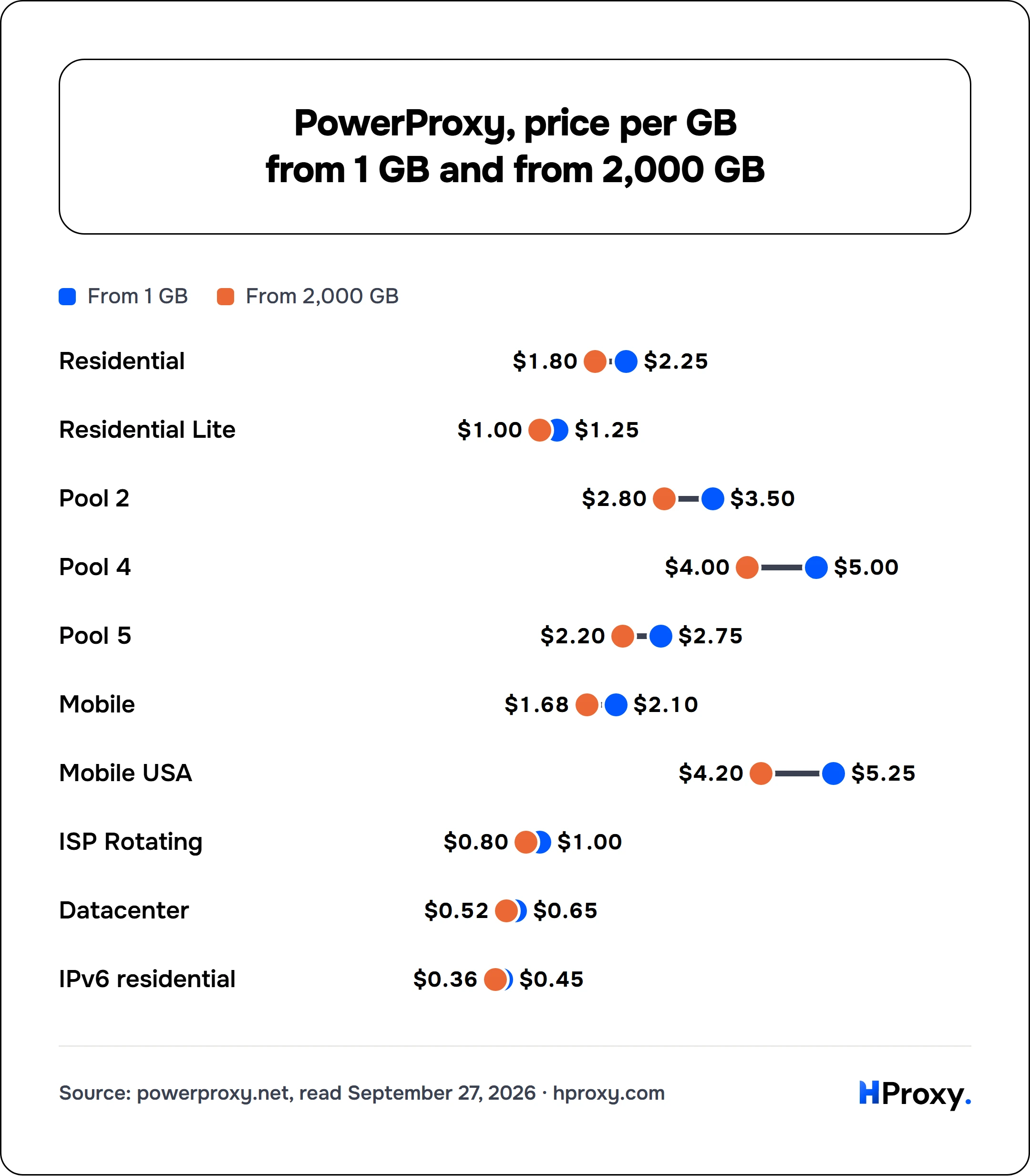
What PowerProxy charges
| product | per GB from 1 GB | per GB from 2,000 GB | targeting |
|---|---|---|---|
| Residential | $2.25 | $1.80 | country, state, city |
| Residential Lite | $1.25 | $1.00 | country |
| Pool 2 | $3.50 | $2.80 | state and city |
| Pool 4 | $5.00 | $4.00 | state, city and ASN |
| Pool 5 | $2.75 | $2.20 | country |
| Mobile | $2.10 | $1.68 | country |
| Mobile USA | $5.25 | $4.20 | United States |
| ISP Rotating | $1.00 | $0.80 | United States |
| Datacenter | $0.65 | $0.52 | one country |
| IPv6 residential | $0.45 | $0.36 | one country |
- From 1 GB
- From 2,000 GB
Every product takes 5% off from 25 GB, 10% from 100 GB, 15% from 500 GB and 20% from 2,000 GB. ISP Static and the unlimited plans show their prices only at checkout.
The fine print
No company named. Its terms, updated in July 2026, name only PowerProxy and choose the law of the country where its operator is established, without naming that country either.
Refunds are rare. Its terms call purchases "generally non-refundable". It may give wallet credit for a verified fault on its side, the wallet balance has no cash value, and crypto payments are final.
Some products stay in one country. Its datacenter, ISP, IPv6 and US mobile products have no location choice, so check the country before you buy.
A trial with no stated size. A free trial comes with a new account, and its pages do not say how much it includes.
Its history
The current registration of powerproxy.net began on 29 May 2026. Older copies of the name in the Internet Archive, from 2005 and 2014, belong to earlier sites, and the proxy shop appears there in June 2026.
Where PowerProxy is stronger
A pool for each job. Five residential pools, from country-only traffic to state, city and ASN targeting.
Week-long sessions. Pool 2 can hold one residential IP for up to 7 days.
Unlimited plans. Access with no traffic cap, sold by time, for jobs that move a lot of data.
Where HProxy differs
We sell proxies too, so read this part as the account of a competitor. Every HProxy fact here comes from our own product code and pages.
By country for less. Lite targets by country at $0.50/GB for one gigabyte, against $1.25 for PowerProxy Residential Lite. Neither side puts an expiry date on purchased gigabytes.
City targeting from one gigabyte. Premium, our pool with state, city and ISP targeting, costs $1.49/GB for one gigabyte, against $2.25 for PowerProxy Residential, with sessions from 3 minutes to 24 hours.
Mobile by the gigabyte. Rotating mobile traffic, targeted by country, costs $1.50/GB, against $2.10 a GB for PowerProxy mobile, which also targets by country.
A company in the German register. Our imprint names the company behind HProxy, registered in the German commercial register.
Where we are behind. We hold sessions for up to 24 hours, not 7 days, and we sell no unlimited residential plan.
The alternatives, side by side
Residential proxies with city targeting, at the smallest buy. The PowerProxy row comes from its price data of 27 September 2026, and every other figure from the page of each vendor, read on 26 or 27 September 2026.
| provider | smallest buy | per GB at that size |
|---|---|---|
| PowerProxy Residential | 1 GB for $2.25 | $2.25 |
| Evomi Core | 15 GB, pay as you go | $0.99 |
| DataImpulse | 5 GB for $5 | $2.00 with city filters |
| Shifter | 5 GB for $10 a month | $2.00 |
| 911Proxy | 10 GB for $27 | $2.70 |
| NST Prime | 50 GB | $1.60 |
| HProxy Premium | 1 GB | $1.49/GB |
Our reviews of Evomi, DataImpulse, Shifter, 911Proxy and NST cover their terms in full.
Who PowerProxy suits
It suits a buyer who wants many pools in one account, week-long sticky sessions, or unlimited traffic, and who does not mind a shop only a few months old.
It suits you less if you want a named company, a refund after testing, or a location choice on datacenter and ISP proxies.
Before you commit
Take the free trial and test the exact pool you plan to buy, since each one has its own rules for location and sessions. Our proxy checker shows whether an address answers, how fast, and from where, whoever sold it.
The limits of this review
We did not buy a plan or test its network. Its pool size and country counts are its own claims, and the ISP Static and unlimited prices appear only at checkout, so they are not on this page.
Every figure here carries the day it was read, and this page is due for a check by 27 December 2026.
Sources
- PowerProxy, powerproxy.net: homepage and the price data it loads, docs and terms of service. Read 27 September 2026.
- Verisign, registry record for powerproxy.net. Read 27 September 2026.
- Internet Archive, titles of powerproxy.net captures, from our record of 20 September 2026.
- Evomi, DataImpulse, Shifter, 911Proxy and NST, residential price pages. Read 26 and 27 September 2026.
- HProxy, our own product records, price table, terms and imprint.