Proxiware (proxiware.com), run by Proxiware LLC in Delaware, sells eight kinds of proxies, from cheap residential traffic to unlimited plans by the day. Every price below comes from its own pages and the price data they load, read on 27 September 2026. For the comparison, jump to the alternatives table.
Proxiware at a glance
| what we found on 27 September 2026 | |
|---|---|
| status | live, plans on sale |
| operator | Proxiware LLC, Delaware, by its terms |
| residential | Eco from $3 a month for 10 GB, Premium from $4 for 1 GB |
| mobile | from $3 a month for 1 GB |
| static ISP | from $0.50 an IP for 30 days, 9 countries |
| unlimited | residential from $28.88 a day at 25 Mbps |
| billing | monthly plans, unused data rolls over while you pay |
| pool | 100M+ IPs in 180+ countries, by its count |
| sessions | rotating, or sticky up to 24 hours on residential |
| refunds | its pages and its terms disagree |
What Proxiware sells
Residential, in two pools. Premium draws on 100M+ IPs and Eco on 30M+, and both take country, state and city targeting and hold a session for up to 24 hours.
Mobile, datacenter and rotating ISP. All three are sold by the gigabyte, and it counts 10M+ mobile IPs, 1M+ datacenter IPs in 25+ locations and 10K+ rotating ISP addresses.
Static ISP. Fixed addresses on ISP networks in 9 countries, billed per IP for 30, 60 or 90 days.
Unlimited plans. Residential and ISP traffic with no data cap, sold by speed for 1, 7 or 30 days, with unlimited ISP in the United States only.
Free tools. It also runs a proxy checker and a free proxy list, open to anyone.
What Proxiware charges
| product | smallest plan | largest plan |
|---|---|---|
| Premium residential | 1 GB for $4 ($4.00 a GB) | 1,000 GB for $1,670 ($1.67 a GB) |
| Eco residential | 10 GB for $3 ($0.30 a GB) | 10,000 GB for $1,500 ($0.15 a GB) |
| mobile | 1 GB for $3 ($3.00 a GB) | 200 GB for $300 ($1.50 a GB) |
| datacenter | 5 GB for $3.50 ($0.70 a GB) | 1,000 GB for $400 ($0.40 a GB) |
| rotating ISP | 1 GB for $1.92 ($1.92 a GB) | 10,000 GB for $3,700 ($0.37 a GB) |
Every plan in this table is a monthly plan, and codes for 25% off were on show for Premium, mobile, datacenter and rotating ISP, but not for Eco. The homepage rate of $1.25 a GB needs both the 1,000 GB Premium plan and the code.
Static ISP starts at $0.50 an IP for 30 days, with 10% off for 60 days and 20% off for 90. Unlimited residential costs $28.88 a day, $95.98 for 7 days or $287.93 for 30 days at 25 Mbps. Unlimited ISP costs $53 for 7 days or $160 for 30 days at the same speed.
The fine print
Refunds, three ways. Its product pages promise a full refund to a buyer who has not used the allocation. Its terms, in force since 14 September 2026, say all payments are final unless it agrees otherwise in writing, and they call account credit "strictly non-refundable". Its unlimited pages rule out refunds under any conditions.
Rollover while you pay. Unused data carries over to the next month only while the subscription stays active.
Identity checks. Its KYC policy lets it ask any new account for an ID, proof of address and a selfie check, run through Stripe.
Pages that disagree. The homepage prints Unlimited ISP at $53 a day, but the plan behind that price runs for 7 days. The datacenter page promises sessions of up to 24 hours, while its price data caps them at 120 minutes. The mobile page promises city targeting, while the mobile data lists country and state only.
Sourcing. It says its residential IPs come from an opt-in network, but no page we read names the apps or partners behind it.
Who you deal with. Proxiware LLC gives no street address, and disputes go to binding arbitration in Delaware, with a class action waiver.
Its history
The domain has had more than one life: in 2001 it carried a notice from Pumatech that its ProxiWeb server had been switched off, and in 2014 it was parked for sale.
The current registration dates from 26 October 2019. By June 2020 the site sold "25+ Million Real Residential Proxies" in 150+ countries, from $7 a month for 1 GB. By June 2025 it claimed "Over 10+ Years of Experience" and sold IPv6 proxies, which are no longer on its menu.
Where Proxiware is stronger
Cheap residential with city targeting. Eco costs $0.30 a GB at 10 GB and $0.15 at 10,000 GB, with country, state and city targeting.
Cheap static ISP. Fixed ISP addresses cost from $0.50 an IP for 30 days, in 9 countries.
Unlimited plans. Residential and ISP traffic with no data cap, by the day, the week or the month.
Where HProxy differs
We sell proxies too, so read this part as the account of a competitor. Every HProxy fact here comes from our own product code and pages.
One gigabyte, no subscription. Lite targets by country at $0.50/GB for one gigabyte. Purchased gigabytes have no scheduled expiry date, and nothing renews.
City targeting from one gigabyte. Premium, our pool with state, city and ISP targeting, costs $1.49/GB for one gigabyte, against $4 a month for the smallest Proxiware Premium plan, with sessions from 3 minutes to 24 hours.
Mobile with no plan. Rotating mobile traffic, targeted by country, costs $1.50/GB, bought once, while Proxiware mobile starts at $3 for 1 GB a month.
No documents. We ask for no documents at sign-up or at an ordinary checkout, and we take cards, Alipay and thirty-two crypto options.
Where we are behind. Eco costs less per gigabyte than our Lite and adds city targeting, and a static ISP address costs $2.70/IP for a month with us, against $0.50 at Proxiware. We sell no unlimited residential plan either.
The alternatives, side by side
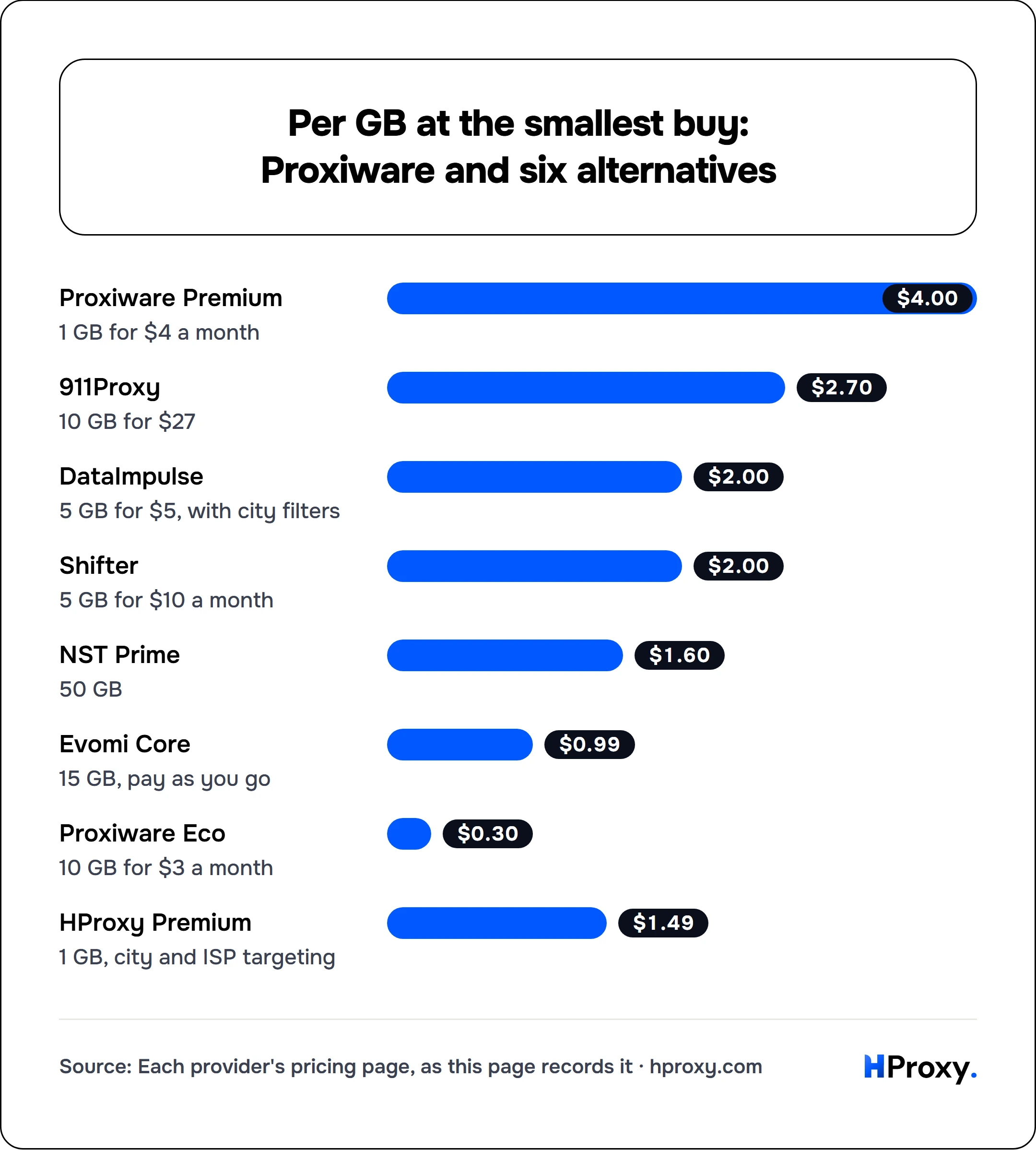
Residential proxies with city targeting, at the smallest buy. The Proxiware rows come from its price data of 27 September 2026, and every other figure from the page of each vendor, read on 26 or 27 September 2026.
| provider | smallest buy | per GB at that size |
|---|---|---|
| Proxiware Eco | 10 GB for $3 a month | $0.30 |
| Proxiware Premium | 1 GB for $4 a month | $4.00 |
| Evomi Core | 15 GB, pay as you go | $0.99 |
| DataImpulse | 5 GB for $5 | $2.00 with city filters |
| Shifter | 5 GB for $10 a month | $2.00 |
| 911Proxy | 10 GB for $27 | $2.70 |
| NST Prime | 50 GB | $1.60 |
| HProxy Premium | 1 GB | $1.49/GB |
Our reviews of Evomi, DataImpulse, Shifter, 911Proxy and NST cover their terms in full.
Who Proxiware suits
It suits a buyer who moves a steady amount of residential traffic every month and wants city targeting at the lowest rate. It also suits someone who needs cheap static ISP addresses or unlimited traffic for a day.
It suits you less if you buy now and then and want data that never expires, need a firm refund promise, or want to know more about the company than a name in Delaware.
Before you commit
Read the refund section of its terms before you pay, since it is stricter than the promise on the product pages. Remember too that unused data survives only while the plan renews. Our proxy checker shows whether an address answers, how fast, and from where, whoever sold it.
The limits of this review
We did not buy a Proxiware plan or test its network. Its pool sizes, uptime and success rates are its own claims, and its pages disagree on sessions and targeting in places. The prices come from the price data its own pages load, read on 27 September 2026.
Every figure here carries the day it was read, and this page is due for a check by 27 December 2026.
Sources
- Proxiware, proxiware.com: homepage, eight product pages, the price data those pages load, terms of service, KYC policy and privacy policy. Read 27 September 2026.
- Internet Archive, copies of proxiware.com from 31 March 2001, 18 December 2014, 1 June 2020 and 2 June 2025. Read 27 September 2026.
- Verisign, registry record for proxiware.com. Read 27 September 2026.
- Evomi, DataImpulse, Shifter, 911Proxy and NST, residential price pages. Read 26 and 27 September 2026.
- HProxy, our own product records, price table and terms.