Open Proxy List is live at openproxylist.com, and it sells no proxies. It lists free public proxies, 816 of them in 87 countries on 27 September 2026, next to public V2Ray and OpenVPN servers. It needs no sign-up, shows ads and names nobody behind it. The alternatives are in the table below.
Is Open Proxy List legit? The record in one table
| what we read on 27 September 2026 | |
|---|---|
| website | openproxylist.com answers normally, behind Cloudflare |
| operator | none named: the terms say only "our Company" |
| what it offers | free proxy, V2Ray and OpenVPN lists, and a proxy checker |
| how it earns | ads, by its privacy policy, and donations on its GitHub lists |
| price | free, with no sign-up |
| domain | registered 7 April 2021, through NameCheap |
| Trustpilot | no page we could read, and no archived copy |
It is a free list with a five-year record in its current form, and what it does not publish is who runs it.
What the free lists offer
The proxy page sorts public proxies by country, port, speed, type and anonymity. That day it showed 816 addresses in 87 countries, with 137 in Indonesia, 95 in India and 57 in Brazil. The site says it checks "every public proxy in minute-level intervals", but we did not measure the list, so that check is its own claim.
The download buttons lead to a public GitHub repository of the same name, created in April 2021 and updated every hour. At 08:00 UTC that day its files held 88 HTTP(S), 150 SOCKS4 and 3 SOCKS5 addresses, and the repository had 929 stars.
Two more lists sit beside the proxies: the V2Ray page showed 909 servers in 53 countries, and the OpenVPN page 796 servers in 23 countries. A free checker on the same site tests up to 100 proxies at a time.
The fine print
Public servers, public risk. Its FAQ says plainly: "They are public servers." Someone you do not know runs each one, so treat every entry as untrusted.
No owner on record. The terms and the privacy policy are general templates that name no company, no address and no law.
Ads pay for it. The privacy policy names Google advertising cookies, and the GitHub lists ask for donations in crypto.
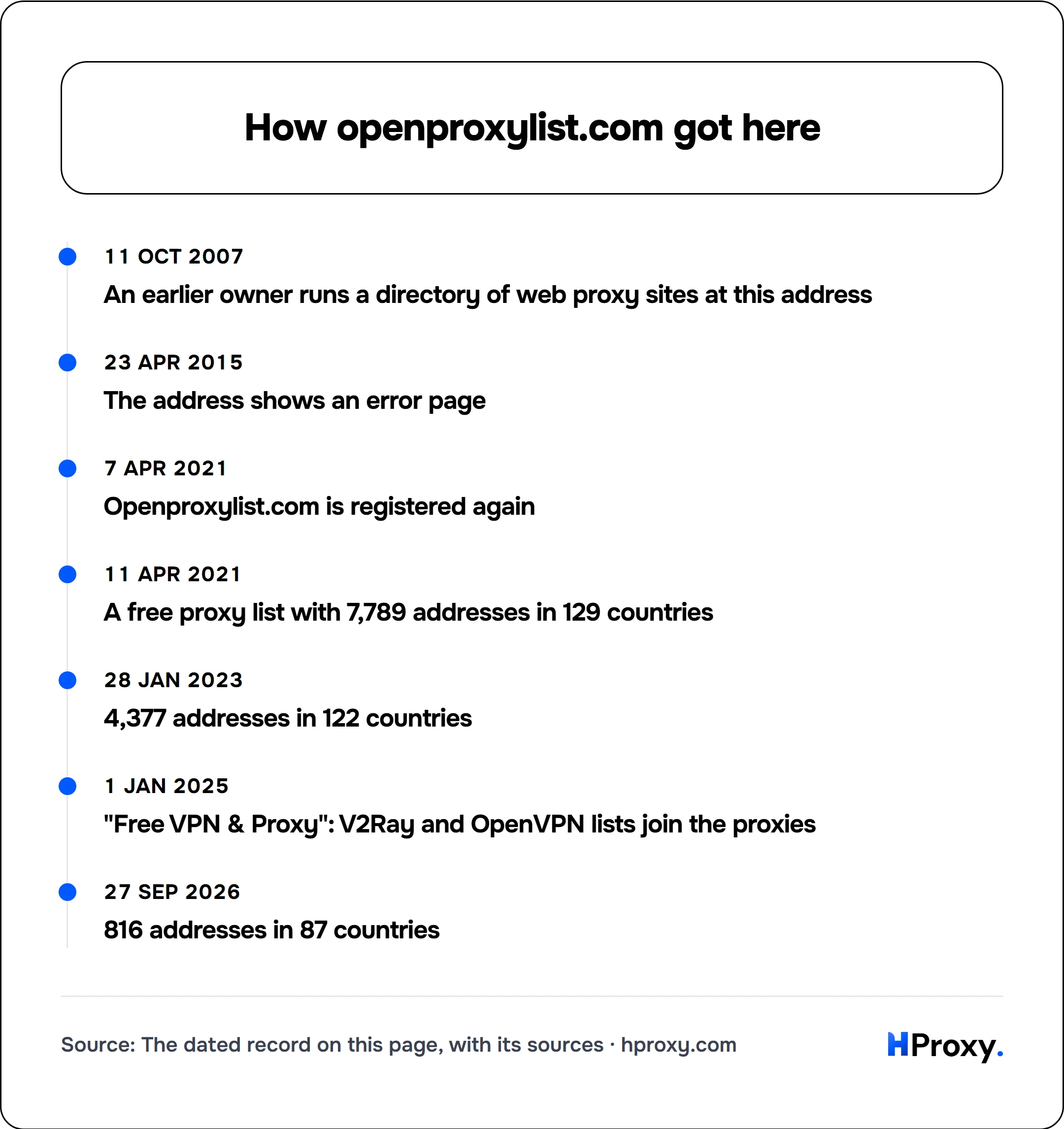
How openproxylist.com got here
| date | what the record shows |
|---|---|
| 11 October 2007 | an earlier owner runs a directory of web proxy sites at this address |
| 23 April 2015 | the address shows an error page |
| 7 April 2021 | openproxylist.com is registered again |
| 11 April 2021 | a free proxy list with 7,789 addresses in 129 countries |
| 28 January 2023 | 4,377 addresses in 122 countries |
| 1 January 2025 | "Free VPN & Proxy": V2Ray and OpenVPN lists join the proxies |
| 27 September 2026 | 816 addresses in 87 countries |
11 Oct 2007
An earlier owner runs a directory of web proxy sites at this address
23 Apr 2015
The address shows an error page
7 Apr 2021
Openproxylist.com is registered again
11 Apr 2021
A free proxy list with 7,789 addresses in 129 countries
28 Jan 2023
4,377 addresses in 122 countries
1 Jan 2025
"Free VPN & Proxy": V2Ray and OpenVPN lists join the proxies
27 Sep 2026
816 addresses in 87 countries
Sources: the domain registry, the Internet Archive and its own pages, read the same day. Nothing links the 2007 directory to the current site.
Open Proxy List alternatives for free and paid proxies
On 9 September 2026 we took a random sample from eleven free lists and opened every address in it. This list was not in that test. The rows below come from our test of eleven free lists.
| list | addresses listed | share that relayed our sample, 9 September |
|---|---|---|
| Open Proxy List | 816 on 27 September | not in our test |
| free-proxy-list.net | 300 | 34.2% |
| ProxyScrape | 624 to 671 | 26.7% |
| Spys.me | 400 | 25.0% |
| TheSpeedX (GitHub) | 3,024 | 7.5% |
| Proxifly (GitHub) | 2,385 | 2.5% |
A longer list did not relay more that day. TheSpeedX published 3,024 addresses and relayed 7.5 percent, while free-proxy-list.net published 300 and relayed 34.2 percent. Our own free proxy list comes from an engine that has run 129M checks across 110 sources, as measured on 2026-08-11.
When free proxies are not enough, paid traffic removes the guesswork. Our Residential Lite costs $0.50 per GB for a first gigabyte, with country targeting. Premium costs $1.49 per GB and adds state, city and ISP targeting. Both are on our price table.
Where Open Proxy List is the better choice
Three kinds of free server in one place. Proxies, V2Ray servers and OpenVPN servers sit side by side, with no account.
Plain text on GitHub. The lists come as text files in a public repository, updated every hour, which suits scripts.
Filters for each list. Country, port, speed, type and anonymity filters narrow the proxy list in the browser.
Where HProxy is the better fit
Measured numbers. We publish what our tests found, with the date, for the free lists we compare, while its checks every minute are its own claim.
A checker for large lists. Our free proxy checker tests up to 100,000 proxies without an account. Its checker takes up to 100 at a time.
A company you can name. HProxy is run by Obsidian UG in Herford, Germany, with its register number in our imprint, while Open Proxy List names no one.
Paid proxies when free ones fail. Our paid proxies come with targeting and a balance that never expires.
Before you commit
Pull a sample from any free list and run it through our proxy checker before you rely on it. Send nothing private through a public proxy, and if most addresses fail, test a gigabyte of paid traffic next.
The limits of this record
We did not test Open Proxy List, so its counts and its checks every minute are its own figures. The counts change by the hour: the site and its GitHub files showed different totals the same morning. This page is due for a check by 27 December 2026.
Other providers we cover
Pages on other proxy brands: Iced Out Proxies, Illusory.io, Impexproxy.com, Incogniton.com and Infatica.io.
Sources
Every source below was read on 27 September 2026, except our free list test of 9 September 2026.
- Open Proxy List: homepage, proxy, V2Ray and OpenVPN lists, proxy checker, terms and privacy policy.
- GitHub, the repository behind its downloads and its hourly text files.
- Verisign, the registry record for openproxylist.com.
- Internet Archive, captures of openproxylist.com from 11 October 2007 to 7 January 2026.
- HProxy, our test of eleven free proxy lists, 9 September 2026.
- HProxy, our free proxy engine figures, product catalog, price table and imprint.