monosans/proxy-list is a free list of HTTP, SOCKS4 and SOCKS5 proxies on GitHub, and it is active: we saw it update at 02:24 and again at 03:26 UTC on 27 September 2026. One developer keeps it, re-tests every proxy each hour with an open source checker that the same developer wrote, and charges nothing. At 03:00 UTC it held 606 proxies. For the comparison, jump to the alternatives table.
monosans/proxy-list at a glance
| what we found on 27 September 2026 | |
|---|---|
| what it is | a free proxy list on GitHub, kept by one developer |
| online since | June 2021 |
| updates | every hour, each one replacing the last |
| size at 03:00 UTC | 606 proxies: 238 HTTP, 41 SOCKS4, 327 SOCKS5 |
| test | every proxy must load a real URL in full |
| formats | four text files and JSON with exit IP, network and city |
| order | fastest first |
| price | free, no signup, no API key, no rate limit |
| popularity | 1,520 stars and 188 forks |
| licence | MIT |
How the list is made
A tool called proxy-scraper-checker, written in Rust by the same developer, collects proxies from public sources and tests each one. A proxy makes the list only if it fetches a real URL completely, so ones that connect and then stall are left out. The tool runs every hour on a server the developer runs and pushes the result to GitHub.
The list comes as six files: all proxies with their protocol, one text file per protocol, and two JSON files. Each JSON entry carries the host, port, response time, the exit IP the target saw, the network owner and a GeoLite2 location down to the city. The files are sorted fastest first, and each update message states the count per protocol.
In June 2024 the owner explained how to read anonymity from the JSON: a proxy counts as anonymous when its exit IP differs from its host. There is no separate anonymity grade.
What we measured
We read the list at 03:00 UTC on 27 September 2026, without connecting to any of the proxies.
| measure | result |
|---|---|
| proxies | 606, none with a user name or password |
| by protocol | 327 SOCKS5, 238 HTTP, 41 SOCKS4 |
| countries | 68; the US 130, Russia 58, Indonesia 58, Colombia 36 |
| largest network | DigitalOcean, 46 proxies |
| exit IP differs from host | 359 of 606 |
| full request time | median 2.47 seconds, slowest 5.88 |
| still listed after the next update | 183 of 606 |
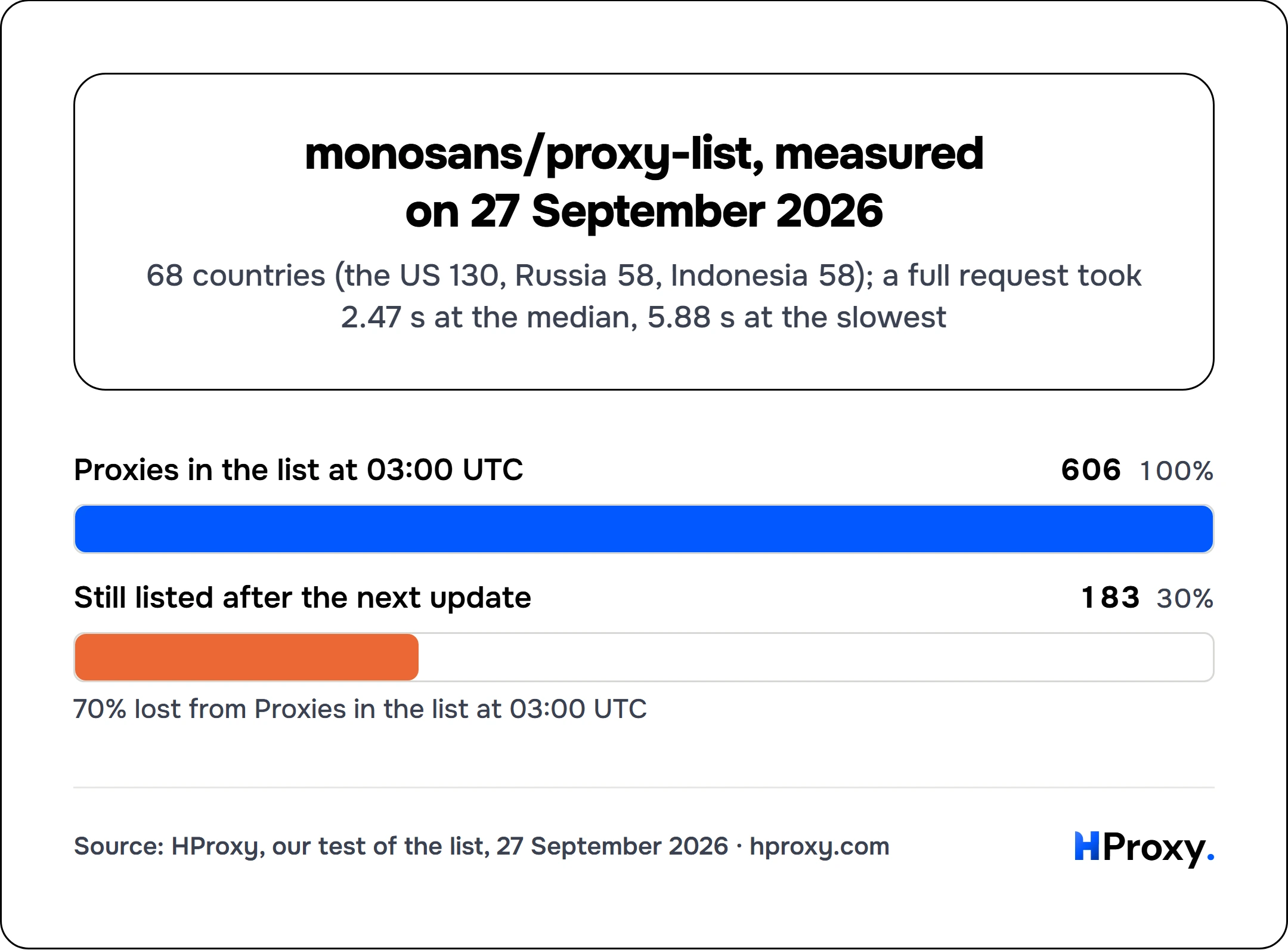
70% lost from Proxies in the list at 03:00 UTC
At the next update, at 03:26 UTC, the list held 545 proxies. Only 183 of the 606 from the hour before were still on it, and 362 were new.
How it changed
The list started in June 2021. In August 2021 it promised updates "every ~15 minutes", and one update held 8,118 proxies, 7,146 of them SOCKS4. By August 2022 it updated every 30 minutes and one update held 851. It has updated hourly since at least January 2025.
Its following grew steadily: 56 stars in August 2021, 442 a year later, 756 in December 2023, about 1,100 in January 2025, and 1,520 on 27 September 2026.
The fine print
Public proxies, public risk. Its README says whoever runs one of these proxies "can see, log and modify everything that passes through it". It advises never to send credentials or personal data through them and to stick to HTTPS.
They die quickly. The README expects a proxy that worked at the top of the hour to be gone by the next update, and asks you to re-fetch the list rather than cache it.
No history. The repository keeps a single commit, and each hourly update replaces it. The list of the day before, and how long a proxy stayed alive, cannot be looked up there.
No promise. It is free and comes with no support or uptime of any kind. The README itself says: "If you need proxies you can actually rely on, use a paid provider."
One person, one sponsor. The project belongs to a single developer, who takes sponsorship requests on Telegram. Its current sponsor, named in the README, is a paid proxy provider.
Where monosans/proxy-list is stronger
Open code you can run. The checker behind the list is open source under the MIT licence, so you can build the same list from your own sources, test URL and schedule.
A strict test. Every proxy has to load a full page, not just open a connection.
Rich, simple files. Plain text for any script, and JSON with exit IP, network and city, sorted fastest first.
Reach. 1,520 stars and 188 forks, far more than our own GitHub list.
No strings. No signup, no key, no rate limit, and no paid tier to push you into.
Where HProxy differs
We run a free proxy list too, so read this part as the account of a competitor. Every HProxy fact here comes from our own code and pages.
Our free list. Our free proxy list covers HTTP, HTTPS, SOCKS4 and SOCKS5 and says it re-checks the pool around the clock. It shows country, anonymity grade, latency and uptime for each proxy, with filters by country, protocol and anonymity, a download, and a free API with no signup.
History that stays. Each proxy that ever appeared keeps its own page with its uptime record, so you can check whether an address was a public proxy and when.
Our GitHub list. We publish the list on GitHub as well, under the MIT licence, with 64 stars. Its description says it is verified around the clock and updated several times a day.
Paid proxies when free ones fail. Our residential Lite pool targets by country at $0.50/GB for one gigabyte. Premium adds state, city and ISP targeting at $1.49/GB for one gigabyte, and $1.00/GB from 1,000 GB+. A dedicated ISP address costs $2.70/IP for a month.
Where we are behind. Our GitHub list has a small fraction of its following: 64 stars against 1,520.
The alternatives, side by side
Free lists and the paid step up. Every figure below comes from the page or repository of each, read on 27 September 2026.
| option | what you get | cost | checks | history |
|---|---|---|---|---|
| monosans/proxy-list | about 600 HTTP, SOCKS4 and SOCKS5 proxies | free | hourly, full page load | none kept |
| proxy-scraper-checker | your own list, your sources | free, runs on your machine | your schedule | yours to keep |
| HProxy free list | thousands of HTTP, HTTPS, SOCKS4 and SOCKS5 proxies | free | around the clock | a page per proxy |
| HProxy residential Lite | rotating residential IPs by country | $0.50/GB for 1 GB | a paid pool | not applicable |
| HProxy residential Premium | state, city and ISP targeting | $1.49/GB for 1 GB | a paid pool | not applicable |
Free lists suit tests, learning and throwaway tasks. When a job has to keep running, the README and we agree: pay for proxies that are yours to use.
Who monosans/proxy-list suits
It suits a developer who wants a small, well-tested free list in plain files, or wants to run the same checker on their own sources. It is a good first stop for experiments.
It suits you less if you need HTTPS proxies listed on their own, an anonymity grade, history per proxy, filters, or anything you can depend on for work.
Before you commit
Fetch the list again rather than caching it, test a few proxies against your own target, and never send anything private through a public proxy. Our proxy checker shows whether an address answers, how fast, and from where, whoever listed it.
More free-list comparisons on our blog: Free Proxy List, Freeproxy, FreeProxyList.cc, Freeproxylists, fyvri/fresh-proxy-list and Geonix.
The limits of this review
We did not connect to any proxy on the list; the measurements come from its own files and metadata. The repository keeps no history, so the older counts come from Internet Archive copies of its GitHub page.
Every figure here carries the day it was read, and this page is due for a check by 27 December 2026.
Sources
- monosans/proxy-list on GitHub: repository data, README, the latest commit, the raw list files and the three issues. Read through the GitHub API on 27 September 2026.
- monosans/proxy-scraper-checker on GitHub: repository data. Read 27 September 2026.
- Internet Archive, copies of the GitHub page from August 2021, August 2022, December 2023, January 2025 and January 2026.
- HProxy, our free proxy list page, our GitHub list, and our product records and price table.