FreeProxy.World publishes fifty addresses on its front page. Each carries a freshness badge saying it was checked minutes ago. We looked up the registered owner of every one of them on 9 September 2026. Thirty-nine belong to Cloudflare, a content delivery network. Two more are network addresses ending in zero, which no host can ever answer on. That makes it a list of edge servers with a timer on it.
What we did
This is a simple check and anyone can repeat it. We fetched the front page and read the fifty addresses out of the table. Then we asked a public ownership service who each address belongs to.
The answers were not mixed. Twenty-seven came back as Cloudflare, Inc. Twelve more as Cloudflare London, LLC. Three belong to a hosting company. The remaining handful sit with a website builder, a domain registrar and a regional telephone company.
Two of the fifty end in zero. An address ending in zero is the name of a network, not a machine inside it. Nothing can listen there, so nothing can proxy through it.
We then tested the same fifty addresses the way we test every list. One of the fifty relayed a request. That is 2.0 percent, against a market that managed 14.0 percent the same afternoon. Two different methods, one answer.
Why this happens, and why we are careful about it
A content delivery network sits in front of millions of websites. Its edge servers answer almost any request arriving with a host header they recognise. They answer it quickly, too.
Point a checker at one of those addresses and something replies. If the checker only asks "did I get a response", it marks the address alive. The address never relayed anything. It simply served a page it was already holding.
We are not guessing at this mechanism. We walked into it ourselves. In an earlier audit of our own pool, 287 addresses looked like proxies leaking the caller's address. That would have been a dramatic finding. They were edge servers returning our own site to us. Our test target sat behind the same network. We threw out all 287 and changed the rule. An address counts only when the reply carries an exit address that is not ours.
Any list that has not made that correction will fill up with these entries on its own. Nobody has to be dishonest for it to happen.
What the rest of the market looks like
On the same afternoon we ran one relay test across nine public lists. One machine, one German datacentre. For each list we took a random sample of up to 120 entries. We opened every address and fetched a real page through it. The reply had to carry an exit address that was not ours.
| List | Addresses published | First run | Thirty minutes later |
|---|---|---|---|
| ProxyNova (decoded) | 26 of 37 rows | 53.8% | not re-run |
| free-proxy-list.net | 300 | 34.2% | 38.3% |
| ProxyScrape | 624 to 671 | 26.7% | 33.3% |
| Spys.me | 400 | 25.0% | 13.3% |
| monosans (GitHub) | 619 | 20.8% | 12.5% |
| iplocate (GitHub) | 646 to 718 | 18.3% | 16.7% |
| Geonode | 500 | not parsed | 7.5% |
| TheSpeedX (GitHub) | 3,024 | 7.5% | 5.0% |
| Proxifly (GitHub) | 2,385 | 2.5% | 4.2% |
| FreeProxy.World | 50 | not parsed | 2.0% |
| clarketm (GitHub) | 400 | 0.8% | 0.0% |
In the first run, 163 of 961 sampled entries relayed a request across the set. That is 17.0 percent. A second run half an hour later gave 158 of 1,131, or 14.0 percent. Two further endpoints answered nothing at all: OpenProxy.space returned HTTP 521 and proxy-list.download returned HTTP 502.
We measured twice, and the numbers moved
Half an hour after the first pass we ran the whole audit again. Same machine, same method, same sample size.
Eight lists were measured twice with a usable sample. The median moved 3.3 percentage points. The largest move was 11.7. Spys.me went from 25.0 percent to 13.3. monosans went from 20.8 to 12.5. Two lists moved the other way: ProxyScrape rose from 26.7 to 33.3, and free-proxy-list.net from 34.2 to 38.3.
With a sample of 120 the ordinary error near a 17 percent rate is about 3.4 points. Swings of eight to twelve points are therefore real churn, not noise.
Read every number on this page with that in mind. None of them is a verdict. They are two photographs of a market that reshuffles inside an hour. That is the strongest argument on this page. A list publishing a bare count, with no date and no method, is telling you nothing.
Note what is missing from that table. Not one of these lists publishes a success rate of its own. They publish a count and an interval, and a reader has no way to check either.
How to check any list in two minutes
You do not need our tooling to do this. Take five addresses off any list and do two things with each.
First, fetch a page through it and look at the address the far end reports. If it matches your own address, nothing was proxied.
Second, look up who owns the address that comes back. If the owner is a content delivery network, a website builder or a registrar, walk away. None of those companies runs open proxies. Their addresses end up on these lists because a scanner found something answering on port 80.
A list that survives both checks is worth your time. Most will not.
What a free proxy is, when it is real
We run a free pool of our own and watch these addresses over time. That lets us describe the lifecycle rather than guess at it.
Of the 767,233 free proxies our engine had set aside by 28 September 2026, 469,417 never answered a single check. 297,816 did work, but most of those sat on 802 addresses with 20 or more ports each. Counting only the other addresses, the 25,977 that worked lasted a median 235 hours, about 10 days. That count also leaves out Amazon's networks and one June evening when our checker failed. 4.9 percent stopped within their first hour, and 30.9 percent were still answering a month later. So most vanish before they ever work, and half of the survivors are gone within about ten days.
Being alive is also not the same as being useful. The median live free proxy in our pool succeeds on 45.5 percent of its own checks. Only 401 of 9,452 live entries passed a bar of ten checks at 90 percent success.
The part that decides whether it works for you
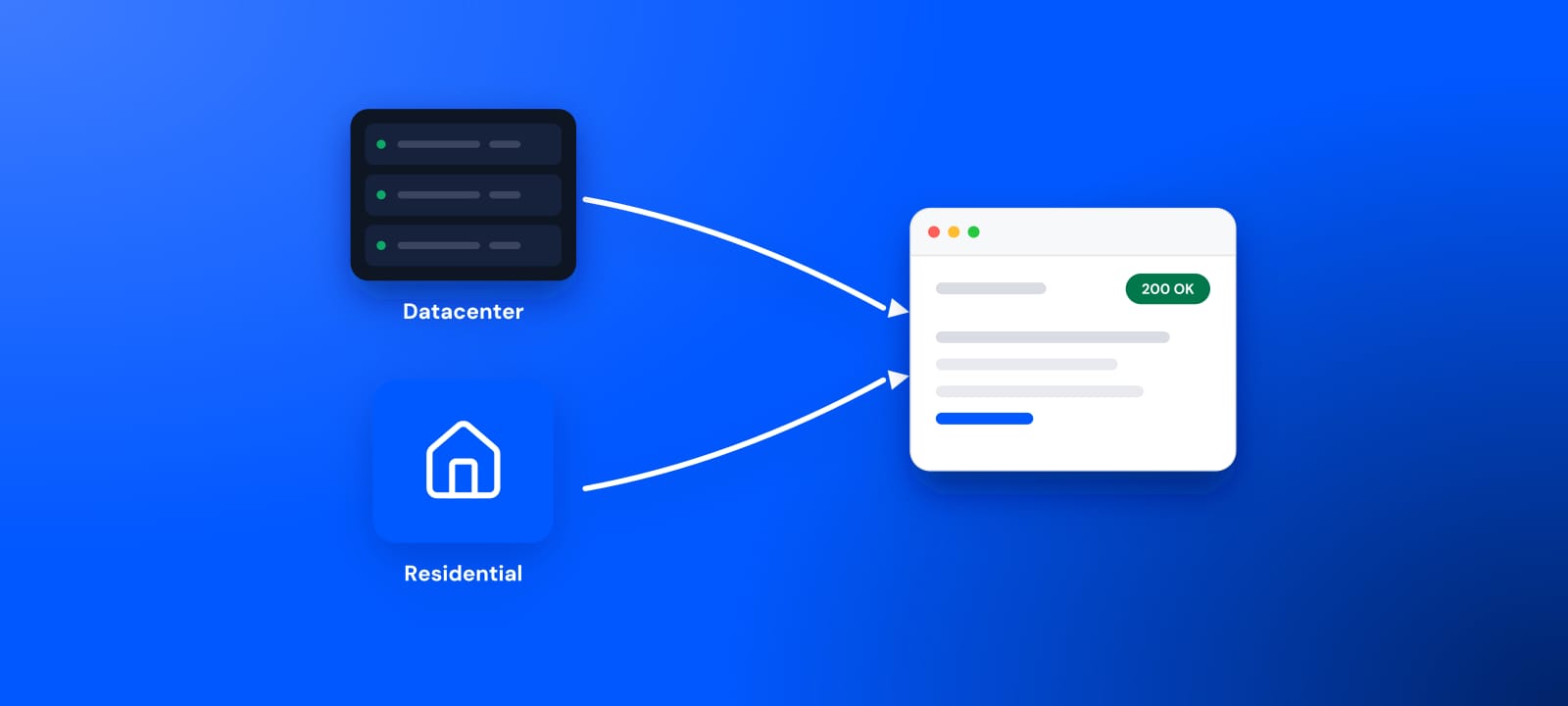
Of the live free proxies we hold fraud data for, 89.3 percent were flagged for recent abuse. The average fraud score was 72.5, and none of them were residential. 82.9 percent sat on datacenter address space.
That is the real reason a free proxy can connect perfectly and still fail. The site you care about already knows the address. The address was burned long before you found it, by someone else, doing something else.
Free proxies are the right tool for a test or a geo check. Our own free list exists for exactly that. When a job has to keep running, the numbers above explain why they stop. HProxy paid proxies use residential, ISP, mobile and datacenter addresses that are not already flagged. They are billed by the gigabyte with no subscription, from $0.44/GB.
Method and limits
The ownership check covers the fifty addresses visible on the front page on 9 September 2026. It is not a claim about every address the site holds. A different page, or a different day, may look different.
We report what the ownership records say, and nothing about intent. A list can fill with edge servers through a weak checker and no bad faith at all. That is the likeliest explanation here, and the one we would bet on.
The relay figures come from one afternoon, one datacentre in Germany, and a random sample per list. A home connection or a school network may see different results. Several operators treat a datacentre address differently from a residential one.
Sources
- Our own address-ownership check of the fifty entries on the FreeProxy.World front page, 9 September 2026.
- Our own market audit of nine public proxy lists, run the same afternoon. Both instruments and their raw output are kept with this article's research folder.
- Our own free proxy pool: 763,409 addresses seen since it opened, 691,179 with a recorded death, queried 5 September 2026.
- Our own free proxy pool again on 28 September 2026, for how long the ones that worked lasted, counted on addresses with fewer than 20 such proxies, without Amazon's networks or one June evening when our checker failed.