
Geonix (geonix.com) is the shop that sold proxies as Proxy-Sale from 2016 and took its new name in the summer of 2025. It rents dedicated datacenter IPv4 addresses, IPv6, ISP and mobile proxies by the address, and residential traffic by the gigabyte. On 14 October 2026 one US IPv4 address cost $1.57 for 30 days, ten cost $14.92 and a hundred $117.75. An IPv6 address cost $0.14 in orders of ten or more, and residential traffic ran from $3 for one gigabyte down to $0.49 a gigabyte at 10,000. For IPv6, and for a hundred IPv4 addresses, Geonix was the cheapest of the sellers whose per-address prices we could read that day. For ten IPv4 addresses Proxy-Cheap was 72 cents cheaper, and for 100 GB of residential traffic Proxy-Cheap and DataImpulse asked $78 and $100 against $180. Its contract names INTERNET CONNECTION BROKER LTD of Sofia, Bulgaria. The comparison prices the same orders at nine sellers.
Geonix's prices on 14 October 2026
Geonix's price calculators do their sums inside the page you load. Each price page carries the numbers they use: a price per address for every country, a percentage for each rental length and a discount for each order size. We read those tables from the pages and did the arithmetic ourselves. The starting prices on its menu are the cheapest corner of each table.
Dedicated IPv4 is its main product. Of the 38 countries on its menu, 11 cost $1.43 an address for 30 days, among them Bulgaria, Czechia, Portugal, Russia and Ukraine. The United States costs $1.57. Another 23 cost $1.65, Germany, France, the United Kingdom, the Netherlands, Japan and Canada among them, and three cost $2.70: Kazakhstan, South Africa and South Korea.
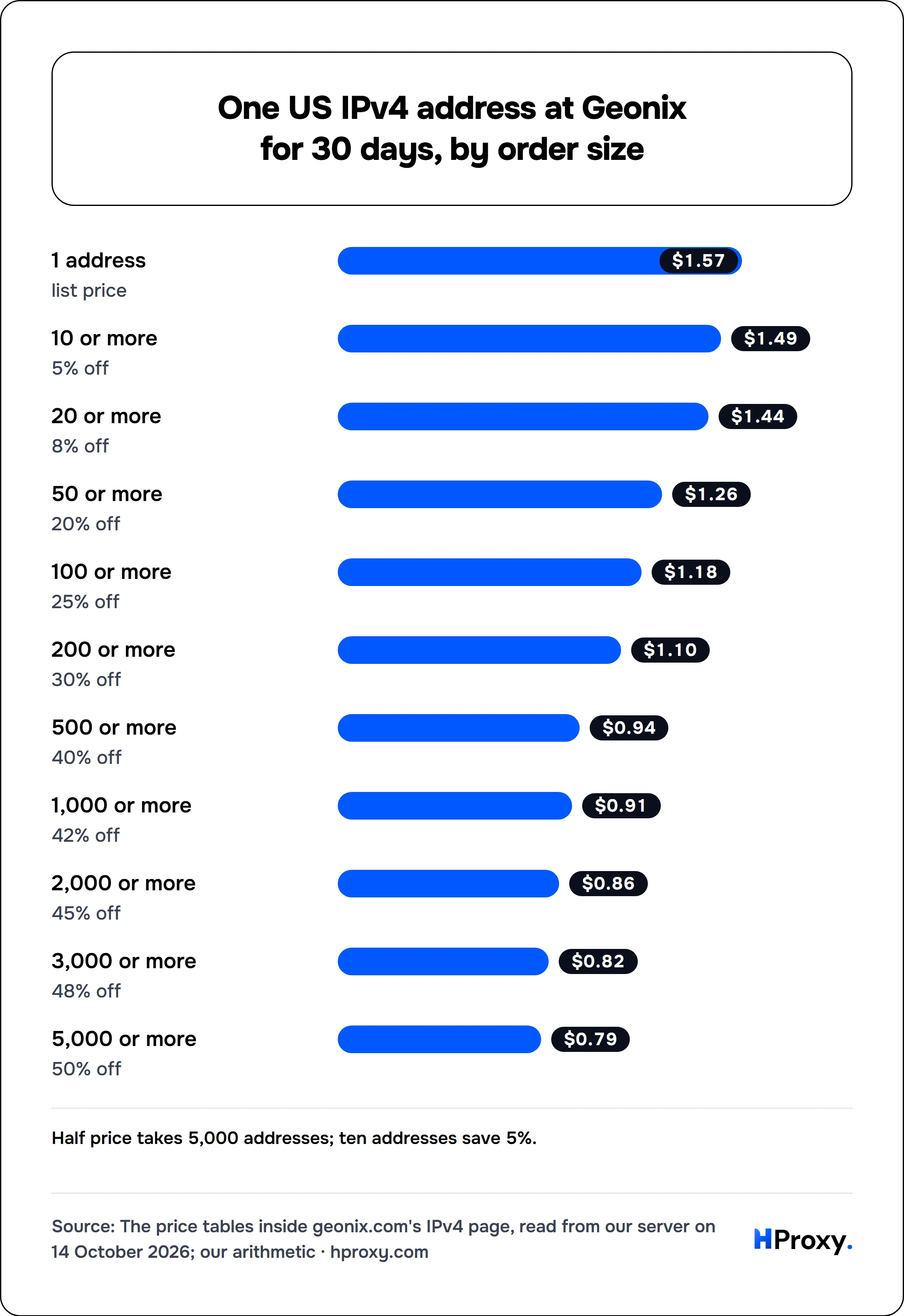
The rental length moves the price as well. A week costs half the 30-day price and two weeks cost three quarters, so a month bought a week at a time comes to about twice the monthly price. Longer terms save little: 90 days cost 291% of one month, 3% under three separate months, while 180 days save 5% and a year 7%. The menu's headline of $0.72 for one address is a single week in one of the $1.43 countries. Its FAQ says package discounts reach "up to 40%", although its own table runs to 50%.
Geonix's static proxies, one address for 30 days
| Type | 30 days | Volume discount |
|---|---|---|
| IPv4, 38 countries | $1.43 to $2.70 | 5% to 50% |
| IPv6, 13 countries | $0.14 | 30% to 50% |
| ISP, 24 countries | $2.70 | 8% to 48% |
| Mobile, 17 countries | $45 to $170 | none listed |
geonix.com's IPv4, IPv6, ISP and mobile pages, read from our server on 14 October 2026
IPv6 is sold in lots of ten or more, at one price in every country: $0.07 an address for a week, $0.14 for 30 days and $0.91 for a year. Twenty addresses take 30% off and a hundred take half, so 500 IPv6 addresses cost $35 a month. An IPv6 address reaches only the sites that accept IPv6, which our guide to IPv4 and IPv6 explains. ISP addresses, which Geonix describes as IPv4 addresses leased from internet providers, cost $2.70 for 30 days in all 24 countries, with 8% off from ten up to 48% from 2,000. Mobile proxies are priced by country and carrier: 30 days cost $45 on Orange in Poland and $125 to $170 in the United States, and the menu's $14 buys two days in Poland.
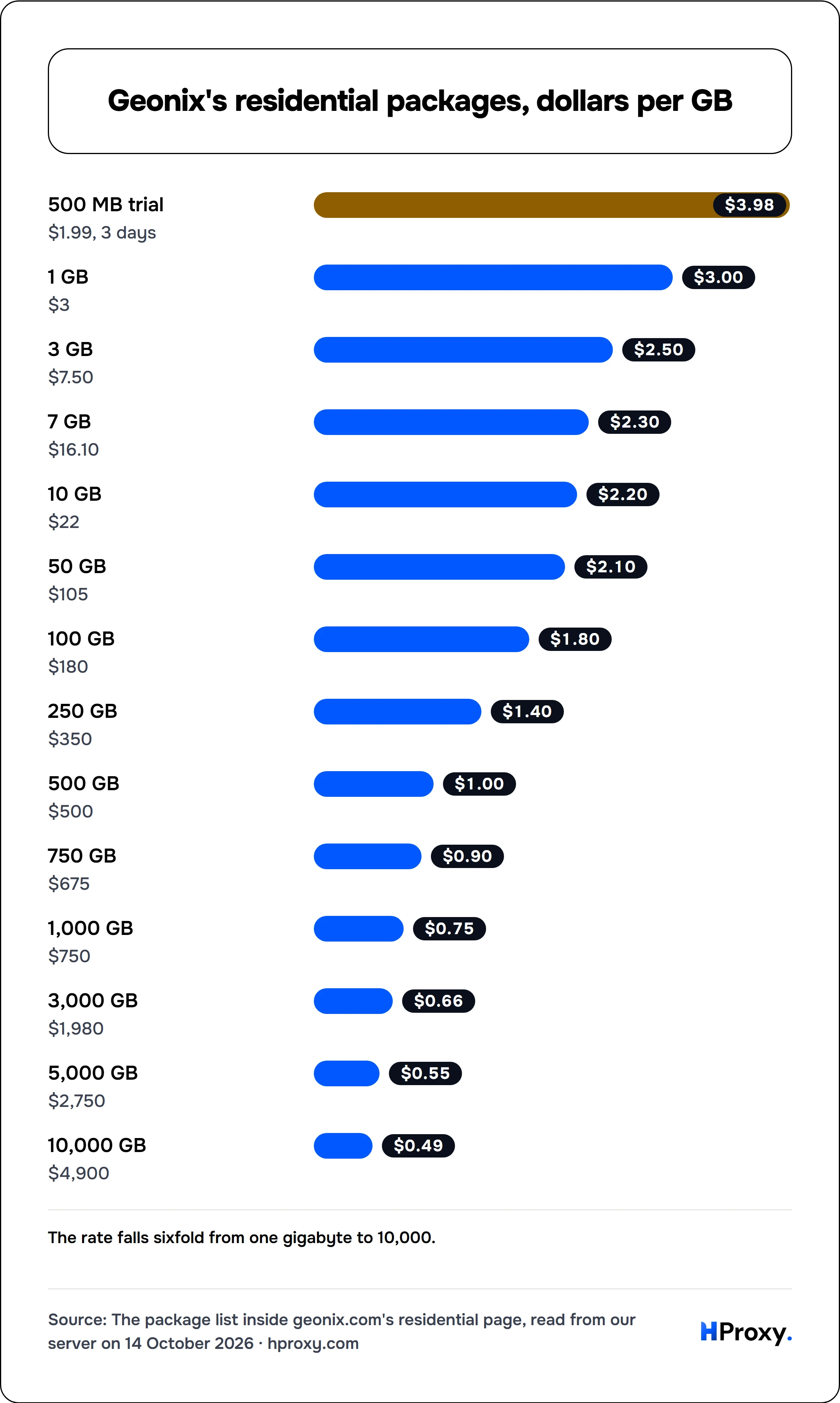
Residential traffic comes in fourteen packages, from a 500 MB trial at $1.99 to 10,000 GB for $4,900, with rotation on a timer or sticky sessions. The same page quotes three other starting rates: $0.7 a GB in its title, $2.30 on its price card and $2 in its FAQ. The title's figure is the menu price of January 2026, left in place after the menu moved to $0.49. The menu gives residential a "rental period from 30 days", yet the package list sets no number of days for any package but the trial. No page we read says what becomes of gigabytes left unused.
How the prices moved
The home page has carried an IPv4 price calculator since at least July 2023. It opened at $2.14 for one address in July 2023, at $1.80 from March 2024 to August 2025 and at $1.65 from January 2026. The archived copies do not show which country it opens on, so these are the calculator's opening prices, whatever its country. The volume steps deepened at the same time: 50 addresses took 15% off in 2024 and take 20% now, a hundred took 20% and take 25%, and new steps run from 1,000 to 5,000 addresses.
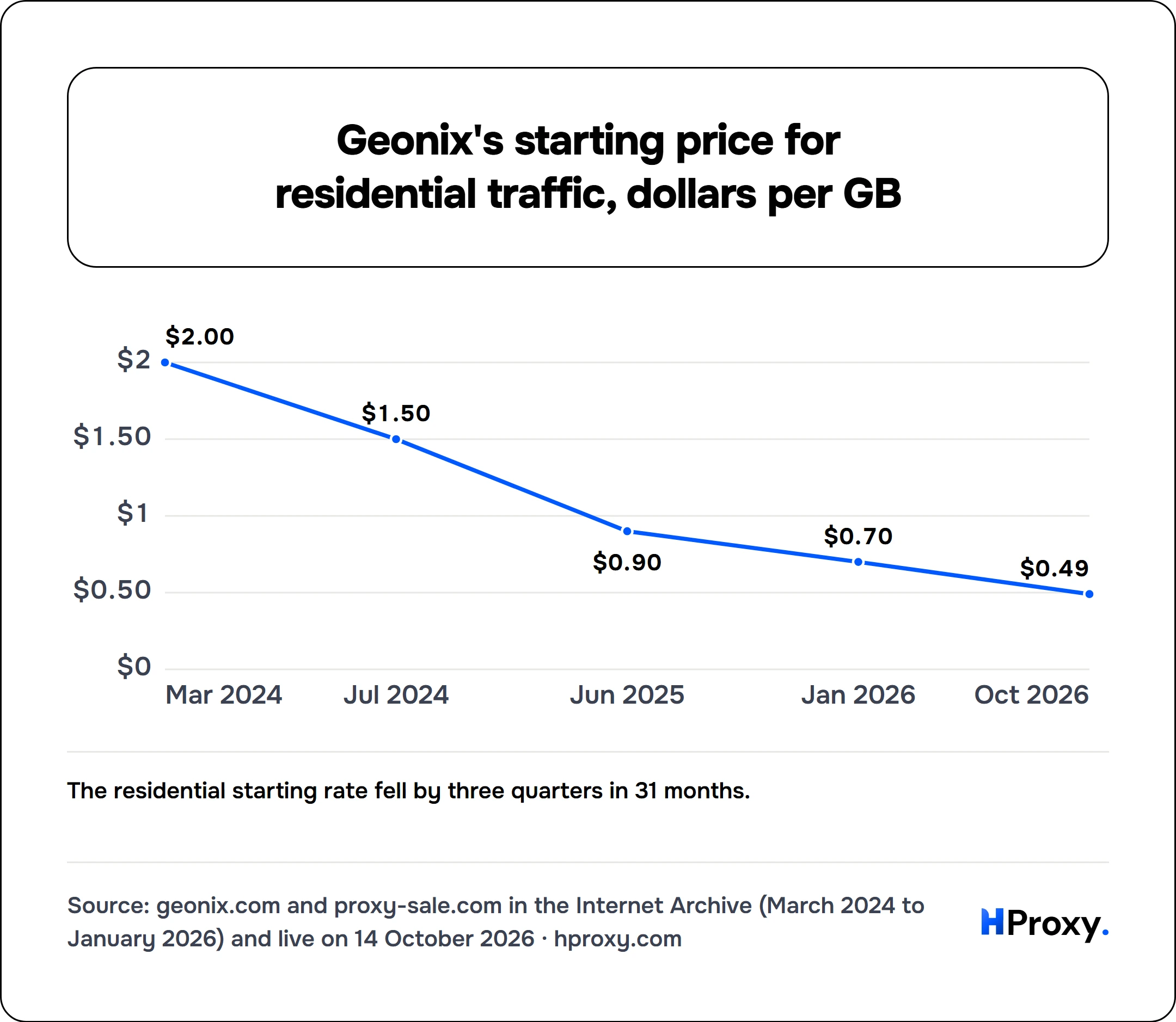
Before 2023 the home page listed a starting price per country, and the currency changed back and forth. The Russian-language shop of September 2016 offered the United States from 95 rubles an address. The copies of 2018 and 2019 said from 2 dollars, those of 2020 and 2021 from 50 rubles, and the copy of July 2022 from $0.70. The menu's starting prices have moved less since then. IPv4 has read $0.70 or $0.72 since 2023, apart from $0.50 in July 2026. Residential fell from $2 a GB in March 2024 to $1.50 in July 2024, $0.90 in mid 2025, $0.70 in January 2026 and $0.49 now.
The fine print: replacement first, 24 hours to complain
Replacement before refund. The return policy opens with the rule that a purchase "cannot be returned, but only replaced". A full refund needs two things. The order must be checked "in the first 24 hours after the payment", and it must fail in a listed way. The list covers dead addresses that cannot be swapped and a login that never works. It also covers too few addresses in the place you paid for, and a purpose its terms do not allow. Rentals of 3 days or less get no refund. Refunds go back only to the account that paid, "Excluding crypto wallets", and the contract rules out any refund once 24 hours have passed. The IPv4 page still promises a "hassle-free refund".
Blocks are the buyer's risk. A private proxy that gets blocked in use is not replaced or refunded. The policy calls a block "a consequence of the intended use" of the buyer.
No free test. Asked for a free test, the FAQ answers "unfortunately, this is not possible" and suggests a small paid order. The residential trial costs $1.99 for 500 MB.
Purpose and identity. Every order form asks for the purpose of use. The contract lets Geonix ask for an explanation and "undergo additional KYC" through Sumsub, and refuse service to anyone who declines.
Two connection limits. The FAQ says "The limit per IP is 6 simultaneous connections", while the contract says "Each IP comes with 100 threads by default". The product pages promise unlimited traffic. A fair-use clause for IPv4 and ISP, and a line in the FAQ, let Geonix slow an address whose traffic passes a level it does not state.
Renewal, payment and law. Rentals end on their date. The shop writes three days before and renews at the list price of the day. Checkout takes cards through Paddle, PayPal and several cryptocurrencies, USDT among them, and the contract falls under the laws of Bulgaria.
Who runs Geonix: Proxy-Sale under a new name
12 Feb 1999
geonix.com registered
registry record
Mar 2001
A telematics firm's site
an unrelated business
3 Jul 2015
proxy-sale.com registered
Sep 2016
Proxy-Sale opens in Russian
prices in rubles
May 2022
Contract names a Sofia company
company code 206493309
Sep 2023
Contract calls the seller GEONIX
the shop is still Proxy-Sale
Mar 2024
geonix.com shows the Proxy-Sale shop
Jul 2025
The pages take the Geonix name
14 Oct 2026
proxy-sale.com forwards to geonix.com
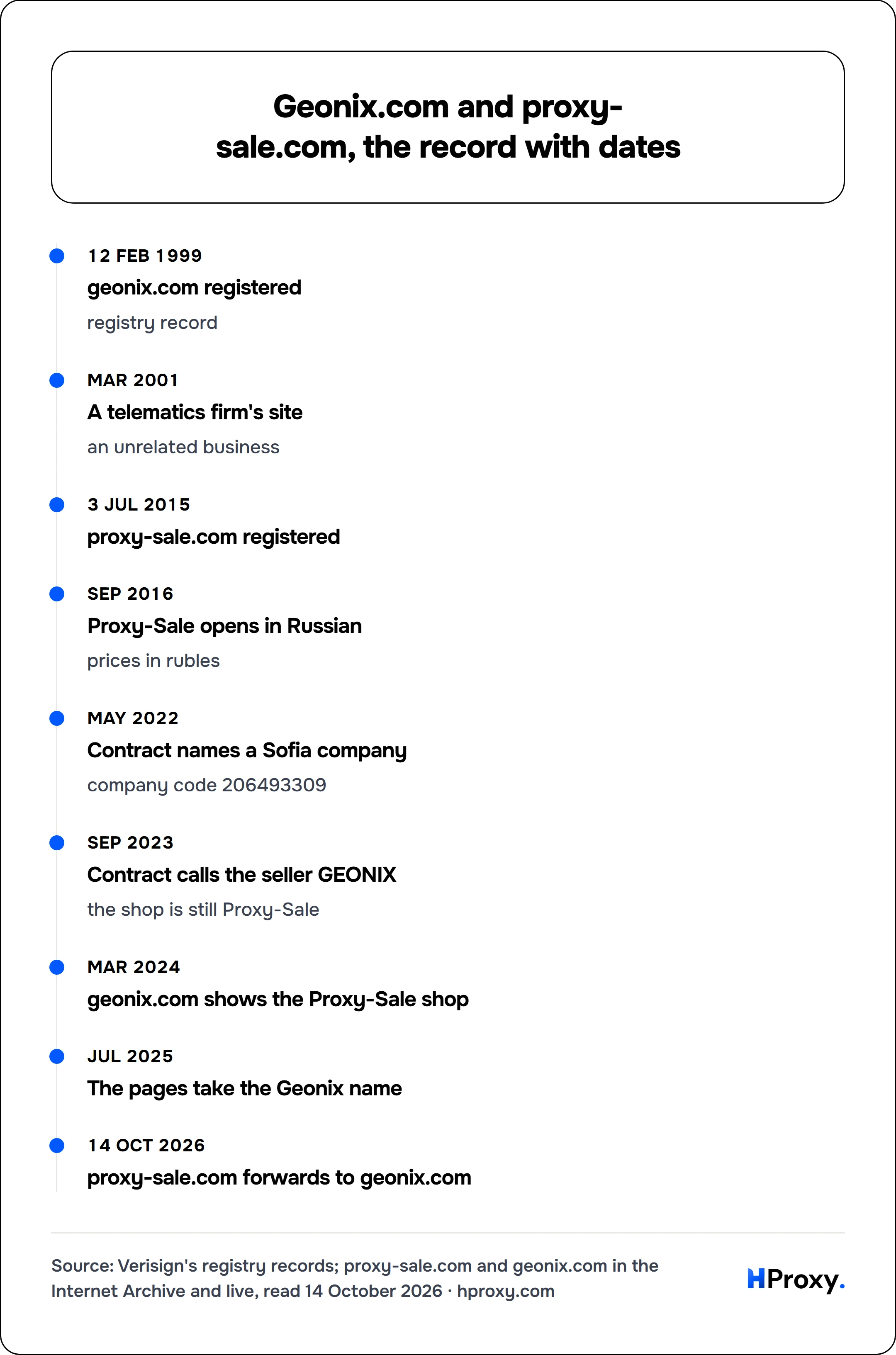
The shop is older than its name. proxy-sale.com was registered in July 2015 and sold private proxies in Russian from September 2016, priced in rubles. Its Russian-language contracts of 2019 and 2021 named no seller and cited the Russian Civil Code. The English contract of May 2022 still cited that code, but closed with the seller's details: INTERNET CONNECTION BROKER LTD, company code 206493309, at Vitosha boulevard 15 in Sofia.
The domain geonix.com is older again. Registered in February 1999, it carried a telematics company's site in 2001 and empty pages in 2019, and by March 2024 it showed the Proxy-Sale shop. The contract moved first. Its copy of September 2023 calls the seller GEONIX and names geonix.com as the website, almost two years before the shop's own pages changed. The archive dates that change between 15 June 2025, when the reviews block still read "A compilation of reviews about Proxy-Sale", and 13 July 2025, when it read "A compilation of reviews about Geonix".
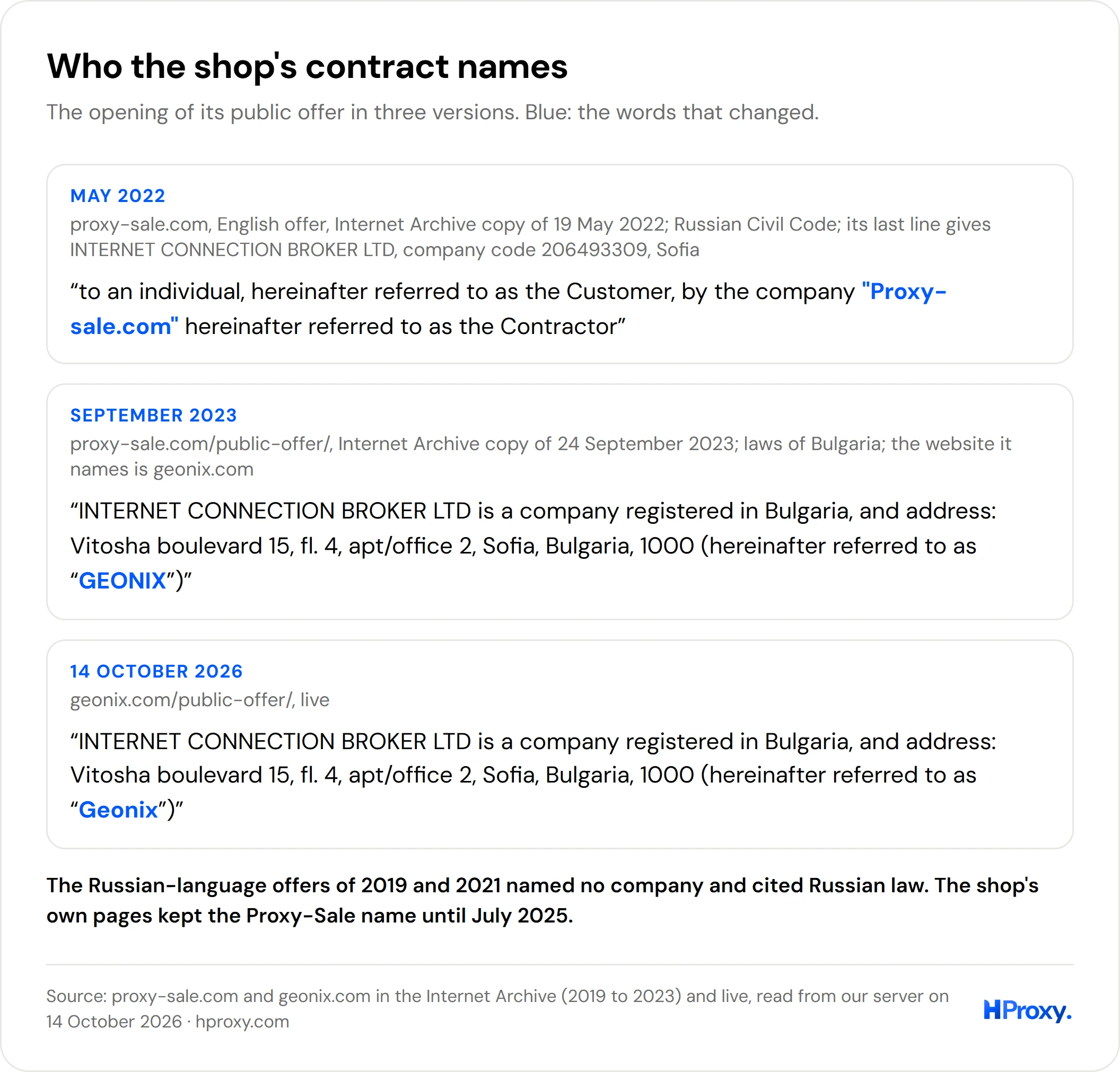
INTERNET CONNECTION BROKER LTD gives its address as Vitosha boulevard 15, fourth floor, office 2, in central Sofia, and the offer of May 2022 gave its company code as 206493309. OpenCorporates holds no company under that code or that name, and we could not read Bulgaria's own commercial register from our server. The paper trail therefore ends at the contract: we found no owner, no manager and no founding date for the company.
The old name has left traces. The site's template folder is still called proxysale, and its API documentation links a YouTube channel named ProxySale. Both domains sit with the same registrar, on the same pair of Cloudflare name servers. Trustpilot showed our server a verification wall in September, so we read the archive's latest copy of the Geonix profile. On 9 March 2026 it showed 4.1 stars from 245 reviews: 186 with five stars and 43 with one. Proxy-Sale's profile had shown 4.6 from 329 reviews in July 2025.
Nine alternatives, priced the same day
We priced the same orders at nine sellers on 14 October 2026, before VAT and as a new customer. Each price comes from the seller's own page or the price data inside it. Static addresses are compared for 30 days, residential traffic for 100 GB used within one month.
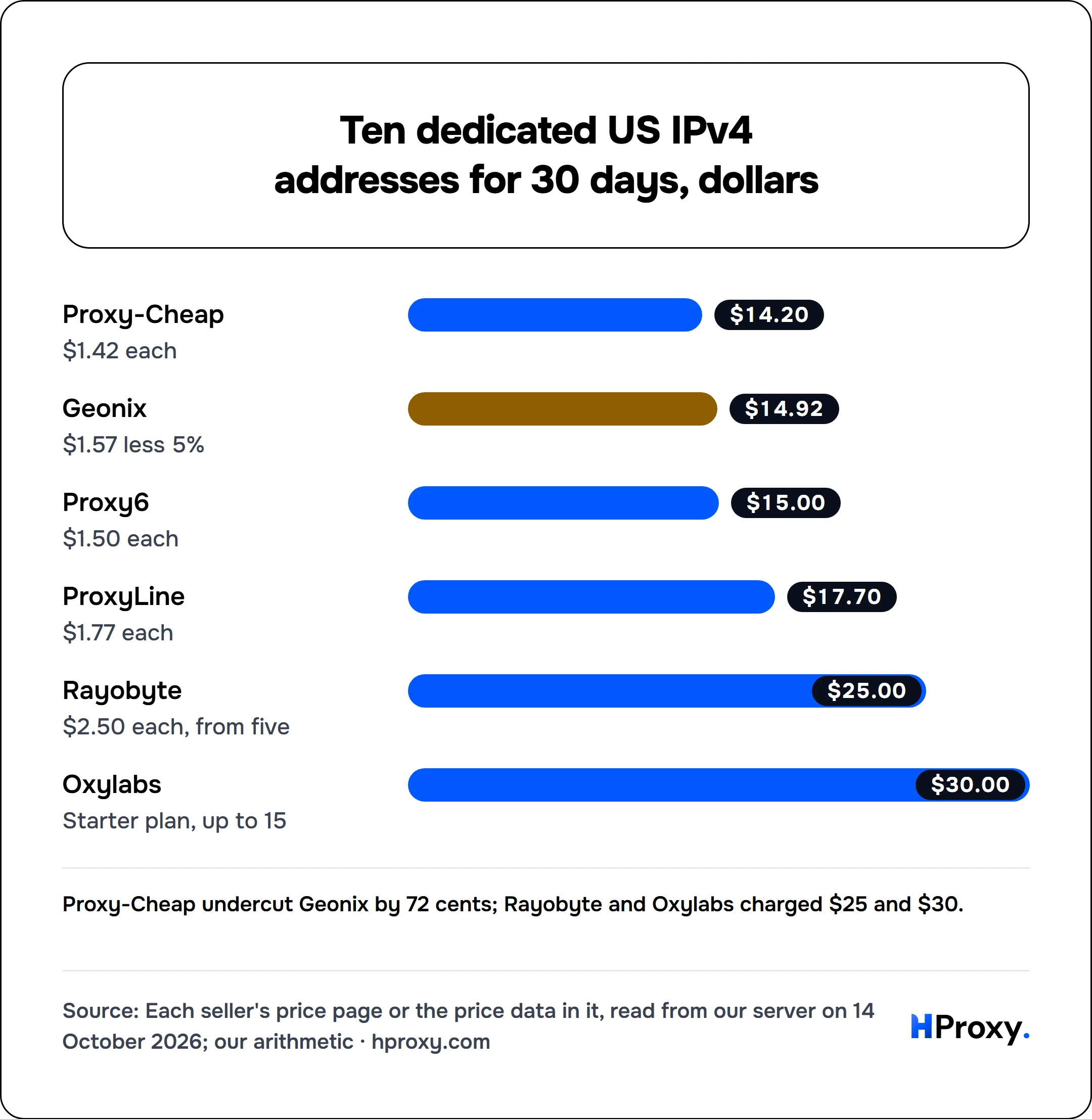
Bigger orders for 30 days, 14 October 2026
| Seller | 100 IPv4 | 500 IPv6 |
|---|---|---|
| Geonix | $117.75 | $35 |
| Proxy6 | $123.80 | $42 |
| Proxy-Cheap | $142 | $75 |
| ProxyLine | $150 | $240 |
| Rayobyte | $213 | $100 |
Geonix's price tables, the price pages of Proxy6 and Rayobyte, and the price data of Proxy-Cheap and ProxyLine, read from our server on 14 October 2026
Ten IPv6 addresses cost $1.40 at Geonix, $1.80 at Proxy-Cheap, $1.89 at Proxy6, $2 at Rayobyte and $5.10 at ProxyLine. The records on our company pages show who stands behind each seller.
- Proxy6: like Proxy-Sale, a Russian-language shop that has rented addresses one at a time since 2016; its Requisites page names PROXY SIX LLC of Elektrostal. IPv4 costs $1.50 a month in orders of up to 99 and $1.238 from 100, and IPv6 falls from $0.258 for a single address to $0.084 from 500.
- ProxyLine: its contract names no company, and its app is published by Unit Hostline Ltd of Paphos, Cyprus. It rents for any period from 5 to 360 days: a dedicated IPv4 address costs $1.77 for 30 days in orders of up to 20 and $1.50 from 90, an IPv6 address $0.51, or $0.48 from 100.
- Proxy-Cheap: its contract names no company, and its marks belong to UAB Lietparkas of Vilnius. A datacenter IPv4 address costs $1.42 a month, with a 7-day trial at $1.13, and IPv6 comes in packs, from ten at $0.18 each to 500 at $0.15. Its static ISP addresses cost $2.71 a month and its residential traffic $0.78 a GB from 51 GB.
- Webshare: owned by Oxylabs since 2022. Ten shared datacenter proxies are free and 100 cost $2.99 a month. Its public price table lists shared proxies, so it stays out of the dedicated comparison. Its 100 GB residential plan costs $225.
- Rayobyte: Blazing SEO, LLC of Colorado trades under this name. Its dedicated datacenter addresses are priced by country from five. A US address costs $2.50 a month, $2.13 from 100 and $1.88 from 1,000, and a US IPv6 address $0.20. Its static ISP addresses cost $5 a month from five, and residential traffic $2 a GB from 50 GB, paid as you go. Its Scale plan sells 6,600 GB for $100 a month, to verified businesses and without targeting.
- Decodo: Smartproxy renamed, sold by Data troops, UAB of Vilnius. Dedicated datacenter addresses start at $2.50 an IP, its shared pay-per-IP plans begin at 100 addresses, and datacenter plans carry a 14-day money-back option. Its 100 GB residential plan costs $275.
- Oxylabs: Oxylabs, UAB of Vilnius. Dedicated datacenter addresses come through monthly credit plans: $2 an IP for up to 15 on the $30 Starter plan, $1.75 for up to 57 on the $100 plan. Residential traffic runs on the same plans, $500 for up to 125 GB.
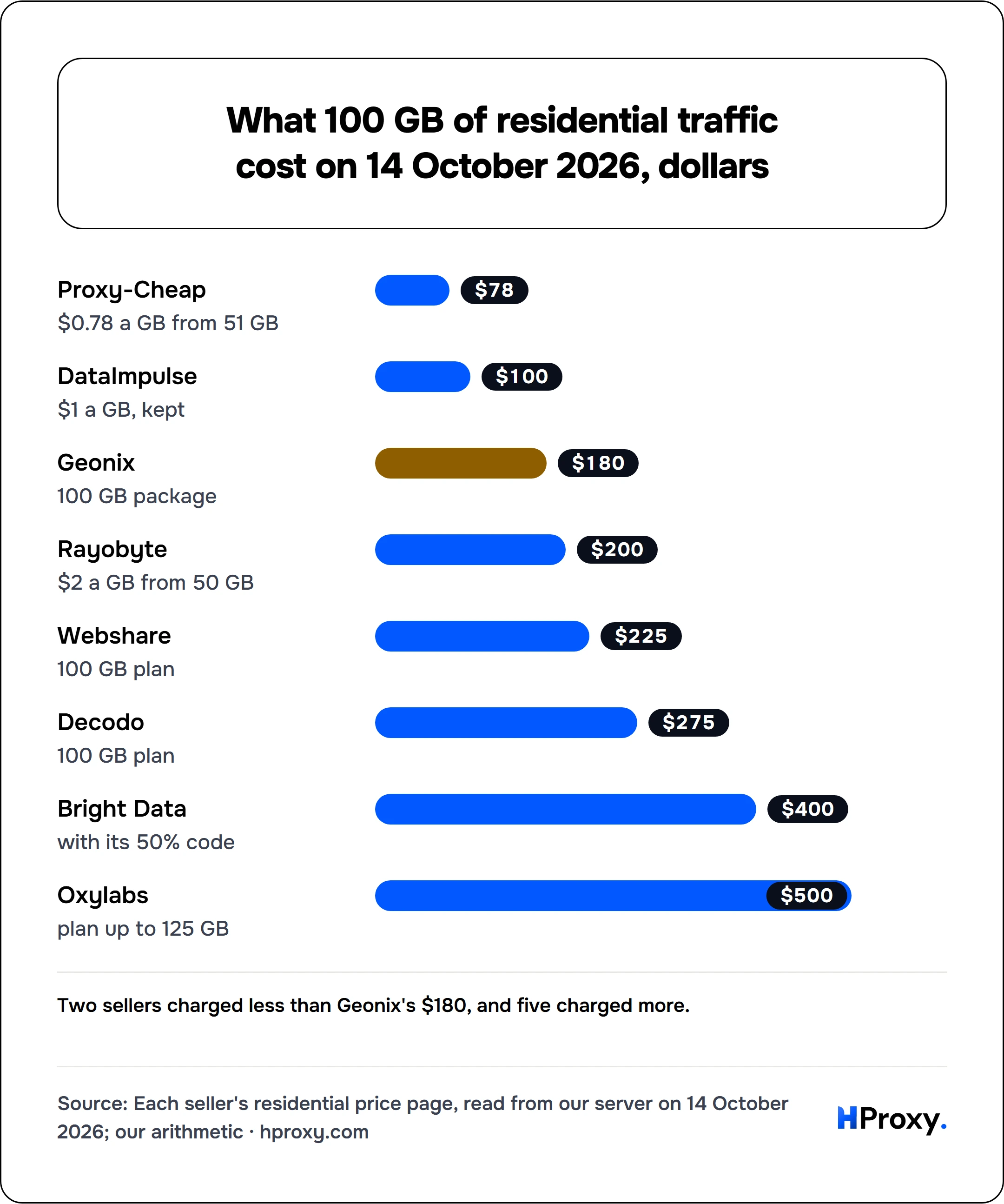
Two residential sellers enter here for the first time:
- DataImpulse: its terms name Softoria LLC of Florida. It charges $1 a GB, and its page says "Unused GBs never expire".
- Bright Data: controlled by EMK Capital. It lists $8 a GB pay as you go, halved by a code for the first three months.
Where HProxy fits
We rent the same kinds of address. A dedicated IPv4 address costs $1.58 per IP for a month, an IPv6 address $0.10 per IP, and a static ISP address $2.70 per IP a month. Residential traffic costs $0.50 per GB, paid from a balance that does not expire. Our terms name our company, Obsidian UG, and German law. Whichever seller you choose, test the addresses you receive in our free proxy checker during the first day, while a refund is still possible.
Which one to pick
- Geonix for IPv6 at any size and for IPv4 orders of a hundred or more, where its tables beat every per-address price we could read. Test the order on the first day, since that is the only refund window.
- Proxy-Cheap for a few IPv4 addresses, or for the lowest residential rate we found, $0.78 a GB from 51 GB.
- Proxy6 for small IPv4 orders on terms close to Proxy-Sale's, at $1.50 an address.
- DataImpulse if residential gigabytes must last, at $1 a GB.
- Webshare to try shared datacenter proxies free before paying anyone.
- ProxyLine only for rental lengths the others do not sell, anywhere from 5 to 360 days.
What we could not find out
We bought nothing and tested no address, so speed, uptime and block rates are the sellers' own claims. Geonix's prices come from the tables in its pages, and its checkout could round them differently. We could not read Bulgaria's commercial register entry for INTERNET CONNECTION BROKER LTD, so its owners and managers are missing here. Trustpilot showed our server a verification wall, so its figures come from the archive. Bright Data's datacenter price page refused our server as well, which keeps it out of the static comparison. We plan to read every price here again by 14 January 2027.
Sources
- geonix.com, read from our server on 14 October 2026: the home page and the five price pages with the tables inside them.
- geonix.com's FAQ, return policy, public offer and contacts page, and docs.geonix.com, read the same day.
- proxy-sale.com and geonix.com in the Internet Archive: home pages from September 2016 to July 2026, the public offers of 2019, 2021, 2022 and 2023, and the Trustpilot profiles of 2025 and 2026.
- Verisign's registry records of geonix.com and proxy-sale.com. OpenCorporates, which holds no company under code 206493309.
- The price pages or price data of Proxy6, ProxyLine, Proxy-Cheap, Webshare, Rayobyte, Decodo and Oxylabs, and the residential price pages of DataImpulse and Bright Data, read on 14 October 2026.
- Our company pages on the nine sellers.
- Google Keyword Planner and Google's search suggestions, 14 October 2026: "geonix", 14,800 searches a month worldwide.
- Our own prices, read from our live price list on the day.