
Leastslow is trading at leastslow.com. It sells rotating residential proxies by the gigabyte, static ISP IPs in the United States by the month, and rotating ISP by the thread, all priced in euros. Residential costs €8.00 a GB at 1 GB, and a static IP €3.50 a month. Its pages name no company, and its Terms of Service link opens a document marked no longer active. The like-for-like prices are in the alternatives table.
Is Leastslow legit? The record in one table
| what we read on 27 September 2026 | |
|---|---|
| website | leastslow.com answers normally, and its dashboard runs at app.leastslow.com |
| company | none named; the privacy policy lists the owner as Leastslow |
| terms | the Terms of Service link opens a document marked no longer active |
| products | rotating residential, static ISP in the US, rotating ISP by threads |
| price | residential from €8.00 a GB; static ISP €3.50 an IP a month |
| protocols | HTTP, HTTPS and SOCKS5, with UDP through SOCKS5 on static ISP |
| payment | crypto or credit card |
| free trial | 1 GB of residential, one static IP, or five threads |
| domain | registered 1 January 2023 |
The homepage claims more than 500 customers and 80 million residential peers, which we could not check. Its footer carries a 2024 copyright line, while its privacy policy was updated on 19 September 2026.
What Leastslow sells, and what it costs
Prices come from its product pages, read on 27 September 2026, in euros.
| residential plan | price shown | per GB |
|---|---|---|
| 1 GB | €8.00 a month | €8.00 |
| 25 GB | €162.50 a month | €6.50 |
| 100 GB | €550.00 a month | €5.50 |
| 1,000 GB | €4,000.00 a month | €4.00 |
| 2,000 GB | €7,000.00 a month | €3.50 |
| 3,000 GB or more | by contact | €3.00 |
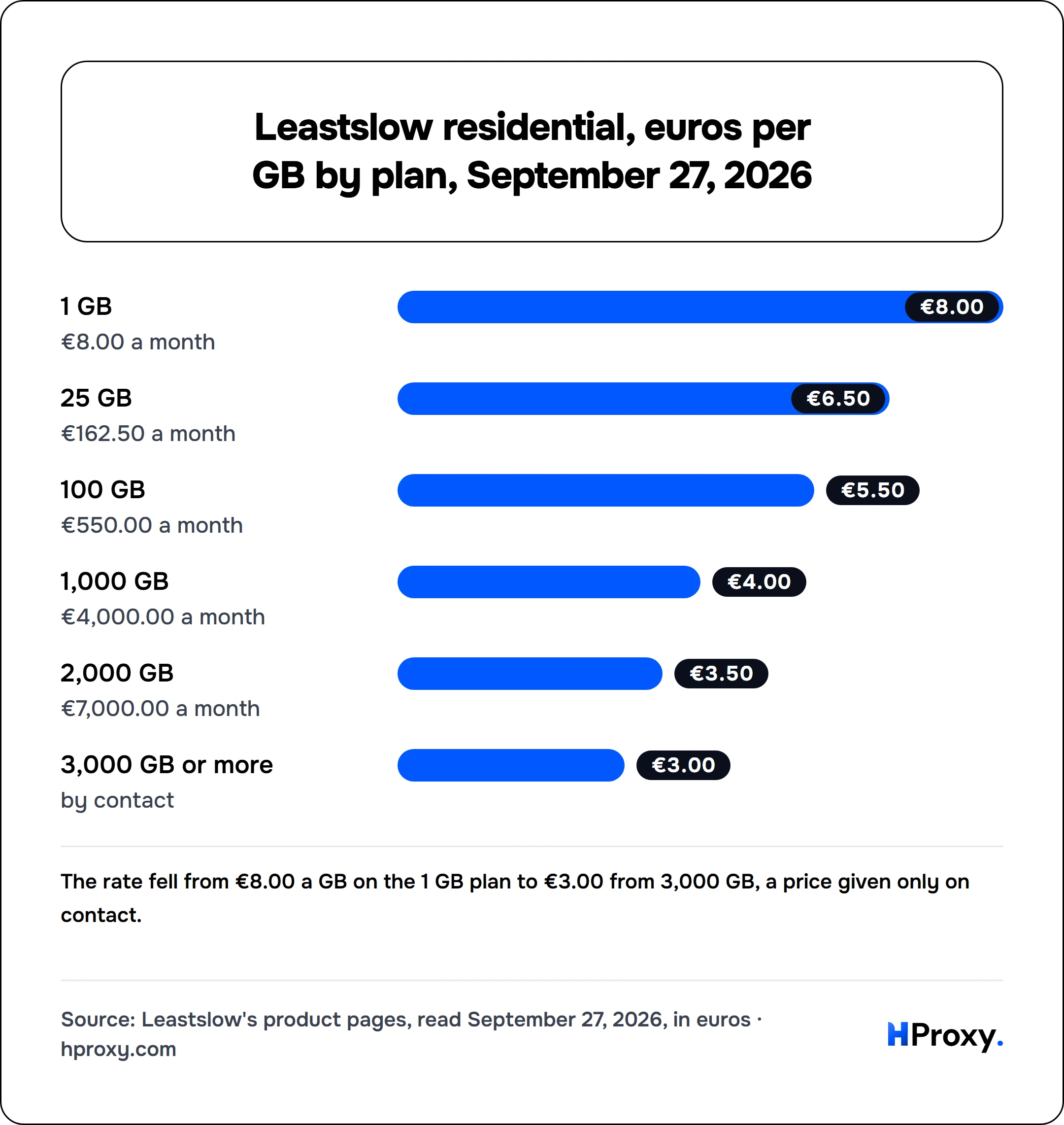
Every plan includes filtering by country, state, city and ASN. Rotation is per request, or sticky for up to 30 minutes. Each card shows its price per month, while the homepage calls residential pay as you go. No page we read says whether unused data expires.
Static ISP IPs sit on AT&T in the United States, with Cogent listed as not in stock. Each IP comes with unlimited threads and traffic:
| static ISP IPs | a month | per IP |
|---|---|---|
| 1 | €3.50 | €3.50 |
| 10 | €30.00 | €3.00 |
| 100 | €260.00 | €2.60 |
| 1,000 | €2,200.00 | €2.20 |
Rotating ISP is priced by threads, meaning parallel connections, with unlimited traffic. It runs from €60 a month for 20 threads to €1,800 for 2,000. Its homepage still marks that product "Available Soon", and a residential IPv6 product is also listed as coming.
The fine print that decides the cost
No active terms. The Terms of Service link in its footer opens an iubenda document that reads "The Terms and Conditions of this Application are no longer active". Its last update is dated 1 June 2024. We found no other page with rules on refunds, expiry or account closure.
No named company. The privacy policy names the owner as Leastslow, with a legal email address, and gives no company name or address.
Monthly prices on residential. Each residential card shows a price per month, while the homepage calls the product pay as you go. Ask whether unused data rolls over before buying a large plan.
United States only for ISP. Static and rotating ISP IPs sit on US carriers, so they do not suit work that needs another country.
Sessions of up to 30 minutes. Sticky residential sessions last up to 30 minutes.
How leastslow.com got here
| date | what the record shows |
|---|---|
| 1 January 2023 | leastslow.com is registered, through NameCheap |
| 25 April 2024 | the site sells static residential IPs on Sprint and CenturyLink, 25 for $49.99 a month |
| 1 June 2024 | the last update of its terms, which now read as no longer active |
| 15 October 2024 | rotating residential at €8.00 to €3.00 a GB, the same prices as today |
| 19 September 2026 | the last update of its privacy policy |
| 27 September 2026 | residential from €8.00 a GB, static ISP from €3.50 an IP a month |
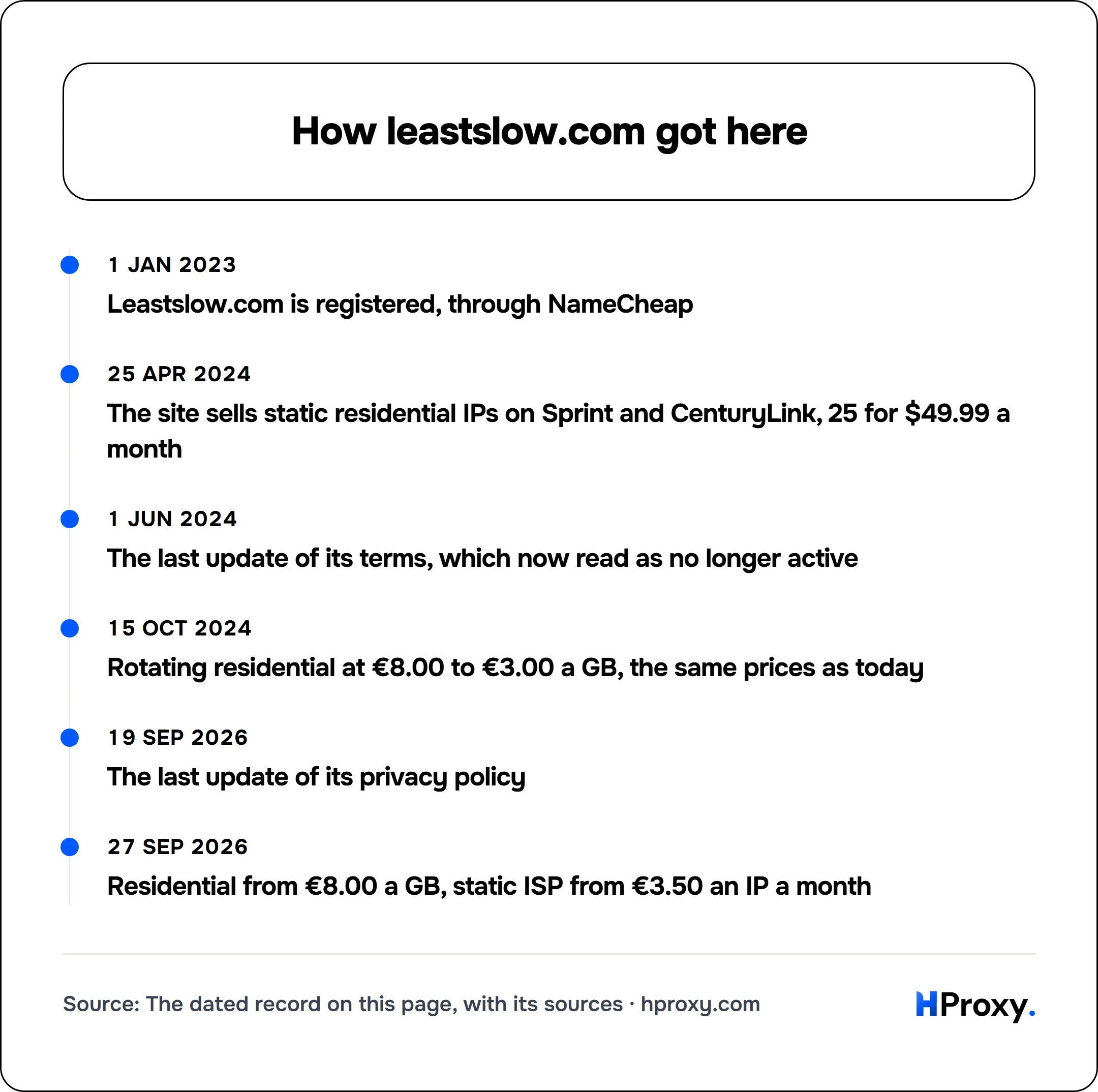
1 Jan 2023
Leastslow.com is registered, through NameCheap
25 Apr 2024
The site sells static residential IPs on Sprint and CenturyLink, 25 for $49.99 a month
1 Jun 2024
The last update of its terms, which now read as no longer active
15 Oct 2024
Rotating residential at €8.00 to €3.00 a GB, the same prices as today
19 Sep 2026
The last update of its privacy policy
27 Sep 2026
Residential from €8.00 a GB, static ISP from €3.50 an IP a month
Sources: the domain registry, the Internet Archive, its own pages and its two legal documents, read 27 September 2026.
Leastslow alternatives for residential traffic
Leastslow prices in euros and the others in dollars. The table compares how each one bills, without converting. Leastslow and DigiProxy were read on 27 September 2026, the others a day earlier.
| provider | smallest purchase | lowest rate printed, and what it needs | unused traffic |
|---|---|---|---|
| Leastslow | €8.00 for 1 GB, shown per month | €3.00 a GB, 3,000 GB or more by contact | not stated |
| DigiProxy rotating | $2.30 for 1 GB | $1.91 a GB, the 100 GB plan | expires after 120 days |
| Webshare | $3.50 for a 1 GB plan | $1.40 a GB, 3,000 GB at $4,200 a month; $0.98 on a yearly plan | resets monthly |
| Evomi | $0.99 a GB, from 15 GB | $0.49 a GB, the 100 GB plan at $49 a month | kept on pay as you go |
| DataImpulse | $5 for 5 GB, $1.00 a GB | $0.80 a GB, 1 TB for $800 | kept |
| HProxy Residential Lite, country targeting | $0.50/GB, from 1 GB | $0.44/GB at 2,000 GB+ | kept, the balance never expires |
| HProxy Residential Premium, state, city and ISP targeting | $1.49/GB, from 1 GB | $1.00/GB at 1,000 GB+ | kept, the balance never expires |
Leastslow filters by city, state and ASN in every plan, so the like-for-like row on our side is Premium, at $1.49 per GB from the first gigabyte. Both of ours are on our residential price table.
For a static ISP IP, each vendor prices one address for a month. Rainproxy was read on 27 September 2026, Evomi and Rayobyte a day earlier.
| provider | one IP for a month | what it needs |
|---|---|---|
| Leastslow | €3.50 | from 1 IP; €2.20 an IP at 1,000 |
| Rainproxy | $2.75 | from 1 IP, dedicated |
| Evomi | $2.50 | a private IP |
| Rayobyte | $5.00 | from 5 IPs; $4.60 an IP at 1,000 |
| HProxy | $2.70 per IP | from 1 IP |
Our static ISP proxies come with unlimited bandwidth through each IP.
Where Leastslow is the better buy
A free trial. Its homepage offers 1 GB of rotating residential traffic, one static ISP IP or five rotating ISP threads free of charge.
Filtering in one price. Every residential plan includes filtering by country, state, city and ASN. On our side, targeting below country level is part of Premium, at $1.49 per GB.
Volume pricing on static IPs. Its static ISP price falls with volume, from €3.50 an IP to €2.20 at 1,000 IPs.
Where HProxy is the better fit
Published terms and a named company. Our imprint names Obsidian UG in Herford, Germany, and our refund policy is published. Leastslow names no company, and its terms link opens a deactivated document.
A balance that never expires. Our balance never expires, so a gigabyte bought today is still there next year. Leastslow shows its residential plans as monthly prices and publishes no rule on unused data.
Longer sticky sessions. Our Premium residential traffic, at $1.49 per GB, holds a sticky IP from 3 to 1,440 minutes. Leastslow sticky sessions last up to 30 minutes.
More ways to pay. Our payment options page lists cards, 32 crypto assets and networks, Alipay, Pix and more. Leastslow takes crypto or credit card.
Before you commit
Take the free Leastslow trial and buy a single gigabyte of our Premium traffic, then run the same job through both. Check the exits in our proxy checker first. Our free proxy list and the checker need no account.
The limits of this record
We did not test Leastslow, so nothing here grades speed or success. Its pool size and customer count are its own claims. Its prices are in euros, and we did not convert them. We could not tell from its pages whether residential plans renew each month, and the live Trustpilot page could not be read. This page is due for a check by 27 December 2026.
Other providers we cover
More pages in this series: Richproxies.com, Roundproxies.com, RSocks.net, S5Proxies.com, Saglamproxy.com and SAProxy.com.
Sources
Every source below was read on 27 September 2026, except the pricing pages of Webshare, Evomi, DataImpulse and Rayobyte, read a day earlier.
- Leastslow: homepage, its three product pages, contacts page, the FAQ in its homepage script, and its terms and privacy documents at iubenda.
- Verisign, the registry record for leastslow.com.
- Internet Archive, captures of leastslow.com from 25 April 2024 to 17 January 2026.
- DigiProxy and Rainproxy, pricing pages.
- Webshare, Evomi, DataImpulse and Rayobyte, pricing pages.
- HProxy, our own product catalog, price table, refund policy, payment options and imprint.