LemonClub (lemonclub.io) sells residential, mobile, ISP and datacenter proxies, pitched at sneaker drops, ticket sales and scraping. Its private residential pool costs $3.20 a GB for 1 GB and $2.50 a GB at 100 GB, and its traffic never expires. It calls itself US-based but publishes no company name or address, and its terms appear only inside the dashboard. Prices below were read on 27 September 2026. The alternatives table prices five sellers, read the same day.
The record, with dates
| date | what happened |
|---|---|
| 27 April 2022 | The domain lemonclub.io is registered, at Namecheap. |
| February 2024 | First archived page: "LemonClub - Sneakers Proxy Solution". |
| June 2025 | The site is rebuilt as "Premium Quality Proxy Services". |
| 7 September 2026 | Its privacy policy is last updated. |
| 27 September 2026 | Our check: live, with the prices below. |
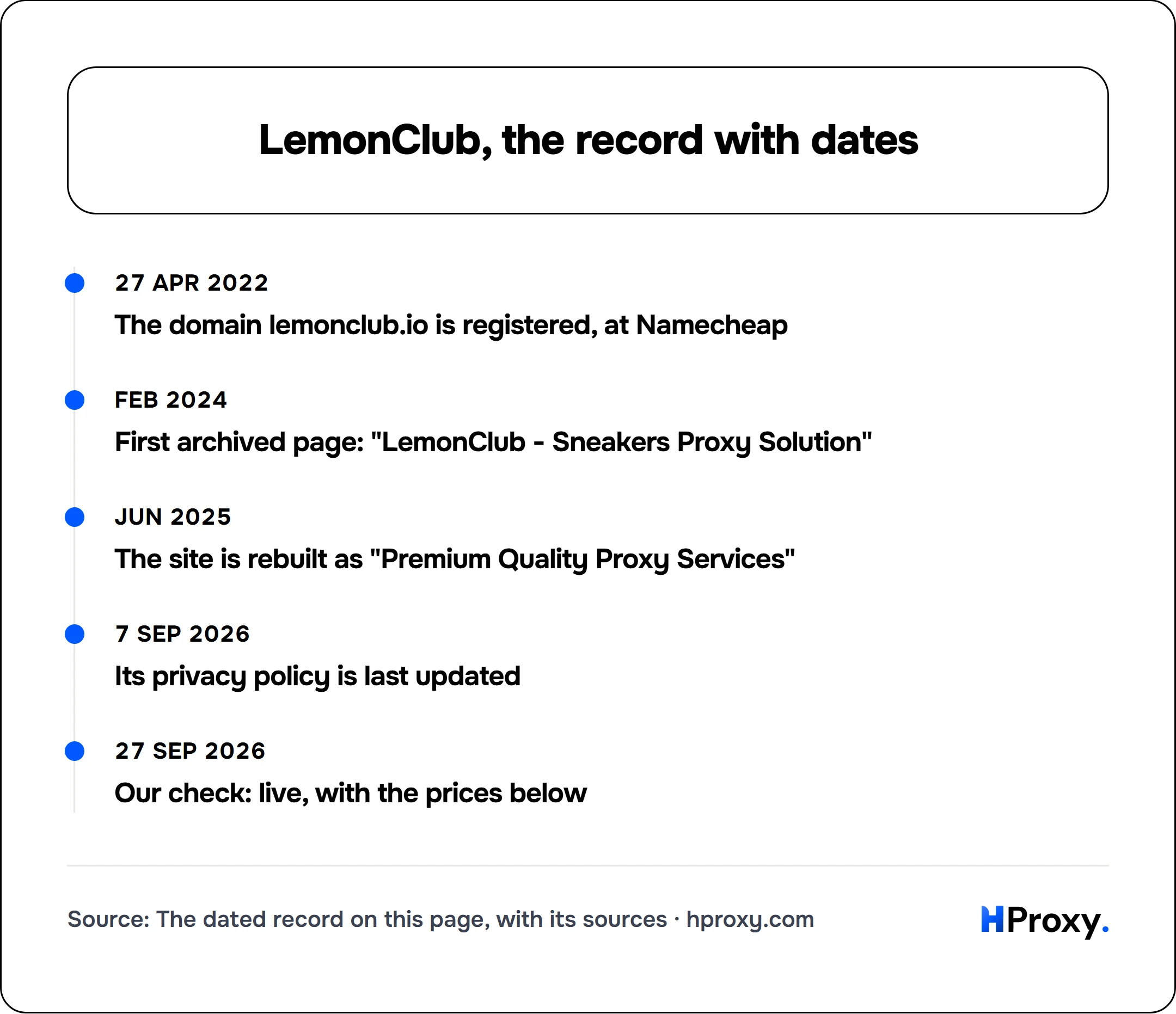
27 Apr 2022
The domain lemonclub.io is registered, at Namecheap
Feb 2024
First archived page: "LemonClub - Sneakers Proxy Solution"
Jun 2025
The site is rebuilt as "Premium Quality Proxy Services"
7 Sep 2026
Its privacy policy is last updated
27 Sep 2026
Our check: live, with the prices below
Sources: the .io registry, the Internet Archive and our own check.
The privacy policy names the data controller only as "LemonClub" and says it operates from the United States. No page we read gives a legal entity or an address, and the usual addresses for terms and refunds answer "not found". The policy says the dashboard runs under terms shown when you create an account.
What it sells, and what it costs
| product | how it is sold | price |
|---|---|---|
| private residential, LemonPrime | per GB | $3.20 a GB for 1 GB, down to $2.50 at 100 GB. |
| sneaker pool, LemonLabs | per GB | $6.00 a GB for 1 GB, down to $3.50 at 100 GB. |
| mobile, LemonMobile | per GB | $3.50 a GB for 1 GB, down to $2.50 at 100 GB. |
| four public residential pools | per GB | From $1.00, $1.50, $2.00 and $2.75 a GB. |
| static ISP | per IP, for 1 to 90 days | $4.00 for one IP for 30 days, down to $1.13 at 1,000 IPs. |
| native ISP | per IP, for 1 to 90 days | From $1.36 an IP. |
| datacenter | per IP, for 1 to 90 days | $2.80 for one IP for 30 days, down to $0.79 at 1,000; one day from $0.52 to $0.26. |
| hybrid, LemonLive | IPs plus data, for 45 or 60 days | From $60 a month. |
| servers next to its proxies | per month | $24 to $192 a month. |
Above 100 GB it quotes residential "below $0.70/GB", by contact only. Its private pool claims 50M+ IPs in 190+ countries, with city, state and ASN targeting; we did not test these claims.
The fine print
- Expiry. Traffic and IPs never expire, and there are no contracts.
- Payment. Cards through Stripe, Apple Pay, Google Pay, 150+ cryptos, and bank transfer by SEPA or wire.
- Terms and refunds. Not on the public site; they appear in the dashboard when you create an account.
- Use. It markets its IPs for ticket and sneaker bots, social media accounts, crypto airdrops, scraping and retail arbitrage, with pages for 30 target sites. Its private pool lists UDP and mail port 25 as supported.
Where LemonClub is the stronger choice
- Pools marketed per retailer, with a page for each of its 30 target sites.
- Bulk static ISP at $1.13 an IP for 1,000 IPs, and datacenter IPs by the day.
- Servers in the same rack as its proxies, from $24 a month.
- Apple Pay, Google Pay and bank transfer, beside cards and crypto.
- Residential traffic that never expires, as with ours.
Where HProxy is different
| LemonClub, 27 September 2026 | HProxy | |
|---|---|---|
| residential, 1 GB | $3.20 on LemonPrime; public pools from $1.00 | $0.50/GB for 1 GB of Lite |
| residential at volume | $2.50 a GB at 100 GB | $0.44/GB at 2,000 GB+ on Lite |
| city and ISP targeting | City, state and ASN on LemonPrime | Premium, $1.49 for one GB and $1.00 per GB at 1,000 GB+ |
| static ISP address | $4.00 for one IP for 30 days | $2.70/IP for a month |
| datacenter IPv4 | $2.80 for one IP for 30 days | $1.58/IP for a month |
| mobile traffic | $3.50 a GB for 1 GB | $1.50 per GB |
| payment | Cards, Apple Pay, Google Pay, crypto, bank transfer | Card, Alipay, crypto and local wallets |
| who runs it | No legal entity or address published | Our imprint names the company and its address |
| does traffic expire | Never | Never: the balance does not expire |
We screen card payments, and we ask for identification when a payment looks wrong or the law requires it. The difference is the default: an ordinary order with us needs no documents.
Five alternatives, priced the same day
Every rate below comes from each vendor pricing page, read from our server on 27 September 2026. A rate you cannot reach is not a price.
| provider | entry rate | lowest published rate | worth knowing |
|---|---|---|---|
| DataImpulse | $1 per GB: 5 GB for $5, for new users | $0.80 per GB at 1 TB for $800 | Traffic never expires. State, city, ZIP and ASN filters count at double the rate. |
| Evomi | $0.99 per GB pay as you go, from 15 GB | $0.49 per GB on the 100 GB plan at $49 a month | It also sells static residential IPs from $1.00 an IP. |
| Webshare | $3.50 for 1 GB a month, half a $7 list price | $1.40 per GB: 3,000 GB for $4,200 a month | Monthly traffic does not roll over. |
| SOAX | $5 per GB on the free Sandbox plan, tier 1 | from $0.85 per GB on the $3,000 a month plan | Credits on Sandbox and monthly plans expire after 60 days. |
| HProxy | $0.50/GB for 1 GB of Lite, country targeting | $0.44/GB at 2,000 GB+ | City and ISP targeting on Premium: $1.49 for one GB. |
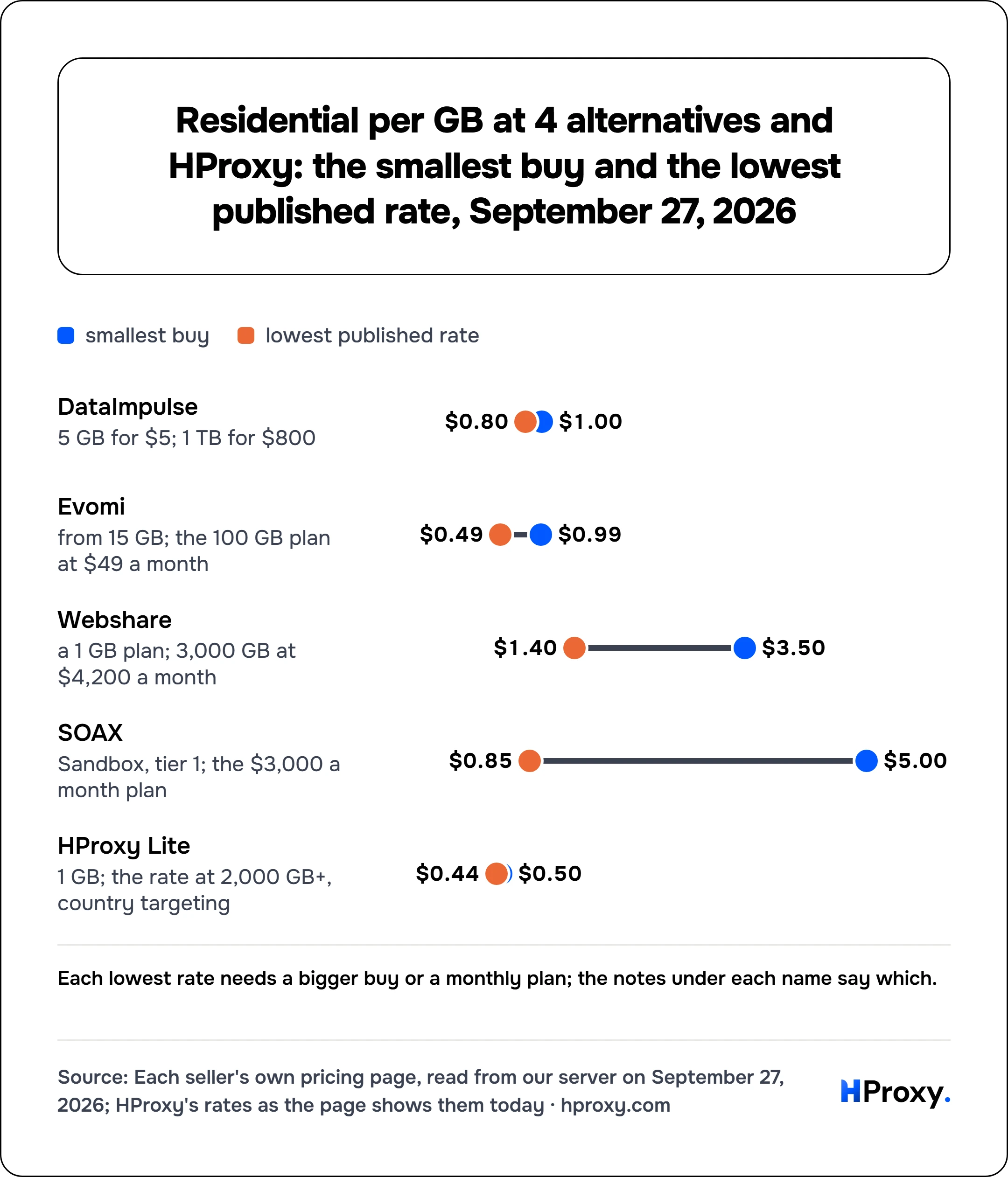
- smallest buy
- lowest published rate
Which one to pick
- You buy for sneaker drops and want a seller that tunes pools per retailer: LemonClub markets exactly that.
- You want residential traffic from 1 GB at a lower entry price: our Lite at $0.50/GB for 1 GB.
- You need city or ISP targeting from one GB: our Premium pool at $1.49 for one GB.
- You want to know who you pay, and to read the terms before paying: pick a seller that publishes both.
Whichever seller you pick, test what you get with our free proxy checker. It checks HTTP and SOCKS proxies with no sign-up.
The limits of this record
We did not buy from LemonClub or open its dashboard, so we have not read its terms, and nothing here measures its pools. Its pool counts are its own claims, and it does not say whose networks its four public pools resell. Its order page shows offers marked "Limited time offer", so prices may change. This page is due for a check by 27 December 2026.
Sources
Read on 27 September 2026, from our server:
- LemonClub: the homepage, nine product pages, the product comparison page and the privacy policy.
- The .io registry and the Internet Archive, for lemonclub.io.
- DataImpulse, Evomi, Webshare and SOAX pricing pages, the DataImpulse targeting docs and the Webshare help center.
- HProxy, our catalogue, payment, KYC and imprint pages, and our product sheets.