This page exists because the search you ran has almost no honest results. Nearly every page ranking for "Roundproxies alternative" earns a commission on the answer it gives you. We earn money if you pick us, which we are stating in the first paragraph rather than the footer.
What we can and cannot tell you about Roundproxies
The company behind the name sits at roundproxies.com. We carry them as a proxy provider.
A price is missing here on purpose. We have not captured a sourced rate for Roundproxies recently enough to publish one, and a stale number in this market is a wrong number.
Look for the tier you would actually land in, not the one at the bottom of the table, and find the expiry and failed-request clauses before the rate impresses you.
How Roundproxies presents itself
As of 9 September 2026 the tab reads "Roundproxies: Proxies for Web Scraping". In the description they hand to search engines: "The best Proxy Service platform with over 180M+ Residential and 3M Datacenter IP Proxies and much more. Extract data from any website."
What else that page states, without interpretation:
The product lines named on that page are residential, datacenter, ISP or static residential, mobile and SOCKS5. They advertise 190 countries or locations. Payment methods mentioned: cards. Their pricing page is titled "Pricing - Roundproxies, Transparent Proxy Plans for Every Need".
That is the vendor speaking, not us. We print it because a claim with a date attached is at least falsifiable.
What the registration record shows
The domain was registered on 1 August 2021, through NameCheap, Inc, which makes it about 5 years old. Those dates come from a registry query on 23 April 2026. Their registration is booked through 1 August 2026.
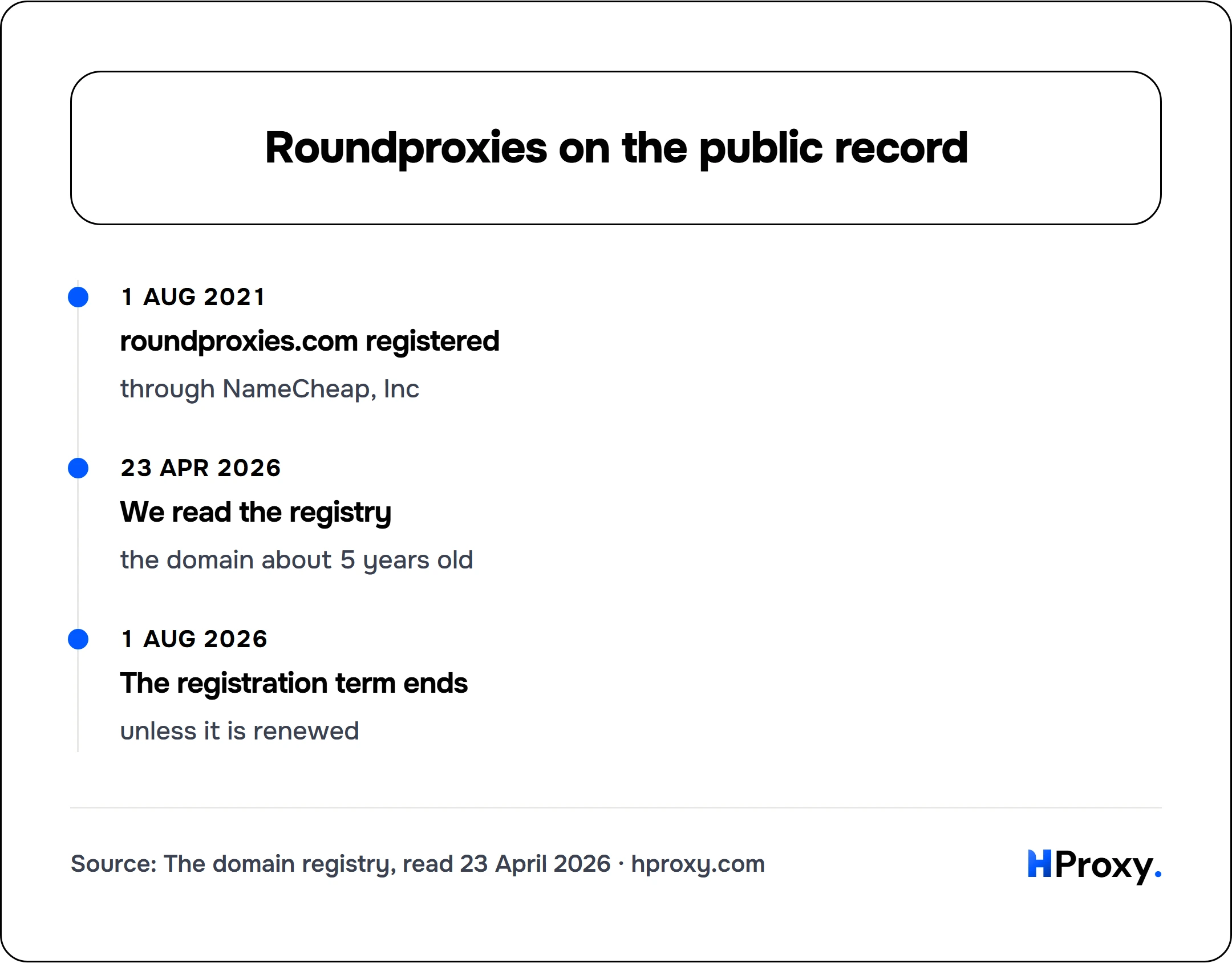
1 Aug 2021
roundproxies.com registered
through NameCheap, Inc
23 Apr 2026
We read the registry
the domain about 5 years old
1 Aug 2026
The registration term ends
unless it is renewed
Read that as a floor rather than a recommendation. Longevity says somebody has kept paying the registrar, and in a market with this much churn that is worth ten seconds of your attention.
What they have built around the product
We crawled 5.107 pages of their site and found 5 pricing pages.
That mix tells you how the company sells. Heavy location pages mean a geography-led pitch, heavy blog means a search-led one, and a single pricing page usually means one simple offer or one sales call.
What the advertised numbers cannot tell you
The expiry question
Expiry is the quietest price increase in this market. A plan sized for a busy month is expensive in a slow one, and the difference never appears in any comparison table, including ones written by vendors who benefit from it.
Why a cheap address is often a used one
An address you share carries the reputation of everyone else on it. That is acceptable for some work and fatal for anything involving a login. The price difference between shared and dedicated usually reflects exactly this.
Who pays for the requests that fail
Divide the spend by the successful responses, not by the requests sent. That single change reorders most price comparisons in this market, and your accounting will use it eventually anyway.
What separates them, in a table
The rows below are the ones that change what you pay and whether the job runs:
| Question to ask | Roundproxies | HProxy |
|---|---|---|
| Entry price | Not verified by us, read their page | From $0.44/GB, pay as you go |
| Does unused balance expire? | On their own terms page | Never |
| Minimum commitment | Read their current terms | None |
| Identity checks | Worth confirming in writing before you commit | Card orders are screened, and verification is sometimes requested |
| Targeting | Read their current terms | Country, city and ISP |
| Free way to evaluate | Worth confirming in writing before you commit | Free proxy list and proxy checker |
Blanks in that table are deliberate. We print what we read and date it, and leave the rest empty rather than repeating something we cannot stand behind.
The ten minute version of this decision
For a few dollars you can get a verdict specific to your job, which no comparison page can honestly promise you.
- Start with the smallest purchase each vendor allows, so the test costs less than the decision it replaces.
- Use your own scraper and your own target. A benchmark against a neutral site measures nothing you will experience.
- Count how many requests returned what you wanted, and how much bandwidth each side spent doing it.
- Spot-check the exits. Confirm they are in the country you paid for and the connection type you were sold.
- Keep whichever pool won on your job. Re-run this whenever success rate drops or the bill moves.
Others in this market
Nearest alternatives by product shape rather than by who pays us, since nobody does:
- Rainproxy alternatives
- Rampageproxies alternatives
- rapidproxy.io alternatives
- Rateproxy alternatives
- Rawproxy alternatives
The competing offer, for completeness
We are the pay as you go option in this market. Residential from $0.44 per GB, ISP and datacenter per address, mobile alongside them, all from one balance with nothing to forfeit. That model wins on irregular volume and loses on very large steady volume, which is worth knowing before you test.