Mobile proxies are the most expensive tier of the market and the most oversold, so a buying guide from a vendor owes you the uncomfortable sentence first: most jobs people buy mobile proxies for would run fine on residential at a fraction of the price. This page explains what a carrier IP genuinely changes, the two pricing models, and how to buy the tier without paying premium rates for trust you did not need.
Why carrier IPs sit at the top of the trust ladder
The mechanism is carrier-grade NAT. Mobile networks put large crowds of real customers behind each shared public address, so from a website's side, one 4G or 5G IP is a whole neighborhood. Block it and you lock out every phone user standing behind it, which is exactly the false-positive damage defended platforms spend money avoiding. The result: carrier ranges get the gentlest treatment of any IP type, gentler than home broadband, far gentler than anything with a datacenter label.
That is the whole product. A mobile proxy rents you a seat inside that protected crowd. Nothing else about your traffic improves, your fingerprint, your timing, your headers all stay your problem, and a clumsy bot on a pristine carrier IP is still a clumsy bot.
When mobile is the right buy, and when it is overspend
Buy mobile when the target measurably treats residential exits with suspicion, which in practice clusters around the most aggressively defended social platforms and mobile-app ecosystems, the places where account trust is the product being defended. Those are the jobs where the carrier crowd effect earns its premium.
Do not buy mobile for price monitoring, SERP tracking, geo-testing, or general scraping. Residential exits already read as normal visitors on those targets, and our own market map and cost breakdown show what the same gigabyte costs a tier down. The five-minute proof beats any opinion: run your actual target through a small residential test first, and buy mobile only if the residential success rate genuinely disappoints. Overbuying trust is the quietest way this market takes money.
The two pricing models, and who each one fits
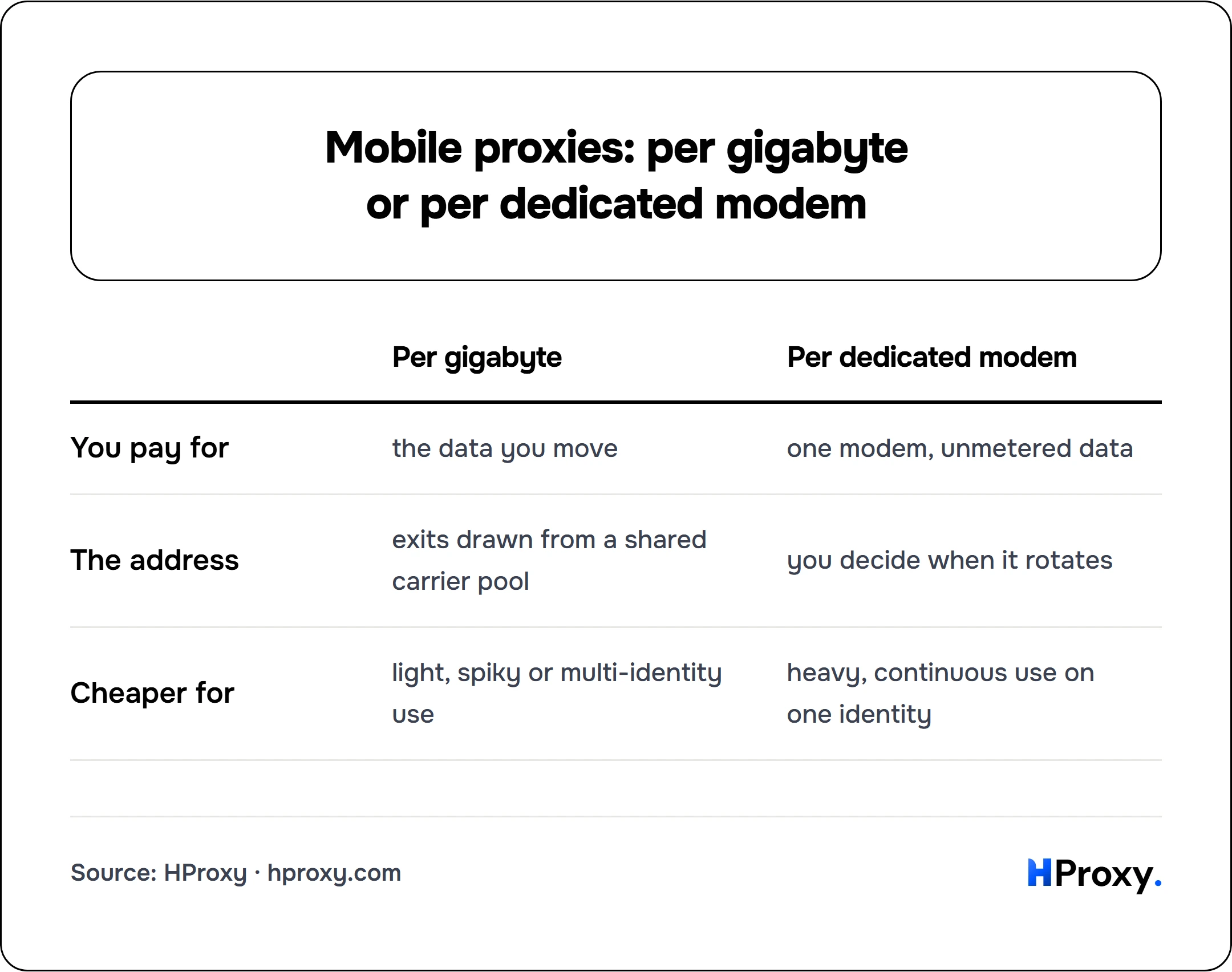
Per gigabyte from a shared carrier pool. You draw exits from the provider's pool and pay for the data you move. This is how our mobile pool is billed: $1.50 per GB, pay as you go, on the same wallet as residential and ISP, topped up from $2 by card, PayPal, Alipay or crypto, with a balance that never expires. Per-GB suits light, spiky, or multi-identity use, and it is the sane way to run the residential-first test above before committing to anything bigger.
Per dedicated modem. Some sellers rent whole physical connections: one modem, one carrier plan, unmetered data, you control when the IP rotates. The arithmetic flips with usage: heavy continuous traffic on one identity gets cheaper per gigabyte on a modem, while light or bursty use pays for idle hardware. Our dedicated option runs $1.50 per GB. If you cannot yet predict your volume, start on per-GB, let a month of real numbers decide, the same logic as pay as you go residential.
| Per gigabyte | Per dedicated modem | |
|---|---|---|
| You pay for | the data you move | one modem, unmetered data |
| The address | exits drawn from a shared carrier pool | you decide when it rotates |
| Cheaper for | light, spiky or multi-identity use | heavy, continuous use on one identity |
Country targeting is the axis that matters
The trust of a mobile exit is local: it comes from being inside a domestic carrier's crowd. A US platform reads a US carrier exit as home traffic; the same request through a foreign carrier arrives as an outsider with a good IP. So the searches people type, mobile proxies for the USA, the UK, Turkey, are asking the right question. Whatever provider you weigh, check that it names real carrier coverage in your target country, then verify with the proxy checker: a genuine mobile exit resolves to a carrier network, and one that resolves to a hosting company just failed the only test that matters.
The buying checklist, compressed
The full provider-judging method is in best place to buy residential proxies and applies here unchanged, with two mobile-specific additions: confirm the exit's network is a real carrier in your country before scaling, and price BOTH models against your measured volume before picking one. Everything else is the standard set, entry price versus fine print, balance expiry, checkout friction, and a few dollars of testing on your actual target before real budget. Ours is on the pricing page next to everything else we sell, and if the test says residential covers you, buy that instead, it is the cheaper way for us to be right about your job.