Readers land here mid-decision, usually with a cart open somewhere. The fastest thing we can do is set out what Hidemium publishes, what it does not, and what a few dollars of testing settles better than any argument.
Hidemium on the record
The company behind the name sits at hidemium.io.
What we do not hold is a current, sourced price for Hidemium. Rather than print a figure we cannot stand behind, this page leaves it out and tells you what to look for when you read their page yourself.
Look for the tier you would actually land in, not the one at the bottom of the table, and find the expiry and failed-request clauses before the rate impresses you.
What is on their front page
As of 9 September 2026 the tab reads "Antidetect Browser for Multi-Account Management, Hidemium". Their meta description, the sentence Google shows under the link, says: "Hidemium is an antidetect browser that creates isolated browser profiles with unique fingerprints. Manage multiple accounts without bans. Rated 4.9/5 , free plan available."
Also on the page, stated plainly:
The product lines named on that page are SOCKS5. They advertise 130 countries or locations. Payment methods mentioned: crypto. The page offers some form of free trial. Their pricing page is titled "Pricing, Hidemium.io".
That is the vendor speaking, not us. We print it because a claim with a date attached is at least falsifiable.
Longevity, on the public record
The domain was registered on 22 February 2023, through NameCheap, Inc, which makes it about 3 years old. Those dates come from a registry query on 23 April 2026. Their registration is booked through 22 February 2027.
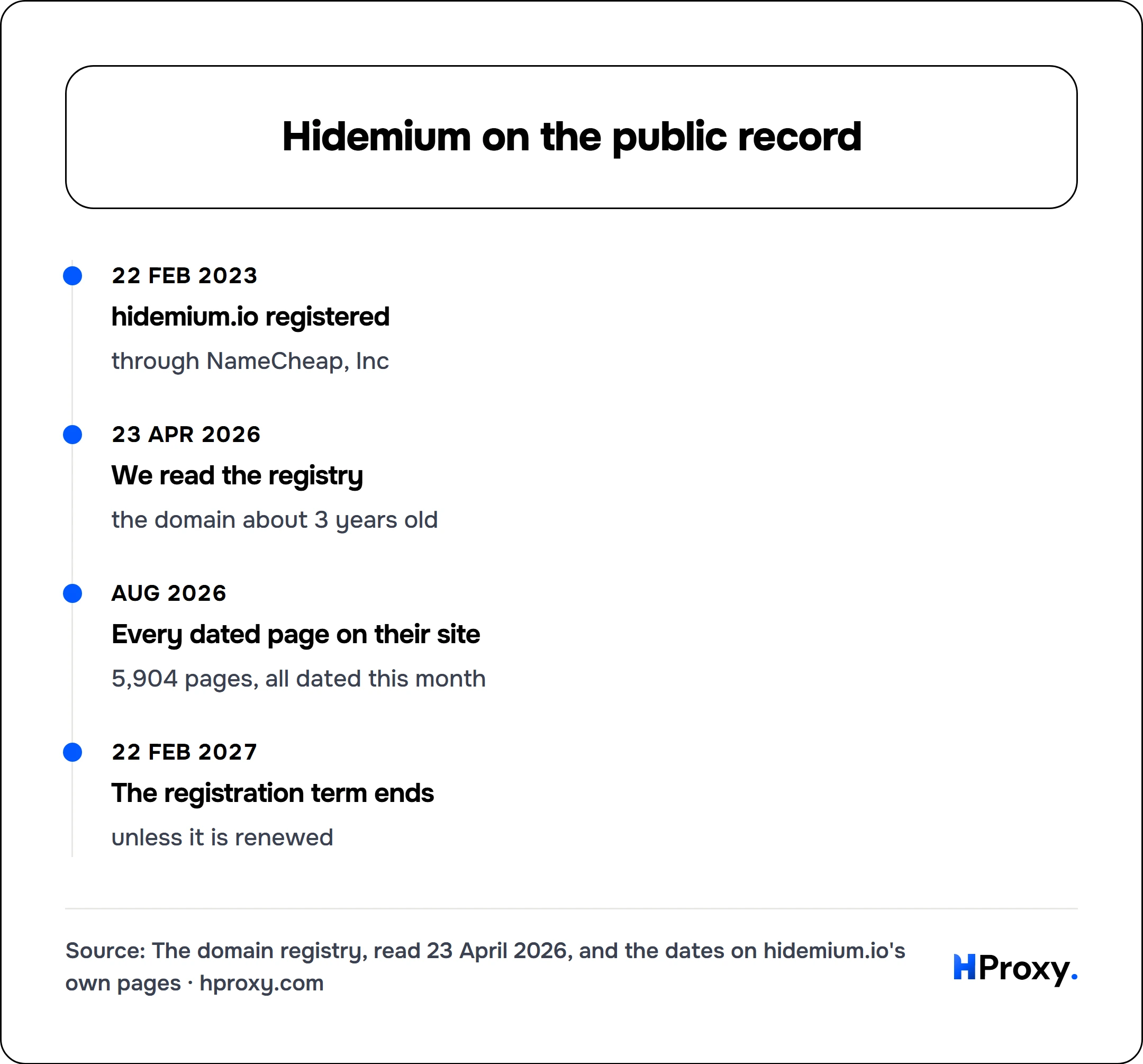
22 Feb 2023
hidemium.io registered
through NameCheap, Inc
23 Apr 2026
We read the registry
the domain about 3 years old
Aug 2026
Every dated page on their site
5,904 pages, all dated this month
22 Feb 2027
The registration term ends
unless it is renewed
Read that as a floor rather than a recommendation. Longevity says somebody has kept paying the registrar, and in a market with this much churn that is worth ten seconds of your attention.
How much site there is
We crawled 5.904 pages of their site and found 1.726 blog pages, 4 pricing pages, 1 location page and 84 use-case pages.
That mix tells you how the company sells. Heavy location pages mean a geography-led pitch, heavy blog means a search-led one, and a single pricing page usually means one simple offer or one sales call.
What the timestamps show
Our crawl of their site found 5,904 pages carrying a date, 1,726 of them articles. The oldest is from August 2026 and the newest from August 2026. 5,904 of them carry a date inside the last twelve months.
An actively maintained site is table stakes rather than a recommendation. It does rule out the failure that costs buyers the most here, which is prepaying a company that has quietly stopped.
Where published figures stop being useful
What happens when it breaks at two in the morning
Support quality is invisible until it is the only thing that matters. A cheap provider that takes three days to answer a routing problem has cost you more than the saving, and no pricing page reveals that.
Why a cheap address is often a used one
An address you share carries the reputation of everyone else on it. That is acceptable for some work and fatal for anything involving a login. The price difference between shared and dedicated usually reflects exactly this.
Who pays for the requests that fail
Divide the spend by the successful responses, not by the requests sent. That single change reorders most price comparisons in this market, and your accounting will use it eventually anyway.
A comparison that admits what it cannot say
This is the shortest table that still decides the purchase:
| Question to ask | Hidemium | HProxy |
|---|---|---|
| Entry price | Not verified by us, read their page | From $0.44/GB, pay as you go |
| Does unused balance expire? | On their own terms page | Never |
| Minimum commitment | Read their current terms | None |
| Identity checks | Worth confirming in writing before you commit | Card orders are screened, and verification is sometimes requested |
| Targeting | Their terms page answers this | Country, city and ISP |
| Free way to evaluate | Check the current terms, this one moves | Free proxy list and proxy checker |
That comparison covers what is publishable. What is not publishable, and what actually decides this, is how many of your requests come back correct.
The ten minute version of this decision
For a few dollars you can get a verdict specific to your job, which no comparison page can honestly promise you.
- Buy the minimum each side offers. Prefer a small paid batch over a trial, because trial traffic does not always ride the same pool.
- Send an identical workload through each: same target, same tooling, same time of day, same request mix.
- Measure what came back correctly and what it consumed, then divide the spend by the successes.
- Push a sample of exit addresses through an independent checker and confirm the country and connection type are what was advertised.
- Keep whichever pool won on your job. Re-run this whenever success rate drops or the bill moves.
The other names that come up
Other providers in the same bracket, priced and dated the same way:
Our side of it
What we offer is one account holding residential, ISP, mobile and datacenter, priced from $0.44 per GB on residential, with no tier to climb and no allocation to lose at month end. Whether that suits you depends on how steady your volume is.