The market Anoproxy trades in has a wide honesty range. Some vendors publish every tier, some publish a starting rate that nobody reaches, and a few publish nothing at all. Knowing which kind you are looking at is half the decision.
The record we hold
Anoproxy operates from anoproxy.online. Our classification for them is mobile proxy provider.
Anoproxy is not in our priced record, so nothing about their rate appears below. That gap is stated rather than filled, which is the only honest option available.
Read their page for the reachable rate rather than the headline, the minimum spend, the expiry clause and the billing treatment of blocked requests. Write down the date, because all four move.
What the registration record shows
The domain was registered on 8 November 2022, through NameCheap, Inc, which makes it about 3 years old. Registry data as of 9 September 2026. It is paid up until 8 November 2026.
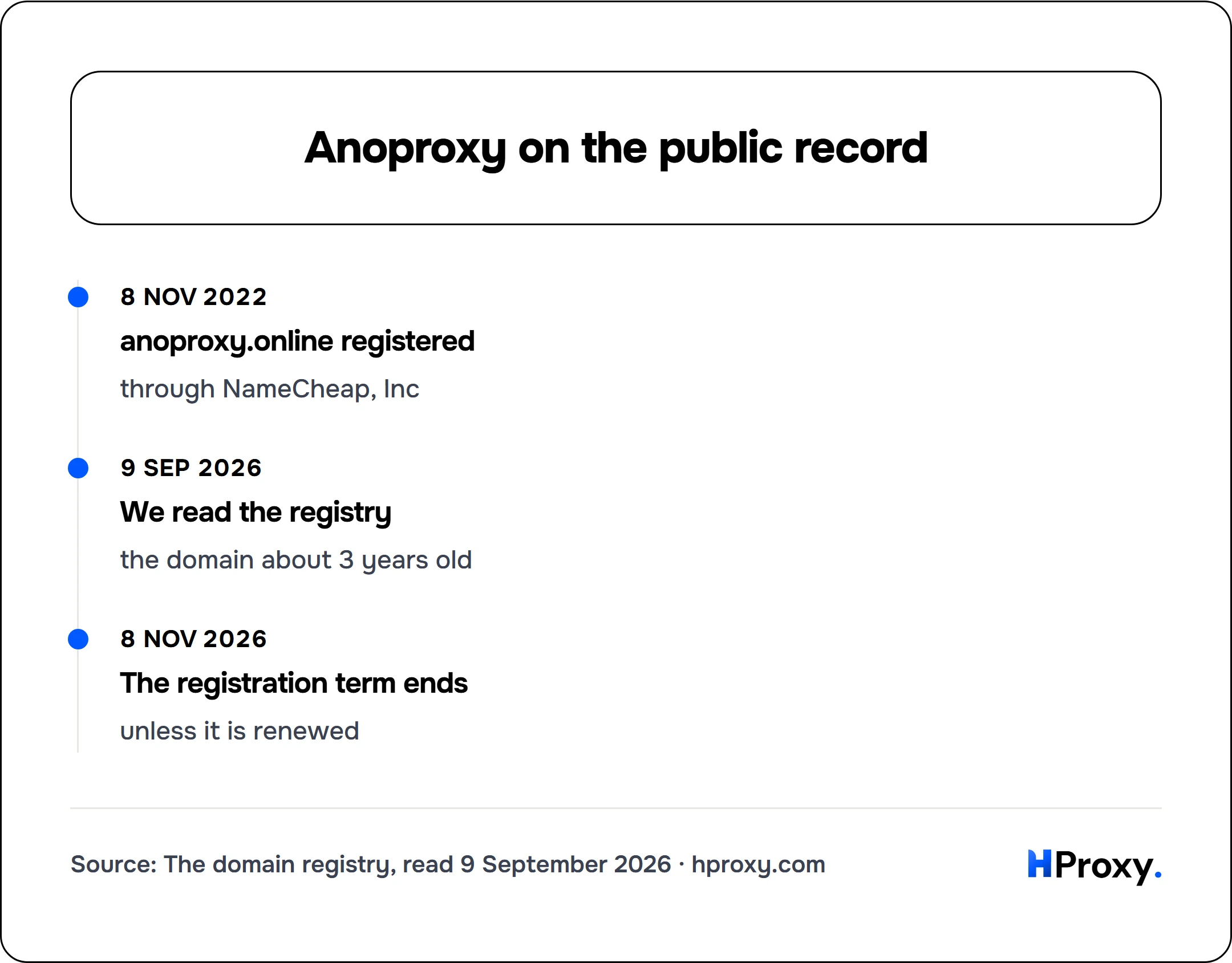
8 Nov 2022
anoproxy.online registered
through NameCheap, Inc
9 Sep 2026
We read the registry
the domain about 3 years old
8 Nov 2026
The registration term ends
unless it is renewed
Read that as a floor rather than a recommendation. Longevity says somebody has kept paying the registrar, and in a market with this much churn that is worth ten seconds of your attention.
The parts no marketing page answers
Who else is using your address
Ask how many accounts can sit on one address at once. Where the answer is unlimited or unspecified, price the plan as shared regardless of what the product is called.
The line item hidden in the success rate
On a hard target, failures are the majority of your traffic. Whether those failures are billed decides the real cost, and the clause covering it is rarely on the pricing page.
What actually caps your throughput
Bandwidth is rarely the constraint on a real workload. Concurrent connections, requests per second and per-session caps are, and they are frequently buried in the documentation rather than the pricing page.
Side by side, with the blanks left blank
This is the shortest table that still decides the purchase:
| Question to ask | Anoproxy | HProxy |
|---|---|---|
| Entry price | Not verified by us, read their page | From $0.44/GB, pay as you go |
| Does unused balance expire? | Worth confirming in writing before you commit | Never |
| Minimum commitment | Their terms page answers this | None |
| Identity checks | Check the current terms, this one moves | Card orders are screened, and verification is sometimes requested |
| Targeting | Not published clearly, ask before paying | Country, city and ISP |
| Free way to evaluate | On their own terms page | Free proxy list and proxy checker |
Nothing in that table settles the decision on its own. It narrows the field to two or three, and then measurement finishes the job.
How to settle it yourself in ten minutes
Run this before you commit any volume. It replaces every opinion on this page, including ours.
- Open an account on each and add the smallest amount they take. Skip the trial if a paid unit is cheap enough to buy outright.
- Point both at your real target, through your real tool, on the same day, with the same mix of requests.
- Log successes, failures and gigabytes used. Cost per successful request is the figure you are after.
- Verify a slice of the exits independently. Country labels in this market are self-reported and are not always right.
- Take the winner and set a reminder to run this again, since a result has a shelf life of about a quarter.
Others in this market
Nearest alternatives by product shape rather than by who pays us, since nobody does:
- Siamproxy alternatives
- Socproxy alternatives
- Usproxy alternatives
- XProxy alternatives
- Almazproxy alternatives
- Foxyproxy alternatives
The competing offer, for completeness
We are the pay as you go option in this market. Residential from $0.44 per GB, ISP and datacenter per address, mobile alongside them, all from one balance with nothing to forfeit. That model wins on irregular volume and loses on very large steady volume, which is worth knowing before you test.