Readers land here mid-decision, usually with a cart open somewhere. The fastest thing we can do is set out what HydraProxy publishes, what it does not, and what a few dollars of testing settles better than any argument.
The record we hold
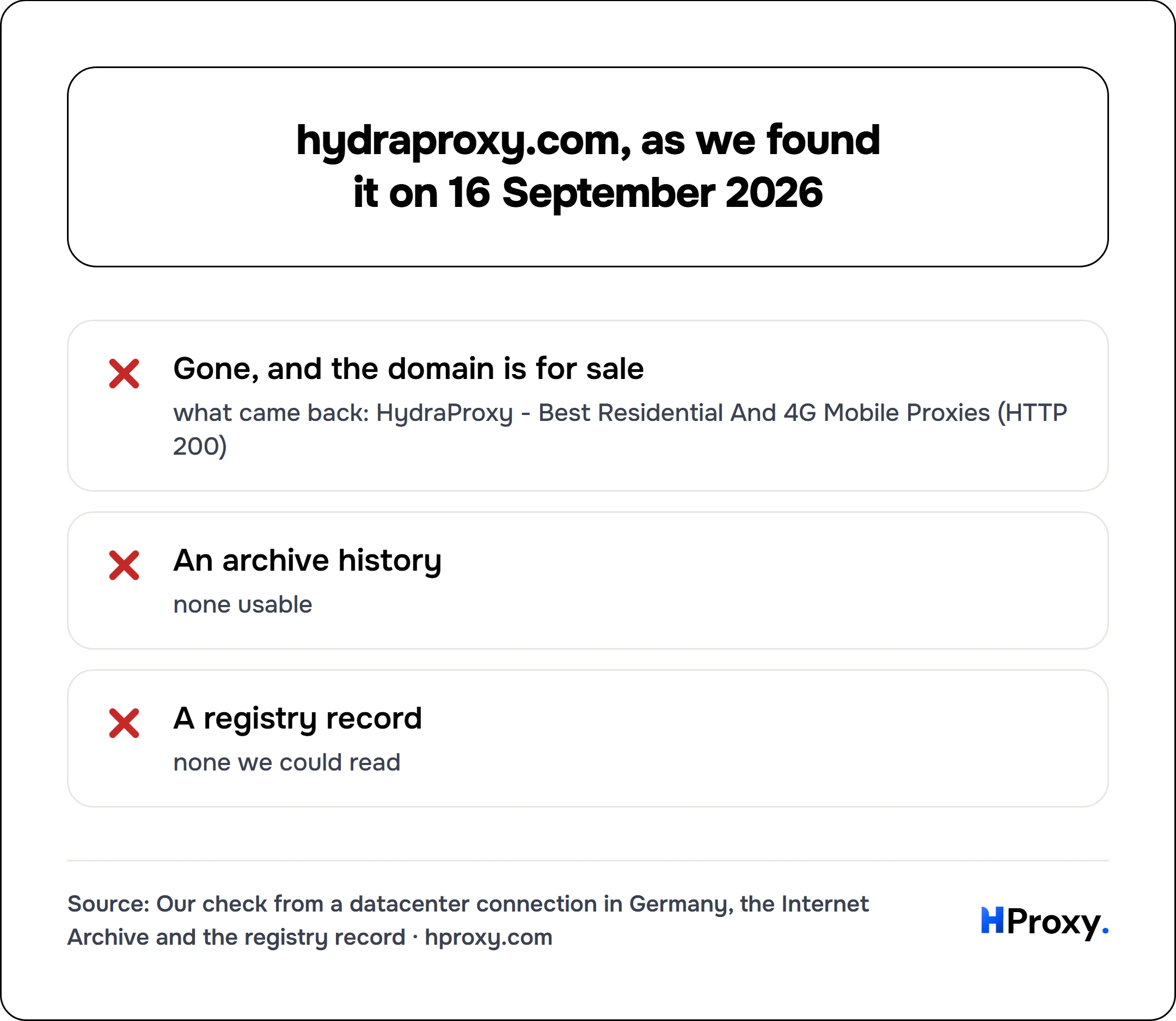
HydraProxy operates from hydraproxy.com. Our classification for them is mobile proxy provider. The last automated check bounced off a bot filter rather than reaching the page. That is ordinary here, and it appears only to explain the gap in our record.
HydraProxy is not in our priced record, so nothing about their rate appears below. That gap is stated rather than filled, which is the only honest option available.
Read their page for the reachable rate rather than the headline, the minimum spend, the expiry clause and the billing treatment of blocked requests. Write down the date, because all four move.
How HydraProxy presents itself
Read 9 September 2026, the homepage titles itself "HydraProxy - Best Residential And 4G Mobile Proxies". Their own summary of the product runs: "Best residential and 4G proxies for your business. Our residential and 4G proxies are carefully set to ensure they are 100% anonymous without any dns leaks."
Taken from the same page, on the same day:
The product lines named on that page are residential, datacenter, ISP or static residential and mobile. Support is advertised as around the clock. A refund or money-back term is mentioned. Their pricing page is titled "Best prices for mobile and residential proxies - HydraProxy".
Treat all of it as advertising, because it is. Its value is that it is dated and quotable, which is more than most comparison pages offer.
What the registration record shows
The domain was registered on 5 January 2019, through GoDaddy.com, LLC, which makes it about 7 years old. That record was read from the registry on 23 April 2026. The registry shows it renewed to 5 January 2028.
Read that as a floor rather than a recommendation. Longevity says somebody has kept paying the registrar, and in a market with this much churn that is worth ten seconds of your attention.
The shape of their site
Our own crawl reached 485 of their pages. The mix was 1 blog page, 1 pricing page and 1 use-case page.
That mix tells you how the company sells. Heavy location pages mean a geography-led pitch, heavy blog means a search-led one, and a single pricing page usually means one simple offer or one sales call.
Signs of life
Our crawl of their site found 485 pages carrying a date. The oldest is from September 2021 and the newest from August 2026. 330 of them carry a date inside the last twelve months.
An actively maintained site is table stakes rather than a recommendation. It does rule out the failure that costs buyers the most here, which is prepaying a company that has quietly stopped.
The demand around this name
The Keyword Planner puts brand demand at 20 a month: 10 a month for their pricing and 10 a month for a review of them. Figures read from Google Keyword Planner on 9 September 2026.
Weighted towards people trying to work out what it costs. A comparison that ignores that and opens with a pitch has misread the room.
Advertisers bid up to $31.68 for one of those clicks, which is a useful proxy for what a customer in this market is worth and for how hard the results page is fought over.
The parts no marketing page answers
What happens when it breaks at two in the morning
Test the support channel before you need it. Ask something specific and technical, and judge both the speed and whether the answer came from somebody who understood the question.
Why a cheap address is often a used one
A shared address arrives with a history you did not create and cannot see. For read-only work it rarely matters. For anything that keeps a session, it is the most common cause of unexplained failure.
Who pays for the requests that fail
Some vendors bill every request, some bill only successful ones, and the difference is the whole comparison once a target starts blocking. A cheap rate with a fifty percent success rate is twice its advertised price.
Side by side, with the blanks left blank
This is the shortest table that still decides the purchase:
| Question to ask | HydraProxy | HProxy |
|---|---|---|
| Entry price | Not verified by us, read their page | From $0.44/GB, pay as you go |
| Does unused balance expire? | Worth confirming in writing before you commit | Never |
| Minimum commitment | Their terms page answers this | None |
| Identity checks | Check the current terms, this one moves | Card orders are screened, and verification is sometimes requested |
| Targeting | Not published clearly, ask before paying | Country, city and ISP |
| Free way to evaluate | On their own terms page | Free proxy list and proxy checker |
That comparison covers what is publishable. What is not publishable, and what actually decides this, is how many of your requests come back correct.
The ten minute version of this decision
For a few dollars you can get a verdict specific to your job, which no comparison page can honestly promise you.
- Open an account on each and add the smallest amount they take. Skip the trial if a paid unit is cheap enough to buy outright.
- Point both at your real target, through your real tool, on the same day, with the same mix of requests.
- Log successes, failures and gigabytes used. Cost per successful request is the figure you are after.
- Verify a slice of the exits independently. Country labels in this market are self-reported and are not always right.
- Take the winner and set a reminder to run this again, since a result has a shelf life of about a quarter.
The other names that come up
Other providers in the same bracket, priced and dated the same way:
- Gridpanel alternatives
- Ltespace alternatives
- Mobileproxy alternatives
- Obitel Proxy alternatives
- Onlineproxy alternatives
- Proxidize alternatives
The competing offer, for completeness
We are the pay as you go option in this market. Residential from $0.44 per GB, ISP and datacenter per address, mobile alongside them, all from one balance with nothing to forfeit. That model wins on irregular volume and loses on very large steady volume, which is worth knowing before you test.