
Free residential proxies exist only in a narrow sense: some open proxies on free lists sit on home and telecom networks. They are open proxies that happen to sit there, not a residential proxy service. We counted them in our own pool on 28 September 2026 at 18:17 UTC, on addresses that held fewer than 20 working entries. Of those 4,202 addresses, 3,325 sat on networks not labelled datacenter. Counting every entry, though, 16,672 of 20,118 working entries were labelled datacenter.
This page covers what our pool showed and how to check the network behind any proxy.
What residential means
A residential proxy uses an address that an internet provider assigns to a home or mobile connection. A datacenter proxy uses an address of a hosting company. Websites tell them apart by the network behind an address, its autonomous system. RFC 1930 defines one as a group of IP prefixes run by one or more network operators under a single routing policy.
Among the simplest signals of IP reputation, Cloudflare names "data center IP addresses, known open proxies". A free proxy on a home line escapes the first signal, not the second. It sits on public lists, which is how anyone finds it. Paid residential proxies come in rotating and static forms, a difference we cover in rotating vs static residential proxies.
What our pool showed
On 28 September 2026 at 18:17 UTC, we counted the working entries of our free proxy list by the datacenter label. The label is the public network type of each address. The query read counts only, from our server, and left out addresses that held 20 or more of the entries it counted.
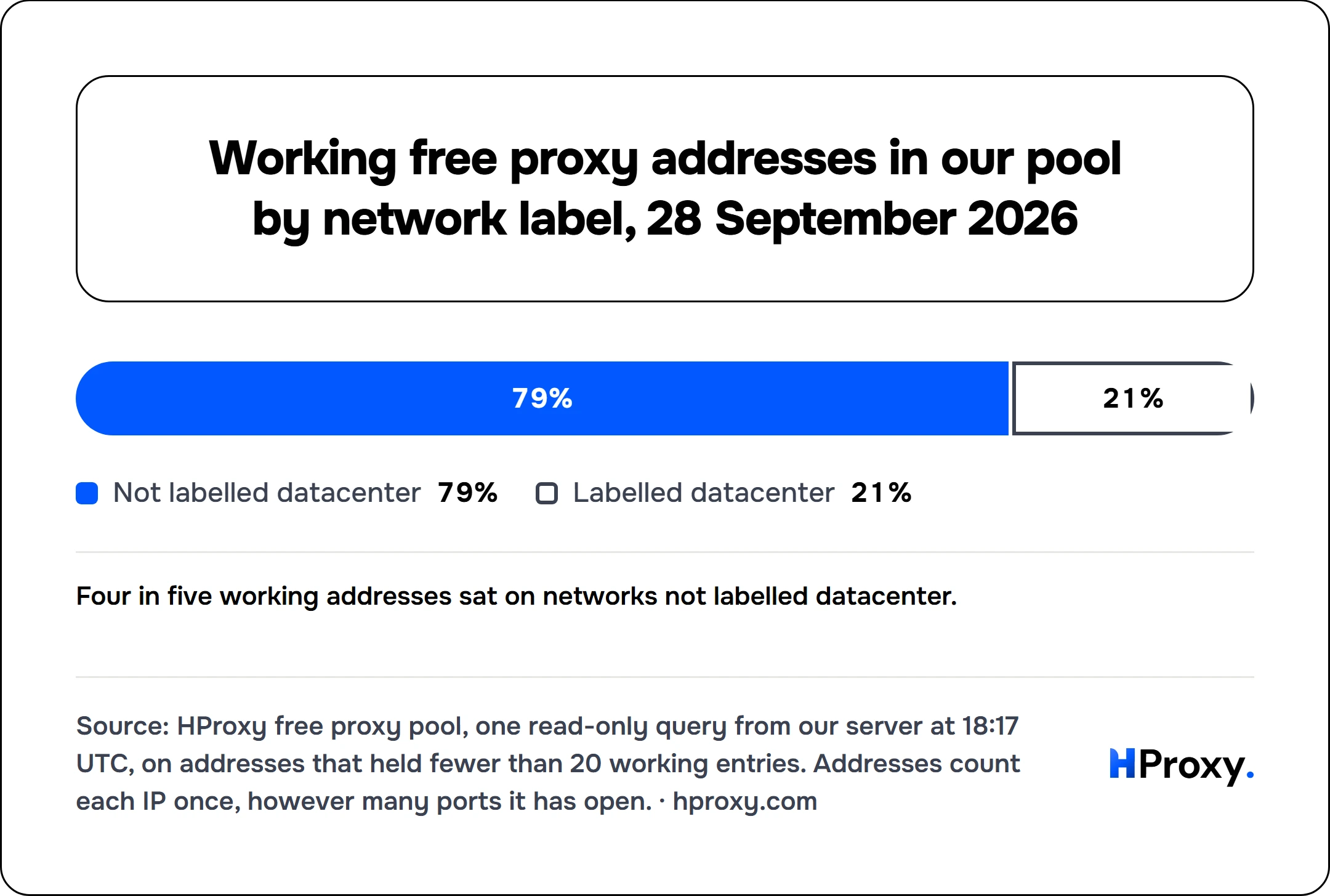
- Not labelled datacenter79%
- Labelled datacenter21%
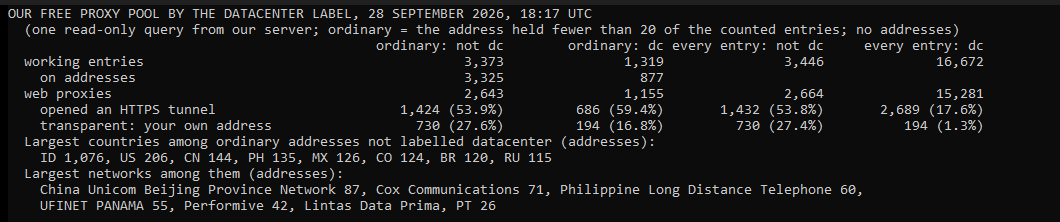
- Entries and addresses. On ordinary addresses, 3,373 of 4,692 working entries sat on networks not labelled datacenter, on 3,325 addresses. Counting every entry, 16,672 of 20,118 were labelled datacenter.
- Networks. The largest networks among them were telecom and cable companies. They include China Unicom, Cox in the United States, PLDT in the Philippines, UFINET in Panama and Telkom Indonesia.
- Countries. Indonesia led with 1,076 of those addresses, then the United States with 206, China with 144 and the Philippines with 135.
- The label. It is a guide, not proof of a home line. At least one of the twelve largest networks in this group is a hosting company. Our own documentation calls the label "a hint, not a verdict".
How they compare with datacenter entries
| Our pool on 28 September 2026, ordinary addresses | Not labelled datacenter | Labelled datacenter |
|---|---|---|
| Working addresses | 3,325 | 877 |
| Web proxies | 2,643 | 1,155 |
| Web proxies that opened an HTTPS tunnel | 1,424 | 686 |
| Transparent web proxies | 730 | 194 |
| Median lifespan of those that stopped | 231.3 hours | 239.4 hours |
| A quarter had stopped within | 23.7 hours | 26.6 hours |
On ordinary addresses, a free proxy on a home or telecom network was a little less likely to open an HTTPS tunnel than a datacenter one, 53.9 against 59.4 percent. It was more likely to be transparent: 730 of 2,643 web proxies, 27.6 percent, against 16.8 percent of datacenter ones. A transparent proxy passes your own address on. Both kinds lasted a median of about ten days, and about three in ten of each stopped within two days.
Why a home connection runs an open proxy
There is little research on it. A 2018 study of more than 107,000 listed open proxies calls it a question that has not undergone rigorous study. It says that "In some instances, the proxies are due to misconfiguration or even compromise". It adds: "Still, many proxies are operated by choice". Our checks cannot tell which of these a given address is. The same study found TLS man-in-the-middle attacks among open proxies. So treat a free proxy on a home line as you would any free proxy: public pages only, and never a login.
Check the network behind any proxy
Look up its address. Our free IP lookup API returns the network number (ASN), its name, the ISP and the datacenter label. It needs no key and no signup.
# Looks up one address: country, network number (ASN) and name, ISP and the datacenter label
curl "https://hproxy.com/api/ip/203.0.113.7"
An internet provider in the answer points to a home or mobile line, and a hosting company points to a server. Then paste the proxy into our free proxy checker for its anonymity grade, and skip transparent ones. Our guides on whether free proxies are safe and on when free proxies are fine cover the rest.
When free is not enough
For web tasks that have to keep running, such as checking your own site from another country, a residential proxy is the better tool. Its address belongs to a home connection, and it stays up while you work. Ours start at $0.44/GB, pay as you go, and purchased traffic has no scheduled expiry date. What residential proxies cost across the market is in how much residential proxies cost.
The plain answer
Free residential proxies are open proxies that happen to sit on home or telecom networks. On 28 September 2026, our pool held 3,325 such addresses among those with fewer than 20 working entries. About a third were in Indonesia. They opened HTTPS tunnels about as often as datacenter entries. But 27.6 percent of their web proxies passed your own address on, and they come with no guarantee from anyone. Use them for public pages only, check each one first, and never sign in through one.
How we measured
We ran one read-only query of our free proxy pool from our server in the United States on 28 September 2026 at 18:17 UTC. It counted the entries that passed their latest check by the datacenter label, the public network type of each address. Each figure leaves out addresses that held 20 or more of the entries it counts. Where the two differ a lot, the figure over every entry stands next to it. It also read the network, country, protocols and anonymity grade from that check. Addresses count each IP once, however many ports it has. The lifespans come from a second query at 15:45 UTC the same day. They count archived entries that answered at least once, on addresses with fewer than 20 of them. They leave out Amazon's networks, where no free proxy relayed a request in our September country tests. They also leave out one evening in June when our checker failed. Each runs from first seen to the start of its last dead streak. We store no proxy addresses from these tests, and every time is in UTC.
Sources
- IETF, RFC 1930: Guidelines for creation, selection, and registration of an Autonomous System, March 1996.
- Cloudflare blog, on detecting bot attacks from residential proxies with machine learning, 24 June 2024, updated 15 July 2026.
- Akshaya Mani, Tavish Vaidya, David Dworken and Micah Sherr, An Extensive Evaluation of the Internet's Open Proxies, arXiv 1806.10258, 27 June 2018.
- HProxy documentation: the IP lookup API and the proxy checker API, read 28 September 2026.