A free proxy works in Android's own Wi-Fi setting only if it is an HTTP proxy that opens an HTTPS tunnel and needs no password. We counted our own free list at 20:57 UTC on 21 September 2026. Of the 6,035 proxies that answered, 1,724 met that bar. The median one took 5.4 seconds to reply, so a free proxy on a phone is for a quick test, not for daily use.
What Android's proxy setting can use
Android keeps its proxy inside each saved Wi-Fi network, not in one place for the whole phone. The setting holds a host and a port with a list of sites to skip, or the link to a PAC file. It has no box for a username or a password, as the ProxyInfo source shows.
That rules out any proxy that needs a login, while public free proxies have none and fit. A paid proxy with a password needs an app instead.
The field also expects an HTTP proxy. Android's Wi-Fi source calls it the HTTP proxy of that network. A SOCKS proxy speaks its own protocol, defined in RFC 1928, so it cannot go in this field at all.
Chrome reads the proxy from Android, so it needs no second setting of its own. The Chromium source takes the host, port, PAC link and skip list straight from the system. Other apps are less certain: Android names two of its own network stacks that follow the setting, and an app with its own network code does not have to.
For an https:// page, the phone asks the HTTP proxy for a CONNECT tunnel and sends the encrypted page through it, as RFC 9110 describes. A proxy that cannot open that tunnel fails on every https:// page, even when it answers plain http:// requests.
| Proxy | In Android's Wi-Fi setting | What you need instead |
|---|---|---|
| HTTP proxy with HTTPS tunnels, no login | Works | Nothing |
| HTTP proxy without HTTPS tunnels | Fails on https:// pages | A different proxy |
| SOCKS4 or SOCKS5 proxy | Cannot be entered | An app that uses the VPN interface |
| Proxy with a username and password | No field for the login | An app, or a browser that asks |
| Proxy for mobile data | The Wi-Fi setting does not apply | The proxy fields in the APN |
How many free proxies pass right now
Our verifier tries every address in our free list twice, through the same HTTP proxy port: once with a plain request and once with a CONNECT tunnel to our own TLS server. This is the count we took on 21 September 2026 at 20:57 UTC.
| What we counted | Proxies |
|---|---|
| Answered at their last check | 6,035 |
| Could carry https:// pages in Android's Wi-Fi setting | 1,724 |
| Of those, answered within 3 seconds | 535 |
| Of those, answered within 1 second | 178 |
| Answered plain HTTP but could not open an HTTPS tunnel | 2,976 |
| Answered only as SOCKS | 1,339 |
Not quite one in three answering proxies suits a phone, and about one in three of those replied within three seconds.
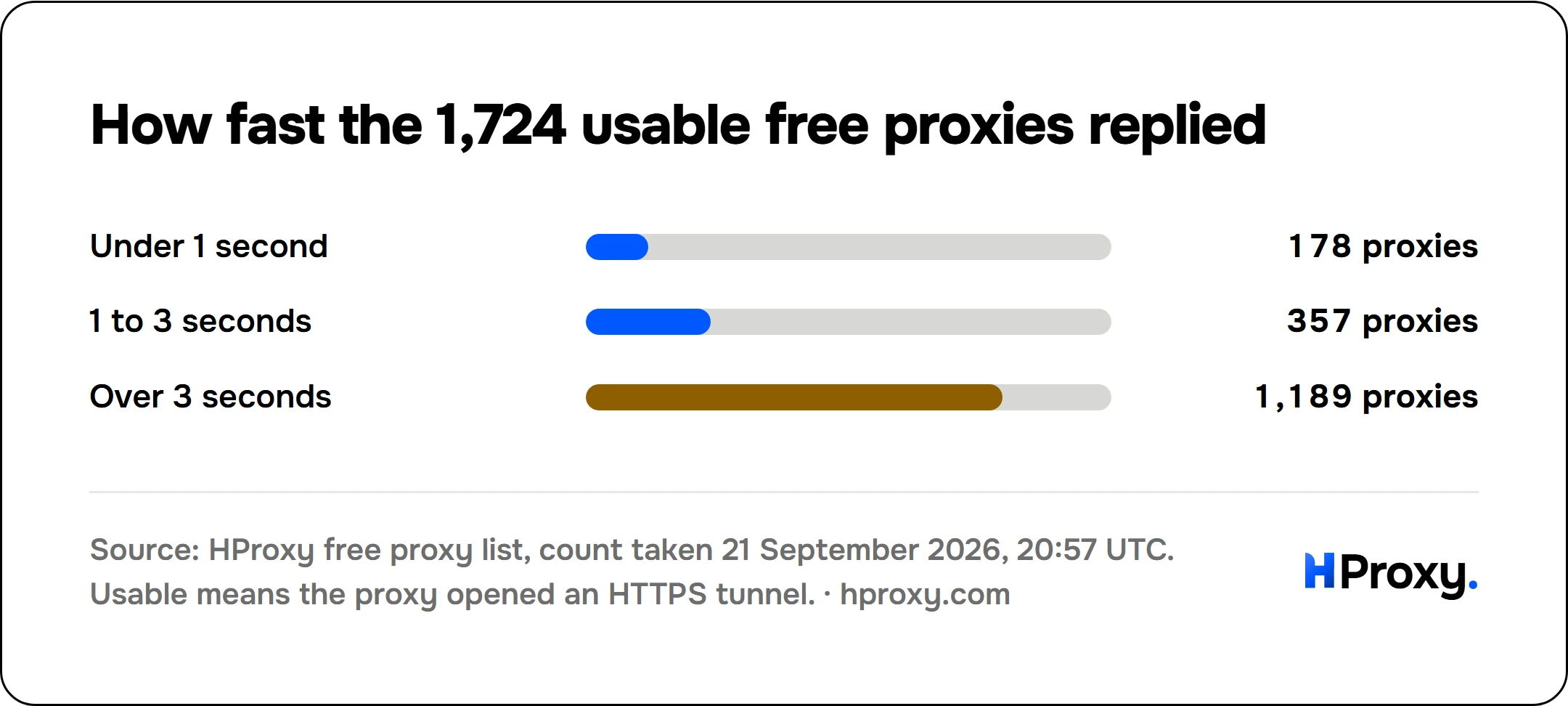
The usable proxies had been checked a median of 11 minutes before the count, and 90 percent within 20 minutes. The largest groups were in the United States (404) and Indonesia (366). Our HTTPS list holds the proxies that passed the tunnel test, now or within the last 48 hours.
How to test a free proxy on your phone
- Paste the proxy into our proxy checker first. It runs the same plain and HTTPS tunnel tests as the list.
- Open the Wi-Fi network you are on, pick the manual proxy, and type the host and the port. The screens differ by phone, and our Android setup guide shows each step.
- Open
cloudflare.com/cdn-cgi/tracein Chrome. Theip=line should show the proxy, not your own connection. - If pages stop loading, set the proxy back to None in the same place.
One more check matters on plain http:// pages. A transparent proxy adds your own IP to each plain request in a header, which RFC 7239 defines. In our count, 231 of the 630 usable proxies that also carry http:// pages did that. On https:// pages they cannot add the header, because they only pass the tunnel along. The proxy still sees the name of every site you open, as the Chromium proxy notes point out.
SOCKS proxies and mobile data
A SOCKS5 proxy needs an app that uses Android's VPN interface, which gives the app a virtual network link and the routing rules to go with it. That is how one app can carry the traffic of other apps.
Mobile data does not use the Wi-Fi setting. It has its own proxy host and port in the APN, the carrier's link profile, as Android's APN source shows. The username and password in the APN belong to the carrier, so do not type a proxy login there.
Where free stops working on a phone
Free proxies come and go fast. Of the 40,876 proxies that worked at some point in the 48 hours before our count, 15 percent still answered at their last check. Over its time in our list, the median usable proxy answered 25 percent of our checks. A slow or dead proxy stops every page and app that goes through it.
When the phone needs a proxy that keeps working, a paid plan can use the same Wi-Fi field if it accepts your own IP instead of a password. Our Residential Premium plan takes up to 150 such IPs per plan. Those connections rotate between IPs, so they are not one fixed address. For a proxy with a username and password, use an app.
Sources
- Android Open Source Project, ProxyInfo.java (Connectivity module), main branch, read 19 September 2026.
- Android Open Source Project, WifiConfiguration.java (Wi-Fi module), main branch, read 19 September 2026.
- Android Open Source Project, VpnService.java, main branch, read 19 September 2026.
- Android Open Source Project, ApnSetting.java, main branch, read 19 September 2026.
- The Chromium Authors, Proxy support in Chrome (net/docs/proxy.md), read 19 September 2026.
- The Chromium Authors, proxy_config_service_android.h, read 19 September 2026.
- IETF, RFC 9110, HTTP Semantics, June 2022, section 9.3.6.
- IETF, RFC 1928, SOCKS Protocol Version 5, March 1996.
- IETF, RFC 7239, Forwarded HTTP Extension, June 2014.
- HProxy, free proxy list count, 21 September 2026, 20:57 UTC.