Proxy6's checker is a free online tool on proxy6.net. You paste a list of proxies, and it sorts them into valid and invalid. For each proxy it shows the type, the ping and an HTTP status code, and Proxy6 says it reads the country too. It can check IPv6 proxies and proxies that need a login and password.
A valid result means the proxy answered. It cannot tell you whether your target site will open through it. That gap matters most for IPv6 proxies, one of the four kinds Proxy6 sells. On October 23, 2026, about half of the most visited sites had no IPv6 address, eBay, PayPal, TikTok and X among them.
This page explains each column, shows our measurement, and ends with free checkers we maintain. We did not run Proxy6's checker: everything about it comes from its page, its script, its FAQ and its API documentation.
What Proxy6's checker shows
The form takes your list and an address to test against. Its placeholder for that address is http://example.com. Proxy6's script sends the whole list to Proxy6's servers in one request and waits up to three minutes. Past that, it says: "The timeout has been exceeded. Send the list again."
The results land in two boxes, Valid and Invalid, and in a table with seven columns:
- Status: valid or invalid, stored as yes or no.
- IP:Port, Login and Password: the proxy as you entered it.
- Type: the proxy's protocol.
- Ping: how fast it answered.
- Answer: an HTTP status code, such as 200 when a page loaded.
No column grades anonymity. A proxy that passes your real address on in a header still counts as valid.
Checking from code: the API's check method
Proxy6 customers can also check from a script. The API's check method takes one proxy per call, by its number in your account or as ip:port:user:pass. It answers true or false. The API allows no more than three calls a second, and extra calls get error 429. Checking 600 proxies one by one takes at least 200 seconds.
What a valid result cannot tell you
Proxy6's FAQ states the limit itself: "IPv6 protocol proxies could be used only for sites that support IPv6 protocol." A checker confirms the proxy works. Whether your target has an IPv6 address is a second question, and Proxy6 answers it with a separate tool.
We measured how often the answer is no. On October 23, 2026, we looked up the 1,000 most visited domains of Tranco, a research ranking, in DNS. 818 of them publish an IPv4 address. Of those, 401 also publish an IPv6 address, 49%:
The biggest sites lead. From rank 251 down, fewer than half have one. The names people often reach through proxies are split:
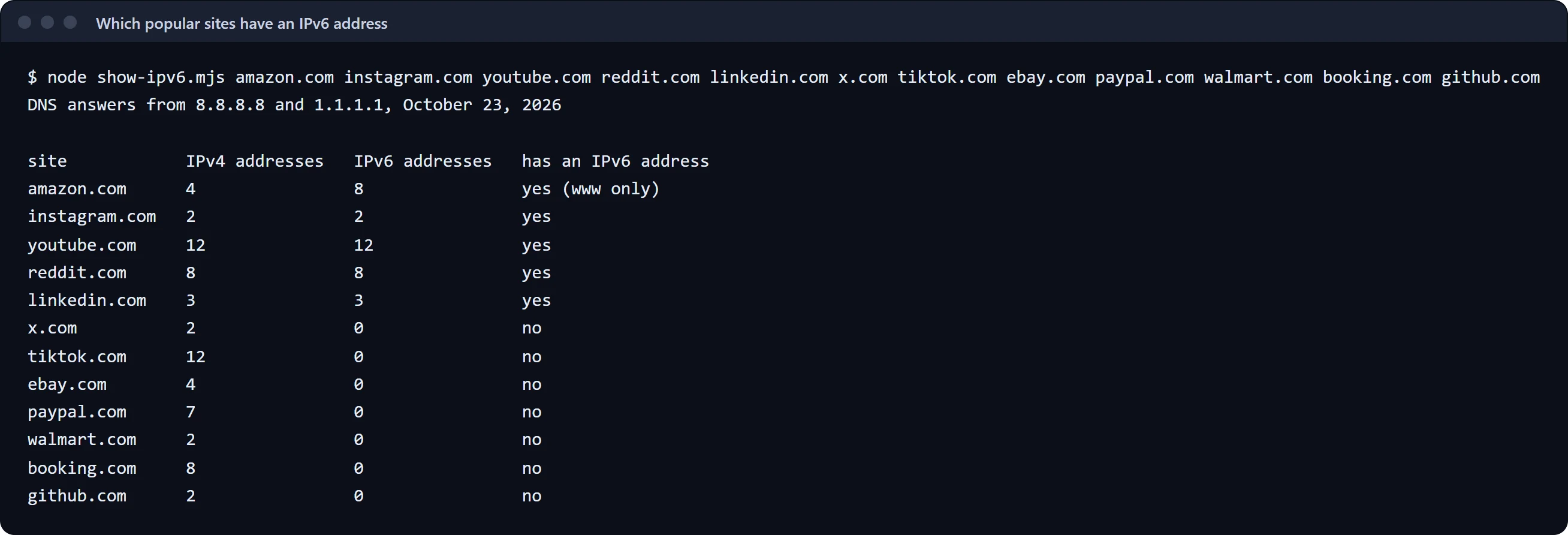
Amazon has an IPv6 address on www.amazon.com only. eBay, PayPal, Walmart, Booking, TikTok, X and GitHub had none. Through an IPv6 proxy, those sites have no address to connect to, and the proxy still tests valid.
People run into this without seeing the cause. In June 2024, a user of an open-source Telegram bot asked on GitHub why new proxies worked in the Telegram app and failed in the bot. One reply came in two words (translated from Russian): "Only IPv4."
How to check a site yourself
Look up the site's AAAA record, the DNS record that holds an IPv6 address:
nslookup -type=AAAA www.example.com
dig AAAA www.example.com +short
The first works on Windows, macOS and Linux, the second on most macOS and Linux systems. Check the bare name and the www name. If neither returns an address, an IPv6 proxy has nothing to connect to. An address in the answer is a good sign, though it does not prove the site serves pages on it.
Proxy6's anonymity check
The other Proxy6 tool people search for is its anonymity check. It looks at the browser you open it in. It compares the address it sees with your time zone, compares two readings of your user agent, and checks WebRTC, blacklists and open ports.
Three of its rows test technology that current browsers no longer run:
- Flash: Adobe stopped supporting Flash Player on December 31, 2020, and blocked Flash content from January 12, 2021.
- Java: an applet needs a browser plug-in, and browser makers removed plug-in support. Java deprecated its Applet API in JDK 9 for that reason.
- ActiveX: Internet Explorer 11's desktop app ended support on June 15, 2022. ActiveX now runs only in Edge's IE mode, on sites an organization lists by policy.
On a current browser those rows can only read off. WebRTC is the row that matters: it can give a site your real address while your traffic goes through a proxy.
Free checkers we maintain
We make free proxy tools, and we sell residential proxies, so read this part with that in mind. Here are Proxy6's two checks next to ours:
| Where the check runs | Grades anonymity | What each proxy gets | |
|---|---|---|---|
| Proxy6 checker | Proxy6's servers | no | Valid or invalid, type, ping, HTTP code |
| Proxy6 API check | Proxy6's servers | no | True or false, three calls a second |
| HProxy online checker | Our servers | yes | Protocols, latency, anonymity, exit country, network |
| HProxy app | Your computer | yes | Protocols, latency, anonymity, exit country, network |
- Our free app checks from your own computer. A proxy locked to your IP address answers only that address, so the app is how you test one. Its judges run on our own domain, and each check carries a one-time code the judge must return. It runs on Windows 10 and 11, macOS and Linux. Get it on our proxy checker page.
- Our online proxy checker needs no install. It takes up to 100,000 lines a run, and 300,000 a day from one address, with no account. It tries HTTP, HTTPS, SOCKS4 and SOCKS5 on every line and grades anonymity. It cannot reach a proxy locked to your own IP address.
- Our proxy leak test covers what still matters in an anonymity check today: the address a site sees, WebRTC, IPv6 exposure and forwarded headers.
We do not offer a blacklist check or a port scanner. To read your results, our guides on checking if a proxy works and on anonymity levels explain each column.
Where HProxy fits
The checkers are free. What we sell is residential proxies: Residential Lite costs $0.50/GB for one GB, falling to $0.44/GB at 2,000 GB+, and the balance does not expire. Whatever you buy, look up your target's addresses first, and test a few proxies against it before you scale. For Proxy6's prices and four rivals, see our Proxy6 alternatives page; for who runs it, see our Proxy6 company page.
What we could not find out
We did not run Proxy6's checker or buy its proxies, so its behavior comes from its page, its script, its FAQ and its API documentation. We did not test IPv6 proxies in our own checkers. Our measurement is one day of DNS answers from two public resolvers. An IPv6 address in DNS does not prove that a site serves pages on it, so 49% is an upper bound for what an IPv6 proxy can open. Tranco's top 1,000 also holds infrastructure names, and the 181 with no address at all are left out.
Sources
- Proxy6's checker page, its form and its script (proxy-checker.js), read as text from our server, October 23, 2026.
- Proxy6's FAQ, its anonymity check page and its API documentation (the check method and its limit of three calls a second), read from our server, October 23, 2026.
- Adobe, "Adobe Flash Player End of Life", updated January 13, 2021.
- Microsoft Lifecycle, "Internet Explorer 11 desktop application ended support for certain operating systems", June 15, 2022; Microsoft Learn, "What is Internet Explorer mode?", updated July 2026.
- OpenJDK, JEP 289, "Deprecate the Applet API", delivered in JDK 9.
- RFC 3596, "DNS Extensions to Support IP Version 6", October 2003; RFC 8828, "WebRTC IP Address Handling Requirements", January 2021.
- Tranco list 746PX (created October 21, 2026), a research ranking of the most visited domains (Le Pochat et al., NDSS 2019).
- Our DNS lookups of its top 1,000 domains and of twelve popular sites from 8.8.8.8 and 1.1.1.1, October 23, 2026.
- A GitHub issue of an open-source Telegram bot, June 10, 2024, in Russian.
- HProxy's app and checker code: the app's judges and result fields, the online checker's limits and its one-time code, the leak test's four checks.