Half a million free proxies have passed through our verification engine. At any given moment, only a couple of thousand of them actually work. That gap is the whole story of free proxies, and this article is the data behind it, pulled straight from the engine that keeps our free proxy list accurate.
At the time of writing, our verification engine has performed more than 129,131,311 checks against over 589,918 unique proxies it has tracked. What those checks say about the free proxy world is below, uncomfortable parts left in.
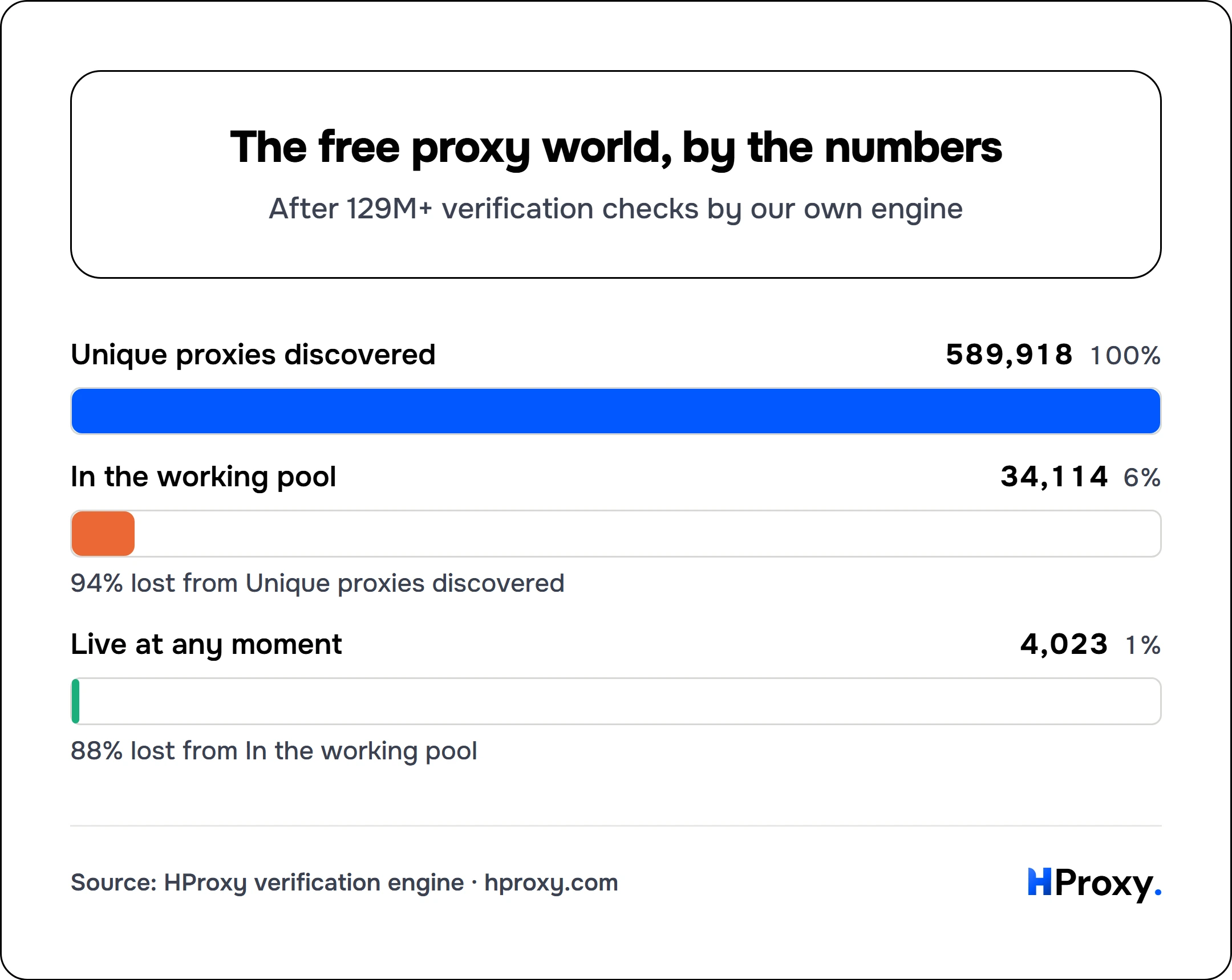
94% lost from Unique proxies discovered
88% lost from In the working pool
Finding 1: how many free proxies actually work
Almost none, at any given moment. Across the 589,918 free proxies our engine has verified, the working pool is only about 34,114, and the live-right-now count is a few thousand. The total count every free proxy list advertises is the least useful number there is.
The distinction that matters is working versus merely discovered. A proxy joins the working pool only if it verified alive within the last 48 hours, and the "alive this second" set is smaller still. Everything else, the overwhelming majority, is dead, dormant, or already blocked by the sites you would want to use it on.
| Metric | Figure |
|---|---|
| Unique proxies ever discovered | 589,918+ |
| Total verification checks run | 129,131,311+ |
| In the working pool (alive within 48h) | 34,114 |
| Live at any single moment | a few thousand |
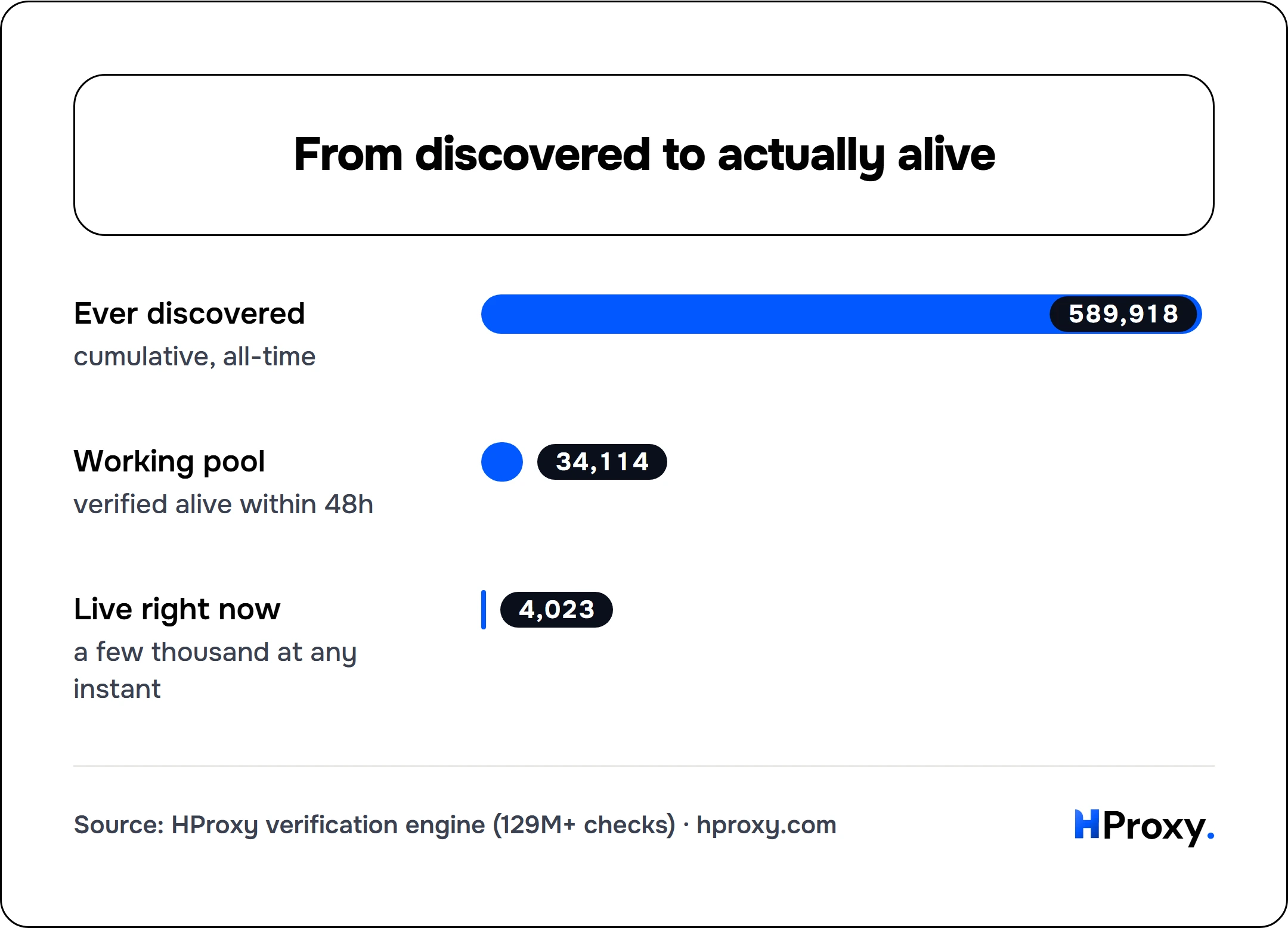
That top-to-bottom collapse, from half a million discovered to a few thousand alive, is the single most important fact about free proxies. Any list showing you "150,000 free proxies" is counting corpses. The only figure that matters is how many are verified alive right now, which is why every row on our list carries a last-checked timestamp and an uptime history instead of a proud, meaningless total.
Finding 2: free proxies die fast, and revive just as unpredictably
Free proxies do not fail gracefully. They blink.
Because we re-check continuously and record each proxy's status over time, the day-view of a typical free proxy looks like a barcode: alive, dead, alive again, dead again, on a cycle measured in minutes to hours, not days. A proxy that passed a check an hour ago has a real chance of being gone now. That pattern is the defining behavior. The machines behind these proxies are misconfigured servers, expired trials and short-lived boxes, none of which were built to stay open to the public.
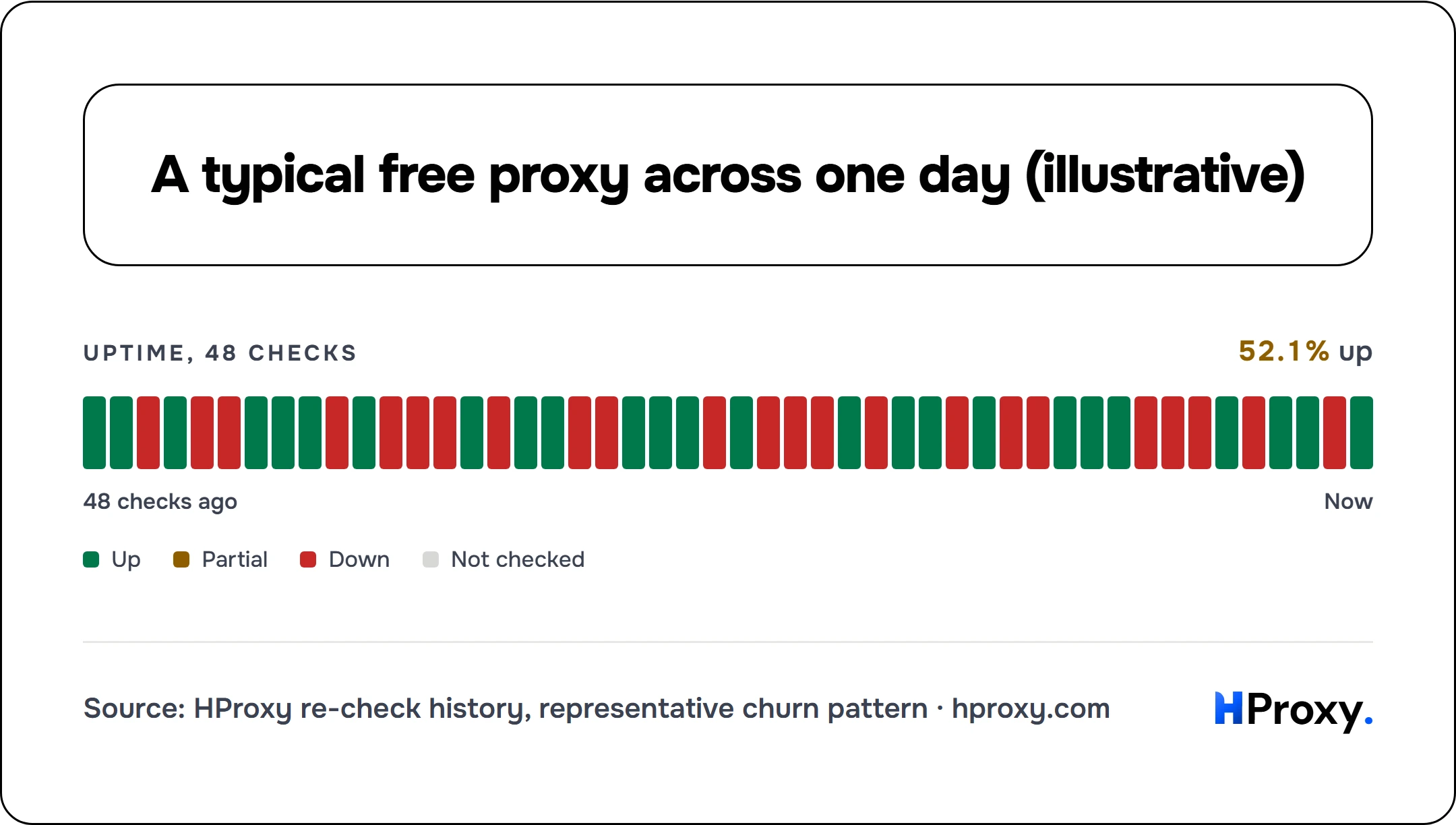
The practical takeaway is blunt: check a free proxy seconds before you use it, never minutes. A list that refreshes hourly is already stale by its own next line. Ours re-verifies every few minutes and archives the dead rather than padding the count with them, and even then, "worked a moment ago" is the only guarantee on offer.
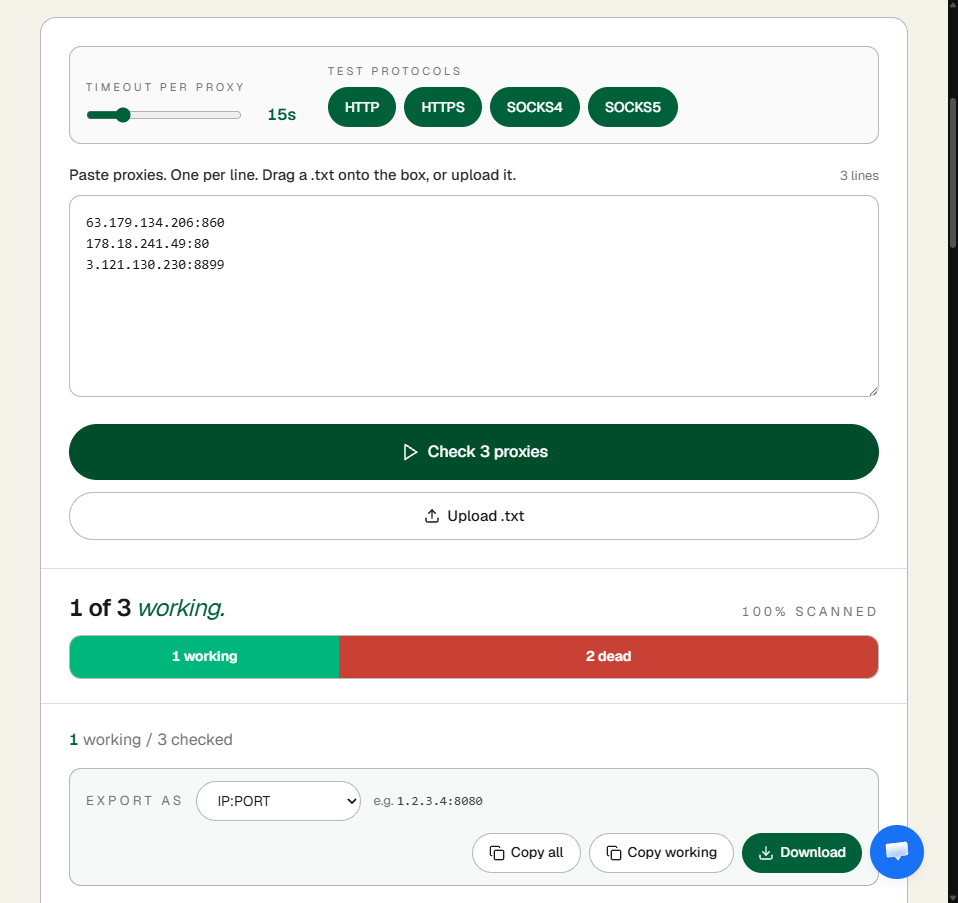
You can watch this happen in real time. We took three proxies off a free list and ran them through our proxy checker seconds later: one answered, two were already dead. Nothing about that sample was unlucky. It is the base rate.
Finding 3: "free residential proxies" are mostly a myth
This is the finding that surprises people most, and it is the most useful.
When we group the proxies alive right now by the network (the autonomous system, or ASN) each IP belongs to, the picture is overwhelmingly datacenter, not residential:
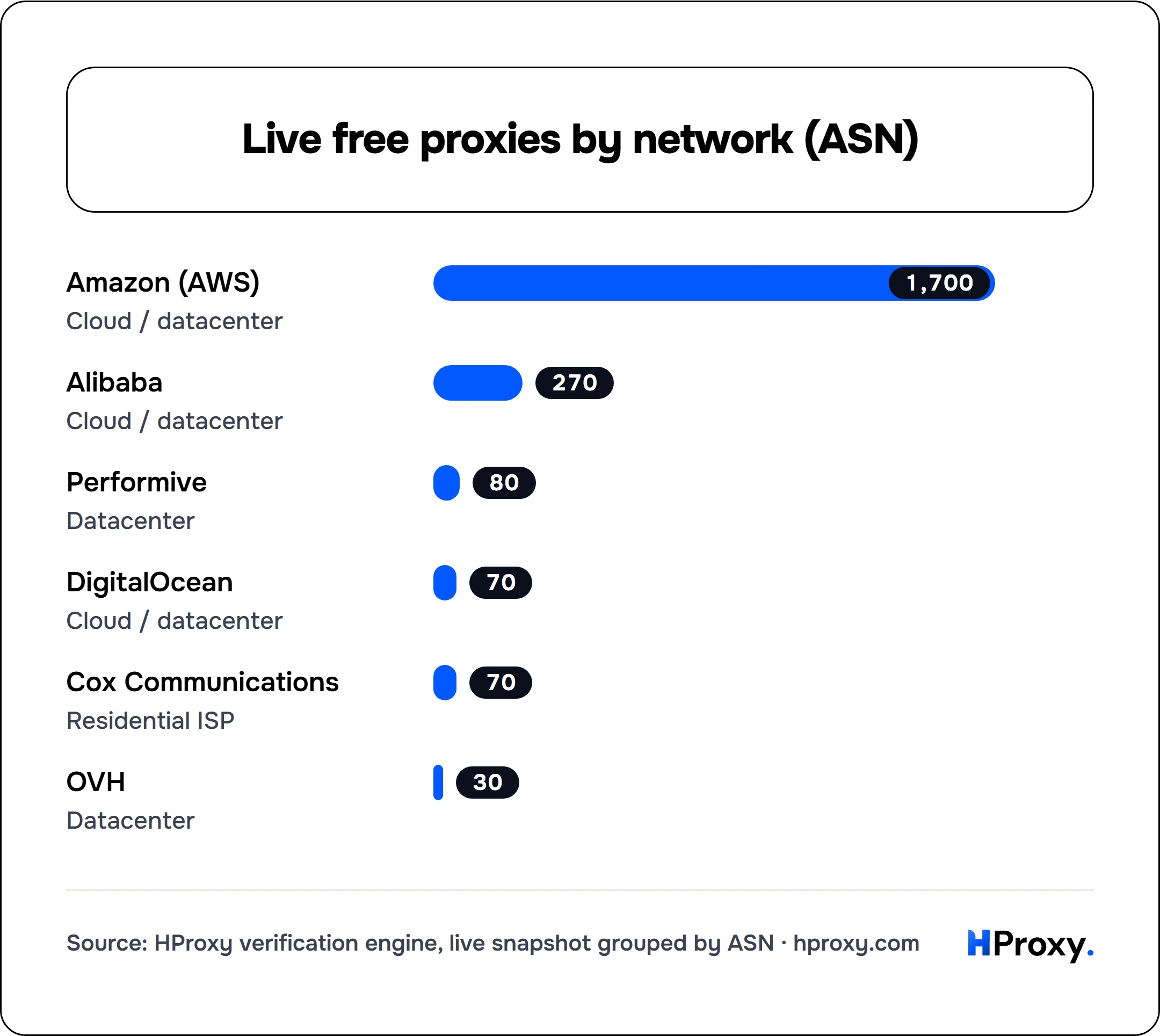
Amazon's cloud alone supplies more live free proxies than the next several networks combined. Look down the list and it is cloud host after cloud host, with the occasional real ISP (like Cox) as the exception that proves the rule.
Why this matters: a datacenter IP is honest about being a datacenter IP. Anti-bot systems classify the network an IP belongs to, and traffic from AWS or Alibaba announces "I am a server, not a person" before your request even finishes. That is precisely why free proxies get blocked so quickly on any site that cares, and why genuinely residential proxies (IPs on real home connections) are a paid product: they are scarce, and scarcity has a price. If a service offers you unlimited "free residential proxies," this data is a good reason to be skeptical about the "residential" part. It is also why work that turns on IP reputation, survey panels above all, never runs from a public list.
We know the network for every proxy because our sister project, the FFraud IP-intelligence engine, enriches each one with its ASN and organization as it is verified. It is the same data now shown in the Network column on the free list itself.
Finding 4: the protocol mix leans more toward SOCKS than you'd expect
Among proxies where we have confirmed the protocol, the split is not as HTTP-dominant as folklore suggests. It runs roughly HTTP 36%, SOCKS4 25%, HTTPS 20%, SOCKS5 19%. SOCKS4 and SOCKS5 together make up about 44% of the graded pool, and SOCKS4 on its own is the second most common protocol we see, ahead of HTTPS. SOCKS proxies carry any TCP traffic, not just web requests (we get into why in the SOCKS5 explainer), so if your tooling can speak SOCKS, you are fishing in a much bigger pond than an HTTP-only setup would suggest.
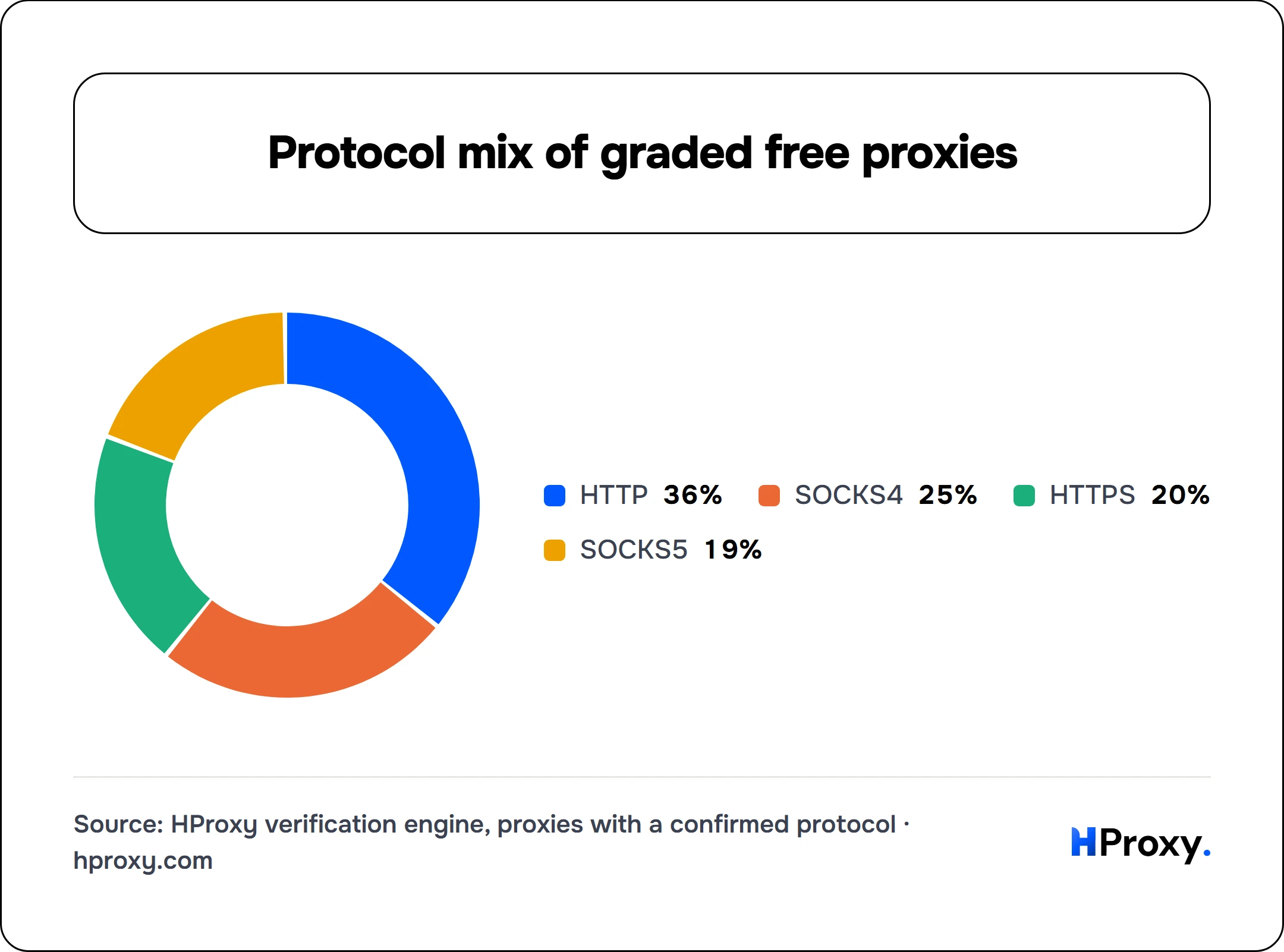
- HTTP36%
- SOCKS425%
- HTTPS20%
- SOCKS519%
Anonymity grade tells an even sharper story. Among proxies we have graded, the distribution is barbell-shaped: about 67% are elite (they hide both your IP and the fact that a proxy is in use), roughly 30% are transparent (they leak your real IP in headers and hide nothing), and only around 3% sit in the "anonymous" middle. The lesson for anyone using a free list: the grade is not decoration. A transparent proxy used for privacy is worse than no proxy, because it adds a hop while still exposing you. Filter for elite, or verify with a checker before trusting any single proxy.
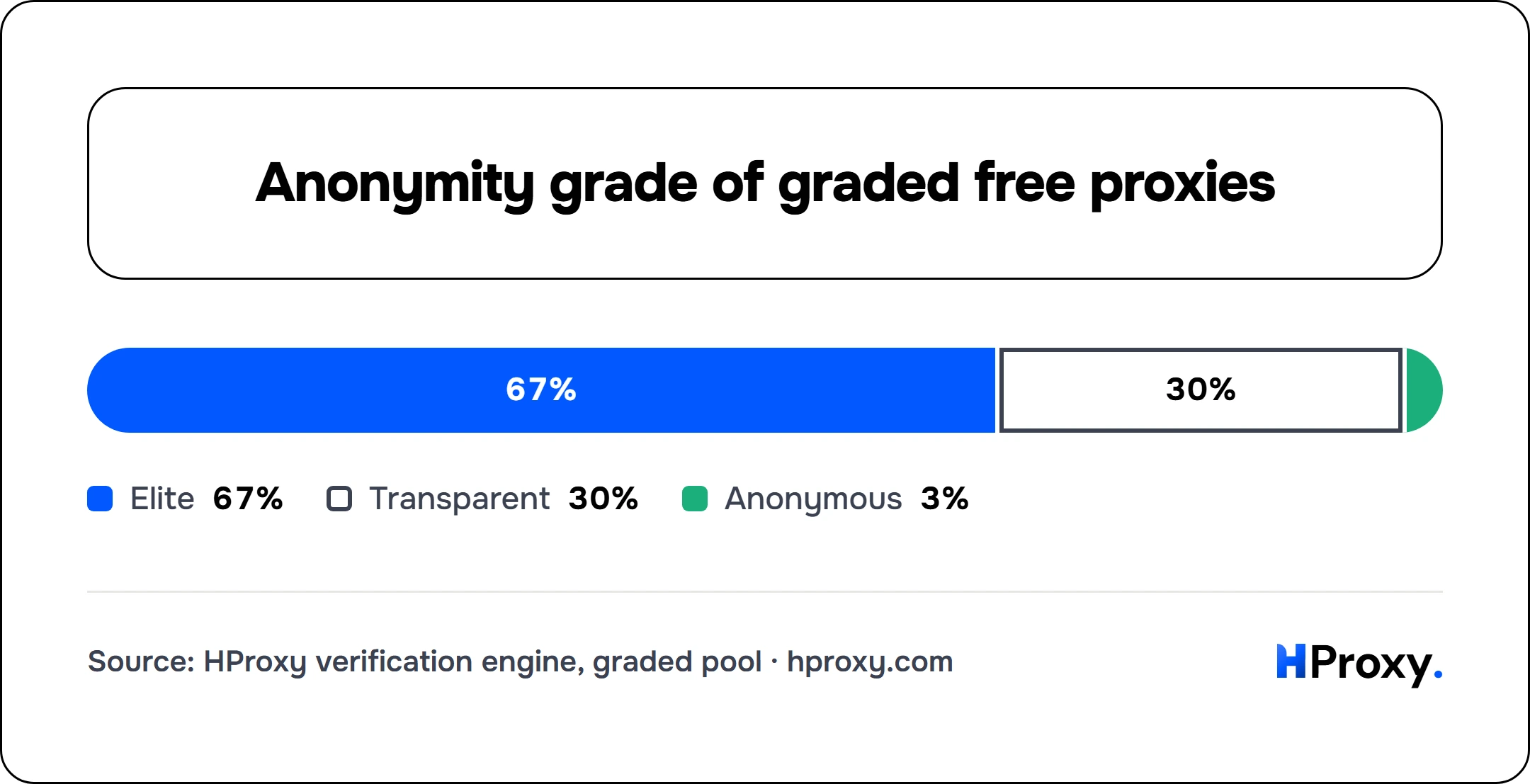
- Elite67%
- Transparent30%
- Anonymous3%
Finding 5: they cluster where servers are, not where people are
Grouped by country, the working pool concentrates in a familiar set: the United States leads by a wide margin, followed by a mix of large internet economies and cloud regions. The current top of the list runs US, Indonesia, China, India, Australia, France, Japan, South Korea, Thailand, Hong Kong, Canada, Germany.
This map tracks where cheap servers and open infrastructure live, not where you might want an IP for a specific task. If you need to appear in a country that is not near the top of this list, a free pool will frequently have zero live options there at the moment you look, which is one more reason free proxies suit "any exit will do" jobs far better than "I need Brazil, specifically, right now" jobs.
What the data adds up to
Put the five findings together and the shape of free proxies is clear:
- Abundant on paper, scarce in reality. Hundreds of thousands discovered, a few thousand alive.
- Ephemeral. Lifetimes in minutes and hours, so freshness is everything.
- Mostly datacenter. Easy to detect, easy to block, "free residential" is largely a myth.
- Uneven in quality and location. Grades and countries vary wildly, so filtering and verifying are not optional.
None of this makes free proxies useless. It makes them a precise tool with a narrow shape: anonymous, disposable, low-stakes tasks where a proxy dying mid-job costs you a retry and nothing more. We wrote the full breakdown of that line in when free proxies are fine (and when they'll burn you), and if your work has outgrown that shape, the data above is the argument for proxies that are built to stay up.
We will refresh these figures as the engine keeps running. The numbers move, but for as long as we have watched them, the story never has.
Methodology: figures are drawn from HProxy's proxy-verification engine at the time of writing: 129,131,311 cumulative checks across 589,918 unique free proxies, continuously re-verified for liveness, latency, anonymity and geolocation, with ASN and organization enrichment from the FFraud IP-intelligence engine. Point-in-time counts (working pool, live-now) fluctuate; cumulative counts only grow.