A comparison written by a competitor is worth reading only if it says where the competitor loses. That rule shapes this page about Parsera, and the last section names the reader who should stay put.
Parsera on the record
Parsera operates from parsera.com. Our classification for them is scraping API.
Parsera is not in our priced record, so nothing about their rate appears below. That gap is stated rather than filled, which is the only honest option available.
Look for the tier you would actually land in, not the one at the bottom of the table, and find the expiry and failed-request clauses before the rate impresses you.
Longevity, on the public record
The domain was registered on 22 January 2020, through GoDaddy.com, LLC, which makes it about 6 years old. That record was read from the registry on 9 September 2026. The registry shows it renewed to 22 January 2027.
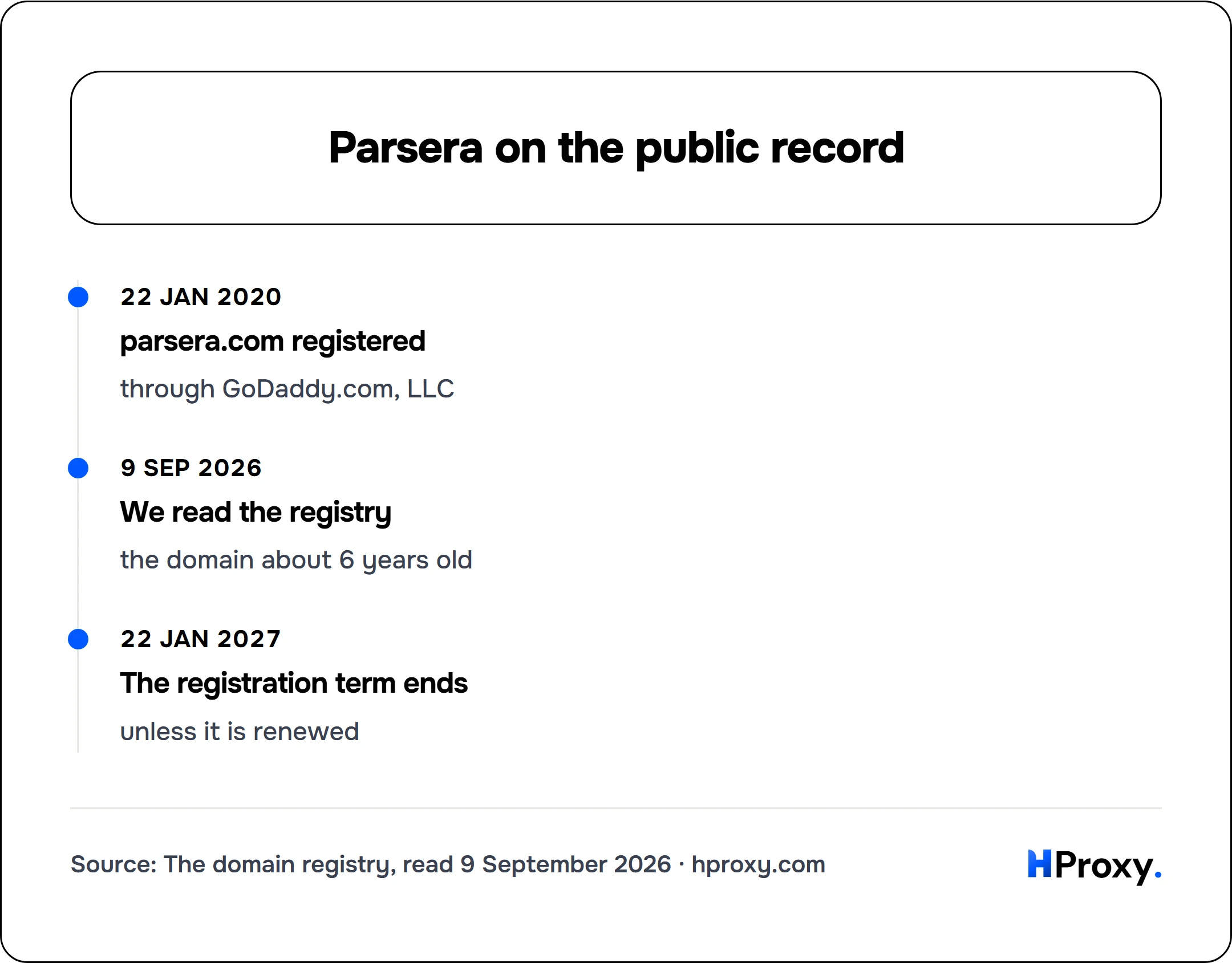
22 Jan 2020
parsera.com registered
through GoDaddy.com, LLC
9 Sep 2026
We read the registry
the domain about 6 years old
22 Jan 2027
The registration term ends
unless it is renewed
Read that as a floor rather than a recommendation. Longevity says somebody has kept paying the registrar, and in a market with this much churn that is worth ten seconds of your attention.
The parts no marketing page answers
Per gigabyte against per address
Residential is normally billed per gigabyte, datacenter and ISP per address, mobile per day or per port. Setting one against another produces a number that means nothing. Convert both sides into the unit your own workload consumes.
Advertised rate against the rate you reach
Rates in this market are quoted from the bottom of the table. The relevant question is which row you land on at your volume, and whether reaching a cheaper row costs more in commitment than it saves per unit.
What actually caps your throughput
A plan with generous traffic and a low thread limit is a slow plan. Find both numbers before you size anything, because the smaller of the two is your actual ceiling.
Side by side, with the blanks left blank
The rows below are the ones that change what you pay and whether the job runs:
| Question to ask | Parsera | HProxy |
|---|---|---|
| Entry price | Not verified by us, read their page | From $0.44/GB, pay as you go |
| Does unused balance expire? | Worth confirming in writing before you commit | Never |
| Minimum commitment | Their terms page answers this | None |
| Identity checks | Check the current terms, this one moves | Card orders are screened, and verification is sometimes requested |
| Targeting | Their terms page answers this | Country, city and ISP |
| Free way to evaluate | Check the current terms, this one moves | Free proxy list and proxy checker |
Nothing in that table settles the decision on its own. It narrows the field to two or three, and then measurement finishes the job.
The ten minute version of this decision
For a few dollars you can get a verdict specific to your job, which no comparison page can honestly promise you.
- Buy the minimum each side offers. Prefer a small paid batch over a trial, because trial traffic does not always ride the same pool.
- Send an identical workload through each: same target, same tooling, same time of day, same request mix.
- Measure what came back correctly and what it consumed, then divide the spend by the successes.
- Push a sample of exit addresses through an independent checker and confirm the country and connection type are what was advertised.
- Take the winner and set a reminder to run this again, since a result has a shelf life of about a quarter.
Who else is in this bracket
The same treatment, applied to the providers most often weighed against this one:
Our side of it
What we offer is one account holding residential, ISP, mobile and datacenter, priced from $0.44 per GB on residential, with no tier to climb and no allocation to lose at month end. Whether that suits you depends on how steady your volume is.