Import.io (import.io) turns web pages into structured data without code: its extractors fetch, render and read the pages, and deliver the rows on a schedule. On 12 October 2026 its smallest plan cost $249 a month, or $199 a month on a yearly term, for 50,000 successful queries, and a 30-day trial gave 5,000 queries without a card. From 2013 to 2016 its pricing page promised a free tool for life. The company now belongs to the Neuralogics group. For teams that write code, ScrapingBee and ScraperAPI cover the same 50,000 pages for $49, as the comparison shows.
What Import.io charges
Its pricing page reads "Prices current as of 16 September 2026". Every plan meters one thing, successful queries, and includes JavaScript rendering, proxies, scheduling and delivery.
Import.io's plans, 12 October 2026
| Plan | Queries a month | Yearly term / monthly |
|---|---|---|
| Trial | 5,000 in 30 days | $0, no card |
| Standard | 50,000 | $199 / $249 |
| Professional | 200,000 | $399 / $499 |
| Advanced | 500,000 | $699 / $899 |
import.io/pricing, read from our server on 12 October 2026
A yearly term is billed monthly for twelve months, and monthly plans can be cancelled at any time. Above the allowance, each further 1,000 queries costs $7 on Standard, $3.50 on Professional and $2.50 on Advanced. Standard runs on datacenter proxies with rate-limited API access. Professional adds regional proxies, webhooks and delivery to S3 and SFTP, and Advanced adds premium and residential proxies and more than one user. Above 500,000 queries a month, Import.io sells managed programs by quote, and the same goes for Aperture, its pricing tool for retailers and brands.
What counts as a query
A query is one page an extractor requests, billed when the page loads and returns data. "Blocked requests, timeouts, errors and pages that return no data are not billed", and a list spread over twelve pages counts as twelve queries. Its own rule of thumb: a catalog of 1,500 products checked daily comes to about 45,000 queries a month, and 200 items checked hourly to about 144,000.
Its newest product, Web Scraper MCP, gives AI agents such as Claude or Cursor web pages as tools. It includes 10,000 successful calls on signup, then charges $0.0002 a call, or $0.20 per 1,000, with a monthly spend limit.
How its prices moved since 2012
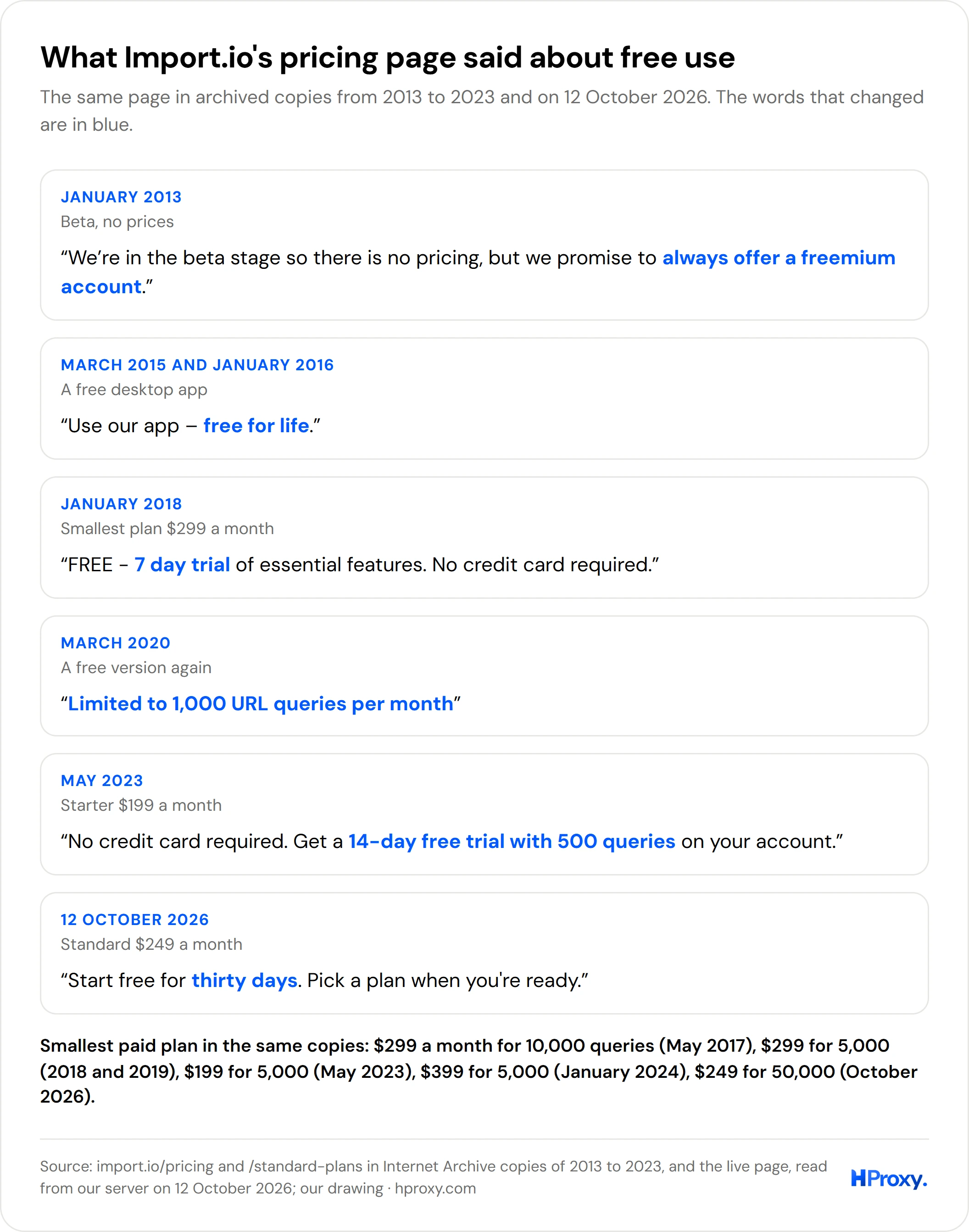
Import.io started in 2012 as a free tool. In January 2013 its pricing page said there was no pricing during the beta, and promised "to always offer a freemium account"; in 2015 and 2016 the app was "free for life". By May 2017 the smallest plan cost $299 a month for 10,000 queries, or $199 a month on a yearly term. In 2018 and 2019 it was $299 a month for 5,000 queries, and in March 2020 a free version with 1,000 queries a month came back. The copies of 2021 and 2022 show no prices.
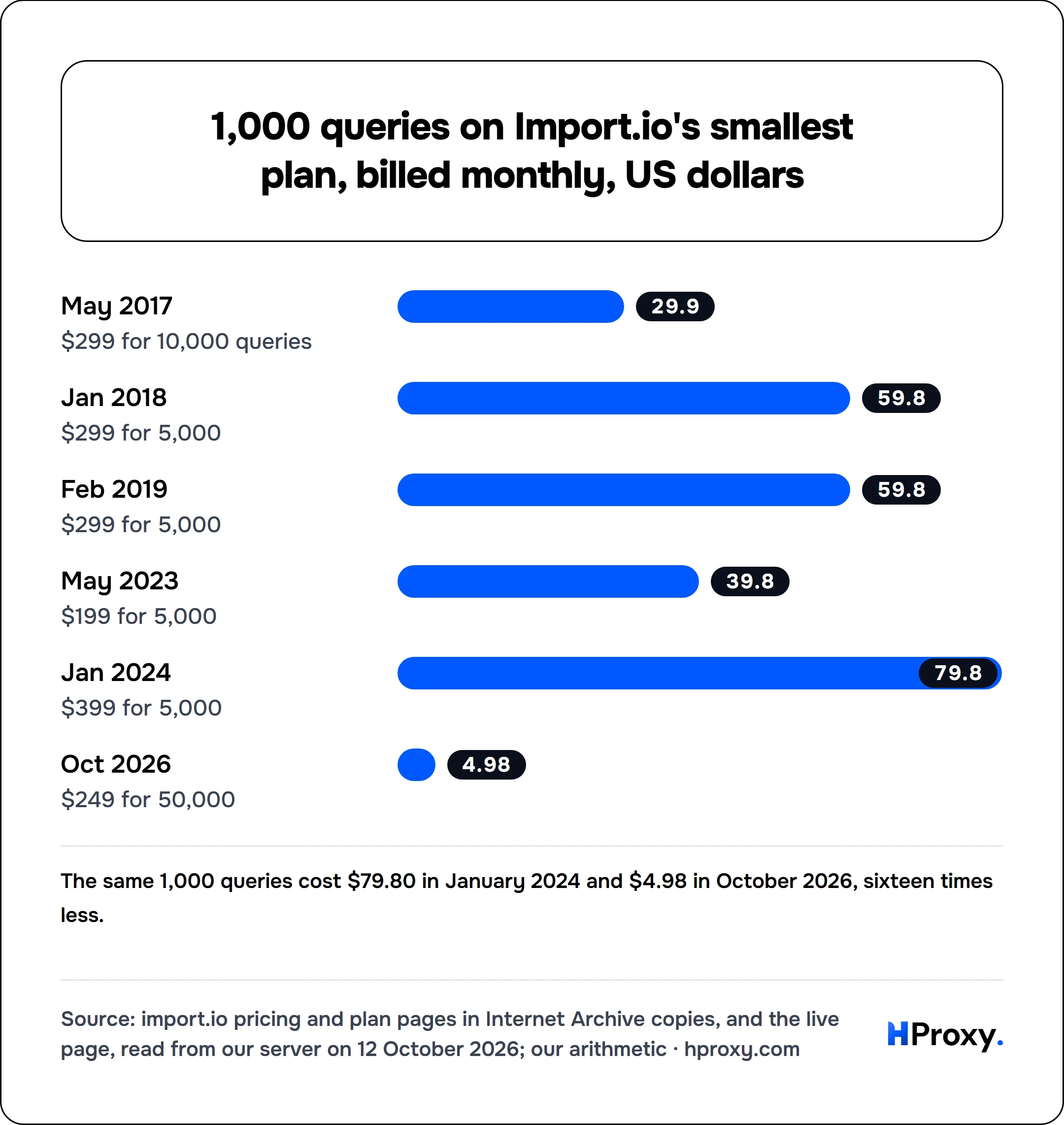
In May 2023 the Starter plan cost $199 a month for 5,000 queries; by January 2024 the same 5,000 queries cost $399. The copies of February 2025 and January 2026 list no plan prices, only overage at $0.056 a query on Starter, $56 per 1,000. By 16 September 2026, the date its pricing page gives, the smallest plan held ten times the queries for $249 a month, and overage had fallen to $7 per 1,000.
Who runs it
Its terms and privacy policy, both dated 28 September 2026, name Import.io Corporation. Its about page lists the steps: founded in 2012, the company bought Connotate, another web data business, in 2019, was acquired by the growth fund Scaleworks in 2023 and "joined the Neuralogics group in October 2025". Neuralogics describes itself as a buyer of B2B software that it rebuilds as "AI-native infrastructure"; its home page does not name Import.io. The about page claims more than 500 billion data points processed a month and more than 5.5 billion pages extracted since the start.
The terms are short. Plans "renew for the same term unless cancelled before renewal", yearly plans run to the end of their term, and after the agreement ends, data can be exported for 30 days. They name no governing law and no court, and hold no refund clause.
Five alternatives by how you work
If you write code
Developer APIs return the page and leave the extraction to your code, which Import.io's builder spares you. In exchange, three of them sell the same 50,000 pages for a fraction of the price.
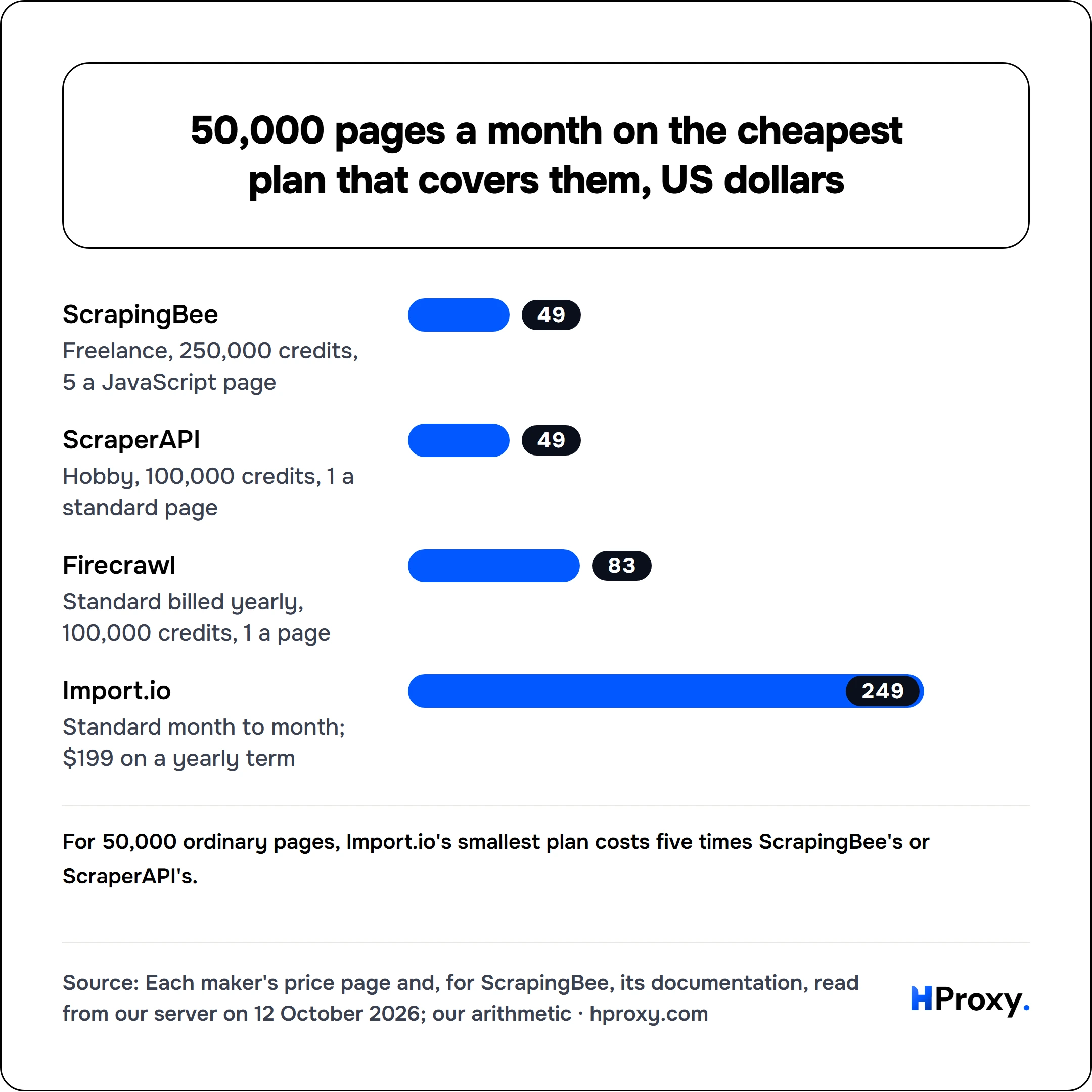
ScrapingBee's Freelance plan costs $49 a month for 250,000 credits. A page fetched with JavaScript, its default, "costs 5 credits per request", so 50,000 such pages fit. ScraperAPI's Hobby plan costs $49 a month, or $44.10 billed yearly, for 100,000 credits: a standard page costs 1 credit, Amazon 5, Google 25, and a site behind bot protection 10 more. Firecrawl charges 1 credit a page for scraping, crawling and mapping, and sells 100,000 credits for $83 a month billed yearly, with 1,000 free credits every month. A Firecrawl page that answers with an error such as 403 still costs a credit, where Import.io bills only pages that return data.
If you do not write code
Import.io and two no-code alternatives, 12 October 2026
| Tool | Free | Paid from |
|---|---|---|
| Import.io | 30-day trial | $199 a month, yearly term |
| Octoparse | 10 tasks | $69 a month billed yearly |
| Web Scraper | The extension | $50 a month billed yearly |
Each maker's price page, read from our server on 12 October 2026
Octoparse builds tasks in a desktop app and runs them on your computer or in its cloud. Its free plan keeps 10 tasks, Standard costs $69 a month billed yearly for 100 tasks, and every plan has a 5-day money-back guarantee. Web Scraper's browser extension is free. Its cloud costs $50 a month billed yearly for 5,000 URL credits, $100 for 20,000, and from $200 for unlimited credits priced by concurrent scraper. Both sell residential proxies as add-ons, Octoparse at $3 per GB and Web Scraper at $2.50. Our Thunderbit page covers two more, Instant Data Scraper and Browse AI.
Where HProxy fits
We sell proxies, and Import.io's plans include their own, as do ScrapingBee's and ScraperAPI's. Our addresses matter when you run the scraper yourself, with Scrapy, Playwright or a desktop tool: residential traffic costs $0.50 per GB and a datacenter address $1.58 per IP for a month. Our proxy checker is free.
Which one to pick
- Import.io for extractors without code, schedules and delivery in one bill, with nothing charged for blocked pages, from $199 a month on a yearly term.
- ScrapingBee or ScraperAPI if you write code: 50,000 pages for $49 a month.
- Firecrawl for scraping, crawling and web search from one API, with 1,000 free credits a month.
- Octoparse or Web Scraper for no-code work on a smaller budget, each with a free tier.
What we could not find out
We bought nothing and ran no extractor, so success rates stay the makers' claims. The archive copies do not show whether the 2023 and 2024 prices were billed monthly or yearly, and the page showed no plan prices in 2021, 2022, 2025 and early 2026. Import.io's terms name no law, and we did not search company registries for Import.io Corporation or for the Neuralogics group. We will read Import.io's pricing page again by 12 January 2027.
Sources
- Import.io: pricing page, terms and privacy policy (28 September 2026) and about page, read from our server on 12 October 2026.
- Import.io's pricing and plan pages in the Internet Archive, from October 2012 to January 2026.
- Neuralogics: home page, 12 October 2026.
- ScrapingBee: price page and documentation; ScraperAPI, Firecrawl, Octoparse and Web Scraper: price pages, 12 October 2026.
- Search counts from Google Keyword Planner, worldwide, 12 October 2026.
- Our own prices, from the price data our site reads live.