The shortest useful answer about ScrapeOps: find out what their current published rate is, find out whether your balance expires, then measure success rate on your own target. Everything below expands those three steps.
What ScrapeOps publishes
Read from their own public pricing pages on 10 August 2026, and stated as advertised rather than as verified by us:
- Scraping API: from $3.60 per 1,000 requests with no commitment, falling to $0.08 per 1,000 requests on $249/month plan, simple targets at 1 credit per request.
Every one of those is a published rate rather than a measured outcome. That is not a criticism of ScrapeOps: our own page is built from the same material. It is the reason the rest of this comparison is about what published rates leave out.
How ScrapeOps presents itself
As of 9 September 2026 the tab reads "ScrapeOps - The DevOps Tool For Web Scraping., ScrapeOps". Written for search engines, their description says: "ScrapeOps is a devops tool for web scraping which enables you to easily monitor, analyse and schedule your scraping jobs."
What else that page states, without interpretation:
The product lines named on that page are residential, mobile and a scraping or SERP API. The page offers some form of free trial. We found no separate pricing page linked from the homepage, which usually means the price arrives by quotation.
All of the above is their copy, not our finding. A dated quotation is the weakest kind of evidence that is still evidence.
Longevity, on the public record
The domain was registered on 16 June 2021, through Blacknight Internet Solutions Ltd, which makes it about 5 years old. That record was read from the registry on 23 April 2026. The registry shows it renewed to 16 June 2027.
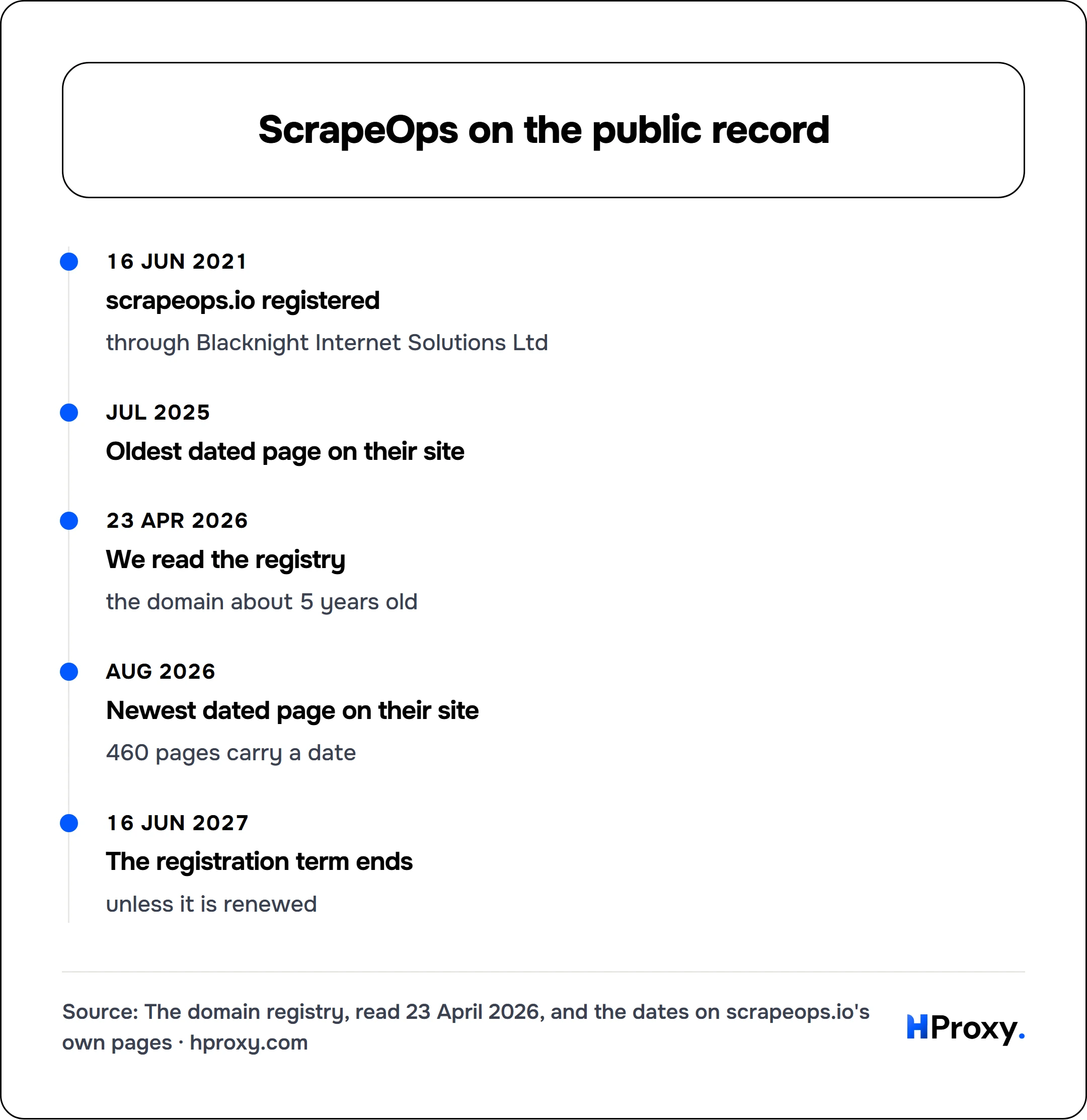
16 Jun 2021
scrapeops.io registered
through Blacknight Internet Solutions Ltd
Jul 2025
Oldest dated page on their site
23 Apr 2026
We read the registry
the domain about 5 years old
Aug 2026
Newest dated page on their site
460 pages carry a date
16 Jun 2027
The registration term ends
unless it is renewed
Age is not quality. A long registration does not make a network good, and a new one does not make it bad. What it does rule out is the shortest-lived pattern in this market, which is a site that appears, sells, and is gone inside a year.
How much site there is
Our own crawl reached 543 of their pages, last run 18 June 2026. The mix was 7 blog pages and 4 integration pages.
Read it as a map of what they emphasise. It is our count, from our crawler, on the date shown, and it is the only figure on this page that neither of us can dispute.
The activity record
Our crawl of their site found 460 pages carrying a date. The oldest is from July 2025 and the newest from August 2026. 452 of them carry a date inside the last twelve months.
Recent dates prove somebody is still at the keyboard. They prove nothing about the network, which is what the test at the end of this page is for.
Where the interest in ScrapeOps goes
Google reports 70 searches a month worldwide across the terms carrying this brand: 70 a month for their pricing. Figures read from Google Keyword Planner on 9 September 2026.
Most of that demand is people trying to work out what it costs. That is what this page is written for, and it is why the sections above lead with what is published rather than with a verdict.
The top bid on those terms reaches $8.25 a click. That is the market pricing its own customers, and it explains why almost every other result you found is an affiliate page.
What the advertised numbers cannot tell you
Units first, prices second
Work out what your job actually consumes, in gigabytes or in concurrent addresses, before you look at any price. Without that number, no two quotations in this market can be compared at all.
Ask whether failed requests are billed
On a hard target, failures are the majority of your traffic. Whether those failures are billed decides the real cost, and the clause covering it is rarely on the pricing page.
What the starting rate leaves out
Divide what you spent in a month by what you actually used, and you have the only rate worth quoting. It usually sits well above the figure on the homepage, because tiers, minimums and unused allocation all sit between the two.
What separates them, in a table
The table answers what we can answer and marks what we cannot:
| Question to ask | ScrapeOps | HProxy |
|---|---|---|
| Entry price | Published, see above, dated 10 August 2026 | From $0.44/GB, pay as you go |
| Does unused balance expire? | Worth confirming in writing before you commit | Never |
| Minimum commitment | Lower rates require one, see above | None |
| Identity checks | On their own terms page | Card orders are screened, and verification is sometimes requested |
| Targeting | Not published clearly, ask before paying | Country, city and ISP |
| Free way to evaluate | On their own terms page | Free proxy list and proxy checker |
Every unfilled cell above is a question to put to them directly, in writing, before money changes hands. Vendors answer those questions readily; comparison sites guess at them.
How to settle it yourself in ten minutes
Run this before you commit any volume. It replaces every opinion on this page, including ours.
- Start with the smallest purchase each vendor allows, so the test costs less than the decision it replaces.
- Use your own scraper and your own target. A benchmark against a neutral site measures nothing you will experience.
- Measure what came back correctly and what it consumed, then divide the spend by the successes.
- Push a sample of exit addresses through an independent checker and confirm the country and connection type are what was advertised.
- Keep whichever pool won on your job. Re-run this whenever success rate drops or the bill moves.
Others in this market
Nearest alternatives by product shape rather than by who pays us, since nobody does:
The competing offer, for completeness
HProxy suits buyers who want to add funds, send traffic and stop thinking about it. Residential from $0.44 per GB, no commitment, nothing expiring. Buyers who need procurement paperwork and a named account manager are better served elsewhere, and we would rather say so here than waste your afternoon.