Choosing a proxy provider on price alone is the most common and most expensive mistake in this market, because a cheap request that fails costs more than a dearer one that works. That framing runs through the whole page.
What is on file for Rampageproxies
Their site is rampageproxies.com. Category, as we track it: proxy provider.
There is no price in this comparison because we do not have one we can date and attribute. What follows instead is the set of questions that decide the cost once you do read their page.
Find the rate available with no commitment, then find the cheapest rate and what it costs to reach. The distance between those two tells you what kind of vendor you are dealing with.
The site, as it reads today
The title tag on 9 September 2026 was "404: NOT_FOUND".
What else that page states, without interpretation:
We found no separate pricing page linked from the homepage, which usually means the price arrives by quotation.
Those are claims, and claims are free. They earn their place here only because the date makes them checkable later.
How long Rampageproxies has been trading
The domain was registered on 23 June 2020, through Cloudflare, Inc, which makes it about 6 years old. We pulled that from the registry on 9 September 2026. The current registration term ends 23 June 2028.
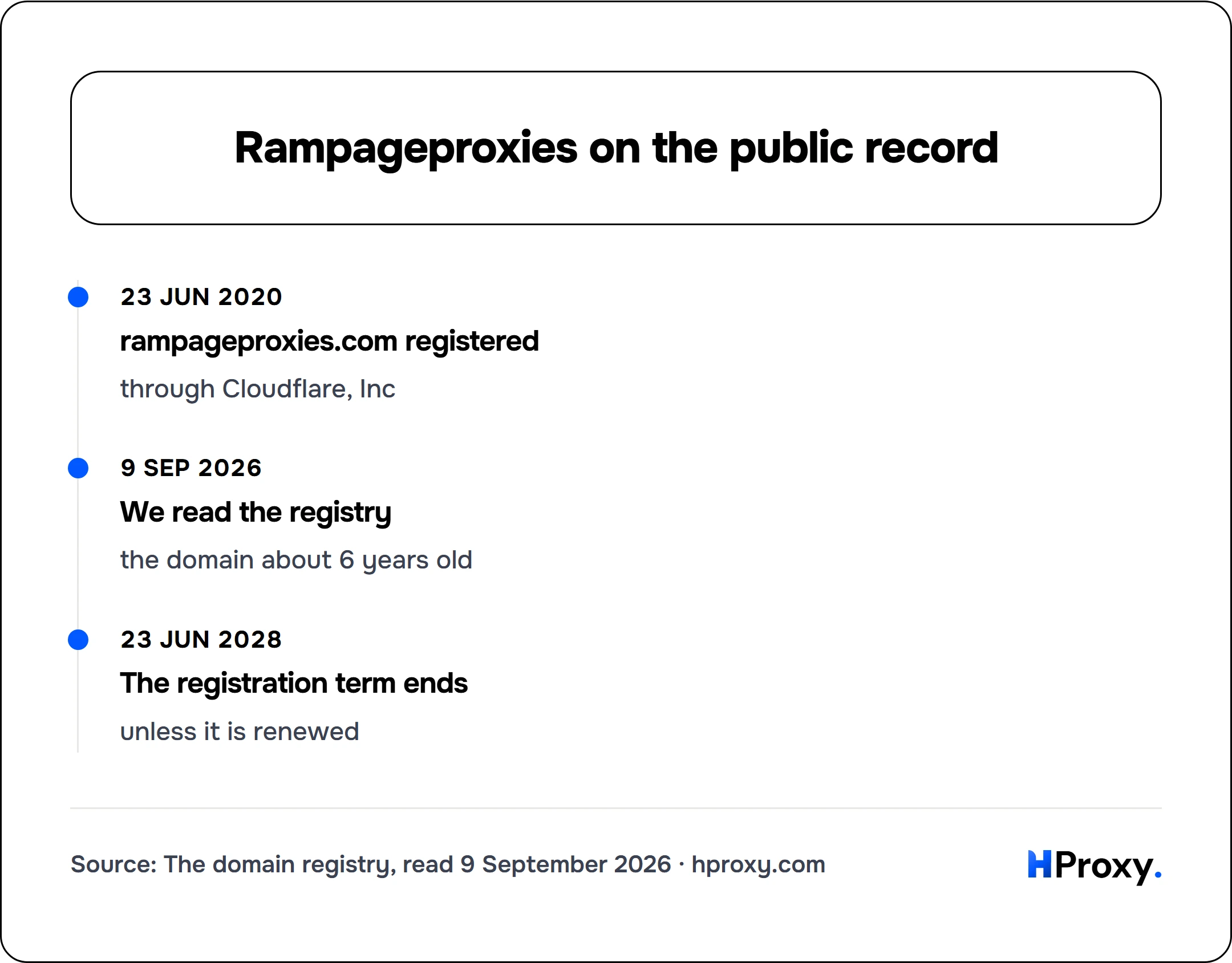
23 Jun 2020
rampageproxies.com registered
through Cloudflare, Inc
9 Sep 2026
We read the registry
the domain about 6 years old
23 Jun 2028
The registration term ends
unless it is renewed
This proves nothing about the product. It is a cheap check against the one failure mode that costs buyers real money in this market, which is paying a provider that will not exist in six months.
What a pricing page leaves out
Why 195 countries tells you nothing
Ask for the pool size in your country rather than in total, and expect the answer to be vague. Where it is not published, the ten minute test at the end of this page settles it for a few dollars.
Per gigabyte against per address
Residential is normally billed per gigabyte, datacenter and ISP per address, mobile per day or per port. Setting one against another produces a number that means nothing. Convert both sides into the unit your own workload consumes.
Concurrency limits decide throughput
Bandwidth is rarely the constraint on a real workload. Concurrent connections, requests per second and per-session caps are, and they are frequently buried in the documentation rather than the pricing page.
The rows that decide it
Set the two side by side on the questions that decide the outcome, rather than on feature counts:
| Question to ask | Rampageproxies | HProxy |
|---|---|---|
| Entry price | Not verified by us, read their page | From $0.44/GB, pay as you go |
| Does unused balance expire? | Not published clearly, ask before paying | Never |
| Minimum commitment | Worth confirming in writing before you commit | None |
| Identity checks | Read their current terms | Card orders are screened, and verification is sometimes requested |
| Targeting | Worth confirming in writing before you commit | Country, city and ISP |
| Free way to evaluate | Their terms page answers this | Free proxy list and proxy checker |
The useful part of that table is the left column. Take those six questions to any provider in this market and the answers will sort them faster than any review.
The test that beats this page
It is a small amount of money for an answer that is actually about your target.
- Take the smallest paid unit each provider will sell you. A free trial works for a first pass, though trials sometimes ride better pools than paid plans do.
- Fire the same batch through both on one afternoon. Different days are different conditions, and that ruins the comparison.
- Track the success rate and the bandwidth. A cheap gigabyte that fails half the time is not cheap.
- Run a sample of the addresses through an independent lookup, because advertised geography and actual geography differ more often than the market admits.
- Go with whichever performed, then measure again next quarter. Networks change underneath you.
Where else buyers look
If this one does not fit, these are the nearest comparable providers we have written up, each on the same terms as this page.
- ProxyBR alternatives
- Proxybrief alternatives
- ProxyBroker (OSS tool) alternatives
- Proxybros alternatives
- ProxyCheck.io alternatives
Where we fit
The offer, stated once: residential from $0.44 per GB, pay per gigabyte, no subscription, balance does not expire, and free tools that stay usable without an account. Everything above this paragraph applies whether or not you choose us.