reproxy.network sits in a market where the advertised number and the number you pay are frequently different, because tiers, minimums and expiry all sit between them. Untangling that is most of the work here.
The record we hold
The domain is reproxy.network.
What we do not hold is a current, sourced price for reproxy.network. Rather than print a figure we cannot stand behind, this page leaves it out and tells you what to look for when you read their page yourself.
Look for the tier you would actually land in, not the one at the bottom of the table, and find the expiry and failed-request clauses before the rate impresses you.
How reproxy.network presents itself
Read 9 September 2026, the homepage titles itself "reProxy , Сервис аренды и управления прокси (IPv4, IPv6, Резидентные)". The description they publish for search engines reads: "reProxy , профессиональный сервис для покупки и управления надежными IPv4, IPv6 и резидентными прокси."
The rest of what the page puts in writing:
The product lines named on that page are IPv6. We found no separate pricing page linked from the homepage, which usually means the price arrives by quotation.
That is the vendor speaking, not us. We print it because a claim with a date attached is at least falsifiable.
Longevity, on the public record
The domain was registered on 23 March 2021, through OVH SAS, which makes it about 5 years old. Registry data as of 23 April 2026. It is paid up until 23 March 2027.
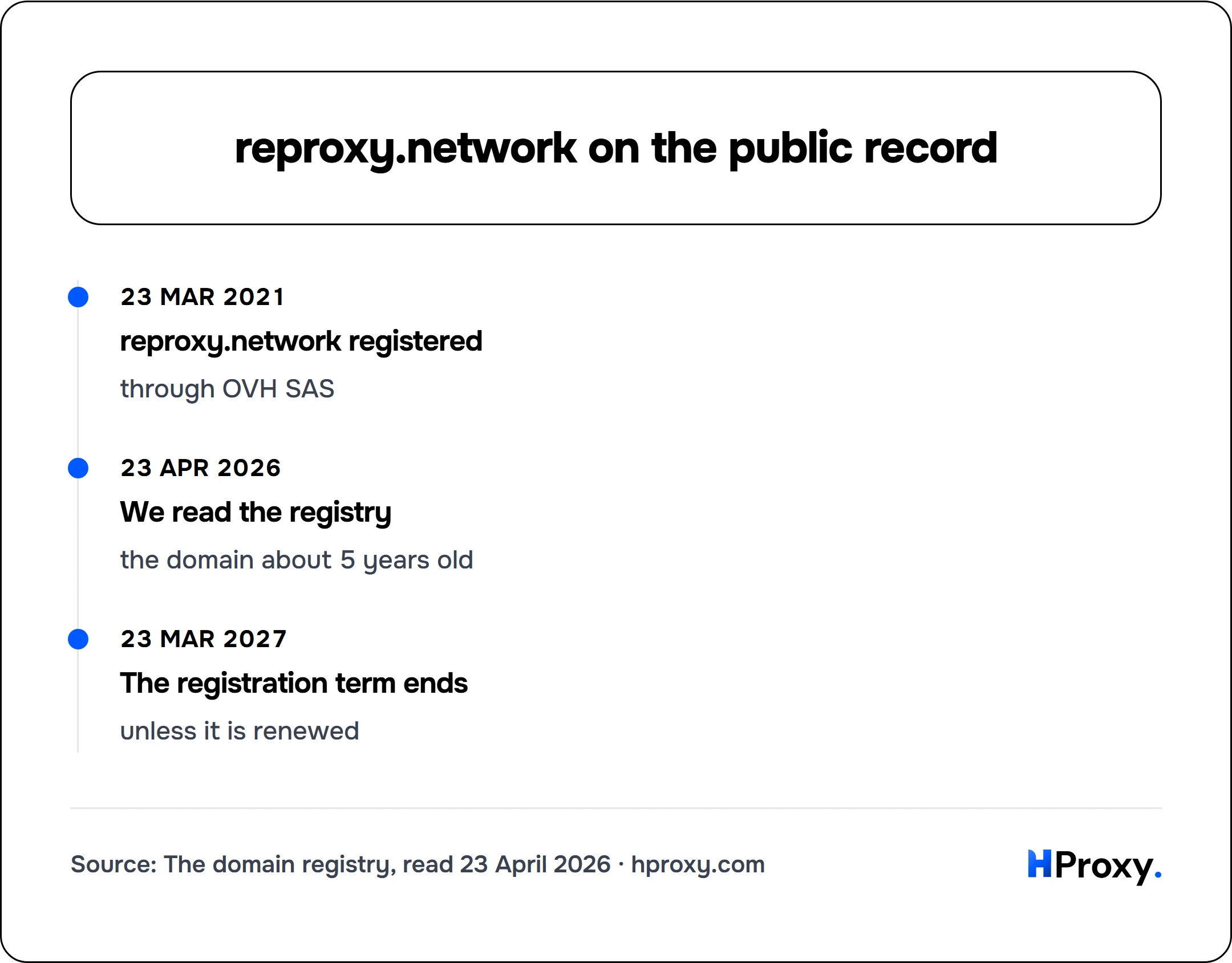
23 Mar 2021
reproxy.network registered
through OVH SAS
23 Apr 2026
We read the registry
the domain about 5 years old
23 Mar 2027
The registration term ends
unless it is renewed
Age is not quality. A long registration does not make a network good, and a new one does not make it bad. What it does rule out is the shortest-lived pattern in this market, which is a site that appears, sells, and is gone inside a year.
The parts no marketing page answers
The country total, and the country you use
Country totals are counted generously across this whole market. A country with a handful of addresses counts the same as one with hundreds of thousands. If your work depends on one location, test that location before you switch.
Shared or dedicated changes everything
Ask how many accounts can sit on one address at once. Where the answer is unlimited or unspecified, price the plan as shared regardless of what the product is called.
What a blocked response costs you
Divide the spend by the successful responses, not by the requests sent. That single change reorders most price comparisons in this market, and your accounting will use it eventually anyway.
Side by side, with the blanks left blank
The rows that matter, with our own answers stated plainly:
| Question to ask | reproxy.network | HProxy |
|---|---|---|
| Entry price | Not verified by us, read their page | From $0.44/GB, pay as you go |
| Does unused balance expire? | Check the current terms, this one moves | Never |
| Minimum commitment | Read their current terms | None |
| Identity checks | Worth confirming in writing before you commit | Card orders are screened, and verification is sometimes requested |
| Targeting | Not published clearly, ask before paying | Country, city and ISP |
| Free way to evaluate | On their own terms page | Free proxy list and proxy checker |
Every unfilled cell above is a question to put to them directly, in writing, before money changes hands. Vendors answer those questions readily; comparison sites guess at them.
How to settle it yourself in ten minutes
Run this before you commit any volume. It replaces every opinion on this page, including ours.
- Buy the minimum each side offers. Prefer a small paid batch over a trial, because trial traffic does not always ride the same pool.
- Send an identical workload through each: same target, same tooling, same time of day, same request mix.
- Log successes, failures and gigabytes used. Cost per successful request is the figure you are after.
- Verify a slice of the exits independently. Country labels in this market are self-reported and are not always right.
- Keep whichever pool won on your job. Re-run this whenever success rate drops or the bill moves.
Who else is in this bracket
The same treatment, applied to the providers most often weighed against this one:
- ProxyNade alternatives
- Proxynet alternatives
- ProxyNo1 alternatives
- ProxyNode alternatives
- Proxyomega alternatives
- Proxyon alternatives
Where HProxy sits in that test
Our own lane is easy to state. Residential starts at $0.44 per GB with country targeting, the balance is topped up when you want and does not expire, there is no subscription unless the optional discount suits you, and city and ISP targeting come with Residential Premium from $1.00 per GB. If the test above puts us second on your target, buy the winner.