Proxyon (proxyon.io) sells residential traffic by the gigabyte, dedicated datacenter IPv4 and IPv6, static ISP proxies, and rotating IPv6 by the thread. Every price below comes from the price settings of its own product pages, read on 27 September 2026. For the comparison, jump to the alternatives table.
Proxyon at a glance
| what we found on 27 September 2026 | |
|---|---|
| status | live, plans on sale |
| operator | Talon Ops LLC, a Wyoming company |
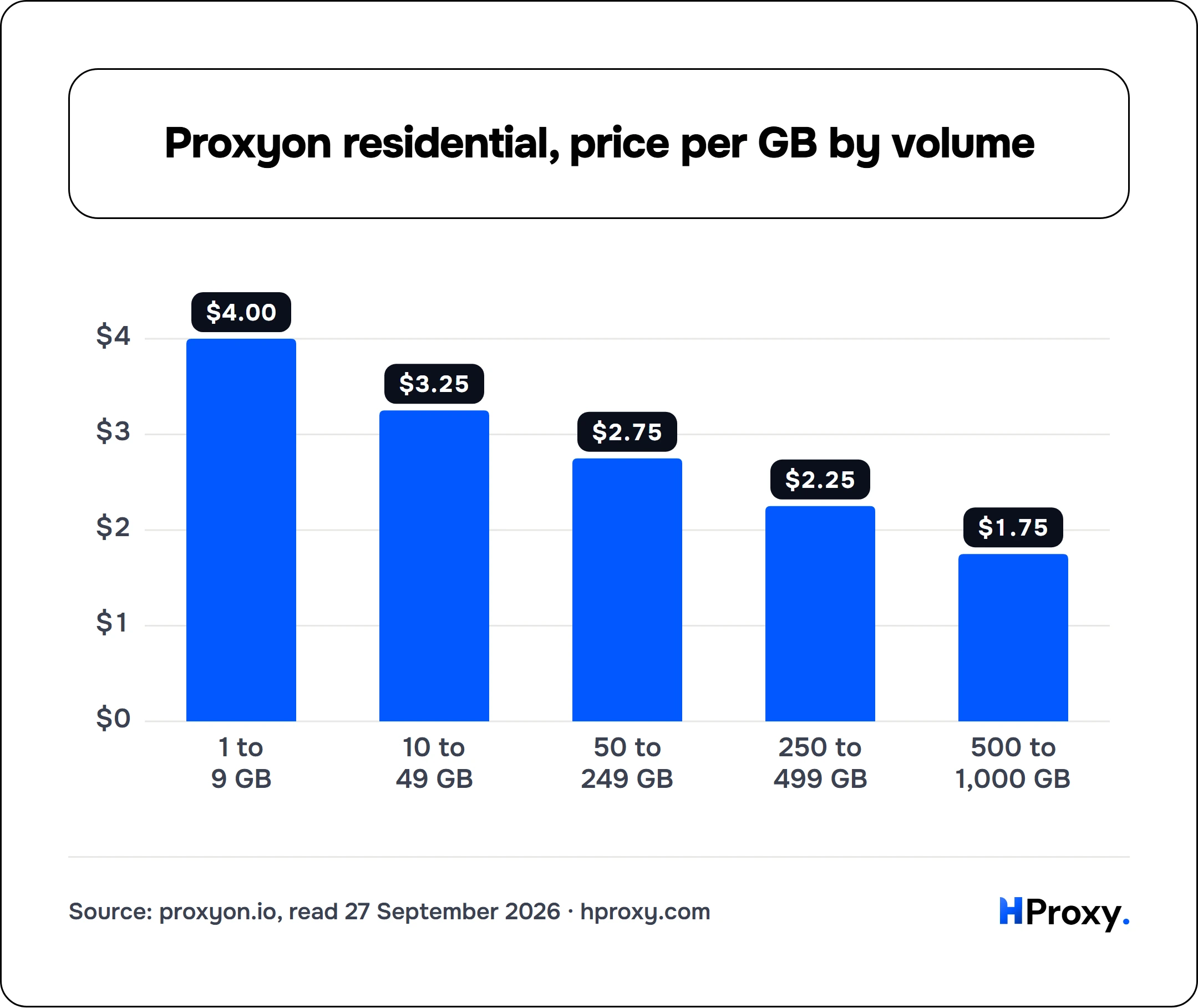
| residential | $4.00 a GB at 1 GB, $1.75 from 500 GB |
| datacenter IPv4 | $1.50 an IP a month |
| IPv6 | $0.25 an IP a month |
| static ISP | $2.75 an IP a month |
| refunds | at its discretion, within 24 hours |
| domain | registered on 3 July 2025 |
What Proxyon sells
Residential by the gigabyte. A pool it puts at 100M+ IPs, with rotating and sticky sessions, HTTP and SOCKS5, and targeting by country, state or city. The bandwidth you buy never expires.
Datacenter IPv4 and IPv6. Dedicated addresses with unmetered bandwidth in six countries, rented by the month, the quarter or the year.
Static ISP. One address registered to a home ISP but hosted in a datacenter, for one buyer, by the month.
Rotating IPv6. A new IPv6 address on every request, sold by the thread from 100 threads.
A small free start. New accounts get 100 MB of free credit without a card, and the smallest deposit is $5.
What Proxyon charges
| residential traffic | per GB |
|---|---|
| 1 to 9 GB | $4.00 |
| 10 to 49 GB | $3.25 |
| 50 to 249 GB | $2.75 |
| 250 to 499 GB | $2.25 |
| 500 to 1,000 GB | $1.75 |
Dedicated IPv4 costs $1.50 an address for a month, or $12.75 for a year, which works out at about $1.06 a month. IPv6 costs $0.25 a month, a static ISP address $2.75 a month, and rotating IPv6 $0.20 a thread each month, or $20 for the minimum of 100 threads.
Its headline says residential "starts from $2.25/GB", which is its price from 250 GB. Small orders cost $4.00 a GB, about twice the $1.95 it charged in December 2025.
The fine print
Refunds at its discretion. Its terms, updated in June 2026, let you ask for a full refund within 24 hours of a purchase if you used under about 500 MB. Proxyon makes the final call, and crypto payments are never refunded.
A Wyoming company. The terms name Talon Ops LLC, a Wyoming company that does business as Proxyon, and choose Wyoming law with individual arbitration. Its about and team pages still read "coming soon".
Reviews older than the domain. Its testimonials carry dates from October 2024 to March 2025, while proxyon.io was registered in July 2025. Its pages do not say where those reviews were first posted.
No KYC, for now. Sign-up asks for no identity check, and its terms keep the right to add one later.
Its history
The domain proxyon.io was registered on 3 July 2025, and the Internet Archive first shows the site in November 2025. In December 2025 it sold residential traffic from $1.95 a GB and datacenter addresses from $0.30 for three days, with ISP proxies marked "Coming Soon".
Where Proxyon is stronger
Cheaper IPv4, above all by the year. A dedicated IPv4 address costs $1.50 a month, or about $1.06 a month on a yearly plan, both less than our $1.58/IP for a month.
Rotating IPv6 by the thread. A flat price per connection suits jobs that need a fresh IPv6 address on every request.
Where HProxy differs
We sell proxies too, so read this part as the account of a competitor. Every HProxy fact here comes from our own product code and pages.
Residential for less at every size. Premium, our pool with state, city and ISP targeting, costs $1.49/GB for one gigabyte, against $4.00 at Proxyon, and our price stays below its tiers at every size it sells. Sessions run from 3 minutes to 24 hours, and neither side puts an expiry date on purchased gigabytes.
Country targeting for less still. If a country is enough, Lite costs $0.50/GB for one gigabyte.
Static ISP and IPv6 for less. Our static ISP address costs $2.70/IP for a month, against $2.75, and IPv6 costs $0.10/IP for a month from ten addresses, against $0.25.
A company in the German register. Our imprint names the company behind HProxy, registered in the German commercial register.
Where we are behind. Our dedicated IPv4 costs more than the $1.50 a month at Proxyon, and our rotating IPv6 is sold by the gigabyte, not by the thread.
The alternatives, side by side
Residential proxies with city targeting, at the smallest buy. The Proxyon row comes from its price settings of 27 September 2026, and every other figure from the page of each vendor, read on 26 or 27 September 2026.
| provider | smallest buy | per GB at that size |
|---|---|---|
| Proxyon | 1 GB | $4.00 |
| Evomi Core | 15 GB, pay as you go | $0.99 |
| DataImpulse | 5 GB for $5 | $2.00 with city filters |
| Shifter | 5 GB for $10 a month | $2.00 |
| 911Proxy | 10 GB for $27 | $2.70 |
| NST Prime | 50 GB | $1.60 |
| HProxy Premium | 1 GB | $1.49/GB |
Our reviews of Evomi, DataImpulse, Shifter, 911Proxy and NST cover their terms in full.
Who Proxyon suits
It suits a buyer who wants cheap dedicated IPv4 for a year, rotating IPv6 by the thread, or a shop with no identity check.
It suits you less if you buy residential traffic in small amounts, or want to know more about the people behind the shop than a company name. It also suits you less if you pay in crypto and may need a refund.
Before you commit
Use the free 100 MB on your own target first, and ask for any refund within 24 hours, since that is the whole window. Our proxy checker shows whether an address answers, how fast, and from where, whoever sold it.
The limits of this review
We did not buy a plan or test its network. Its pool size, uptime and reviews are its own claims, and its pages do not say where its testimonials were first posted.
Every figure here carries the day it was read, and this page is due for a check by 27 December 2026.
Sources
- Proxyon, proxyon.io: homepage, pricing page, the price settings of its four product pages, terms, contact, about and team pages. Read 27 September 2026.
- Identity Digital, registry record for proxyon.io. Read 27 September 2026.
- Internet Archive, captures of proxyon.io from November 2025 to June 2026. Read 27 September 2026.
- Evomi, DataImpulse, Shifter, 911Proxy and NST, residential price pages. Read 26 and 27 September 2026.
- HProxy, our own product records, price table, terms and imprint.