Before anything about ProxyNade: pool totals, uptime badges and country counts predict almost nothing about your result. What predicts it is a measured success rate on your own target, and that measurement costs a few dollars.
What we can and cannot tell you about ProxyNade
The company behind the name sits at proxynade.net.
ProxyNade is not in our priced record, so nothing about their rate appears below. That gap is stated rather than filled, which is the only honest option available.
Note the price, the unit it is quoted in, the minimum, and the expiry. Unit and expiry are where most comparisons in this market quietly go wrong.
What ProxyNade says about itself today
As of 9 September 2026 the tab reads "PROXYNADE, Volume Residential Proxies With Real Pricing". The blurb under their search result reads: "Buy Volume Residential, Premium Residential, Datacenter, Static ISP, and Servers with public pricing."
Also on the page, stated plainly:
The product lines named on that page are residential, ISP or static residential and SOCKS5. Their pricing page is titled "Proxynade Pricing, Proxies, ISP, Servers".
Those are claims, and claims are free. They earn their place here only because the date makes them checkable later.
The domain record
The domain was registered on 10 January 2025, through NameCheap, Inc, which makes it about 1 year old. Those dates come from a registry query on 9 September 2026. Their registration is booked through 10 January 2027.
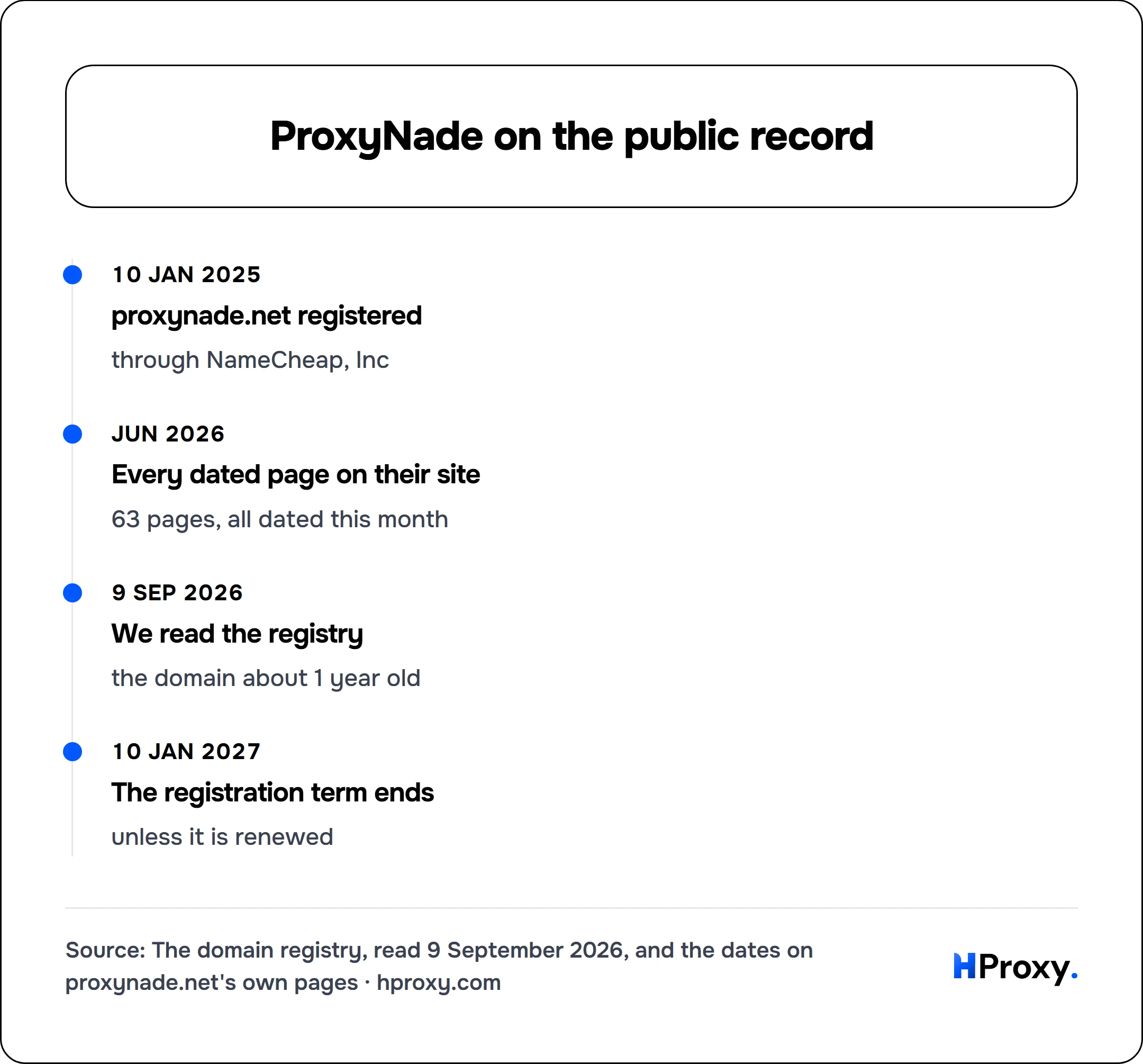
10 Jan 2025
proxynade.net registered
through NameCheap, Inc
Jun 2026
Every dated page on their site
63 pages, all dated this month
9 Sep 2026
We read the registry
the domain about 1 year old
10 Jan 2027
The registration term ends
unless it is renewed
Read that as a floor rather than a recommendation. Longevity says somebody has kept paying the registrar, and in a market with this much churn that is worth ten seconds of your attention.
What they have built around the product
Our own crawl reached 63 of their pages. The mix was 1 pricing page.
That mix tells you how the company sells. Heavy location pages mean a geography-led pitch, heavy blog means a search-led one, and a single pricing page usually means one simple offer or one sales call.
Signs of life
Our crawl of their site found 63 pages carrying a date. The oldest is from June 2026 and the newest from June 2026. 63 of them carry a date inside the last twelve months.
An actively maintained site is table stakes rather than a recommendation. It does rule out the failure that costs buyers the most here, which is prepaying a company that has quietly stopped.
The parts no marketing page answers
Coverage in the one country you need
Ask for the pool size in your country rather than in total, and expect the answer to be vague. Where it is not published, the ten minute test at the end of this page settles it for a few dollars.
The response time nobody advertises
Support quality is invisible until it is the only thing that matters. A cheap provider that takes three days to answer a routing problem has cost you more than the saving, and no pricing page reveals that.
Nothing here stays true for long
Pools are rebuilt, suppliers change and detection improves. A provider that beat the field last spring may be mid-table now. Nothing in this market stays true long enough to buy once and stop measuring.
Side by side, with the blanks left blank
This is the shortest table that still decides the purchase:
| Question to ask | ProxyNade | HProxy |
|---|---|---|
| Entry price | Not verified by us, read their page | From $0.44/GB, pay as you go |
| Does unused balance expire? | Worth confirming in writing before you commit | Never |
| Minimum commitment | Their terms page answers this | None |
| Identity checks | Check the current terms, this one moves | Card orders are screened, and verification is sometimes requested |
| Targeting | Not published clearly, ask before paying | Country, city and ISP |
| Free way to evaluate | On their own terms page | Free proxy list and proxy checker |
Blanks in that table are deliberate. We print what we read and date it, and leave the rest empty rather than repeating something we cannot stand behind.
How to settle it yourself in ten minutes
Run this before you commit any volume. It replaces every opinion on this page, including ours.
- Open an account on each and add the smallest amount they take. Skip the trial if a paid unit is cheap enough to buy outright.
- Point both at your real target, through your real tool, on the same day, with the same mix of requests.
- Log successes, failures and gigabytes used. Cost per successful request is the figure you are after.
- Verify a slice of the exits independently. Country labels in this market are self-reported and are not always right.
- Take the winner and set a reminder to run this again, since a result has a shelf life of about a quarter.
The other names that come up
Other providers in the same bracket, priced and dated the same way:
- Fineproxy alternatives
- FizzyProxy alternatives
- FlamingoProxies alternatives
- FleetProxy alternatives
- FlexyProxies alternatives
The competing offer, for completeness
We are the pay as you go option in this market. Residential from $0.44 per GB, ISP and datacenter per address, mobile alongside them, all from one balance with nothing to forfeit. That model wins on irregular volume and loses on very large steady volume, which is worth knowing before you test.