The shortest useful answer about ProxyNo1: find out what their current published rate is, find out whether your balance expires, then measure success rate on your own target. Everything below expands those three steps.
ProxyNo1 on the record
The domain is proxyno1.com.
ProxyNo1 is not in our priced record, so nothing about their rate appears below. That gap is stated rather than filled, which is the only honest option available.
Read their page for the reachable rate rather than the headline, the minimum spend, the expiry clause and the billing treatment of blocked requests. Write down the date, because all four move.
What ProxyNo1 says about itself today
Read 9 September 2026, the homepage titles itself "Proxy 4G, Proxy Dân Cư Việt Nam, Proxy VN, ProxyNo1". The description they publish for search engines reads: "ProxyNo1 cung cấp proxy 4G, proxy dân cư Việt Nam, proxy VN riêng. Hỗ trợ HTTP, SOCKS5, IP allow, user/pass, OpenVPN, API và quản lý cổng trực quan."
Also on the page, stated plainly:
The product lines named on that page are mobile, SOCKS5 and IPv6. Support is advertised as around the clock. We found no separate pricing page linked from the homepage, which usually means the price arrives by quotation.
Nothing there has been tested. It is a record of what the page said on the day, which is the honest limit of what a page like this can offer without a measurement.
Longevity, on the public record
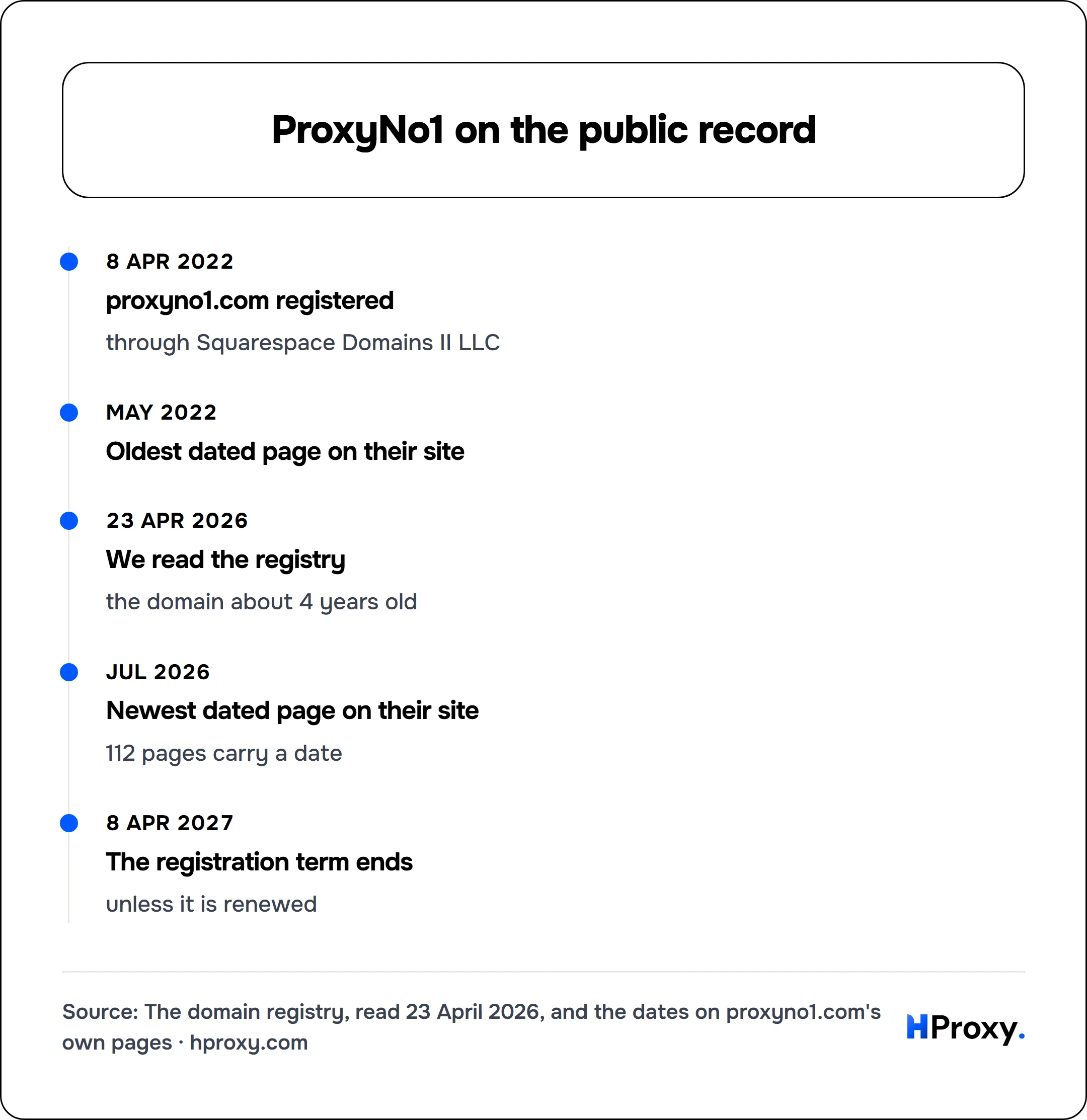
The domain was registered on 8 April 2022, through Squarespace Domains II LLC, which makes it about 4 years old. Registry data as of 23 April 2026. The Internet Archive holds 20 snapshots of the site, the earliest from January 2007. It is paid up until 8 April 2027.
8 Apr 2022
proxyno1.com registered
through Squarespace Domains II LLC
May 2022
Oldest dated page on their site
23 Apr 2026
We read the registry
the domain about 4 years old
Jul 2026
Newest dated page on their site
112 pages carry a date
8 Apr 2027
The registration term ends
unless it is renewed
Age is not quality. A long registration does not make a network good, and a new one does not make it bad. What it does rule out is the shortest-lived pattern in this market, which is a site that appears, sells, and is gone inside a year.
The shape of their site
We crawled 112 pages of their site and found 102 blog pages.
Read it as a map of what they emphasise. It is our count, from our crawler, on the date shown, and it is the only figure on this page that neither of us can dispute.
What the timestamps show
Our crawl of their site found 112 pages carrying a date, 102 of them articles. The oldest is from May 2022 and the newest from July 2026. 65 of them carry a date inside the last twelve months.
Recent dates prove somebody is still at the keyboard. They prove nothing about the network, which is what the test at the end of this page is for.
What the advertised numbers cannot tell you
Ten million addresses, and none of them yours
Nobody audits pool totals in this market, and the counting rules differ between vendors. Even an accurate figure describes addresses that exist, not addresses you will be routed through. Treat it as a marketing unit rather than a capability.
Shared or dedicated changes everything
An address you share carries the reputation of everyone else on it. That is acceptable for some work and fatal for anything involving a login. The price difference between shared and dedicated usually reflects exactly this.
What a blocked response costs you
Some vendors bill every request, some bill only successful ones, and the difference is the whole comparison once a target starts blocking. A cheap rate with a fifty percent success rate is twice its advertised price.
What separates them, in a table
The table answers what we can answer and marks what we cannot:
| Question to ask | ProxyNo1 | HProxy |
|---|---|---|
| Entry price | Not verified by us, read their page | From $0.44/GB, pay as you go |
| Does unused balance expire? | Worth confirming in writing before you commit | Never |
| Minimum commitment | Not published clearly, ask before paying | None |
| Identity checks | On their own terms page | Card orders are screened, and verification is sometimes requested |
| Targeting | Not published clearly, ask before paying | Country, city and ISP |
| Free way to evaluate | On their own terms page | Free proxy list and proxy checker |
Every unfilled cell above is a question to put to them directly, in writing, before money changes hands. Vendors answer those questions readily; comparison sites guess at them.
A test worth more than this comparison
Do this once and you will never need a comparison page for this decision again.
- Open an account on each and add the smallest amount they take. Skip the trial if a paid unit is cheap enough to buy outright.
- Point both at your real target, through your real tool, on the same day, with the same mix of requests.
- Count how many requests returned what you wanted, and how much bandwidth each side spent doing it.
- Spot-check the exits. Confirm they are in the country you paid for and the connection type you were sold.
- Buy the one that won on your target, and diarise a re-test in three months.
Who else is in this bracket
The same treatment, applied to the providers most often weighed against this one:
- Foxscrape alternatives
- Foxxyproxies alternatives
- Freeproxy24 alternatives
- Freeproxylist alternatives
- Froxy alternatives
- FusionProxy alternatives
The competing offer, for completeness
HProxy suits buyers who want to add funds, send traffic and stop thinking about it. Residential from $0.44 per GB, no commitment, nothing expiring. Buyers who need procurement paperwork and a named account manager are better served elsewhere, and we would rather say so here than waste your afternoon.