You can settle this yourself for less than the price of lunch. That is the argument of this page, and the sections before the test exist to tell you what to measure once you start.
What we can and cannot tell you about Proxies
The domain is proxies.black.
Proxies is not in our priced record, so nothing about their rate appears below. That gap is stated rather than filled, which is the only honest option available.
Read their page for the reachable rate rather than the headline, the minimum spend, the expiry clause and the billing treatment of blocked requests. Write down the date, because all four move.
The domain record
The domain was registered on 18 October 2020, through NameCheap, Inc, which makes it about 5 years old. Registry data as of 9 September 2026. It is paid up until 18 October 2026.
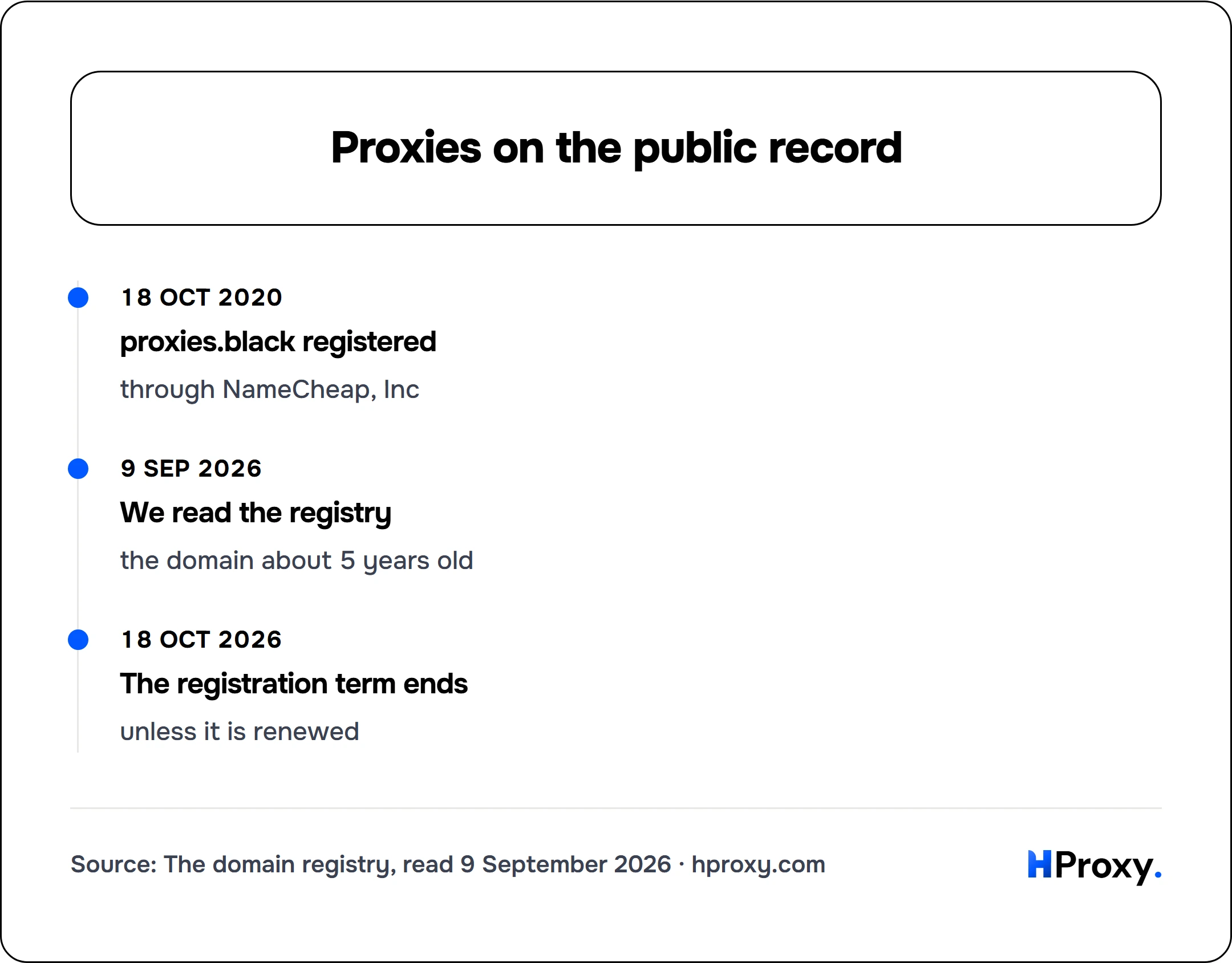
18 Oct 2020
proxies.black registered
through NameCheap, Inc
9 Sep 2026
We read the registry
the domain about 5 years old
18 Oct 2026
The registration term ends
unless it is renewed
Age is not quality. A long registration does not make a network good, and a new one does not make it bad. What it does rule out is the shortest-lived pattern in this market, which is a site that appears, sells, and is gone inside a year.
The demand around this name
Google reports 170 searches a month worldwide across the terms carrying this brand: 170 a month for a review of them. Figures read from Google Keyword Planner on 9 September 2026.
Most of that demand is people checking whether to trust it. That is what this page is written for, and it is why the sections above lead with what is published rather than with a verdict.
What the advertised numbers cannot tell you
Ten million addresses, and none of them yours
Nobody audits pool totals in this market, and the counting rules differ between vendors. Even an accurate figure describes addresses that exist, not addresses you will be routed through. Treat it as a marketing unit rather than a capability.
The entry price is not the effective price
A starting rate is a marketing number. What you pay depends on the tier your volume lands in, the minimum purchase, and what happens to traffic you bought and did not use. An expiring balance quietly raises the price of every unit you did consume.
The expiry question
This single term separates cheap providers from providers that look cheap. If a plan resets at month end, your effective rate is the plan price divided by what you actually used. Ours does not expire, which is easy to say and easy to verify in the terms.
What separates them, in a table
The table answers what we can answer and marks what we cannot:
| Question to ask | Proxies | HProxy |
|---|---|---|
| Entry price | Not verified by us, read their page | From $0.44/GB, pay as you go |
| Does unused balance expire? | Worth confirming in writing before you commit | Never |
| Minimum commitment | Not published clearly, ask before paying | None |
| Identity checks | On their own terms page | Card orders are screened, and verification is sometimes requested |
| Targeting | Not published clearly, ask before paying | Country, city and ISP |
| Free way to evaluate | On their own terms page | Free proxy list and proxy checker |
Two notes on that table. The rows we left for you to check are not evasions: those terms change, and printing a stale figure is exactly the failure this page is trying to avoid. And no table can hold the number that should decide your purchase, which is the success rate on your own target.
A test worth more than this comparison
Do this once and you will never need a comparison page for this decision again.
- Open an account on each and add the smallest amount they take. Skip the trial if a paid unit is cheap enough to buy outright.
- Point both at your real target, through your real tool, on the same day, with the same mix of requests.
- Count how many requests returned what you wanted, and how much bandwidth each side spent doing it.
- Spot-check the exits. Confirm they are in the country you paid for and the connection type you were sold.
- Buy the one that won on your target, and diarise a re-test in three months.
The other names that come up
Other providers in the same bracket, priced and dated the same way:
The competing offer, for completeness
HProxy suits buyers who want to add funds, send traffic and stop thinking about it. Residential from $0.44 per GB, no commitment, nothing expiring. Buyers who need procurement paperwork and a named account manager are better served elsewhere, and we would rather say so here than waste your afternoon.