A comparison written by a competitor is worth reading only if it says where the competitor loses. That rule shapes this page about ProxiesAPI, and the last section names the reader who should stay put.
The record we hold
The domain is proxiesapi.com.
ProxiesAPI is not in our priced record, so nothing about their rate appears below. That gap is stated rather than filled, which is the only honest option available.
Copy down the entry rate, the commitment attached to the cheapest rate, the minimum top-up and the expiry rule. Those four turn a marketing figure into something you can compare.
What the registration record shows
The domain was registered on 2 December 2019, through Squarespace Domains II LLC, which makes it about 6 years old. That record was read from the registry on 23 April 2026. The Internet Archive holds 20 snapshots of the site, the earliest from August 2020. The registry shows it renewed to 2 December 2028.
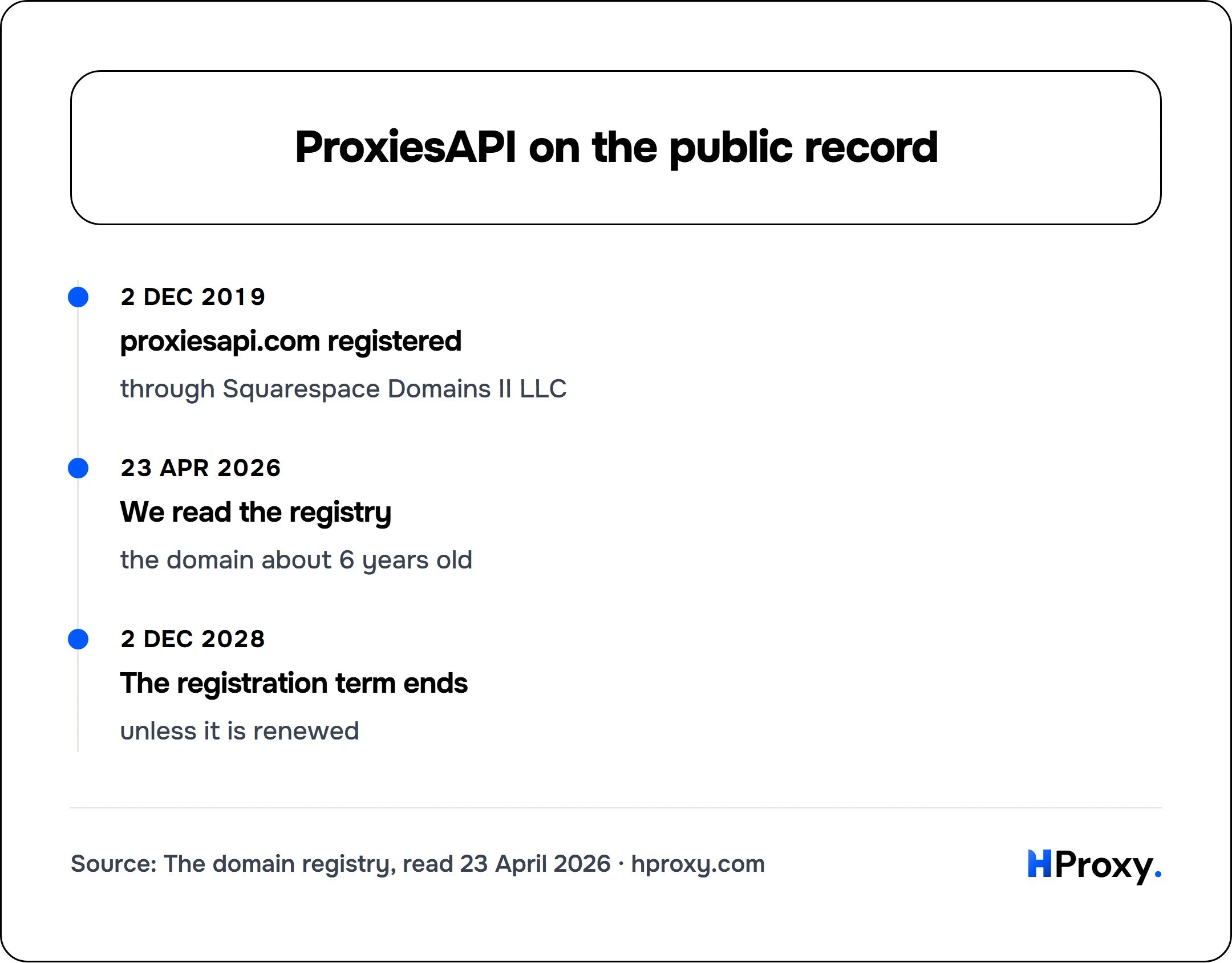
2 Dec 2019
proxiesapi.com registered
through Squarespace Domains II LLC
23 Apr 2026
We read the registry
the domain about 6 years old
2 Dec 2028
The registration term ends
unless it is renewed
Read that as a floor rather than a recommendation. Longevity says somebody has kept paying the registrar, and in a market with this much churn that is worth ten seconds of your attention.
The parts no marketing page answers
The expiry question
This single term separates cheap providers from providers that look cheap. If a plan resets at month end, your effective rate is the plan price divided by what you actually used. Ours does not expire, which is easy to say and easy to verify in the terms.
Why a cheap address is often a used one
Ask how many accounts can sit on one address at once. Where the answer is unlimited or unspecified, price the plan as shared regardless of what the product is called.
Who pays for the requests that fail
On a hard target, failures are the majority of your traffic. Whether those failures are billed decides the real cost, and the clause covering it is rarely on the pricing page.
Side by side, with the blanks left blank
The rows below are the ones that change what you pay and whether the job runs:
| Question to ask | ProxiesAPI | HProxy |
|---|---|---|
| Entry price | Not verified by us, read their page | From $0.44/GB, pay as you go |
| Does unused balance expire? | On their own terms page | Never |
| Minimum commitment | Read their current terms | None |
| Identity checks | Worth confirming in writing before you commit | Card orders are screened, and verification is sometimes requested |
| Targeting | Read their current terms | Country, city and ISP |
| Free way to evaluate | Worth confirming in writing before you commit | Free proxy list and proxy checker |
Nothing in that table settles the decision on its own. It narrows the field to two or three, and then measurement finishes the job.
A test worth more than this comparison
Do this once and you will never need a comparison page for this decision again.
- Start with the smallest purchase each vendor allows, so the test costs less than the decision it replaces.
- Use your own scraper and your own target. A benchmark against a neutral site measures nothing you will experience.
- Count how many requests returned what you wanted, and how much bandwidth each side spent doing it.
- Spot-check the exits. Confirm they are in the country you paid for and the connection type you were sold.
- Buy the one that won on your target, and diarise a re-test in three months.
Others in this market
Nearest alternatives by product shape rather than by who pays us, since nobody does:
Our side of it
What we offer is one account holding residential, ISP, mobile and datacenter, priced from $0.44 per GB on residential, with no tier to climb and no allocation to lose at month end. Whether that suits you depends on how steady your volume is.