The market Proxies.st trades in has a wide honesty range. Some vendors publish every tier, some publish a starting rate that nobody reaches, and a few publish nothing at all. Knowing which kind you are looking at is half the decision.
What we can and cannot tell you about Proxies.st
The company behind the name sits at proxies.st.
A price is missing here on purpose. We have not captured a sourced rate for Proxies.st recently enough to publish one, and a stale number in this market is a wrong number.
Look for the tier you would actually land in, not the one at the bottom of the table, and find the expiry and failed-request clauses before the rate impresses you.
What Proxies.st says about itself today
Read 9 September 2026, the homepage titles itself "Proxies.st - Scalable HTTP and SOCKS proxies for pipelines". Written for search engines, their description says: "Access a large rotating pool of HTTP and SOCKS proxies: dashboard, plans, secure crypto top-ups, and plain-text bulk feeds for automation and data pipelines."
Also on the page, stated plainly:
We found no separate pricing page linked from the homepage, which usually means the price arrives by quotation.
That is the vendor speaking, not us. We print it because a claim with a date attached is at least falsifiable.
What they have built around the product
A crawl of 74 pages returned 60 blog pages and 1 use-case page.
That mix tells you how the company sells. Heavy location pages mean a geography-led pitch, heavy blog means a search-led one, and a single pricing page usually means one simple offer or one sales call.
Signs of life
Our crawl of their site found 74 pages carrying a date, 60 of them articles. The oldest is from January 2026 and the newest from July 2026. 74 of them carry a date inside the last twelve months.
An actively maintained site is table stakes rather than a recommendation. It does rule out the failure that costs buyers the most here, which is prepaying a company that has quietly stopped.
What the advertised numbers cannot tell you
What happens when it breaks at two in the morning
Support quality is invisible until it is the only thing that matters. A cheap provider that takes three days to answer a routing problem has cost you more than the saving, and no pricing page reveals that.
Why a cheap address is often a used one
An address you share carries the reputation of everyone else on it. That is acceptable for some work and fatal for anything involving a login. The price difference between shared and dedicated usually reflects exactly this.
Who pays for the requests that fail
Divide the spend by the successful responses, not by the requests sent. That single change reorders most price comparisons in this market, and your accounting will use it eventually anyway.
What separates them, in a table
This is the shortest table that still decides the purchase:
| Question to ask | Proxies.st | HProxy |
|---|---|---|
| Entry price | Not verified by us, read their page | From $0.44/GB, pay as you go |
| Does unused balance expire? | On their own terms page | Never |
| Minimum commitment | Read their current terms | None |
| Identity checks | Worth confirming in writing before you commit | Card orders are screened, and verification is sometimes requested |
| Targeting | Read their current terms | Country, city and ISP |
| Free way to evaluate | Worth confirming in writing before you commit | Free proxy list and proxy checker |
Nothing in that table settles the decision on its own. It narrows the field to two or three, and then measurement finishes the job.
How to settle it yourself in ten minutes
Run this before you commit any volume. It replaces every opinion on this page, including ours.
- Start with the smallest purchase each vendor allows, so the test costs less than the decision it replaces.
- Use your own scraper and your own target. A benchmark against a neutral site measures nothing you will experience.
- Count how many requests returned what you wanted, and how much bandwidth each side spent doing it.
- Spot-check the exits. Confirm they are in the country you paid for and the connection type you were sold.
- Buy the one that won on your target, and diarise a re-test in three months.
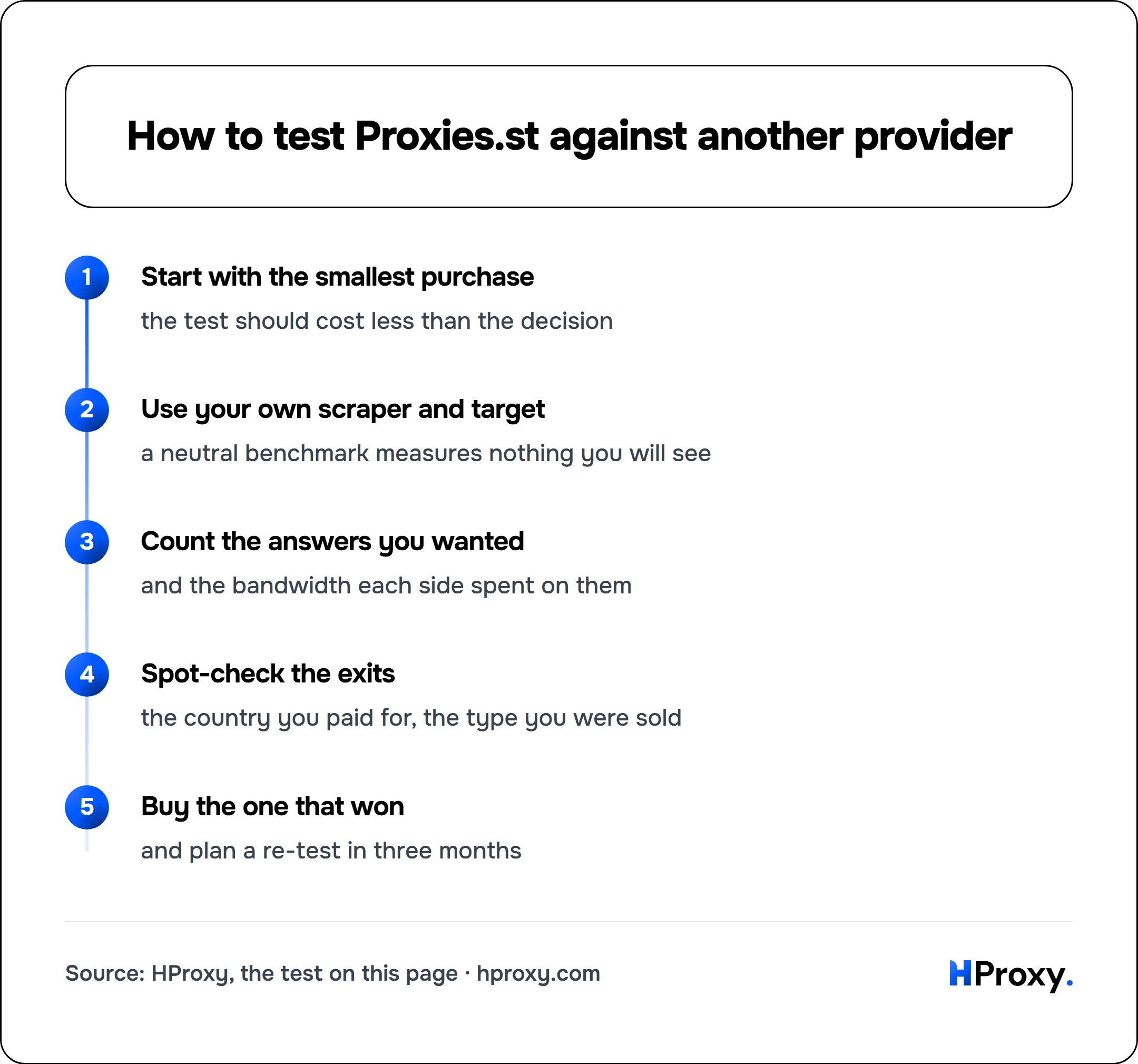
Start with the smallest purchase
the test should cost less than the decision
Use your own scraper and target
a neutral benchmark measures nothing you will see
Count the answers you wanted
and the bandwidth each side spent on them
Spot-check the exits
the country you paid for, the type you were sold
Buy the one that won
and plan a re-test in three months
Others in this market
Nearest alternatives by product shape rather than by who pays us, since nobody does:
Where HProxy sits in that test
We sell residential proxies from $0.44 per GB with no subscription and a balance that does not expire, plus ISP, mobile and datacenter in the same account. That is the pitch, and the test above is a better judge of it than this paragraph.