A proxy provider comparison is only as good as its dates. Prices, pools and policies all move, so every number below carries the day it was read, and anything we could not read is marked as unverified rather than filled in.
What we know about Proxyserver, and what we do not
Their site is proxyserver.com.
There is no price in this comparison because we do not have one we can date and attribute. What follows instead is the set of questions that decide the cost once you do read their page.
Find the rate available with no commitment, then find the cheapest rate and what it costs to reach. The distance between those two tells you what kind of vendor you are dealing with.
The site, as it reads today
The title tag on 9 September 2026 was "403 - Forbidden".
Reading the same page for the things buyers actually ask about:
We found no separate pricing page linked from the homepage, which usually means the price arrives by quotation.
Treat all of it as advertising, because it is. Its value is that it is dated and quotable, which is more than most comparison pages offer.
How long Proxyserver has been trading
The domain was registered on 29 December 1996, through NameCheap, Inc, which makes it about 29 years old. We pulled that from the registry on 9 September 2026. The current registration term ends 28 December 2026.
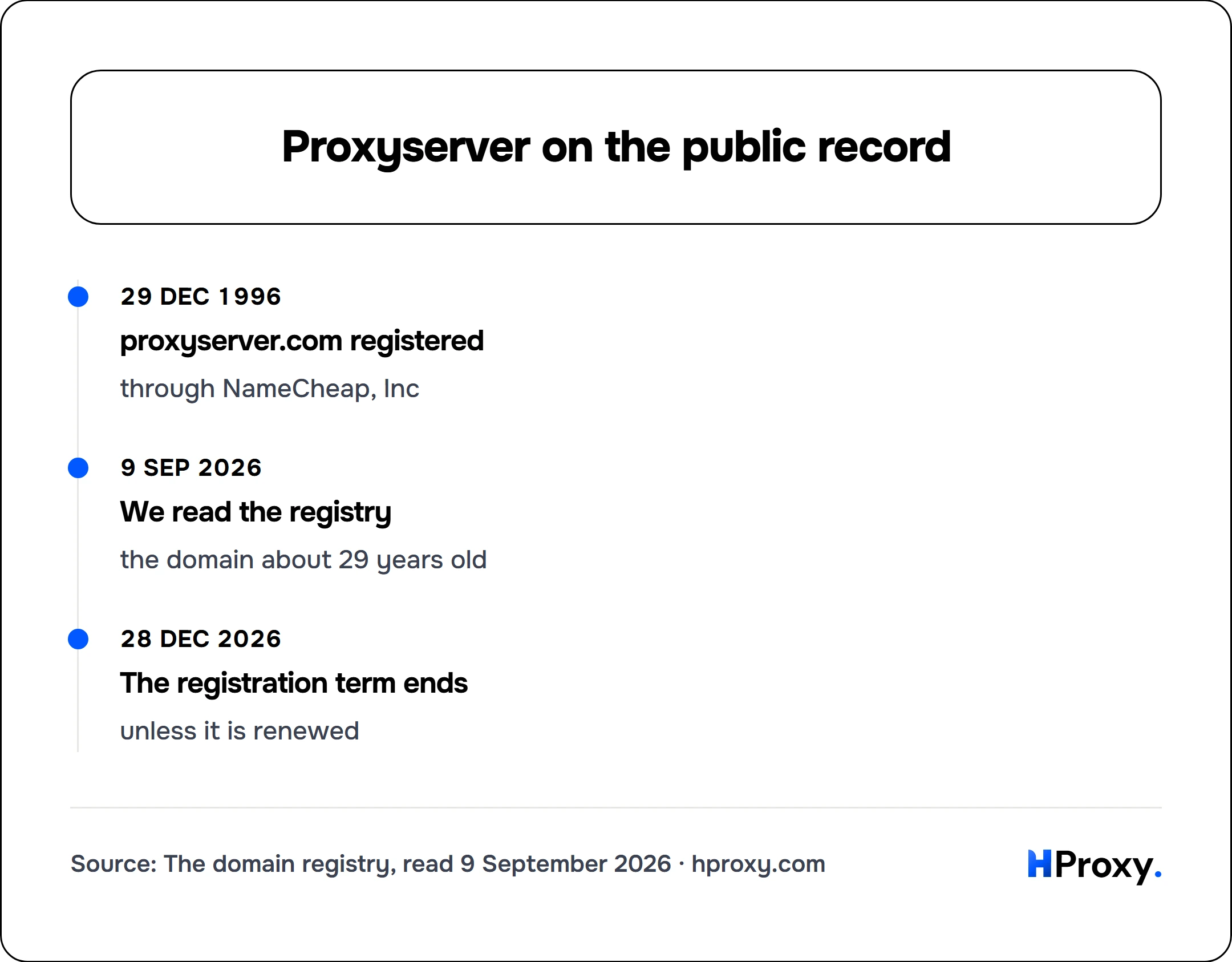
29 Dec 1996
proxyserver.com registered
through NameCheap, Inc
9 Sep 2026
We read the registry
the domain about 29 years old
28 Dec 2026
The registration term ends
unless it is renewed
This proves nothing about the product. It is a cheap check against the one failure mode that costs buyers real money in this market, which is paying a provider that will not exist in six months.
What a pricing page leaves out
Advertised rate against the rate you reach
Rates in this market are quoted from the bottom of the table. The relevant question is which row you land on at your volume, and whether reaching a cheaper row costs more in commitment than it saves per unit.
Who else is using your address
An address you share carries the reputation of everyone else on it. That is acceptable for some work and fatal for anything involving a login. The price difference between shared and dedicated usually reflects exactly this.
Ask whether failed requests are billed
Some vendors bill every request, some bill only successful ones, and the difference is the whole comparison once a target starts blocking. A cheap rate with a fifty percent success rate is twice its advertised price.
The rows that decide it
Six questions, both answers, and an honest blank where we do not hold a current figure:
| Question to ask | Proxyserver | HProxy |
|---|---|---|
| Entry price | Not verified by us, read their page | From $0.44/GB, pay as you go |
| Does unused balance expire? | Their terms page answers this | Never |
| Minimum commitment | On their own terms page | None |
| Identity checks | Not published clearly, ask before paying | Card orders are screened, and verification is sometimes requested |
| Targeting | Worth confirming in writing before you commit | Country, city and ISP |
| Free way to evaluate | Read their current terms | Free proxy list and proxy checker |
Read the table as a list of questions rather than a scoreboard. The answers on their side move, and the row that decides the outcome, success rate on your target, is not printable by anyone.
The test that beats this page
It is a small amount of money for an answer that is actually about your target.
- Take the smallest paid unit each provider will sell you. A free trial works for a first pass, though trials sometimes ride better pools than paid plans do.
- Fire the same batch through both on one afternoon. Different days are different conditions, and that ruins the comparison.
- Track the success rate and the bandwidth. A cheap gigabyte that fails half the time is not cheap.
- Run a sample of the addresses through an independent lookup, because advertised geography and actual geography differ more often than the market admits.
- Choose on the measurement, not the marketing, and expect the answer to change within a year.
The rest of the shortlist
Buyers comparing this name usually have two or three of these open in other tabs:
- IPCook alternatives
- IPDeep alternatives
- IPFighter alternatives
- Ipfoxy alternatives
- IPIPGO alternatives
What we sell, stated plainly
Our position is narrow. Residential from $0.44 per GB, no subscription, no expiry on the balance, and a public record of what our free network actually does. A provider unwilling to be measured is telling you something, and so is one that asks to be.