IPFighter.com is a free IP score page whose name people search about 22,200 times a month. Its lookup starts every address at 100% and takes points off for two things: a datacenter address and a listing on a threat blocklist. On 14 October 2026 that gave Google's public resolver, 8.8.8.8, a score of 90% and the label "Good reputation", and it filed a Tor exit relay in Stockholm as a "Residential ISP". The site lives on banners and coupon codes from proxy and antidetect sellers, and its terms name no company. For a second opinion, pick the checker by your question. Scamalytics shows a fraud score with the blocklists behind it, and ipinfo flags VPN, proxy, Tor and hosting addresses. IPQualityScore sells a fraud score with 1,000 free lookups, and MXToolbox checks email blocklists.
What IPFighter's score counts
IPFighter's lookup page states its own rule: the score "starts at 100% and drops for non-residential (datacenter) addresses and threat-blacklist listings". We looked up three public addresses there on 14 October 2026: Google's resolver 8.8.8.8, Cloudflare's resolver 1.1.1.1, and 171.25.193.25, the first address on the Tor Project's list of exit relays that morning. Both resolvers came back as "Datacenter / hosting", clean on the blocklist, at 90%. The Tor exit came back as a home connection found on the blocklist, at 40%. In the lookup, then, a datacenter address costs 10 points and a blocklist listing costs 60.
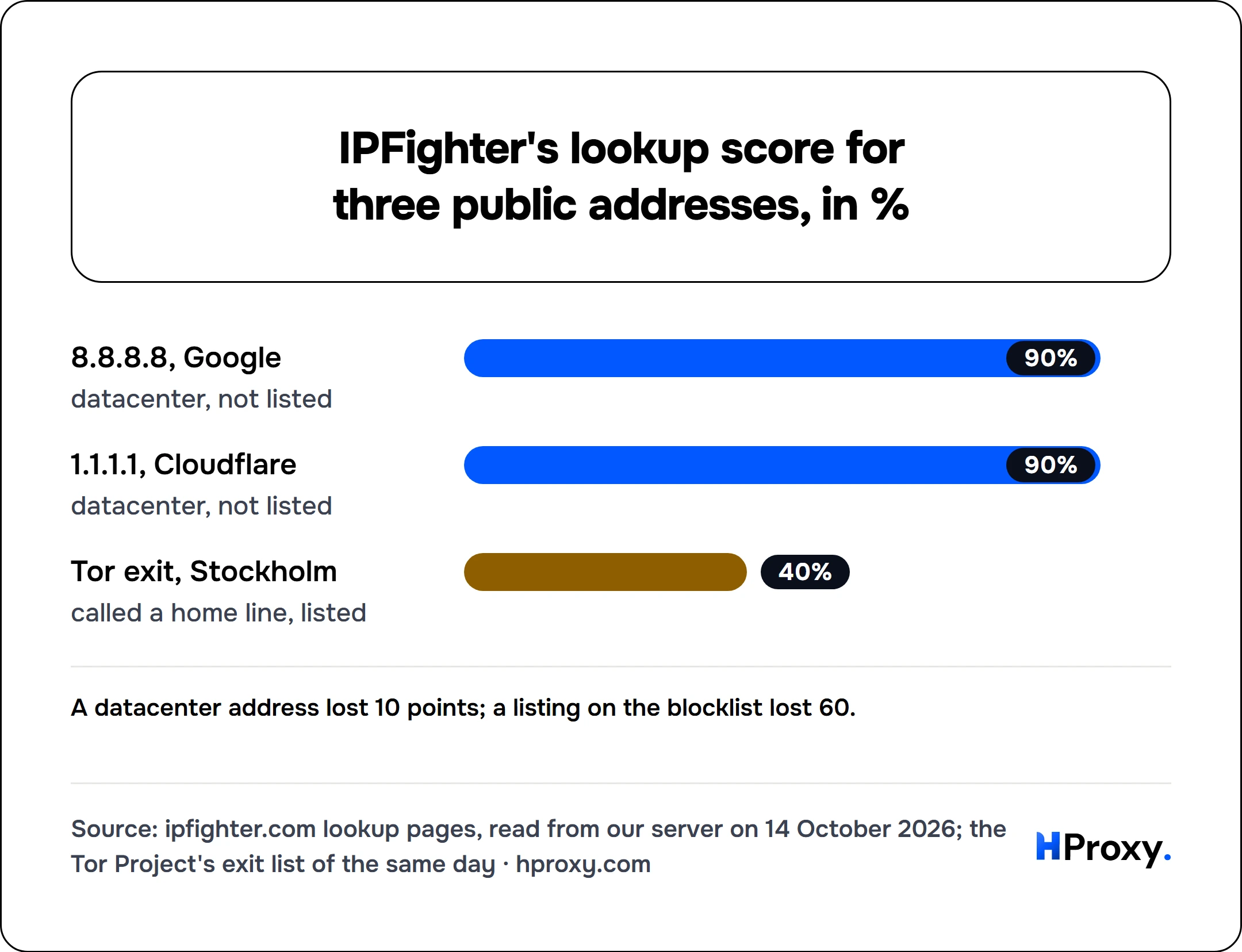
Its own guide sorts the score into four labels: 80% and above "Good", 40% to under 80% "Needs improvement", 20% to under 40% "Poor" and below 20% "Critical". The same guide says the middle band "often just means you're on a datacenter or shared IP". Its lookup put both datacenter addresses at 90%, inside "Good", and the lookup page itself says a score of 80 to 100% "behaves like a clean residential connection".
What your own visit adds
When you open the home page, it also checks your browser. It compares your time zone and language with the address, looks for WebRTC and DNS leaks, and checks the address against a DNS blocklist. Our server reads pages without a browser, so those checks did not run for it. The page it received still carried a score for its address: 90%, "Good", with one deduction, "Non-residential IP -10%", on a page that marked the same address as a proxy and as a hosting address. Its data also held a score for each of 12 sites, from 80 for Etsy to 96 for YouTube.
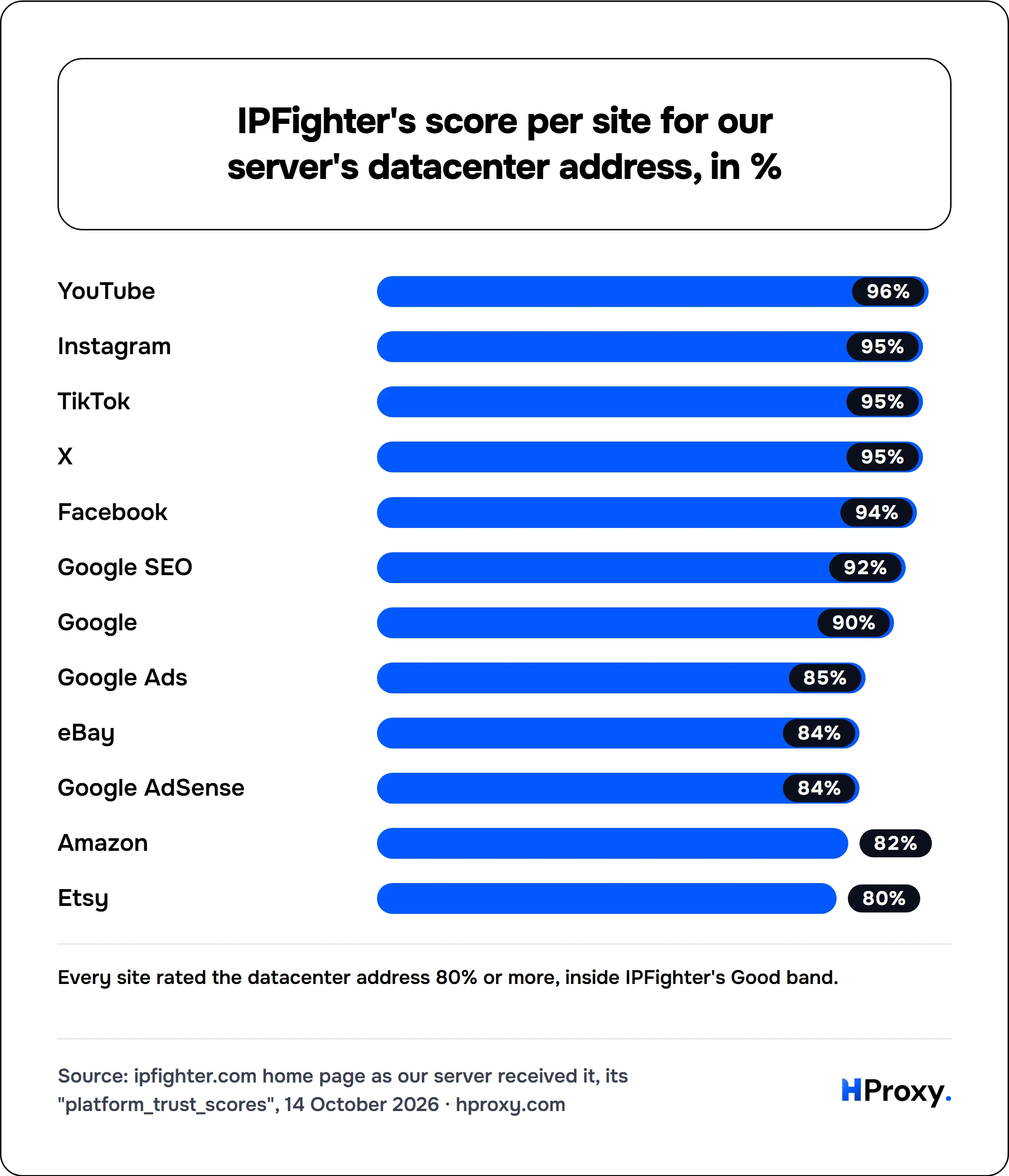
The page heads them "Platform Trust Score Details" and does not say how it weighs each site. For our address the only deduction it listed was the datacenter one.
A trust score, so the scale runs backwards
IPFighter's article on fraud scores, updated on 7 August 2026, says the site "uses a trust-based scoring system rather than a traditional fraud score": the higher, the cleaner. Fraud scores run the other way. On Scamalytics and IPQualityScore 0 is the best mark, and the same article quotes IPQualityScore's bands, in which 90 and above is "strongly associated with abusive or malicious activity". The site's llms.txt file, written for AI crawlers, still calls IPFighter's number "your IP fraud score", from 0 to 100. A 90 on IPFighter and a 90 on IPQualityScore point in opposite directions, so read the label before the number. Our guide to what a good IP fraud score is explains the risk scales.
One Tor exit, three checkers
The Tor exit we looked up sits on a network registered to Foreningen digitala fri- och rattigheter (DFRI) in Stockholm, under the hostname tor-exit-read-me.dfri.se. We read what three checkers said about it on the same morning.
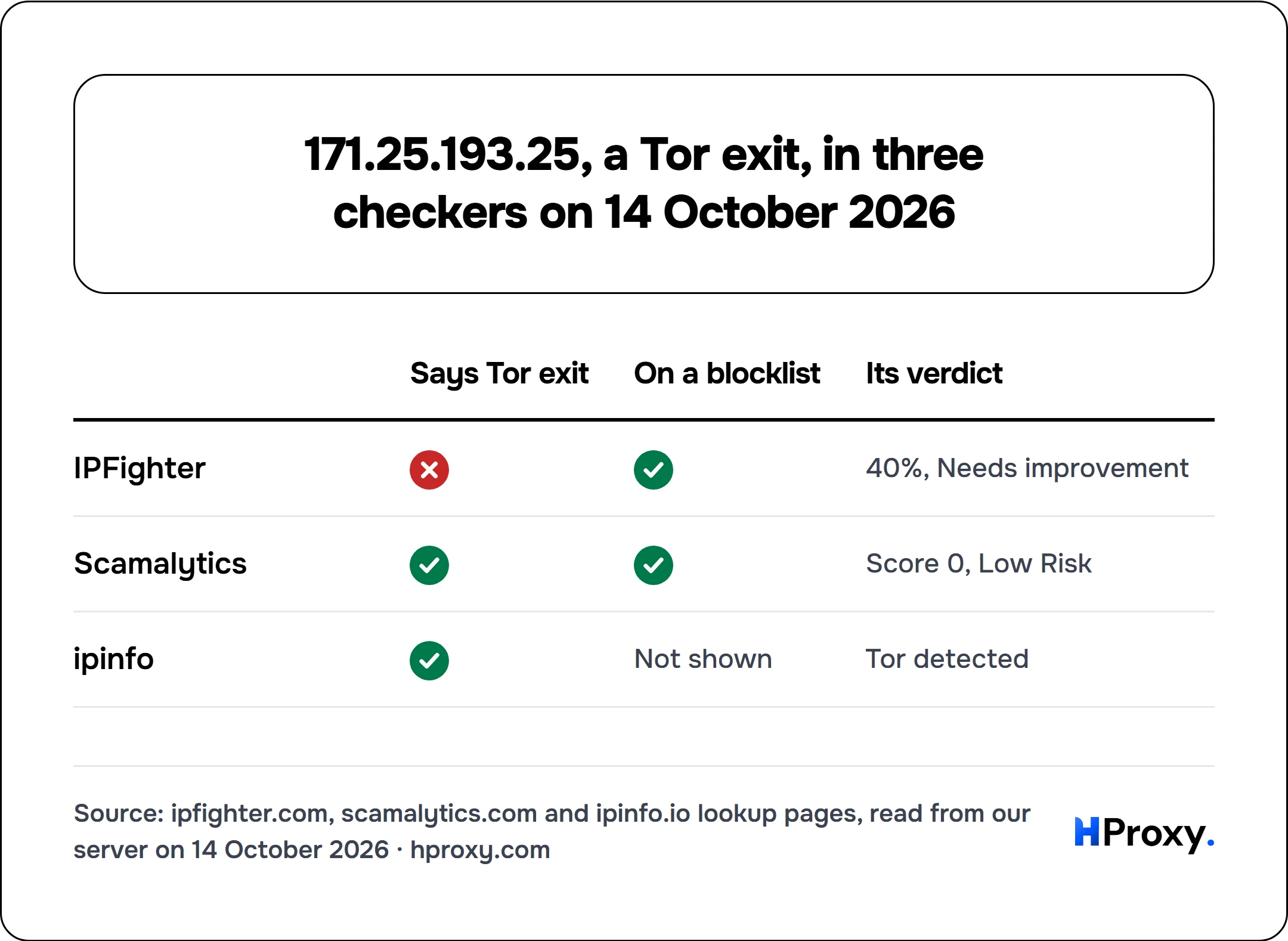
| Says Tor exit | On a blocklist | Its verdict | |
|---|---|---|---|
| IPFighter | no | yes | 40%, Needs improvement |
| Scamalytics | yes | yes | Score 0, Low Risk |
| ipinfo | yes | Not shown | Tor detected |
IPFighter found the address on its threat blocklist and scored it 40%, "Needs improvement". It also called the connection "Residential ISP" and its proxy check "Not detected". The advice under the score began "A clean residential proxy usually fixes this" and pointed to its list of providers and deals. Scamalytics marked the address as a Tor exit node and found it on two of the five open blocklists it shows, Firehol and IPsum. It still gave a fraud score of 0, "Low Risk": its page says the score rates the web traffic it has seen from the address through its own fraud-detection network. ipinfo flagged it as Tor.
For the two resolvers the checkers agreed on the facts and differed on the scale. Scamalytics gave both a fraud score of 0 and marked them as datacenter addresses, ipinfo flagged both as hosting, and IPFighter gave both 90%. In all three, the flags under the number told more than the number.
How IPFighter pays for itself
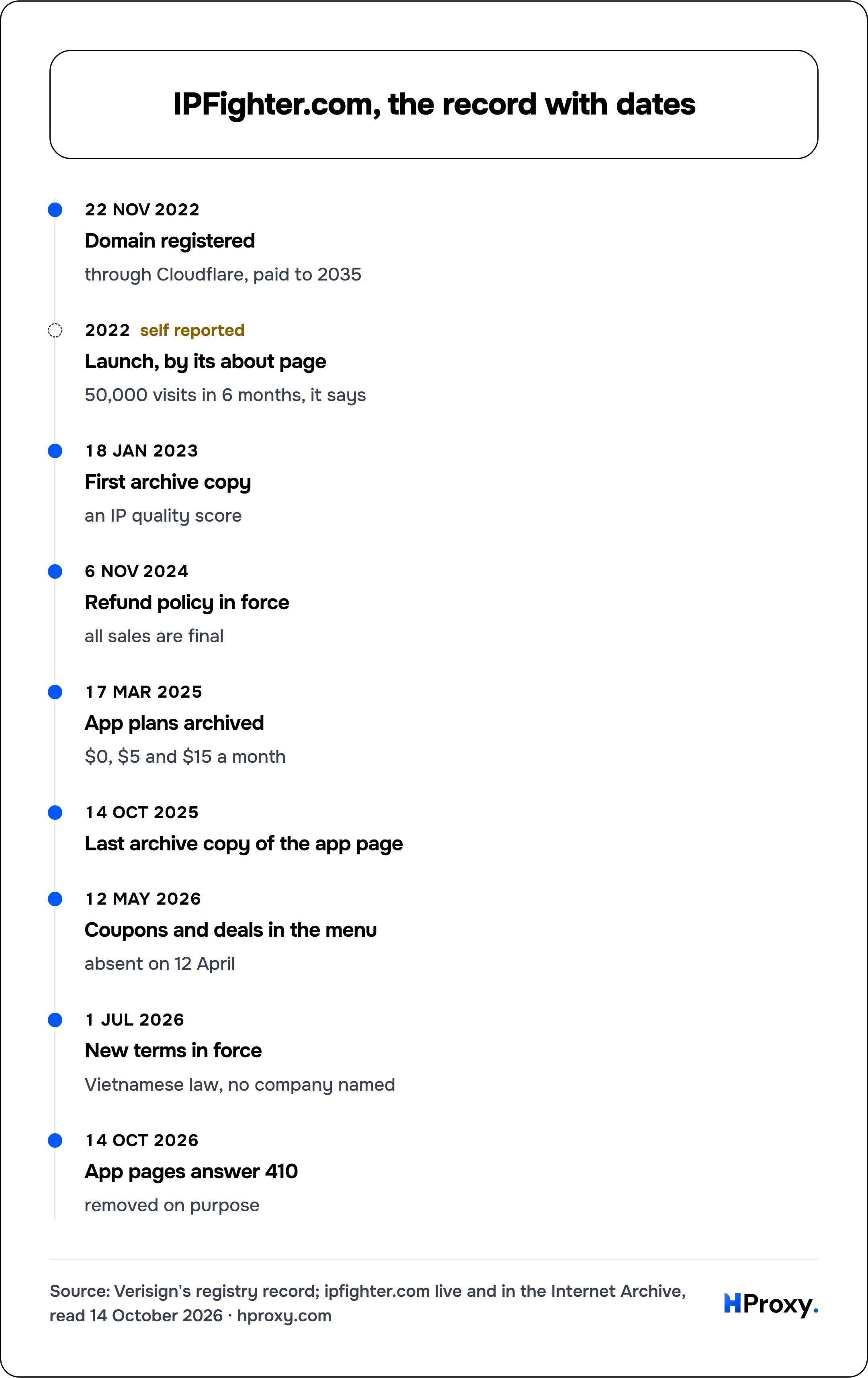
22 Nov 2022
Domain registered
through Cloudflare, paid to 2035
2022self reported
Launch, by its about page
50,000 visits in 6 months, it says
18 Jan 2023
First archive copy
an IP quality score
6 Nov 2024
Refund policy in force
all sales are final
17 Mar 2025
App plans archived
$0, $5 and $15 a month
14 Oct 2025
Last archive copy of the app page
12 May 2026
Coupons and deals in the menu
absent on 12 April
1 Jul 2026
New terms in force
Vietnamese law, no company named
14 Oct 2026
App pages answer 410
removed on purpose
ipfighter.com was registered on 22 November 2022, through Cloudflare, and is paid up until 2035. The oldest copy in the Internet Archive, from 18 January 2023, calls the site "the quality scoring service of the IP address" and checks for Flash, ActiveX and Java, as Whoer does to this day. Its about page says it reached "50,000 visits within just 6 months".
From late 2024 the footer read "Take one, get all. One place for all your proxy apps." and the site sold the IPFighter app, a proxy manager for Windows and macOS. The archive's copy of the app page from 17 March 2025 lists three plans: Basic for free, Advanced at $5 a month and Premium at $15. Each sits beside a struck-out price five times higher, under a banner for "an 80% discount on all packages, limited time only!" whose countdown read zero. The refund policy, in force from 6 November 2024, said "all sales are final". The archive last caught the app page on 14 October 2025. On 14 October 2026 the app, refund, affiliate, partner and referral pages all answered 410, the code for a page removed on purpose.
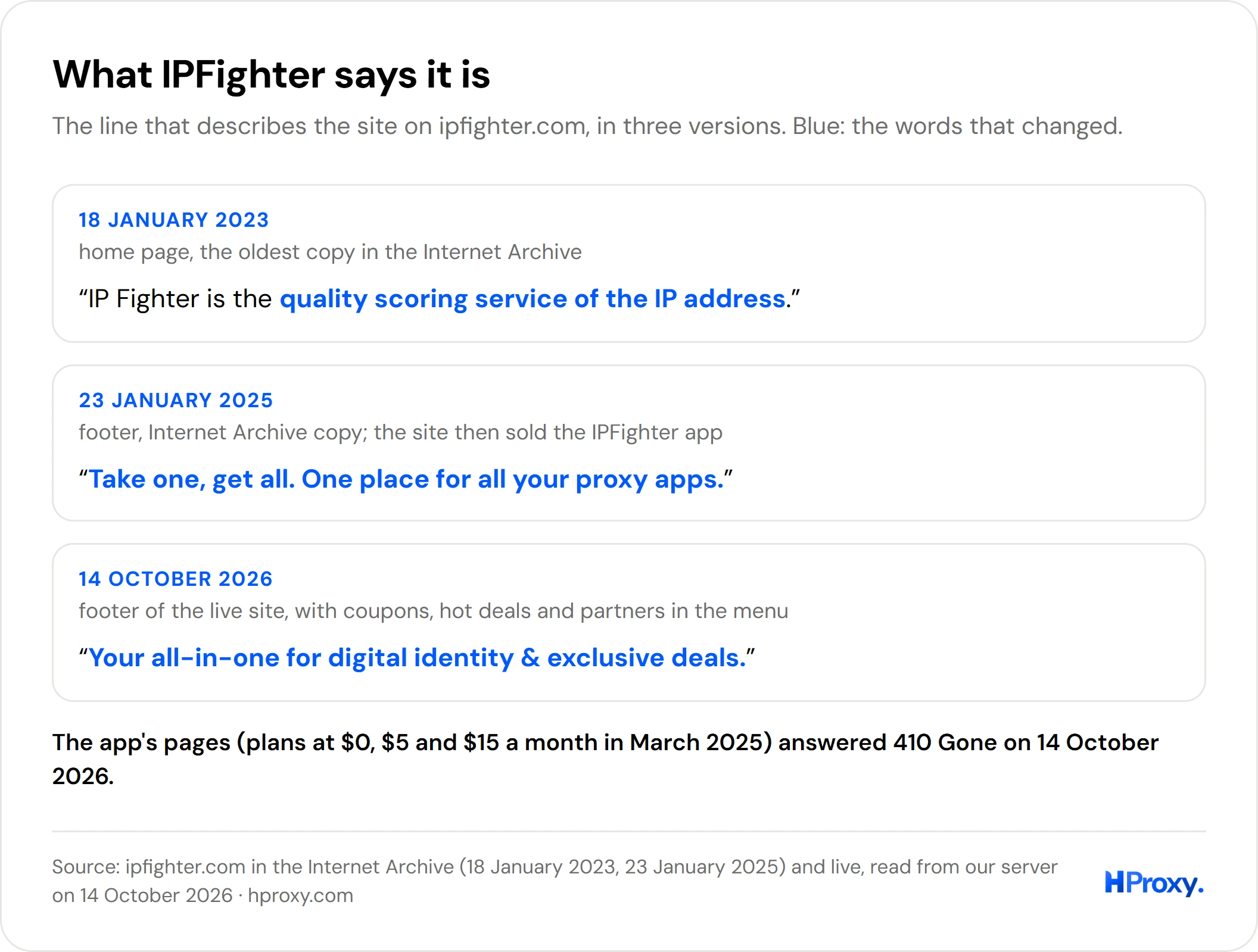
The deals came next. The archive's copy of 12 April 2026 has no coupons; the copy of 12 May 2026 has "Coupons", "Hot Deals" and "Our Partners" in its menu. Its llms.txt now lists coupon codes "from 50+ proxy providers". Its advertising page sells banners, paid upfront, and tells sellers that "100% of IPFighter's users are deeply engaged with topics like proxies, VPNs, and services for staying anonymous online". On 14 October 2026 the banners beside our results carried codes for NodeMaven ("35OFF"), Floppydata ("30% extra traffic with code IPFIGHTER") and Hidemyacc ("10% OFF - IPFIGHTER"), and ads for CatProxies and Whitecloakproxy. The advice under a low score points to the same deals.
Who stands behind it
The terms of service and the privacy policy, both in force from 1 July 2026, name no company. They place disputes before "the courts in Vietnam", send questions to live chat, a Facebook page and a Telegram channel, and call every payment "final and non-refundable". Parts of the terms still describe the desktop app, with an account, "your proxy information" and prices "within the app".
The records show one thread to another brand. Hidemyacc, an antidetect browser whose terms name ONEADX Co., Ltd. under Vietnamese law, has a banner and a coupon page on IPFighter. The old app named Hidemyacc first among the browsers it worked with, and the archive holds a visit to IPFighter tagged "utm_source=hidemyacc" from 5 December 2023. None of these records names IPFighter's owner, so the question stays open.
The free web proxy keeps logs
IPFighter also runs a free web proxy. By its own account every session leaves "through a genuine home IP address", and the page does not say whose homes those are. The terms say it keeps "the URLs requested, timestamps, and the IP address used". It may hand them to "a competent authority" on a valid legal request, and it clears each session's cookies and cache when the session ends.
Other checkers, by question
Where else to check, 14 October 2026
| Question | Checker, and who runs it |
|---|---|
| What fraud score does the address carry? | Scamalytics, by Scamalytics Ltd; IPQS, by IPQualityScore LLC |
| Is it a VPN, proxy, Tor or hosting address? | ipinfo, by IPinfo Inc.; Scamalytics |
| Is it on an email blocklist? | MXToolbox; Spamhaus, step by step in our guide |
| What does my browser give away? | Our leak tests; the checkers on our Pixelscan page |
Each checker's own pages and terms, read from our server on 14 October 2026; Companies House
Fraud scores: Scamalytics and IPQualityScore
Scamalytics is run by SCAMALYTICS LTD of London, company 08112186, incorporated on 20 June 2012. Its free page for any address shows a fraud score from 0 to 100, the network behind it, the blocklists it found the address on and its proxy flags. By API the first 5,000 lookups a month are free; 25,000 cost $25 a month and 1,000,000 cost $200. Its data on residential proxy networks costs $100 a month on top. Its terms ask for written consent before any automated reading of its pages.
IPQualityScore, by IPQualityScore LLC, sells the fraud score with 1,000 free lookups, at most 35 a day, once you register. Its paid plans start at $139.99 a month for 5,000 lookups, and its detection of residential proxies comes with the SMB+ plan, $1,149.99 a month for 75,000. Its lookup page builds the result in your browser, so the copy our server received carried no score.
Network flags: ipinfo
ipinfo, by IPinfo Inc., shows on its free web pages whether an address belongs to hosting, a VPN, a proxy, Tor or a relay. By API the free Lite plan returns the country and the network only. The VPN, proxy, Tor and relay flags start with the Core plan at $31 a month, or $310 a year, for 150,000 lookups a month. The Max plan adds residential proxies and the names of the services behind them from $196 a month. At a million lookups a month, Core costs $207 and Max $786.
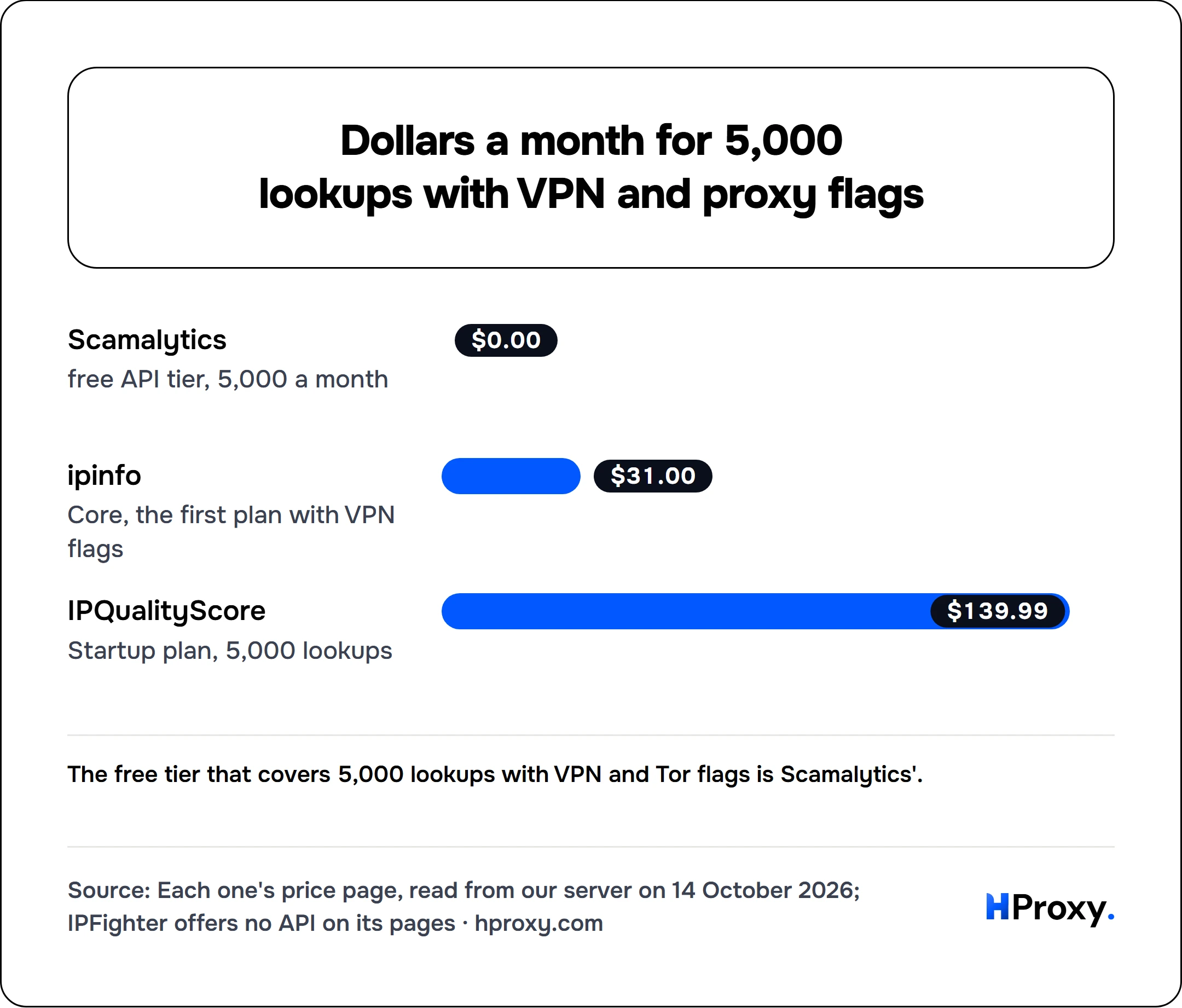
Free and paid, read 14 October 2026
| Checker | Free | Paid, a month |
|---|---|---|
| Scamalytics | Web pages; 5,000 API lookups | $25 for 25,000; $200 for 1,000,000 |
| ipinfo | Web pages; country and network by API | $31 for 150,000 with VPN flags |
| IPQS | 1,000 lookups, 35 a day | $139.99 for 5,000 |
| IPFighter | Web checks | No API on its pages |
scamalytics.com/ip/api/pricing, ipinfo.io/pricing, ipqualityscore.com/plans and ipfighter.com
Blocklists: MXToolbox and Spamhaus
MXToolbox checks an address against "over 100 DNS based email blacklists" on one free page. Its page warns that a listed mail server may see "some email you send" go undelivered. Our guide on how to check if an IP is blacklisted walks through Spamhaus' own lookup and its answer codes.
Score pages like IPFighter
IPFighter's model is common among free score pages. WhoerIP offers an IP lookup and a check against "20+ DNSBLs and reputation services" beside special deals from Multilogin and NodeMaven. Iphey shows a trust score it calls "MX Score" next to a banner for residential proxies at "$1/GB". For what your browser gives away, our Pixelscan comparison and Whoer comparison cover the fingerprint and leak checkers.
Where HProxy fits
We sell proxies, and we publish free checks of our own. Our IP lookup shows an address's country, network and operator, whether it is datacenter or residential, and whether it is a known proxy. Beside it sit a proxy leak test, a WebRTC leak test and a proxy anonymity checker. Our residential proxies cost $0.50 per GB, paid as you go with no subscription, over HTTP or SOCKS5.
Which one to pick
- Scamalytics to see a fraud score beside the blocklists and proxy flags behind it.
- ipinfo to learn whether an address is a VPN, a proxy, a Tor exit or a hosting address; by API those flags start with its paid plan.
- IPQualityScore if you need its score in particular, with 1,000 free lookups.
- MXToolbox, or Spamhaus by the steps in our guide, for email blocklists.
- IPFighter for one trust number with your browser's checks, keeping in mind that 90% can still mean a datacenter.
What we could not find out
We read three addresses on one morning, so the results above are a sample of three and test no checker's accuracy. Our server reads pages without a browser: IPFighter's browser checks did not run, and its per-site scores exist here only for our own address. IPQualityScore's lookup shows its result only in a browser, and AbuseIPDB answered our server with a browser check, so neither scored the three addresses. Scamalytics' terms ask for written consent before automated reading, so we read three of its pages once and stopped there. IPQualityScore's plan list gives each plan's lookups without saying "a month"; we read them as monthly because each plan is priced by the month. No record we found names IPFighter's owner. We plan to look again by 14 January 2027.
Sources
- IPFighter.com, read from our server on 14 October 2026: the home page and the lookup pages for 8.8.8.8, 1.1.1.1 and 171.25.193.25.
- IPFighter.com on the same day: the about page, the terms of service and privacy policy (both in force from 1 July 2026), the advertising and web proxy pages, llms.txt, its guides to IP scores and fraud scores, and its Hidemyacc coupon page.
- IPFighter.com in the Internet Archive, copies from 18 January 2023 to 1 October 2026, among them the app page (17 March 2025) and the refund policy (in force from 6 November 2024); its record in Verisign's registry.
- The Tor Project's list of exit addresses, 14 October 2026.
- Scamalytics' lookup pages for the three addresses, its API price list and its terms; Companies House's record of SCAMALYTICS LTD.
- ipinfo's lookup pages, price list and terms of service; IPQualityScore's plan list and lookup page.
- MXToolbox's blacklist check page; the home pages of WhoerIP and Iphey; Hidemyacc's terms.
- Google Keyword Planner's worldwide monthly searches for "ipfighter", read on 12 October 2026.
- Our own price, from HProxy's live price list.